


Science Staff Writer Kelly Servick discusses how physicians have sifted through torrents of scientific results to arrive at treatments for SARS-CoV-2.
Sarah also talks with Wesley Reinhart, of Pennsylvania State University’s Department of Materials Science and Engineering and Institute for Computational and Data Science, about why we should be building smart cities from smart materials, such as metamaterials that help solar panels chase the Sun, and living materials like self-healing concrete that keep buildings in good shape.
Science Staff Writer Adrian Cho joins host Sarah Crespi to talk about plans for the next generation of gravitational wave detectors—including one with 40-kilometer arms.
The proposed detectors will be up to 10 times more sensitive than current models and could capture all black hole mergers in the observable universe.
Sarah also talks with Pavani Cherukupally, a researcher at Imperial College London and the University of Toronto, about her Science Advances paper on cleaning up oil spills with special cold-adapted sponges that work well when crude oil gets clumpy.
Science’s Online News Editor David Grimm joins host Sarah Crespi to talk about a 2000-year-old pet cemetery found in the Egyptian city of Berenice and what it can tell us about the history of human-animal relationships.
Also this week, Dipon Ghosh, a postdoctoral fellow at the Massachusetts Institute of Technology, talks about how scientists missed that the tiny eyeless roundworm Caenorhabditis elegans, which has been intensively studied from top to bottom for decades, somehow has the ability to detect colors.
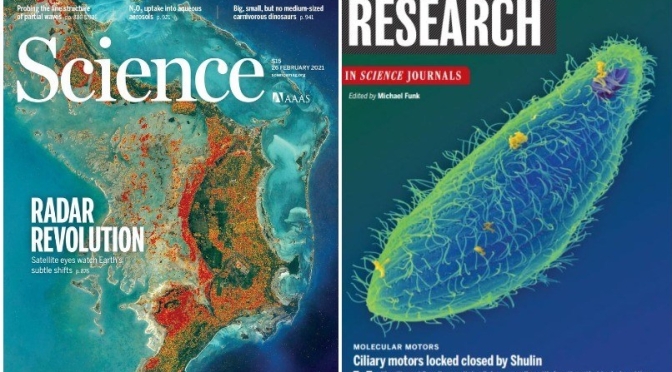
First up, science journalist Julia Rosen talks with host Sarah Crespi about a growing fleet of radar satellites that will soon be able to detect minute rises and drops of Earth’s surface—from a gently deflating volcano to a water-swollen field—on a daily basis.
Sarah also talks with Hui Cao, a professor of applied physics at Yale University, about a new way to generate enormous streams of random numbers faster than ever before, using a tiny laser that can fit on a computer chip.
Science Staff Writer Jon Cohen joins host Sarah Crespi to take on some of big questions about the COVID-19 vaccines, such as: Do they stop transmission? Will we need boosters? When will life get back to “normal.”
Sarah also talks with Anders Johansen, professor of planetary sciences and planet formation at the University of Copenhagen, about his Science Advances paper on a new theory for the formation of rocky planets in our Solar System. Instead of emerging out of ever-larger collisions of protoplanets, the new idea is that terrestrial planets like Earth and Mars formed from the buildup of many small pebbles.







 Boomers Daily