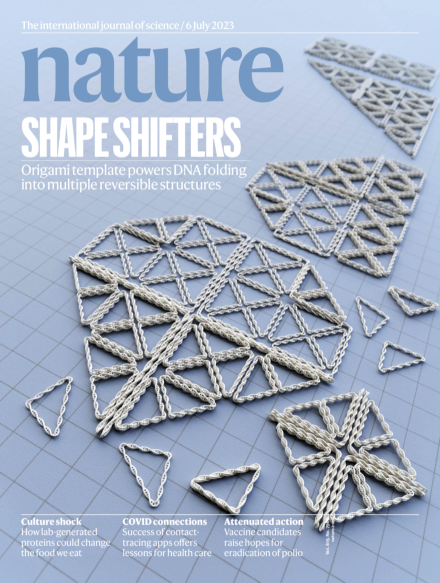
nature Magazine -July 6, 2023 issue:Shape shifters – DNA origami allows useful supramolecular structures to be created from templates. But the process has its limitations, with most structures confined to two configurations: folded or unfolded.
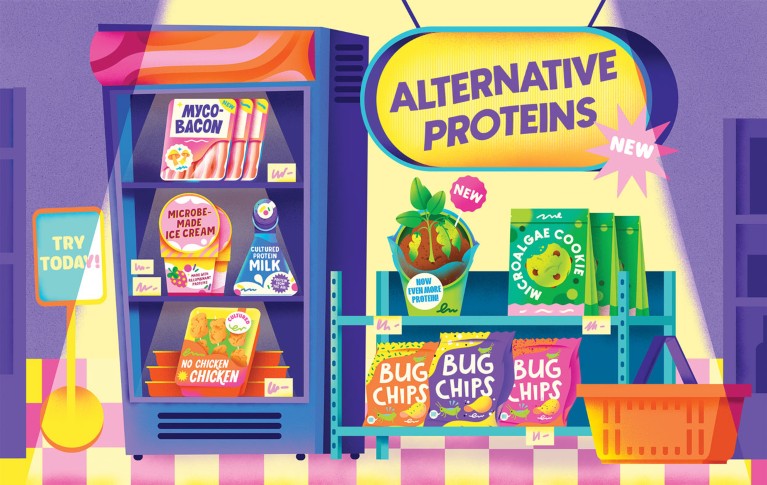
Humanity needs to eat less meat. Here are seven alternatives.
Would you eat a burger enriched with mealworms? Fake bacon sliced from a mass of fermented fungi? Milk proteins extruded by microbes? Maybe you already have. Dozens of companies are now banking on these alternatives to animal protein becoming a regular part of your diet.
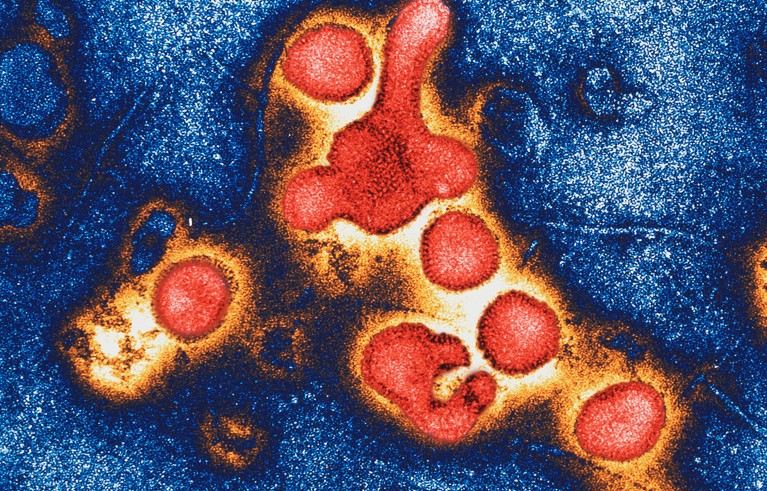
Complexes formed from ‘nanobodies’ and an antiviral drug halt infection in its tracks.
A dynamic duo comprising an antiviral drug joined to an antibody fragment provides strong protection against the two main types of influenza that infect humans, according to research in mice.
Research efforts to learn more about diseases of the human eye have been hampered as these organs degrade rapidly after death, and animal eyes are quite different to those from humans.
To address this, a team have developed a new method to revive retinas taken from donors shortly after their death. They hope this will provide tissue for new studies looking into the workings of the human eye and nervous system.
How did the earliest biochemical process evolve from Earth’s primordial soup? One popular theory is that life began in an ‘RNA world’ from which proteins and DNA evolved. However, this week a new paper suggests that a world composed of RNA alone is unlikely, and that life is more likely to have begun with molecules that were part RNA and part protein.
We discuss some highlights from the Nature Briefing. This time, the ‘polarised sunglasses’ that helped astronomers identify an ultra-bright pulsar, and how a chemical in sunscreen becomes toxic to coral.
AI algorithms can now churn out predictions for the 3D shapes of proteins with a precision matching that of painstaking laboratory techniques. The programs, and the blizzard of protein structures they have revealed, are Science’s 2021 #BOTY. https://t.co/zBZlWr0fispic.twitter.com/snrEsDbTH0
News Intern Rachel Fritts talks with host Sarah Crespi about a new way to think about endometriosis—a painful condition found in one in 10 women in which tissue that normally lines the uterus grows on the outside of the uterus and can bind to other organs.
Next, Raphael Townshend, founder and CEO of Atomic AI, talks about predicting RNA folding using deep learning—a machine learning approach that relies on very few examples and limited data.
Finally, in this month’s edition of our limited series on race and science, guest host and journalist Angela Saini is joined by author Lundy Braun, professor of pathology and laboratory medicine and Africana studies at Brown University, to discuss her book: Breathing Race into the Machine: The Surprising Career of the Spirometer from Plantation to Genetics.





 Boomers Daily