

This Morning With Gordon Deal: Town halls show two distinct styles between President Trump and Joe Biden, dealing with covid stress, and do you really need a new iPhone.

This Morning With Gordon Deal: Town halls show two distinct styles between President Trump and Joe Biden, dealing with covid stress, and do you really need a new iPhone.

President Trump and former Vice President Biden hold network TV town halls this evening. Nominee Amy Coney Barrett’s testimony has wrapped up, but her confirmation hearings for Supreme Court justice continue today, featuring supporters and opponents of the nomination.
Europe is re-trenching against a new surge of COVID-19 after seeing more than 100,000 new cases per day on average over the past week.

NPR News Now reports: Second day of testimony of Amy Coney Barrett at Senate, President Trump campaigns, early voting in Georgia and other top news.
NPR’s Tamara Keith and Amy Walter of the Cook Political Report join Judy Woodruff to discuss the latest political news, including President Trump’s return to large, in-person rallies after his COVID-19 diagnosis, the Trump campaign’s strategy for appealing to voters beyond his base and which Senate races could be in play.
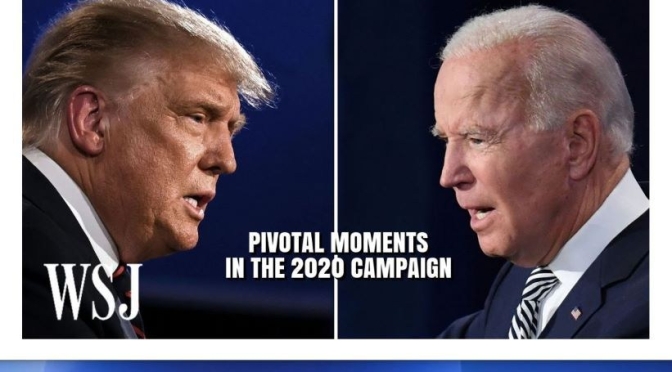
Like so much in 2020, the presidential campaign was thrown into turmoil because of the coronavirus pandemic. WSJ’s political team reviews the critical events of this year’s campaign season and looks forward to what might influence voters on Election Day.
Photos: Jim Watson and Saul Loeb/AFP
Supreme Court nominee hearings set up partisan battle ahead of election, White House seeks limited coronavirus relief bill, and Minnesota community comes together to build a disabled Navy vet a ramp.

NPR News Now reports: President Trump to host White House event, Hurricane Delta, cease fire talks in Azerbaijan-Armenia fighting and more top news.
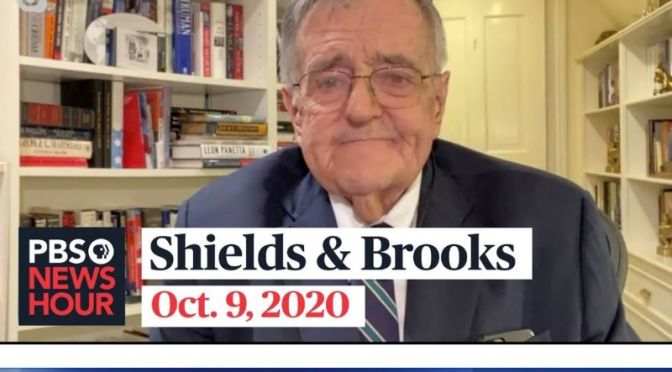
Syndicated columnist Mark Shields and New York Times columnist David Brooks join Judy Woodruff to discuss the week in politics, including how the pandemic is influencing voters in battleground Wisconsin, President Trump’s response to his own coronavirus diagnosis, the vice presidential debate and Senate races in the spotlight.

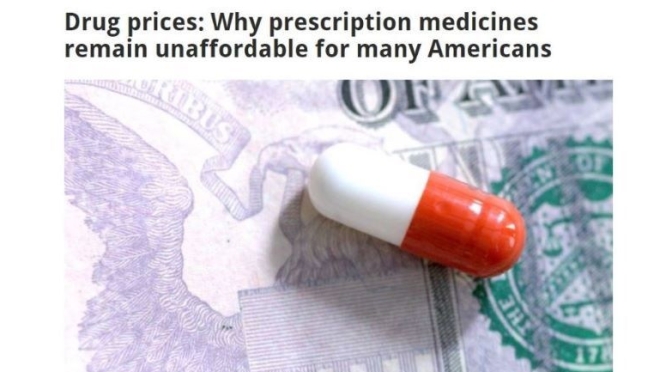
There may be few issues that unite Americans ahead of the 2020 election as do their concerns about the cost of prescription drugs.
A clear majority — 75% — of respondents to a July survey said the cost of prescription medicines would be among the factors likely to influence their votes this year, according to a report from Gallup and the nonprofit West Health. Gallup reported on results from 1,007 interviews conducted with adults between July 1 and July 24.
Both President Donald Trump, a Republican, and former Vice President Joe Biden, a Democrat, have highlighted insulin costs in their discussions of the need to lower drug prices.
In a January interview with the New York Times editorial board, Biden noted the widespread discontent among Americans about sticker shock often experienced at pharmacies. He spoke of a need for the federal government to act to make medicines more affordable.
“This is a place where I find, whether you’re Republican or Democrat, you think you’re getting screwed on drug prices. And you are, in terms of everything from insulin to inhalers and a whole range of other things,” Biden said. “So, again, can I guarantee that it gets done? No, but I can tell you what, if anybody can get it done, I can, and I think there’s a consensus for it.”
Congress has taken different approaches in designing the terms under which the two largest federal health programs, Medicaid and Medicare, buy drugs.
Medicaid is a program run by states with federal contributions and oversight. It covers people with low incomes and disabilities. Almost 67 million people were enrolled in Medicaid as of May 2020, including about 29 million children. In 1990 Congress decided that drugmakers who want to have their products covered by Medicaid must give rebates to the government. The initial rebate is equal to 23.1% of the average manufacturer price (AMP) for most drugs, or the AMP minus the best price provided to most other private-sector payers, whichever is greater. An additional rebate kicks in when prices rise faster than general inflation.
There’s widespread frustration among lawmakers and policy analysts about the lack of clarity about the role of middlemen in the supply chain for medicines. Known as pharmacy benefit managers (PBMs), these businesses describe the aim of their business as making drugs more affordable for consumers. Insurers like Cigna and UnitedHealth operate some of the nation’s largest PBMs, as does pharmacy giant CVS Health, which also owns insurer Aetna.
“They will tell you their mission is to lower drug costs,” said Rep. Earl L. “Buddy” Carter, a Georgia Republican, a pharmacist and a critic of PBMs, in a speech on the House floor last year. “My question to you would be: How is that working out?”
Kesselheim also has written on what he terms “Specialty Drugs — A Distinctly American Phenomenon.” That’s the title of a 2020 paper in the New England Journal of Medicine Kesselheim authored with Huseyin Naci, an associate professor of health policy at the London School of Economics.
In this Perspective article, Kesselheim and Naci look at how the “specialty” designation morphed from its origin in the 1970s. It then referred to a need for extra steps for preparation and delivery of new injectable and infusion products.
The median cost for a medicine developed in recent years was $985 million, according to a study published in JAMA in March 2020, “Estimated Research and Development Investment Needed to Bring a New Medicine to Market, 2009-2018.”
“Rising drug prices have attracted public debate in the United States and abroad on fairness of drug pricing and revenues,” write the study’s authors: Olivier J. Wouters of the London School of Economics; Martin McKee of the London School of Hygiene and Tropical Medicine; and Jeroen Luyten of Leuven Institute for Healthcare Policy, KU Leuven, Belgium. “Central to this debate is the scale of research and development investment by companies that is required to bring new medicines to market.”

White House press secretary and two aides have tested positive for coronavirus, U.S. faces shortage of up to 8 billion meals in next 12 months, and Georgia pastor shocks pregnant Waffle House waitress with $12G tip.



 Boomers Daily