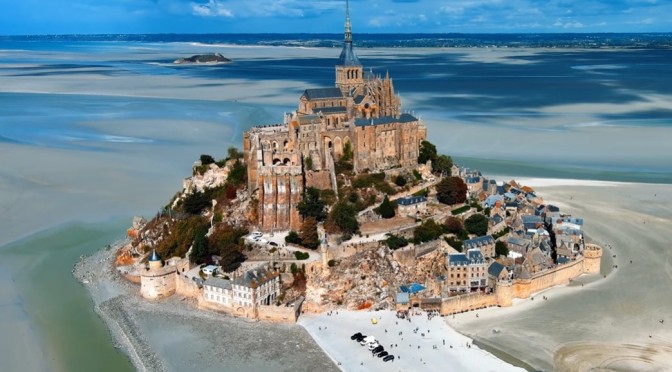

Since the first stone was laid in 1023, it has been home to monks, monarchs and prisoners; a historic pilgrimage site that welcomes 3 million visitors each year. In this edition we meet some of the people who preserve its magic.

Since the first stone was laid in 1023, it has been home to monks, monarchs and prisoners; a historic pilgrimage site that welcomes 3 million visitors each year. In this edition we meet some of the people who preserve its magic.

Video timeline: Intro 01:01 How to get there and when is the best time? 01:34 How they built it 02:21 Dangerous surrounding 03:08 The architecture of Mont-Saint-Michel 04:39 Inhabitants: monks and nuns 05:19 The darkest secret of the abbey 06:07 A deeply mysterious place
Surrounded by water at high tide, at low tide you can walk across the tidal flats to visit it. Mont-Saint-Michel is one of France’s most visited locations, and is a UNESCO World Heritage Site. Have you ever been there?

Much further north, near Mont-Saint-Michel in Normandy, the Château de La Ballue is most remarkable for its listed gardens, where geometric shapes abound. Finally, on the French Riviera, the luxurious Eilenroc villa is especially famous for its rose garden, with varieties named after film stars.
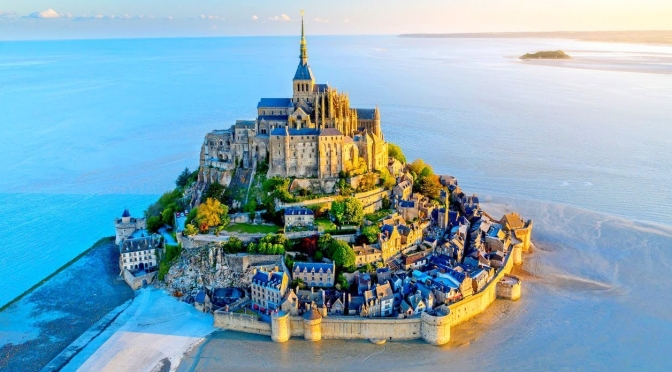
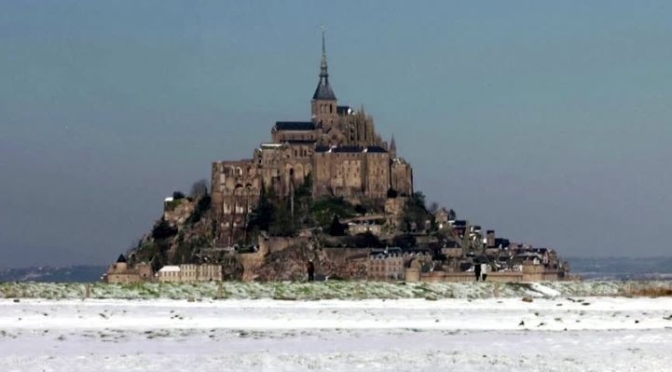
Mont-Saint-Michel, rocky islet and famous sanctuary in Manche département, Normandy région, France, off the coast of Normandy. It lies 41 miles (66 km) north of Rennes and 32 miles (52 km) east of Saint-Malo. Around its base are medieval walls and towers above which rise the clustered buildings of the village with the ancient abbey crowning the mount. One of the more popular tourist attractions in France, Mont-Saint-Michel was designated a UNESCO World Heritage site in 1979.
Mont-Saint-Michel is almost circular (about 3,000 feet [900 metres] in circumference) and consists of a granite outcrop rising sharply (to 256 feet [78 metres]) out of Mont-Saint-Michel Bay (between Brittany and Normandy). Most of the time it is surrounded by vast sandbanks and becomes an island only when the tides are very high. Before the construction of the 3,000-foot causeway that connects the island to land, it was particularly difficult to reach because of quicksand and very fast-rising tides. The causeway, however, has become a barrier to the removal of material by the tides, resulting in higher sandbanks between the islet and the coast.
Mont-Saint-Michel, rocky islet and famous sanctuary in Manche département, Normandy région, France, off the coast of Normandy. It lies 41 miles (66 km) north of Rennes and 32 miles (52 km) east of Saint-Malo. Around its base are medieval walls and towers above which rise the clustered buildings of the village with the ancient abbey crowning the mount. One of the more popular tourist attractions in France, Mont-Saint-Michel was designated a UNESCO World Heritage site in 1979.
Mont-Saint-Michel is almost circular (about 3,000 feet [900 metres] in circumference) and consists of a granite outcrop rising sharply (to 256 feet [78 metres]) out of Mont-Saint-Michel Bay (between Brittany and Normandy). Most of the time it is surrounded by vast sandbanks and becomes an island only when the tides are very high. Before the construction of the 3,000-foot causeway that connects the island to land, it was particularly difficult to reach because of quicksand and very fast-rising tides. The causeway, however, has become a barrier to the removal of material by the tides, resulting in higher sandbanks between the islet and the coast.
Filmed in August 2022.
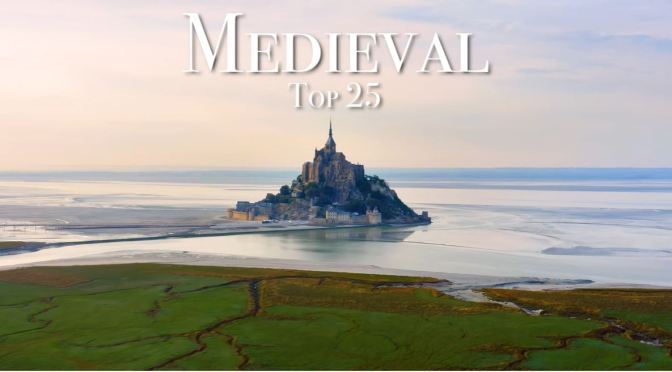
Europe is home to countless medieval places. From the island of Mont Saint-Michel, to the medieval walled city of Avila, Europe’s Middle Ages provided some of the world’s most amazing places and history!
A shaft of pure sunlight illuminating the pastel façade of a village house, the improbably clear emerald shallows of a deserted Corsican beach or the unspoilt powdery snow of majestic Alpine peaks – these are just a few of the most beautiful places in France. It’s time to start planning a road trip to see them all.
A wave of snow and freezing temperatures set a unique scene on Wednesday February 10 at the Mont Saint-Michel in Normandy.
Le Mont-Saint-Michel is a tidal island and mainland commune in Normandy, France. The island lies approximately one kilometre off the country’s north-western coast, at the mouth of the Couesnon River near Avranches and is 7 hectares in area.
Filmed and Edited by: JÉRÉMIE ELOY, Wanali Films
Filmed on April 3, 2020
Le Mont-Saint-Michel is a tidal island and mainland commune in Normandy, France. The island is located about one kilometer off the country’s northwestern coast, at the mouth of the Couesnon River near Avranches and is 7 hectares in area.
The original site was founded by an Irish hermit, who gathered a following from the local community. Mont-Saint-Michel was used in the sixth and seventh centuries as an Armorican stronghold of Gallo-Roman culture and power until it was ransacked by the Franks, thus ending the trans-channel culture that had stood since the departure of the Romans in 460. From roughly the fifth to the eighth century, Mont Saint-Michel belonged to the territory of Neustria and, in the early ninth century, was an important place in the marches of Neustria.
When Louis XI of France founded the Order of Saint Michael in 1469, he intended that the abbey church of Mont Saint-Michel become the chapel for the Order, but because of its great distance from Paris, his intention could never be realised.
The wealth and influence of the abbey extended to many daughter foundations, including St. Michael’s Mount in Cornwall. However, its popularity and prestige as a centre of pilgrimage waned with the Reformation, and by the time of the French Revolution there were scarcely any monks in residence. The abbey was closed and converted into a prison, initially to hold clerical opponents of the republican regime. High-profile political prisoners followed, but by 1836, influential figures—including Victor Hugo—had launched a campaign to restore what was seen as a national architectural treasure. The prison was finally closed in 1863, and the mount was declared a historic monument in 1874. Mont Saint-Michel and its bay were added to the UNESCO list of World Heritage Sites in 1979, and it was listed with criteria such as cultural, historical, and architectural significance, as well as human-created and natural beauty.
From Wikipedia



 Boomers Daily