


Tag Archives: Literary Magazines
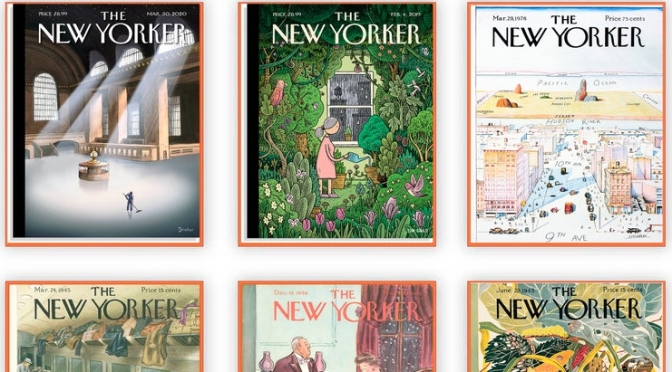
THE NEW YORKER MAGAZINE – MARCH 2, 2026 PREVIEW

Ian McKellen Swings from Shakespeare to Gandalf to Virtual Reality
On a visit to New York, the actor reflected on mortality and coming out, and unleashed an Elizabethan anti-ICE monologue on “Colbert” that went viral. By Henry Alford
James Talarico Puts His Faith in Texas Voters
The Senate candidate believes that Democrats can win by appealing to higher values. Can he succeed in the age of Trump? By Tad Friend
Why the World Cup Can Feel Like War
Soccer stadiums can be dominated by violence, tribalism, chauvinism, and near-religious fervor‚ animated by the memory of old hostilities and the power of ritual. By Ian Buruma
The Trial of Gisèle Pelicot’s Rapists United France and Fractured Her Family
After fifty-one men were convicted, Pelicot became a feminist hero. But additional accusations left her children struggling to accept her new role. By Rachel Aviv
LONDON REVIEW OF BOOKS – FEBRUARY 19, 2026 PREVIEW

LONDON REVIEW OF BOOKS: The latest issue features Seamus Perry: Pluralism and Poetry; James Wolcott: Updike Reconsidered; James Meek on Romania’s Far Right;
Seamus Perry · Pluralism and the Modern Poet: Pluralism and Poetry
‘Art arises,’ Auden writes, ‘out of our desire for both beauty and truth and our knowledge that they are not identical.’ We want things two ways, which analysis says we cannot have; but for a moment a poem lets us, in a way that discursive prose, for instance, cannot.
Jonathan Rée – Kojève v. Hegel
Alexandre Kojève described his book on Hegel as ‘very bad’, and he had a point. His take on The Phenomenology of Spirit is not only misleading but slapdash, dogmatic, frivolous and flamboyant. The characters he filled it with, from the Master and Slave to the Sensualist and the Sage, sound rather like Mr Worldly Wiseman, Madam Bubble and Mr Sagacity in Pilgrim’s Progress.
THE NEW YORKER MAGAZINE – FEBRUARY 16 & 23, 2026

THE NEW YORKER MAGAZINE: The latest issue features The Anniversary Issue: Dhruv Khullar on Ozempic, David Remnick on Joe Rogan, Ava Kofman on a surrogacy scandal, and more.
Is There a Remedy for Presidential Profiteering?
Until now, Trump always seemed unembarrassed to crow about his side hustles. But, if the Emirati payment was kept secret, what else might be? By David D. Kirkpatrick
Can Ozempic Cure Addiction?
GLP-1 drugs, which have helped some people curb drug and alcohol use, may unlock a pathway to moderation. By Dhruv Khullar
What Is Claude? Anthropic Doesn’t Know, Either
Researchers at the company are trying to understand their A.I. system’s mind—examining its neurons, running it through psychology experiments, and putting it on the therapy couch. By Gideon Lewis-Kraus
THE NEW YORKER MAGAZINE – FEBRUARY 9, 2026

THE NEW YORKER MAGAZINE: The latest issue features Nathan Heller on Gavin Newsom, Joshua Yaffa on Russia’s single-use agents, Michael Schulman on A.I. in film, and more.
Gavin Newsom Is Playing the Long Game
California’s governor has been touted as the Democrats’ best shot in 2028. But first he’ll need to convince voters that he’s not just a slick establishment politician. By Nathan Heller
Why the D.H.S. Disaster in Minneapolis Was Predictable
For decades, ICE and Border Patrol have operated with fewer constraints than typical law-enforcement agencies. By Jonathan Blitzer
Inside Russia’s Secret Campaign of Sabotage in Europe
How Russian military intelligence is recruiting young people online to carry out espionage, arson, and other attacks across the Continent. By Joshua Yaffa

Literary Review Of Canada – March 2026 Preview
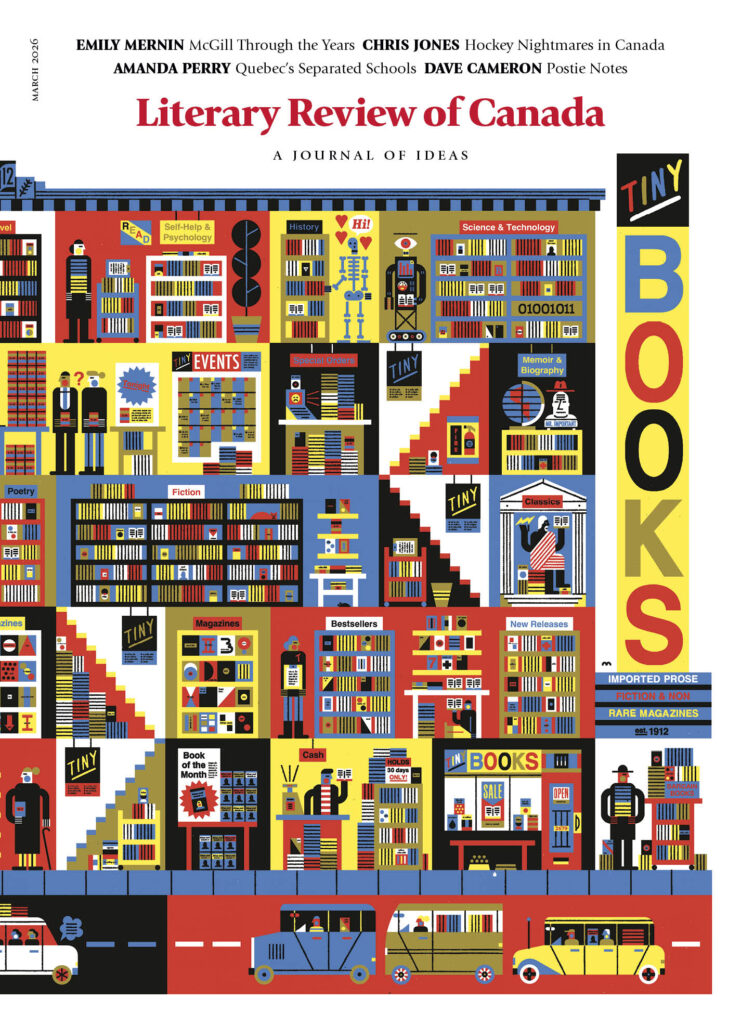

Literary Review of Canada The latest issue features:
Ulysses Unbound
Navigating this Age of Appetite by Krzysztof Pelc
Here’s a question I often bat around with graduate students in my International Political Economy seminar: In book 12 of the Odyssey, how do the shipmates know which Ulysses to trust?
You know the story. Ulysses and his crew have been on Circe’s island for a year. They’re finally about to depart when the goddess takes Ulysses aside and warns him of the dangers that await them. The first of these is the “piercing songs” of the Sirens. “So listen,” she says, “I will give you good instructions; another god will make sure you remember.”
Circe tells Ulysses to put wax in his sailors’ ears but that he can listen to the Sirens if he wants to — as long as his shipmates bind him “hand and foot” to the mast: “So bound, you can enjoy the Sirens’ song. But if you beg your men to set you free, they have to tie you down with firmer knots.”
As their ship approaches the Sirens’ sharp rocks, the wind dies down, they pull the sails, and they begin to row. As predicted, Ulysses yells out to his men to set him free. He is still their captain. But instead of obeying his orders, Eurylochus and Perimedes stand up and “tie him down with firmer knots.” How, I ask my students, do they know to trust the first Ulysses over the second? How is it that as readers, we never question their choice?
Cemented Legacy
Form follows Ford by Kelvin Browne
Albert Kahn has been called “the father of industrial architecture” and “the architect of Detroit.” His firm was certainly prolific: it was responsible for the Ford Motor Company of Canada factory in Toronto, near a laneway that bears his name, and the General Motors assembly plant in Regina, along with nearly 900 buildings in Motor City alone. Kahn’s oeuvre encompassed offices, grand homes for his industrialist clients, and libraries and fraternity houses at the University of Michigan, in Ann Arbor, not to mention a post office, a synagogue, and multiple hospitals and skyscrapers. Many of Kahn’s buildings reflect a pastiche of styles that might be considered a precursor of a postmodern eclectic. Yet this prolific architect is relatively unknown today, especially outside of Michigan.
Albert Kahn Inc.: Architecture, Labor, and Industry, 1905–1961 by Claire Zimmerman
The MIT Press / 488 pages, hardcover
Floe State? – On trouble in Greenland
The mood on the Sea Adventurer’s bridge was grim. “She’s only making eight knots,” said our expedition leader. “We need to hit at least fourteen to keep to our itinerary.” We were four days into a two-week sailing and anchored off Ilulissat, near a UNESCO World Heritage site nestled into the crenellated western coast of Greenland.
Earlier that day, I had found myself at the helm of a Zodiac, manoeuvring the rubberized craft through thick fog, near-freezing water, and growlers. The ten high-paying passengers under my care likely had no idea that this was my first trip with the tour operator or my first time north of the Arctic Circle.
LONDON REVIEW OF BOOKS – FEBRUARY 5, 2026 PREVIEW
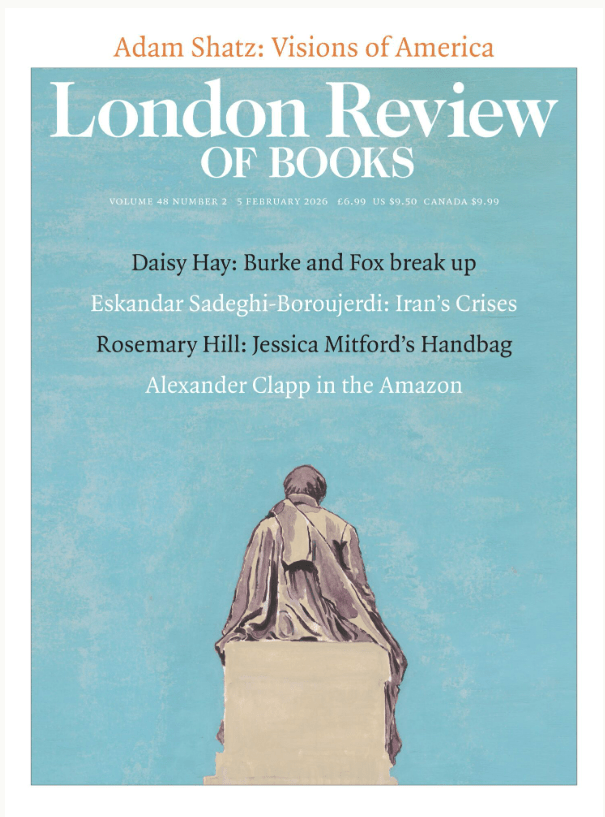
LONDON REVIEW OF BOOKS: The latest issue features ‘Visions of America’
Made in Tehran
Iran’s Grand Strategy: A Political History by Vali Nasr.
No King
Friends until the End: Edmund Burke and Charles Fox in the Age of Revolution by James Grant.
One Life to Lead: The Mysteries of Time and the Goods of Attachment by Samuel Scheffler
El Cid: The Life and Afterlife of a Medieval Mercenary by Nora Berend
THE NEW YORKER MAGAZINE – FEBRUARY 2, 2026

THE NEW YORKER MAGAZINE: The latest issue features Jason Zengerle on Tucker Carlson, Joshua Yaffa on Trump and Greenland, Hermione Hoby on David Foster Wallace, and more.
Trump’s Greenland Fiasco
The President caused a crisis in NATO and deepened European distrust toward the U.S. to end up with basically the same set of options that existed months ago. By Joshua Yaffa
What MAGA Can Teach Democrats About Organizing—and Infighting
Republicans have become adept at creating broad coalitions in which supporting Trump is the only requirement. Democrats get tied up with litmus tests.
How Shinzo Abe’s Assassination Brought the Moonies Back Into the Limelight
A shocking act of political violence exposed the cult’s deep influence. By E. Tammy Kim
THE NEW YORKER MAGAZINE – JANUARY 26, 2026

THE NEW YORKER MAGAZINE: The latest cover features Adrian Tomine’s “Post-Vacation” – Staying warm.
Why Trump Supports Protesters in Tehran but Not in Minneapolis
During the President’s second Administration, universal principles such as self-determination and due process are wielded only opportunistically.
By Benjamin Wallace-Wells
The Lights Are Still On in Venezuela
After the ouster of President Nicolás Maduro, some residents fear that one unelected despot has been swapped for another.
By Armando Ledezma
LONDON REVIEW OF BOOKS – JANUARY 22, 2026 PREVIEW
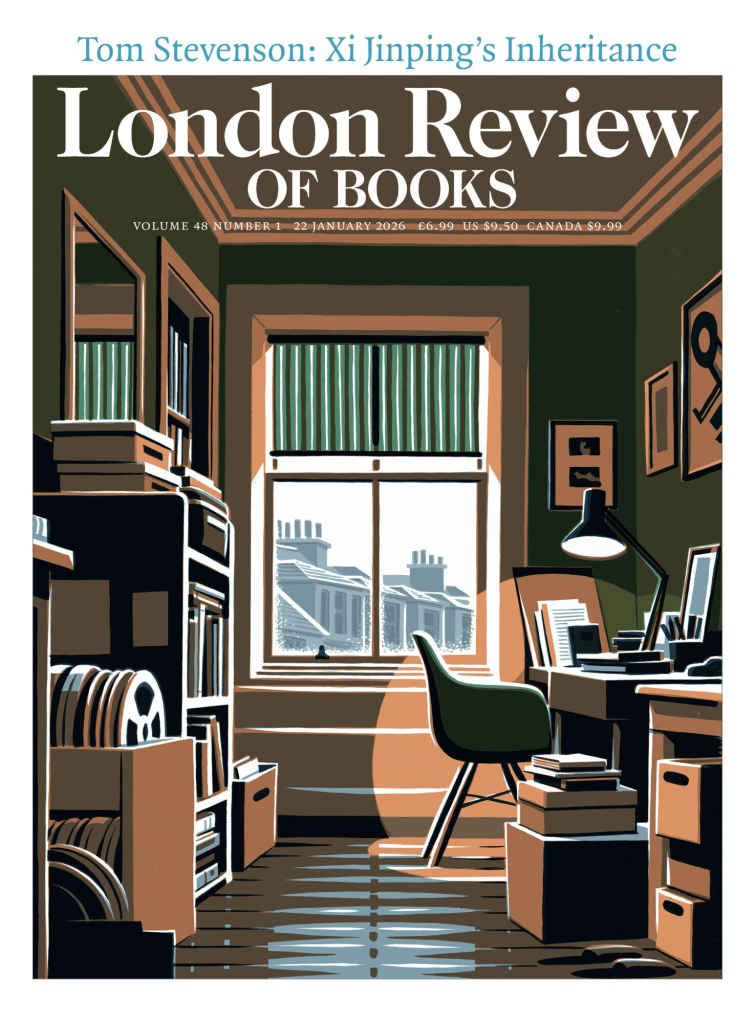
LONDON REVIEW OF BOOKS: The latest issue features…
 Boomers Daily