From a Harvard Gazette online article (March 10, 2020):
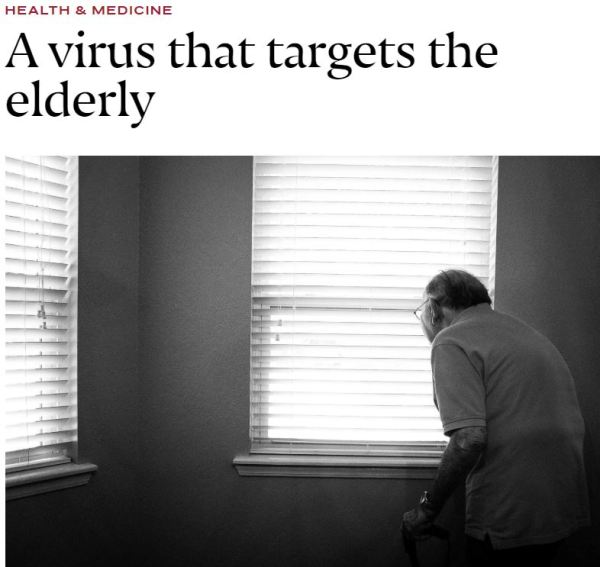 There’s a symptom review, there’s a travel review, and there’s an exposure review. And if the answer to any of those questions is yes, then you’re asked to not come in. And so far people have been compliant and have left. So that is a good thing.
If you have a cough and a fever, if you’ve got respiratory symptoms and you’re short of breath, if you’ve traveled to a place of concern or if you may have been exposed to someone who did — especially if you’re symptomatic — then I would definitely ask, “Do I really need to visit my grandma today? Can I wait and can I Skype her? Can I do FaceTime?”
I know that’s hard for some of our older adults who aren’t technologically savvy, but maybe now is the time to get them hooked up. It really would be heartbreaking if, in wanting to do something positive for someone’s emotional or mental health, you ended up infecting them.
Harvard-affiliated Hebrew SeniorLife offers a continuum of care for 3,000 elderly people daily, with a range of services including residential assisted living, short-term rehabilitation, outpatient services, and long-term care for those with chronic illness. In a Q&A interview aimed at understanding the challenges involved, Harvard Medical School Assistant Professor Helen Chen, Hebrew SeniorLife’s chief medical officer, discussed steps the facility has taken to combat the virus and the outlook going forward.
Read full article



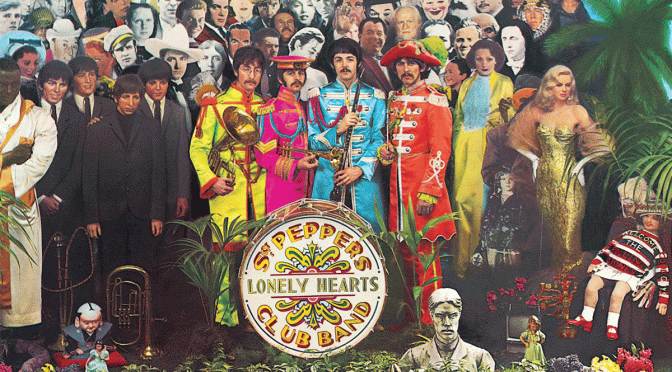
 Rock ’n’ roll, or even popular music, [was] often highly gendered and sexist. It certainly was paternalistic in the ’60s and prior, in terms of songs being directed at women as objects, women as needing to be “counseled” about love, [or] it was about coming on to them, even if it was just something innocent and romantic, “I Want to Hold Your Hand.” And the Beatles very consciously in 1965 began to change their tone. They created a very specific type of female character who would think for herself and did not need a man.
  Looking back at your favorite classic rock songs through the lens of today’s attitudes about women’s empowerment, male privilege, and even sexual violence can be cringeworthy at best. But just as they were trailblazers in music, film, fashion, and popular culture, the Beatles were ahead of their time in embracing feminism, argues Kenneth Womack, a well-known authority on the band and dean at Monmouth University, evolving from early patronizing “hey, girl” entreaties to songs filled with independent women who don’t need a man, not even a Beatle. Ideological Diversity, a Harvard Kennedy School student organization, hosts a free talk with Womack on Thursday about how the group explored issues of feminism, gender, and inclusion in ways few rock bands dared in the 1960s.
 The Grand Challenge Prize is looking for bold, audacious innovations, ideas that can really change aging. We’re looking in science, in technology and engineering, in policy, social sciences, behavioral sciences, economic policy, in traditional medical science and health care, and in work focused on specific diseases. It’s really very broad. We’re looking for innovative thinking that can have global impact. The prizes are going to roll out on three levels. There will be 450 Catalyst Prizes awarded over a three-year period. The first of the three yearly calls will be in January 2020. Once it’s announced, there will be six weeks to submit your idea — just the idea, it doesn’t require any pilot work — and a two-page application. They’ll be reviewed within four months and prizes announced by July. The Catalyst Award is intended as seed funding to get the idea into its earliest stages of development. They’re relatively small in dollar amount, about $50,000 each, but they will give access to an annual meeting bringing together world experts in these fields.
 “When you live paycheck to paycheck, there are times you fall behind. There was a healthy dose of fear, but I knew that my business would grow if I kept pushing.” Getting an M.B.A. felt superfluous. “I would rather be paid to learn,” he said. “There’s not a lot you can learn in an M.B.A. program that you can’t learn online or through other mechanisms. I’m not a big fan of taking those years and spending money that you could put to better use.”
 Boomers Daily