

Tag Archives: Germs

Arts/Books: Times Literary Supplement – Sept 29, 2023

Image

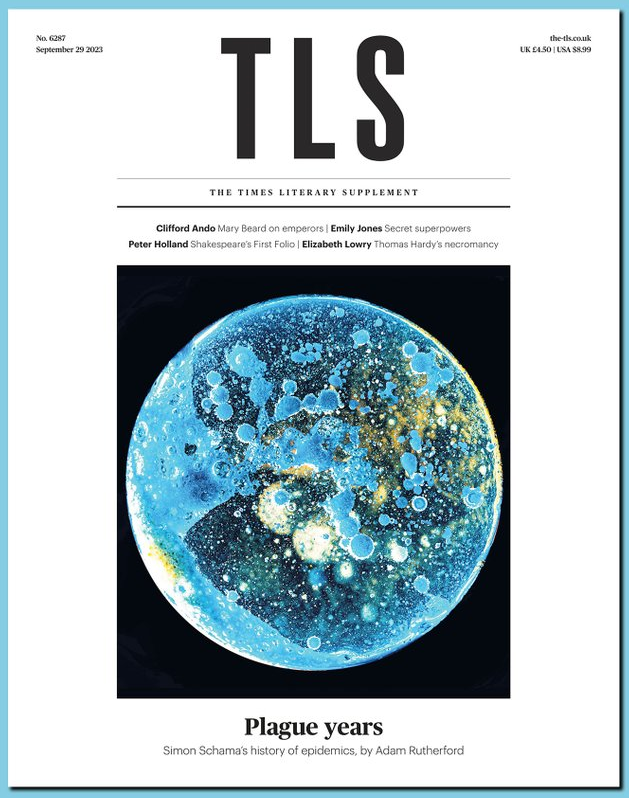
Times Literary Supplement (September 29, 2023): The new issue features The First Folio at 400; how disease shaped global history; novels of queer experience; what Britain laughs at; literary thefts and coincidences – and much more…

Germ of an idea

How disease has shaped global history

By Adam Rutherford

Scientists often make poor historians. Their shortcomings in describing and analysing the past include a failure to shed the whiggish stories that academic history moved away from decades ago. Straight lines are still drawn between Great Men and the impact of their brilliant insights on our view of reality. They also sometimes fail to treat the material of history with the seriousness they bring to their own discipline. Simple questions that are drummed into schoolchildren are frequently ignored in analysing documentary evidence: who wrote this, why, and for whom? The result is context-lite narrative that doesn’t stand up to scrutiny.

Our Shakespeare, rise

A copy of the First Folio at Christie's, London, 2016

Works to commemorate the 400th anniversary of the First Folio

Next year, the Folger Shakespeare Library in Washington DC will reopen after a three-year closure for a large-scale renovation of its building, which dates from 1932. The centrepiece of the new Shakespeare Exhibition Hall, will be, as the press release puts it, something “that only the Folger could produce: all 82 copies of the 1623 First Folio of Shakespeare that were collected by Henry and Emily Folger”. The Folger holds slightly more than a third of all extant copies of the book and now eighty of them will be on permanent show in a “20-foot long visible vault”, while two more will be open in cases as part of an “interactive” visitor experience. Peering into the vault says much about the Folgers’ appetite for cornering the market in Folios but, since nearly all copies differ in some respects, it did make some kind of sense to buy many of them.


Analysis: Multiresistant Bacteria That Outsmart Antibiotics (Video)

Antimicrobial resistance is one of the greatest medical challenges of our time. Among the causes are industrial livestock farming, poor hygiene in hospitals, and the misuse of antibiotics. This documentary looks at approaches to fighting multiresistant strains of bacteria.

Each year 33,000 people in Europe die after becoming infected with bacteria that are resistant to antibiotics. Hygiene specialist Dr. Ron Hendrix has been working for years to prevent outbreaks of infectious disease in hospitals. Dr. Hendrix says that he and other experts in the Netherlands recognized early on that they’d have to fight the spread of bacteria just as actively as they would the actual infection.

Hendrix has convinced a number of German hospitals to re-open their diagnostic laboratories, as well. In the early 2000s, many of these labs had been shut down as a cost-cutting measure. And farmers in Denmark voluntarily chose to sharply reduce their use of antibiotics, after evidence showed that intensive livestock farming caused multiresistant bacteria to multiply.

Infectious disease specialist Dr. Patrick Soentjens was able to convince Belgium’s health ministry to allow the use of “phages” to treat stubborn antimicrobial resistant pathogens. Phages are special viruses that kill bacteria. Dr. Soentjens is certain that this well-known, but largely forgotten option could save many lives. Belgium has become the first western European country where phages have been officially recognized as a legitimate medical treatment.

Health & Design: The New “Touchless Products” To Limit Spread Of Germs

The importance of touchless bathroom and kitchen products during the coronavirus pandemic is highlighted in this video interview with Patrick Speck from Grohe, as part of the brands takeover of Virtual Design Festival Today.

Speck is the the vice president of design consumer experience for the EMENA region of Japanese water technology brand Lixil, which is the parent company of bathroom and kitchen brand Grohe. Speck told Dezeen that following the coronavirus pandemic, the brand has seen an increased demand for products that limit the spread of germs and diseases.

“With the increased demand for hygiene we’re having right now, we know that to minimise the risk of spreading germs and also cross contamination, we need to reduce contact with any surface as much as we can,” Speck explained in the video. According to Speck, the solution could be touchless products such as faucets and toilets that rely on sensor technology.

Read more on Dezeen: http://www.dezeen.com/vdf