Madagascar rarely makes front page news but the toppling of its president by protesters led by Gen Z Madagascar is part of a phenomenon that stretches from Nepal to Indonesia and the Philippines to Morocco. Leaderless groups, formed online, have learned from one another as they take to the streets to vent their frustration against what they see as corrupt older elites and a lack of economic opportunity for their generation.
Our southern Africa correspondent, Rachel Savage, explains how a tumultuous month unfolded on the Indian Ocean island and explores the deep-seated discontent that led to the military siding with student demonstrators to force President Andry Rajoelina out of power.
Five essential reads in this week’s edition
Spotlight | A far-right fight club on their hands Ben Makuch reports on security service monitoring of ‘active clubs’ as they move across borders to spread extremism, mixing the behaviour of football hooligans with the ideology of the Third Reich
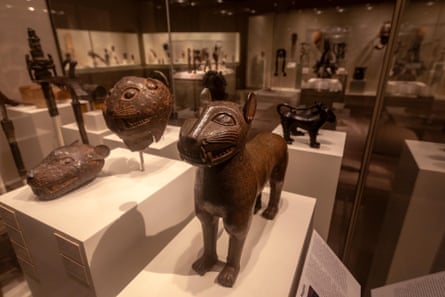
Benin bronzes at the Metropolitan Museum of Art in New York. Photograph: Art2010/Alamy
Spotlight | Nothing to see here? Due to open within weeks,Nigeria’s Museum of West African art is intended to showcase the Benin bronzes and other masterpieces stolen by 19th-century colonisers. But the project has been beset by political rows that mean, as Philip Oltermannand Eromo Egbejule report, visitors will see more replicas than original pieces
Science | Waiting for graphene to explode Two decades after the material was first produced and then much hyped, graphene has dropped from business and general discussion. Julia Kollewe reports on the successes and setbacks of taking it from lab to mainstream use
Opinion | An A-level in English won’t make integration work A government demand that immigrants get a qualification that most British citizens don’t have if they want to earn the right to stay is the latest absurd way to focus on ‘outsiders’ rather than address domestic problems, argues Nesrine Malik
Culture | The hardest part David Harewood reflects on returning to play Othello after almost 20 years and with fellow Black actors looks at how attitudes to Shakespeare’s most difficult tragedy have changed
What else we’ve been reading
The year’s Stirling prize has gone to a social housing complex for older people in south-east London. Catherine Slessor writes with great enthusiasm about how the award-winning architects Witherford Watson Mann have completely reimagined accommodation for later life. Out with disorientating corridors, in with bright, informal, nature filled spaces, described by the Stirling judges as “a provision of pure delight”. Emily El Nusairi, deputy production editor
Kathryn Lewek as the Queen Of The Night in The Magic Flute at the Royal Opera House. Photograph: Tristram Kenton/The Guardian
I saw The Magic Flute in Paris last year, and it was fascinating to see how different opera houses interpret the staging. This review of a London production made me reflect on the way different directors handle staging and sound to bring the story to life. It reminded me of listening to the Queen of the Night’s aria when I was growing up and the experience of seeing opera live. Hyunmu Lee, CRM executive
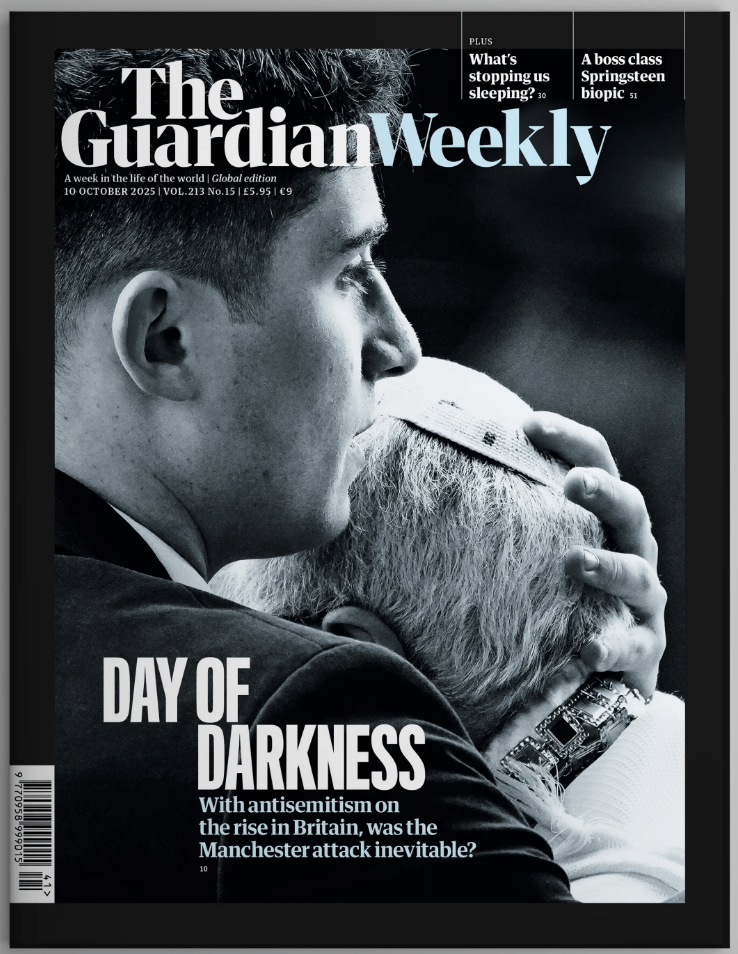
Last week was Yom Kippur, the holiest day in the Jewish calendar. A day of prayer and staying away from news. As people made their way to Heaton Park synagogue in north Manchester, they saw a small car being driven erratically before it crashed into the gates. In seconds, Jihad al-Shamie had jumped from the vehicle and started stabbing those nearby. Within six minutes three people had been killed, including the attacker, who was shot by armed police.
For our cover story, Chris Osuh and Geneva Abdul speak to members of the Jewish community about how they feared such an assault was likely, as well as their hopes for unity in the face of hatred. Our reporting team pieces together what is known about Shamie, and Jonathan Freedland says the terror attack was no surprise amid rising antisemitism, but must be a turning point.
Five essential reads in this week’s edition
Spotlight | A chilling message David Smith reports on how Donald Trump is stepping up attacks on Democratic donors little more than a year before the midterm elections for Congress
Science | Catching Zs If you’ve ever found yourself awake in the small hours, mind whirring, you’re not alone. Jillian Pretzel asks experts about what causes maintenance insomnia – inability to stay asleep – and which treatments can help to tackle it
Feature | Broken connection A volcanic eruption in the South Pacific in 2022 ripped apart the underwater cables that connect Tonga to the world.Samanth Subramanian examines how losing the internet catapulted the archipelago back in time
Opinion | Man without a plan? Latin American governments are fretfully watching a big US military buildup around Venezuela as Donald Trump steps up action against drug cartels. The president’s efforts to act as a neighbourhood policeman, writes Simon Tisdall, are regressive, dangerous and almost certain to backfire
Culture | Boss mode New biopic Springsteen: Deliver Me from Nowhere captures the musician at a pivotal point in his career. Alexis Petridis speaks to the film’s cast and crew about bringing the musical icon to life
The killing of Charlie Kirk last week sent shock waves through America among both supporters and opponents of his views. Yet until last week, the young rightwing activist was relatively unheard of – by older generations anyway – outside the US.
As the ripples and implications of his death continue to spread across the US and beyond, our big story takes a step back. Washington bureau chief David Smith explains how the young activist rose to prominence and gained a place within Donald Trump’s inner circle, his provocative brand of populism and charisma playing an outsize role in the Republicans’ 2024 election victory. As Steve Bannon, the prominent rightwing commentator, told the Guardian, Kirk’s popularity with young voters “changed the ground game” for Trump and the Maga movement.
Spotlight | Why has England become festooned with flags? Chief reporter Daniel Boffey visits a Birmingham suburb to track down the genesis of a movement that wants to see the union jacks or the flag of St George displayed across the country
Special investigation | Boris Johnson’s pursuit of profit A cache of leaked documents show a blurring of lines in the former prime minister’s private business ventures and political role after leaving office, our investigations team reveals
Feature | The porn business stripped bare In Amsterdam, at Europe’s biggest pornography conference, Amelia Gentleman discovers the perils of a booming industry, from burnout to the advent of AI
Opinion | Trump is just a paper tiger While the US president likes to present himself as the biggest, baddest strongman, he crumples in the face of Benjamin Netanyahu or Vladimir Putin’s belligerence, says Simon Tisdall
Culture | The power of pure pop Famous for getting us through lockdowns with her kitchen disco and a stream of catchy hits, Sophie Ellis-Bextor tells Rebecca Nicholson about why the perimenopause is a gift to renewed creativity
Xi Jinping had been waiting for the right moment to serve notice of China’s growing might and influence to the rest of the world, and the 80th anniversary of the end of the second world war provided the Mao-suited Chinese leader with the perfect opportunity.
Last week’s bombastic (or should that be bomb-tastic?) military parade in Beijing – in the presence of Vladimir Putin, Kim Jong-un and a host of other global strongmen – was intended as a show of force and stability to contrast sharply with the chaotic unpredictability of Donald Trump’s America. And, as the leaders of the world’s most notorious pariah states bear-hugged and strolled around Tiananmen Square like the cast of Reservoir Dogs, the optics did not disappoint.
But behind the scenes, how robust actually is the so-called “axis of upheaval”? As our big story this week explores, the illiberal alliance is riven by internal fractures and mistrust between China, Russia and North Korea that date back many years and cannot be discarded as quickly as Xi, or anyone else, might like.
Spotlight | France’s latest political crisis The fall this week of prime minister François Bayrou exposed a political malaise that is likely to sour French politics well beyond the 2027 presidential election, reports Paris correspondent Angelique Chrisafis
Interview | Leonard Barden, chairman of the chess board From honing his game in air raid shelters during the second world war to beating grand masters, our record-breaking chess columnist has lived an extraordinary life. Now aged 96, he chats to our chief sports reporter Sean Ingle
Feature | Syria’s cycle of sectarian violence Over a few brutal days in March, as sectarian violence and revenge killings tore through parts of the country, two friends from different communities tried to find a way to survive. By Ghaith Abdul-Ahad
Opinion | Angela Rayner’s exit is a bombshell for Keir Starmer The UK deputy prime minister’s fall will exacerbate all the doubts about the PM himself and his ability to keep Labour in power, writes Jonathan Freedland
Culture | Spinal Tap turn it up to 11, one last time More than 40 years since the film This Is Spinal Tap was mistaken for a comedy, its hard-rocking subjects are back for a legally obligated final gig. Our writer Michael Hann smells the glove
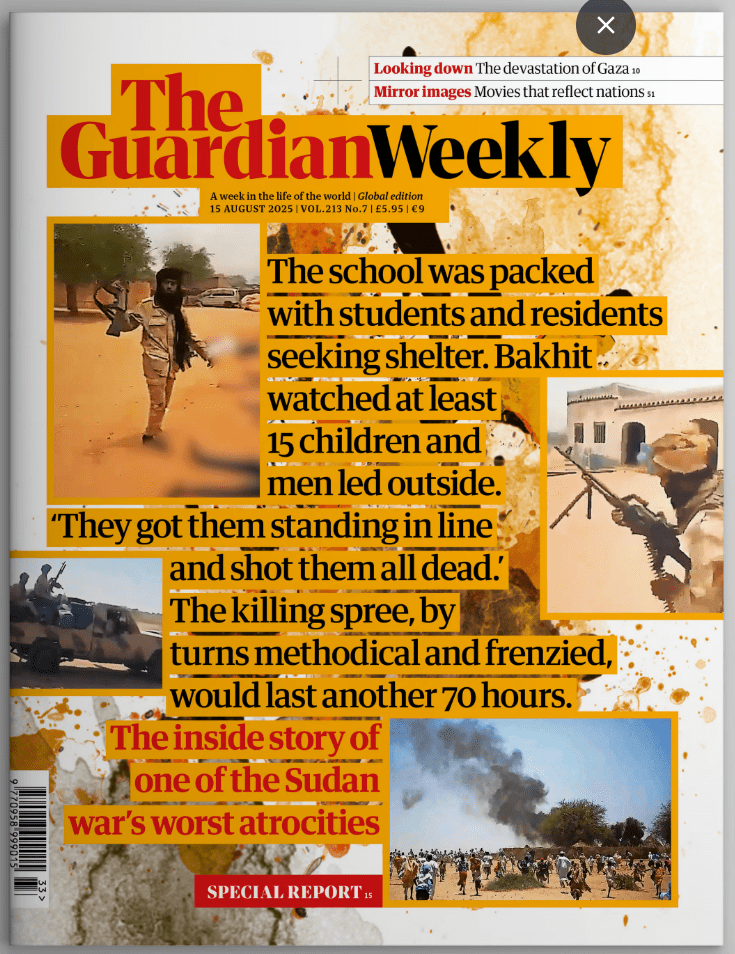
While the wars raging in Ukraine and Gaza have dominated global news agendas for months turning into years, relatively little attention has been paid to the ongoing civil war in Sudan – which for many western media outlets remains out of sight and largely out of mind.
This can’t be said of the Guardian’s Mark Townsend, who has reported tirelessly on the effects of the war between the Arab-led Rapid Support Forces and Sudanese military since it broke out in April 2023. It’s a conflict that has been characterised by repeated atrocities, forcing millions from their homes and causing the world’s largest humanitarian crisis.
In April this year, just as a British-led conference was being held in London to explore how to end the war, one such atrocity was unfolding in Zamzam refugee camp in North Darfur. Details were at first sketchy, but only now – thanks to the piecing together of intelligence reports and witness testimony – can it be revealed what happened during the attack on the camp by RSF forces and why it was not stopped.
As Mark’s remarkable account reveals, the 72-hour rampage in April may have taken the lives of more than 1,500 civilians in one of the most notorious war crimes of Sudan’s catastrophic conflict.
Five essential reads in this week’s edition
The big story | The ruins of Gaza, as seen from above Guardian international correspondent Lorenzo Tondo joins a Jordanian military airdrop for a rare chance to observe a landscape devastated by Israel’s offensive. With photography by Alessio Mamo
Science | The truth about sunscreen Too much exposure to the sun has traditionally been seen as a danger. Now claims that sunscreen is toxic flood the internet. Our science editor, Ian Sample, weighs up the evidence
Interview | Demis Hassabis, the cautious AI optimist The head of Google’s DeepMind tells Steve Rose how artificial intelligence could usher in an era of ‘incredible productivity’ and ‘radical abundance’. But who will it benefit?
Opinion | The world is in flames. But I’ve found some hope amid the gloom Columnist Jonathan Freedland makes a moral case for escapism, as a means of retaining the ability to see the world – and the people – around us
Culture | The films that capture a nation’s soul What single film best represents a nation? Twelve writers choose the one work they believe most captures their home’s culture and cinema – from a bold cricket musical to a nine-hour documentary, gritty crime dramas to frothy tales of revenge
Images of starving Palestinians have appeared with increasing insistency across the world’s media over the past few weeks. Deciding whose child and which picture best illustrates the territory’s slide into famine is a grim task. Five-year-old Lana Salih Juha, on this week’s cover, weighed just 8kg when this photograph was taken in Gaza City on 28 July.
As Malak A Tantesh reports from Gaza for this week’s big story, Lana’s parents are among many inside the territory forced to watch children waste away as deliberate aid restrictions from Israel mean hunger is becoming a killer. It was, as Malak reports, a week when two milestones were reached: a Palestinian official record of 60,000 deaths and the Integrated Food Security Phase Classification, a group of UN and aid organisations, stating that the whole population of 2.2 people were now living in a state of famine.
Five essential reads in this week’s edition
Spotlight | Transatlantic barbs traded over social media safety The UK’s new law restricting under-18s’ internet access has only just come into force but already US tech giants and rightwing commentators are bolstering Nigel Farage’s efforts to turn restriction into a free speech issue, reports Dan Milmo
Environment | The best job in the world Matthew Jefferyexplains to Donna Ferguson how he became Cambridge University’s first expedition botanist since Darwin and how he prepared for his new post
Feature | Has nature writing strayed off the path of success? In the footsteps of the controversy over The Salt Path, Alex Clark explores how, despite public appetite, memoirs of redemption through the natural world may have reached journey’s end
Opinion | A good jigsaw is simply champion Why did the Lionesses bring Lego, sourdough starters and a puzzle or two to the Women’s Euro 2025? Because they are perfect ways to build mental resilience, explainsAmy Izycky
Culture | AI rescues Woody Guthrie’s basement tapes The legendary folk singer’s daughter and granddaughter tell Dave Simpson how they became custodians of his vast archive, including tracks that have now been released
News, Views and Reviews For The Intellectually Curious









 Boomers Daily