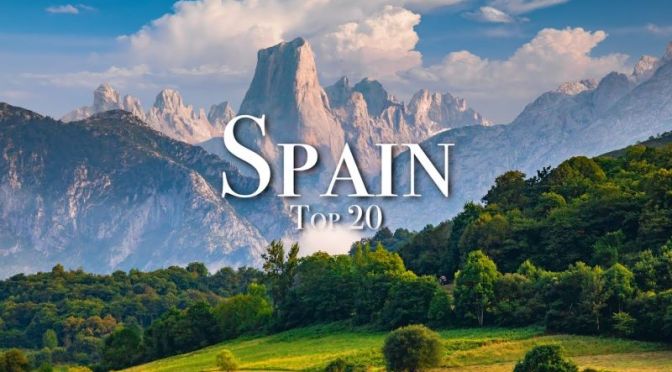
Spain is one of my all time favorite countries! From cliff jumping in Ibiza to hiking the mountains of Picos de Europa, Spain offers so much variety to experience and explore!
Spain, a country on Europe’s Iberian Peninsula, includes 17 autonomous regions with diverse geography and cultures. Capital city Madrid is home to the Royal Palace and Prado museum, housing works by European masters. Segovia has a medieval castle (the Alcázar) and an intact Roman aqueduct. Catalonia’s capital, Barcelona, is defined by Antoni Gaudí’s whimsical modernist landmarks like the Sagrada Família church.
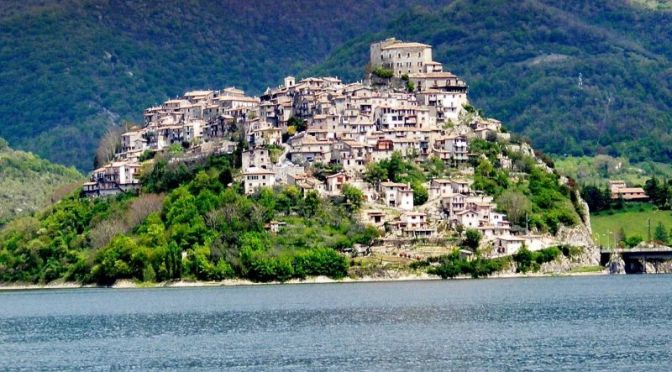
Castel di Tora is a comune in the Province of Rieti in the Italian region Lazio, located about 50 kilometres northeast of Rome and about 20 kilometres southeast of Rieti. Castel di Tora borders the following municipalities: Ascrea, Colle di Tora, Pozzaglia Sabina, Rocca Sinibalda, Varco Sabino.
The first historical evidence of this village dates back to 1035, when in some chronicles there is talk of a Castrum Vetus de Ophiano, and up to 1864 in fact the village had Castelvecchio as its name. The current name was intended to be linked to an ancient Roman settlement called Tora, where in 251 AD. the martyrdom of Santa Anatolia took place. For centuries it was called “Castelvecchio”, a name changed after the unification of Italy in 1864 to that of Castel di Tora, in memory of an ancient Roman Sabine pagus called Thora Thiora. The Abbey of Farfa owned the territory of Castel di Tora. Subsequently the property belonged to the Buzi – Brancaleoni and then to the Mareri, to whom it was confiscated in 1241 by Frederick II of Swabia. In 1440 the fief of Castelvecchio passed to the Orsini and from 1558 to 1570 to the Estouteville and then passed to the Borghese. From this period there remains the testimony of a painting (1601) by the Flemish painter Paul Bril, with a harsh landscape with two castles guarding the gorge formed by the Turano. In the years 1935-38 the Posticciola dam was built and the Turano artificial lake was created which submerged the most fertile soils of the valley, causing a strong emigration of the local population. In recent years, there has been a complete transformation of the local economy, which from agriculture and pastoralism is progressively transforming and moving towards the tertiary sector of trade and tourism.
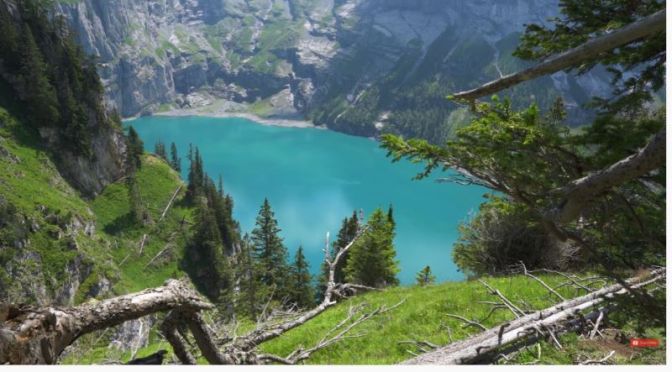
Hiking A High Alpine Trail With Amazing Epic Views Of The Lake Oeschinensee !
Oeschinen Lake is a lake in the Bernese Oberland, Switzerland, 4 kilometres east of Kandersteg in the Oeschinen valley. At an elevation of 1,578 metres, it has a surface area of 1.1147 square kilometres. Its maximum depth is 56 metres. The lake is fed through a series of mountain creeks and drains underground.
A journey along Norway’s most northern coast to the northernmost point in Europe that can be accessed by car: North Cape. The more north you travel, the more remote, vast and rough the environment gets. From the Lyngen Alps it was still roughly 400 Kiolometers to Nordkapp – and we decided to cover this distance in one day. We met ( a lot of!!!) reindeer, rode on route E6 over the mountain pass Kvænangsfjellet at 402 meters altitude (yes, that doesn’t sound very high, but it’s indeed one of the highest passes in this far north of Norway) and turned on Route 69 at Olderfjord to follow the coast. The closer we got to Nordkapp, the more I felt like like dreaming. Maybe because all of a sudden our goal was so close. But instead of driving straight to North Cape we drove to the town Honningsvåg first after driving through the North Cape tunnel and reaching the island Magerøya. Honningsvåg has the largest cruise port in Northern Norway and was our base to head to North Cape at 5am the following morning. We had a reason to visit Nordkapp that early. Rumors said that taking a motorcycle to the iconic globe, the symbol of North Cape, is only possible as long as the tourist center is closed. With opening times from 10.30 am to 1 am in summer due to the midnight sun, there is only a very limited time frame to do so. If you want to know how to ride your motorcycle to North Cape this episode is for you – or if you just want to reach the northernmost point in Europe that can be accessed by vehicle with me.
Spain, a country on Europe’s Iberian Peninsula, includes 17 autonomous regions with diverse geography and cultures. Capital city Madrid is home to the Royal Palace and Prado museum, housing works by European masters. Segovia has a medieval castle (the Alcázar) and an intact Roman aqueduct. Catalonia’s capital, Barcelona, is defined by Antoni Gaudí’s whimsical modernist landmarks like the Sagrada Família church.
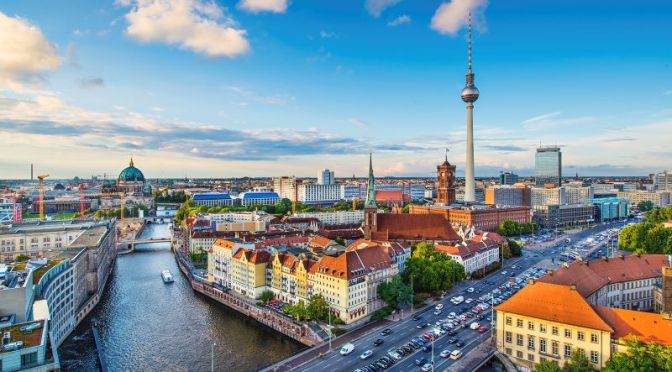
Take a virtual walk through Berlin’s historic centre of culture and view the breathtaking sites and buildings that played a role in the history of this city. Enjoy the empty streets like never before during the 2021 corona pandemic.
Berlin, Germany’s capital, dates to the 13th century. Reminders of the city’s turbulent 20th-century history include its Holocaust memorial and the Berlin Wall’s graffitied remains. Divided during the Cold War, its 18th-century Brandenburg Gate has become a symbol of reunification. The city’s also known for its art scene and modern landmarks like the gold-colored, swoop-roofed Berliner Philharmonie, built in 1963.
As it has been a long time since our last release, and because big things are on the way, we are starting a new series of short documentaries based on the stunning nature around northern Norway. It is also a way for us to flag the current saddening state of the Arctic and how climate change is affecting it more / faster than any other part or the world.
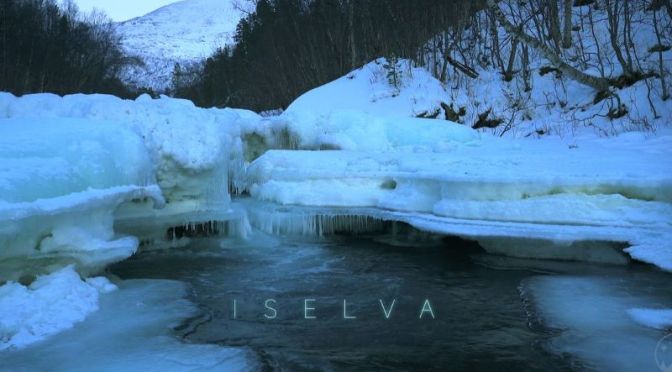
This series of clips were taken in Målselva, Norway on January 10th 2020. Typically at this time of year and around that inland area, temperature are much colder and rivers are dormant, buried under feet of snow. This year, however, is a total different story. For the past years, we’ve been seeing a general trend with much milder, later winters with very little snow until February. This year, Tromsø has had zero centimeters thus far, which is quite alarming. Rivers should barely be running or visible.
The Målselva is a river in Målselv Municipality in Troms og Finnmark county, Norway. The 140-kilometre (87 mi) long river flows through the Målselvdalen valley and then empties into the Målselvfjorden, an arm of the Malangen fjord. The municipality and the valley through which the river runs are both named after the river.
Civita di Bagnoregio is a hilltop village in central Italy. It’s accessed via a pedestrian bridge from the nearby ticket office in Bagnoregio village. The Porta Santa Maria gateway was built by the Etruscans. Founded in the 7th century, the Romanesque San Donato Church sits in the main square. Nearby is the Geological and Landslides Museum, whose exhibits document projects to shore up the village’s eroding hillside.
Ticino is an Italian-speaking region in southern Switzerland with palm-lined lakes and sharp Alpine peaks. Its architecture, cuisine and culture is closely related to that of neighboring Italy. Bellinzona, the capital of Ticino, is home to medieval castles. Lugano, a town on glacial Lake Lugano, is known for its waterfront promenade and Piazza della Riforma, a square lined with neoclassical buildings.




 Boomers Daily