
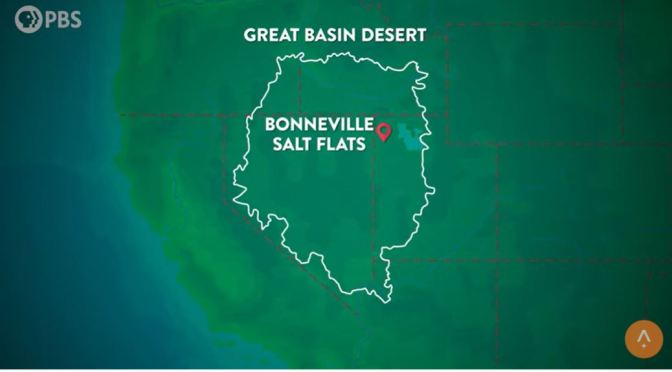
The Bonneville Salt Flats are perfect for speed. Every year, cars and motorcycles break land speed records on the flat expanse of the Bonneville Salt Flats. It’s been a tradition for more than a century, and racers have built a thriving community around the salt races. But how did these salt flats form, and why are they disappearing now?
Tag Archives: Environment
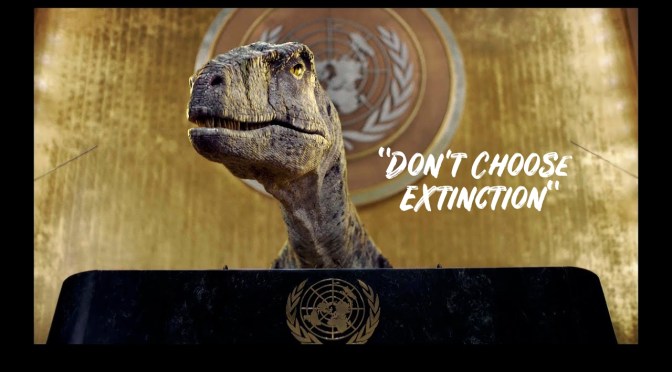
Climate Change: “Don’t Choose Extinction” (U.N.)
A visitor to the United Nations General Assembly has a message about climate change, telling us government-supported fossil fuel subsidies will prove disastrous to our species. The computer-animated Frankie the Dinosaur (voiced by actor Jack Black) stars in this message produced by the U.N. Development Program as part of its “Don’t Choose Extinction” campaign, timed to the COP-26 climate conference in Glasgow.

Nature: Belize Converts Debt To Protect 30% Of Its Coral Atolls, Barrier Reef
The Belize Barrier Reef System features three of four coral atolls in the Atlantic, lush mangrove forests, numerous offshore islands, and one of the most extensive seagrass areas in the Caribbean. It hosts 77 species listed as threatened by the IUCN, including a sizeable population of West Indian Manatees.
Now, Belize has reaffirmed its environmental leadership by becoming the first country in the Americas to finalize a debt conversion for ocean conservation—and one that represents an impact investment for marine protection that’s unprecedented in scale. This commitment will enable Belize to restructure approximately US$550 million of external commercial debt—an amount that represents 30 percent of the country’s GDP—and reduce the national debt by 12 percent.
Views: What 3°C Of Global Warming Will Look Like
If global temperatures rise three degrees Celsius above pre-industrial levels, the results would be catastrophic. It’s an entirely plausible scenario, and this film shows you what it would look like.
Video timeline: 00:00 – What will a 3°C world look like? 00:57 – Climate change is already having devastating effects 02:58 – How climate modelling works 04:06 – Nowhere is safe from global warming 05:20 – The impact of prolonged droughts 08:24 – Rising sea levels, storm surges and flooding 10:27 – Extreme heat and wet-bulb temperatures 12:51 – Increased migration and conflict 14:26 – Adaptation and mitigation are crucial

Science: Floating ‘Seed’ Sensors, Human Walking Pace, Genome Editing
How tiny seed-like sensors could monitor the environment, and the latest from the Nature Briefing.
In this episode:
00:45 Spinning seeds inspire floating electronics
Researchers have developed miniature electronic-chips with wings that fall like seeds, which could be a new way to monitor the environment.
Research article: Kim et al.
Video: Seed-inspired spinners ride the wind and monitor the atmosphere
06:02 Research Highlights
How humans can adjust to an energy-efficient walking pace almost without thinking, and the viral shell that excels at delivering genome-editing tools.
Research Highlight: Humans walk efficiently even with their heads in the clouds
Research Highlight: A CRISPR fix for muscles hatches from a viral shell
08:34 Briefing Chat
We discuss some highlights from the Nature Briefing. This time, the mystery of the Sun’s super-hot corona, and the latest efforts to toilet-train cows.
Physics World: The enduring mystery of the solar corona
The Guardian: Cows ‘potty-trained’ in experiment to reduce greenhouse gas emissions
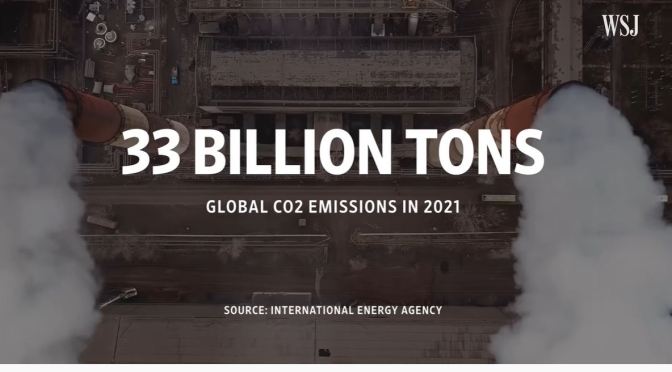
Environment: Investing In Carbon Capture Systems
The system could be one answer to slashing Earth’s carbon emissions. A Swiss startup has created a giant vacuum cleaner to capture carbon dioxide from the air, helping companies offset their emissions. WSJ visits the facility to see how it traps the gas for sale to clients like Coca-Cola, which uses it in fizzy drinks. Composite: Clément Bürge.
Renewable Energy: The Political Backlash (WSJ)
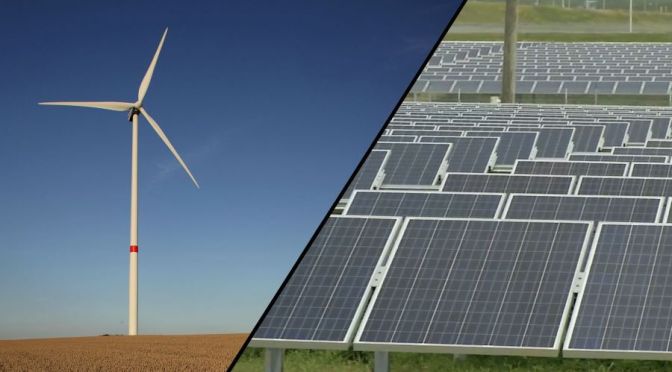
Political battles at the most local levels are slowing the pace of decarbonization Property owners in the windy and sunny parts of the U.S. are pushing back against large-scale renewable energy development, opposition that researchers say could slow the transition to a cleaner economy. Photo: Aaron Yoder/WSJ
Conservation: The Marble Quarries Of Carrara, italy
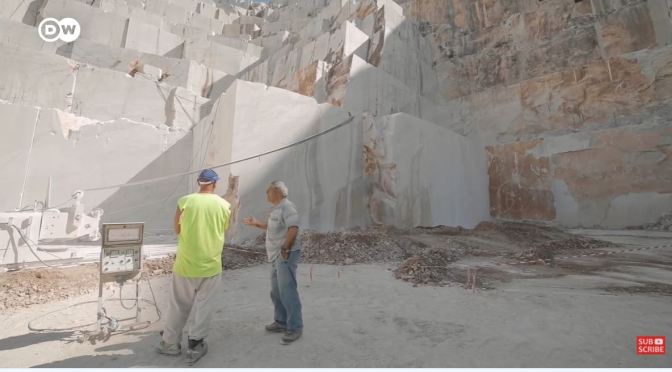
Italy’s Carrara marble quarries are a source of controversy, pitting nature against economic gain. Environmentalists warn of overexploitation, while others defend the jobs these Tuscan quarries provide.
Franco Barratini quarries marble blocks that sell for €4,000 per ton. The amount of marble that was once quarried in a month can now be extracted in just three days, and environmentalists are alarmed at the consequences. Marble dust leaks into groundwater, turns rivers milky-white and hangs in the air. The effects of this are still not completely clear.
Sandro Manfredi is fighting what he sees as severe overexploitation in the marble quarries of Tuscany’s Apuan Alps. In 2018, he filed a complaint against an illegal marble quarry, and afterwards was nearly killed when someone tampered with his car. Carrara has experienced four floods in the last nine years. Environmentalists blame marble quarrying, which has increased dramatically thanks to rapidly evolving extraction techniques, upsetting the region’s hydrogeological balance.
Analysis: The Western U.S. Drought’s Major Impacts
Watering the Country’s Food Basket Is Becoming a Challenge
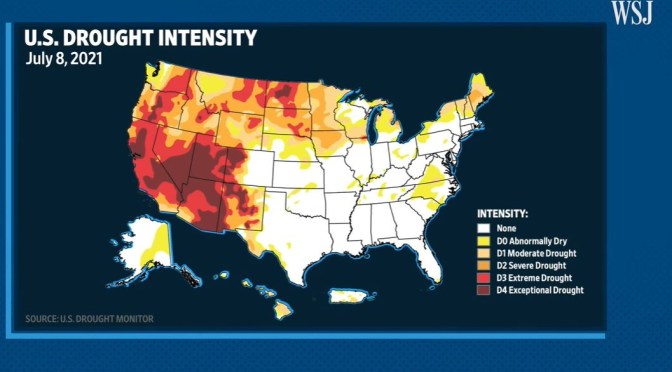
Droughts are part of a natural cycle of water. But the drought currently gripping the Western U.S. has climate scientists concerned that the cycle may be shifting. This has major implications for those who rely on the water the most: farmers and the communities they surround. Photo Illustration: Carter McCall/WSJ
 Boomers Daily