Tag Archives: Economics

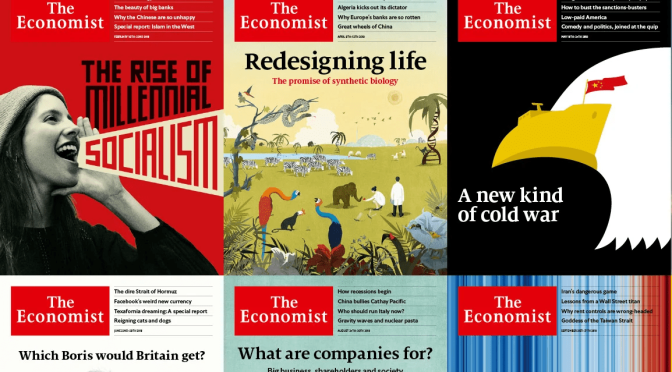
THE ECONOMIST MAGAZINE – OCTOBER 18, 2025 PREVIEW

THE ECONOMIST MAGAZINE: The latest issue featuresThe coming debt emergency

The rich world faces a painful bout of inflation

Governments are living far beyond their means. Sadly, inflation is the most likely escape

Brute force is no match for today’s high-tech drug-runners

They are more inventive and adaptable than ever

The America v China spat reveals a dangerous dynamic

A balance of economic terror is no basis for stability

First Brands is a painful but necessary warning for Wall Street

Lessons from a $10bn panic on the prairie

Why Trump is looking the wrong way in the Arctic

Forget Greenland; worry about Alaska

THE ECONOMIST MAGAZINE – OCTOBER 11, 2025 PREVIEW

THE ECONOMIST MAGAZINE: The latest issue featuresA new beginning

A new beginning for the Middle East

The breakthrough in Gaza could open up a new approach to peace

Donald Trump’s fortress economy is starting to hurt America

The pain from trade and immigration restrictions cannot be postponed forever

Japanese politics enters its heavy-metal phase

Takaichi Sanae is a refreshing change—but problems loo

Cybercrime is afflicting big business. How to lessen the pain

Banning the payment of ransoms would be a start

Africa’s leaders-for-life offer a warning to the world

The longer autocrats stay in power, the worse they become

THE ECONOMIST MAGAZINE – OCTOBER 4, 2025 PREVIEW

THE ECONOMIST MAGAZINE: The latest issue featuresRussia tests the West

Vladimir Putin is testing the West—and its unity

NATO must resist Russia’s efforts to corrode it from within

The White House’s plan for Gaza deserves praise

America, Israel and perhaps Hamas have changed their positions

Donald Trump’s cure for drug prices is worse than the disease

The problem is not greedy pharma firms

The new SCOTUS term will reshape America’s constitution

If the justices do not check an overmighty president, the country will suffer

Unleash the robotaxi revolution

Across the West, safety rules are standing in the way of progress

THE ECONOMIST MAGAZINE – SEPTEMBER 27, 2025 PREVIEW

THE ECONOMIST MAGAZINE: The latest issue featuresFree speech in America‘…

Donald Trump is trying to silence his critics. He will fail

But the country could still lose

The desperate search for superstar talent

Too much potential goes to waste

Fixing the rot in Ukraine

Things are going wrong away from the front line. Europe needs to help

How to stop AI’s “lethal trifecta”

Coders need to start thinking like mechanical engineers

THE ECONOMIST MAGAZINE – SEPTEMBER 20, 2025 PREVIEW

THE ECONOMIST MAGAZINE: The latest issue featuresHow Israel is losing America

How Israel is losing America

Public opinion is souring even in Israel’s strongest ally. Israelis should worry

America’s monetary policy risks getting too loose

Jobs growth is probably weak because of low migration, not a cold economy

What Elon Musk gets wrong about Europe’s hard right

He imagines a continental revolt against Islam and elites

India could be a different kind of AI superpower

It won’t look like America or China. It could still be a winner

China’s 200m gig workers are a warning for the world

What a giant precarious workforce reveals about the future of jobs

THE ECONOMIST MAGAZINE – SEPTEMBER 13, 2025 PREVIEW

THE ECONOMIST MAGAZINE: The latest issue featuresThe $3trn bet on AI‘…

What if the $3trn AI investment boom goes wrong?

Even if the technology achieves its potential, plenty of people will lose their shirts

Don’t panic about the global fertility crash

A world with fewer people would not be all bad

Israel’s Qatarstrophic error 

Its extra-territorial campaign against terrorists has to have limits

The Kremlin’s plot to kill NATO’s credibility

The alliance needs an emphatic response to Russian air incursions

Nitazenes: another failure of drug prohibition

As countries crack down on fentanyl, a new synthetic opioid takes off

THE ECONOMIST MAGAZINE – SEPTEMBER 6, 2025 PREVIEW

THE ECONOMIST MAGAZINE: The latest issue featuresAmerica’s missing opposition

Donald Trump is unpopular. Why is it so hard to stand up to him?

Republicans are servile. Courts are slow. Can the Democrats rouse themselves?

How Europe’s hard right threatens the economy

At best, the continent should expect stagnation, at worst a bond-market rout

Xi Jinping’s anti-American party

To see the cost of Trump’s bullying, tally the world leaders flocking to China 

Schools should banish smartphones from the classroom

Grades will rise—and pupils will be happier

THE ECONOMIST MAGAZINE – AUGUST 30, 2025 PREVIEW

THE ECONOMIST MAGAZINE: The latest issue features ‘What Brazil Can Teach America’

Brazil offers America a lesson in democratic maturity

It is a test case for how countries recover from a populist fever

Humiliation, vindication—and a giant test for India

Trump has triggered a trade and defence crisis: how should Modi respond?

How much danger is America’s central bank in?

Whether Lisa Cook stays or goes, important norms have been broken

France’s government is on the brink of collapse, again

Emmanuel Macron looks likely to lose another prime minister over an attempt to curb public debt

Don’t forget the downsides of China’s innovation push

China’s industrial policy attracts fans abroad, critics at home

THE ECONOMIST MAGAZINE – AUGUST 23, 2025 PREVIEW

THE ECONOMIST MAGAZINE: The latest issue features All-American silicon‘…

Donald Trump’s fantasy of home-grown chipmaking

To remain the world’s foremost technological power, America needs its friends

A new opposition could be a healthy sign for Syria

Ahmed al-Sharaa, the new president, needs to bring his critics closer

Who will America’s president listen to next on Ukraine?

The problem with Donald Trump’s fast-moving, unpredictable diplomacy

Pregnant women need protecting from heatwaves

As temperatures rise, so must understanding of the risks

The Silvered City with a Fevered Heart

In 1590, the Spanish port of Seville was the epicenter of the first global economy—a city drowning in silver, haunted by plagues, and inventing the anxieties we now know all too well. Its story is a warning.

By Michael Cummins, Editor, Intellicurean, August 20, 2025

Before there was Wall Street, London, or Shanghai, there was Seville. We live today in a world defined by intricate global supply chains, where fortunes are made on the abstract flow of capital and data, and where a single ship stuck in a canal can trigger worldwide anxiety. We know the feeling of living in a hyper-connected age, with all its dizzying wealth and its profound fragility. We talk of unicorn companies, bubbles, and systemic risk, sensing that the towering edifice of our prosperity rests on foundations we don’t fully understand. But what did the very first version of that world feel like, before the risks were modeled and the consequences were known?

To understand the unnerving vertigo of our own time, you have to go back to a muddy river in southern Spain, four centuries ago, when the modern world was being born in a flash of silver and blood. You have to imagine a spring morning in 1590.

At first light, the galleon Nuestra Señora de la Merced drifts slowly up the Guadalquivir River. Its sails, slack after the long Atlantic crossing from Panama, are stained with salt and sea-spray. Its sturdy Iberian oak hull, scarred by shipworms and storms, creaks under the registered weight of 500 tons. On the bustling Arenal waterfront, a dockworker named Mateo shields his eyes against the rising sun. He sees not a symbol of imperial glory, but the promise of a day’s wage, the chance to buy bread for his family at a price that seems to climb higher every month. His ropes are coiled in calloused hands, the air thick around him with the smell of pitch, citrus, and the river’s brackish breath.

Further back, shielded from the morning sun in the arcaded loggias of the Calle de las Gradas, men of a different class watch the same ship with a far more specific terror. A Genoese banker in sober black silk mentally calculates the interest on the massive loan he extended to King Philip II, a loan secured against this very shipment. Beside him, a Castilian merchant, having mortgaged his ancestral lands to finance a speculative cargo of wine and olive oil on the outgoing voyage, feels a tremor of hope and fear. Was the voyage profitable? Did pirates strike? Did the storms claim his fortune?

In a dusty office nearby, a scribe from the Casa de la Contratación—the formidable House of Trade—readies his quills and ledgers. He will spend the day recording every ingot, every barrel, every notarized claim, his neat columns tracking the quinto real, the “royal fifth,” the 20% tax on all precious metals that funds Spain’s sprawling wars in Flanders and the Mediterranean. In this moment, a city of nearly 150,000 souls—the largest and most important in Castile—holds its breath. The Guadalquivir carries not only treasure but the very lifeblood of an empire. And with it, a new kind of global pulse.

For nearly a century, Seville held the absolute monopoly on all trade with the Americas. Granted by the crown in 1503, this privilege meant every ounce of silver from the great mountain-mine of Potosí, every barrel of cochineal dye, every crate of indigo, and every human being—whether a returning colonist, a hopeful migrant, or an enslaved African—was funneled through its port. It was not merely a metropolis; it was a complex, living organism. Its artery was the river; its brain was the bureaucracy of the Casa; its beating heart was the Plaza de San Francisco, where coin, credit, and rumor changed hands with dizzying speed.

The brain of this operation, the Casa de la Contratación, was an institution without precedent. It was a combination of a shipping board, a research institute, and a supreme court for all maritime affairs. Within its walls, master cartographers secretly updated the Padrón Real, the master map of the New World, a document of such immense geopolitical value that its theft would be a blow to the entire empire. Its school for pilots trained men to navigate by the stars to a world that was, to most Europeans, still a realm of myth. The Casa licensed every ship, certified every sailor, and processed every manifest. It was the centralized, bureaucratic engine of the world’s first truly global enterprise.

The lifeblood of the system was the annual treasure fleet, the Flota de Indias. This convoy system, a necessity born from the existential threat of French and English privateers, was a marvel of logistics. Sailing in two main branches—one to Mexico, the other to Panama to collect the silver of Peru—the fleets were floating cities, military and commercial operations of immense scale. Their return, usually in late spring, was the moment the imperial heart beat loudest. The sheer volume of wealth was staggering. According to the foundational economic data compiled by Earl J. Hamilton, in the two decades from 1581 to 1600, over 52 million pesos in silver and gold were officially registered passing through Seville. The clang of heavy presses striking that silver into the iconic reales de a ocho, or pieces of eight—the world’s first global currency—echoed from the Royal Mint near the river.

This deluge of wealth transformed the city. To manage the booming trade, construction had begun in 1584 on a grand new merchant exchange, the Casa Lonja de Mercaderes. Designed by Juan de Herrera, the architect of the king’s austere Escorial palace, its monumental Renaissance style was a physical manifestation of Seville’s self-image: ordered, powerful, and the nerve center of a global Christian empire. The great Gothic Cathedral, already one of the largest in Christendom, glittered with new silver candlesticks and gold-leafed altarpieces forged from American bullion. The city attracted a complex web of foreign merchants and bankers who operated in a state of symbiotic tension with the Spanish crown. As historian Eberhard Crailsheim explains, foreign merchants were “indispensable for the functioning of the Spanish monopoly system, while at the same time they were its greatest threat.” They provided the credit and financial instruments the empire desperately needed, ensuring that American silver circulated rapidly into the European economy to pay the crown’s debts, often before it had even been unloaded at the Arenal.


But this firehose of silver was never pure. The same river that delivered the bullion also carried plague, contraband, and devastating floodwaters. That river of wealth was also a river of poison.

The most visceral fear was disease. Each arriving fleet was a potential vector for an epidemic. Ships from the Caribbean, their crews weakened by months at sea and ravaged by scurvy, disgorged sailors carrying typhus, smallpox, and what was then called vómito negro (yellow fever) into the densely packed, unsanitary tenements of the Triana neighborhood across the river. An outbreak meant sudden, terrifying death. It meant closed gates, armed guards preventing travel, and the dreaded chalk mark on the door of an infected house. While the truly catastrophic Great Castilian Plague of 1596–1601, which would kill a quarter of the city’s population, was still a few years away, smaller outbreaks kept the city in a perpetual state of anxiety.

Economic contagion was just as insidious. The endless flood of American silver triggered a century-long inflationary crisis known as the Price Revolution. As the money supply swelled, the value of each coin fell, and the price of everything—from bread and wine to cloth and rent—skyrocketed. A blacksmith or farmer in the Castilian countryside found himself poorer each year, his labor worth less and less. The very treasure that enriched the king and a small class of merchants was simultaneously impoverishing the kingdom. This paradox revealed the empire’s core fragility: it was living on credit, perpetually on the verge of bankruptcy (which it would declare again in 1596), its vast military and political ambitions financed by treasure it had not yet received.

Illicit trade pulsed through the artery with the same rhythm as legal commerce. Silver was smuggled to avoid the quinto real, often with the collusion of the very officials meant to prevent it. Forbidden books—Protestant tracts from Northern Europe or scientific texts deemed heretical—were hidden in barrels and circulated in the city’s more than one hundred taverns. And in the shadows of the Cathedral, a teeming underworld flourished. This was the world Miguel de Cervantes knew intimately. In the late 1580s, he served in Seville as a naval commissary, requisitioning wheat and olive oil for the navy—a frustrating job that landed him in jail and exposed him to the city’s seedy underbelly. His experience shaped his picaresque tale Rinconete y Cortadillo, a brilliant portrait of a city of hustlers, thieves, and corrupt officials who had created a perfect, parasitic society in the shadow of imperial wealth.

The Guadalquivir itself, the source of all this prosperity, was turning against the city. Centuries of deforestation and agricultural runoff were causing the river channel to silt up, creating treacherous sandbars near its mouth. As modern hydrological studies confirm, the late sixteenth century was a period of extreme environmental change in the estuary. At the time, the city’s frequent, devastating floods were interpreted as divine punishment for its sins of greed and luxury. In reality, it was a slow, man-made thrombosis. The great artery was hardening.


In a city defined by such spectacular contradictions—unimaginable wealth and desperate poverty, global connection and epidemic disease, rigid piety and rampant crime—life was lived on a knife’s edge. To manage these profound anxieties, Seville transformed itself into a grand stage, and the river became the backdrop for its most important dramas of power, faith, and identity.

The sensory experience of the port was an unforgettable piece of theater. Chroniclers describe the overwhelming smells of spices and sewage, the cacophony of ships’ bells and construction cranes, and the shouts of sailors in a dozen languages. Enslaved West Africans loaded and unloaded cargo in the grueling sun, their forced labor the invisible foundation of the entire enterprise. Moorish artisans crafted vibrant ceramics in Triana, while Flemish merchants in lace collars inspected textiles near the Casa Lonja. It was a microcosm of a new, globalized world, assembled by force and commerce on the banks of a single river.

To contain the social and spiritual anxieties this world produced, the city deployed the power of art and ritual. Painters of the emerging Seville School, like Francisco Pacheco, experimented with dramatic chiaroscuro, their canvases echoing the city’s tension between divine order and worldly excess. The church, enriched beyond measure by the tithes on American silver, became the primary patron of this art. As historian Amanda Wunder argues in her book Baroque Seville, these spectacular displays were essential civic mechanisms. The city, she writes, sought to “transmute the New World’s silver into a spiritual treasure that could be stored up in heaven” as a defense against the very instability that wealth created.

Nowhere was this clearer than during the feast of Corpus Christi, the city’s most important celebration. The streets were covered in flowers. The great guilds marched with their banners. And at the heart of the procession was the custodia, an immense, fortress-like monstrance of solid silver, paraded through the city as a tangible symbol of God’s presence. This was not mere decoration; it was a carefully choreographed piece of public therapy. It took the source of the city’s anxiety—silver—and transformed it into an object of sacred devotion, reassuring the populace that their chaotic world was still under divine control. In this baroque theater, as the eminent historian Antonio Domínguez Ortiz noted, Seville’s greatness was inseparable from its “spectacular fragility.”

Overseeing this entire performance was the Holy Office of the Inquisition, its headquarters looming in the castle of Triana. The Inquisition was not just hunting heretics; it was policing the boundaries of thought and expression in a dangerously cosmopolitan city. Its public trials, the autos-da-fé, were another, darker form of theater, designed to root out dissent and reinforce social order. Its presence created a climate of suspicion that simmered beneath the city’s vibrant surface.


The year 1590 was, in retrospect, a historical precipice. To a contemporary observer standing on the Triana bridge, watching the forest of masts on the river, Seville must have seemed invincible, the permanent heart of a permanent empire. The monumental walls of the Casa Lonja were rising, the mint’s hammers clanged incessantly, and the Cathedral shone with American treasure.

Yet within its very triumph lay the seeds of its decay. The shocking defeat of the Spanish Armada just two years prior had been a blow to both the treasury and the national psyche. The bankruptcy of 1596 loomed. The river’s sedimentation was worsening, a physical reality that would, over the next few decades, slowly choke the port and eventually divert the monopoly of trade to Cádiz. The great artery was silting, even as its pulse quickened.

Still, to walk the riverbank in 1590 was to witness the apex. Children stared at ships vanishing over the horizon toward a nearly mythical world; merchants prayed over contracts sealed with a handshake; artisans fashioned silver into monstrances of breathtaking complexity. The Guadalquivir carried all these flows—material, sensory, and symbolic. Its pulse was not merely economic; it was emotional, theological, and aesthetic. A popular epithet of the time called Seville “the city where the world’s heart beats.” In 1590, that heartbeat was fevered, irregular, and already trembling with overexertion—but it was magnificent.

At dusk, as the river darkened to ink, the silver locked away in the city’s coffers seemed to gleam like a heart beating too fast, too bright, and far too fragile to last. In that shimmer lay the paradox of Seville: a city at once glorious and doomed, sustained and threatened by the very waters that had forged its destiny. It’s a paradox baked into the very nature of globalization—a fevered heartbeat we can still hear in the rhythm of our own world.

THIS ESSAY WAS WRITTEN AND EDITED UTILIZING AI