
Tag Archives: Books

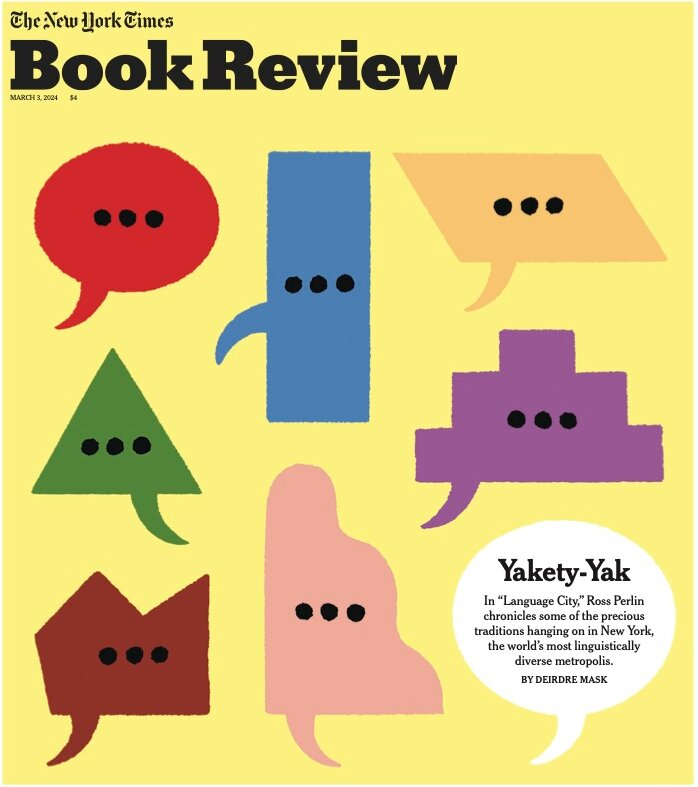
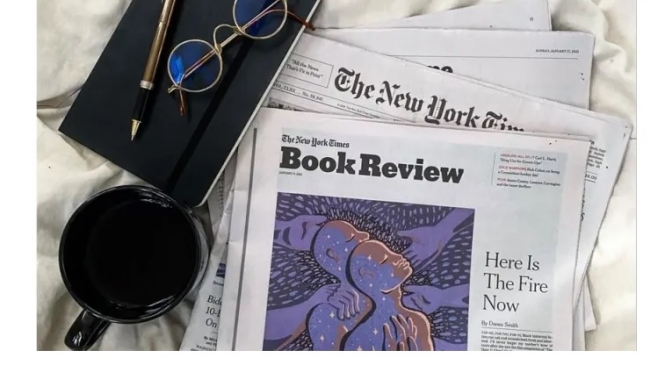
The New York Times Book Review-Sunday May 21, 2023

Illustration by Dakarai Akil

THE NEW YORK TIMES BOOK REVIEW – MAY 21, 2023

In This Satire, Televised Blood Baths Offer Prisoners a Path to Freedom

You can’t applaud Nana Kwame Adjei-Brenyah’s thrilling debut novel, “Chain-Gang All-Stars,” without getting blood on your hands.

The Martian Chronicles

Astronauts simulating a Mars spacewalk. As Matthew Shindell points out, our obsession with the planet is a relatively recent phenomenon.

In Matthew Shindell’s “For the Love of Mars,” perceptions of the planet reflect the changing culture of Earth.

Essential Neil Gaiman and A.I. Book Freakout

From the cult comic book series “The Sandman” to the giddy novel “Good Omens” (co-written with his friend Terry Pratchett) to the horror-tinged children’s story “Coraline” and beyond, the fantasy writer Neil Gaiman is so inventive and so prolific that you’ve probably stumbled across his influential work without even realizing it.

Arts & Culture: The New Criterion — June 2023

The New Criterion – June 2023 issue:

The diversity myth  by Peter Thiel
Emperor of chaos  by Gary Saul Morson
Pfitzner & the conservative artist  by Adam Kirsch
Vermeer in Amsterdam  by Benjamin Riley


New poems  by Dylan Carpenter, Karl Kirchwey & John Barr

The New York Review Of Books — June 8, 2023

Home | The New York Review of Books

The New York Review of Books (June 8, 2023) – Sacagawea after Lewis & Clark, Cryptocurrency reflects a radical marketization of politics, Nicole Flattery’s Factory Girls and more.

The Price of Crypto

A cryptocurrency mine, Gondo, Switzerland

By Trevor Jackson

Despite its boosters’ frequent references to democracy and freedom, cryptocurrency reflects a radical marketization of politics in which major players can rewrite the rules as needed.

The Cryptopians: Idealism, Greed, Lies, and the Making of the First Big Cryptocurrency Craze by Laura Shin

Proof of Stake: The Making of Ethereum and the Philosophy of Blockchains by Vitalik Buterin, edited by Nathan Schneider

None of this had to happen. In the fall of 2008, amid the great shipwreck of the international financial order, an anonymous person or group of persons writing under the name Satoshi Nakamoto proposed a new electronic cash system called Bitcoin. In the “white paper” proposing the system, initially circulated to a cryptography mailing list, Nakamoto claimed that it would “allow online payments to be sent directly from one party to another without going through a financial institution.” 

Ideal Detachments

Kevin Power

Tracing the memories of an employee at Andy Warhol’s Factory, Nicole Flattery’s Nothing Special dramatizes a young woman’s self-scrutiny in an era defined by male looking and listening.

Nothing Special by by Nicole Flattery

Arts/Books: Times Literary Supplement – May 19, 2023

Image

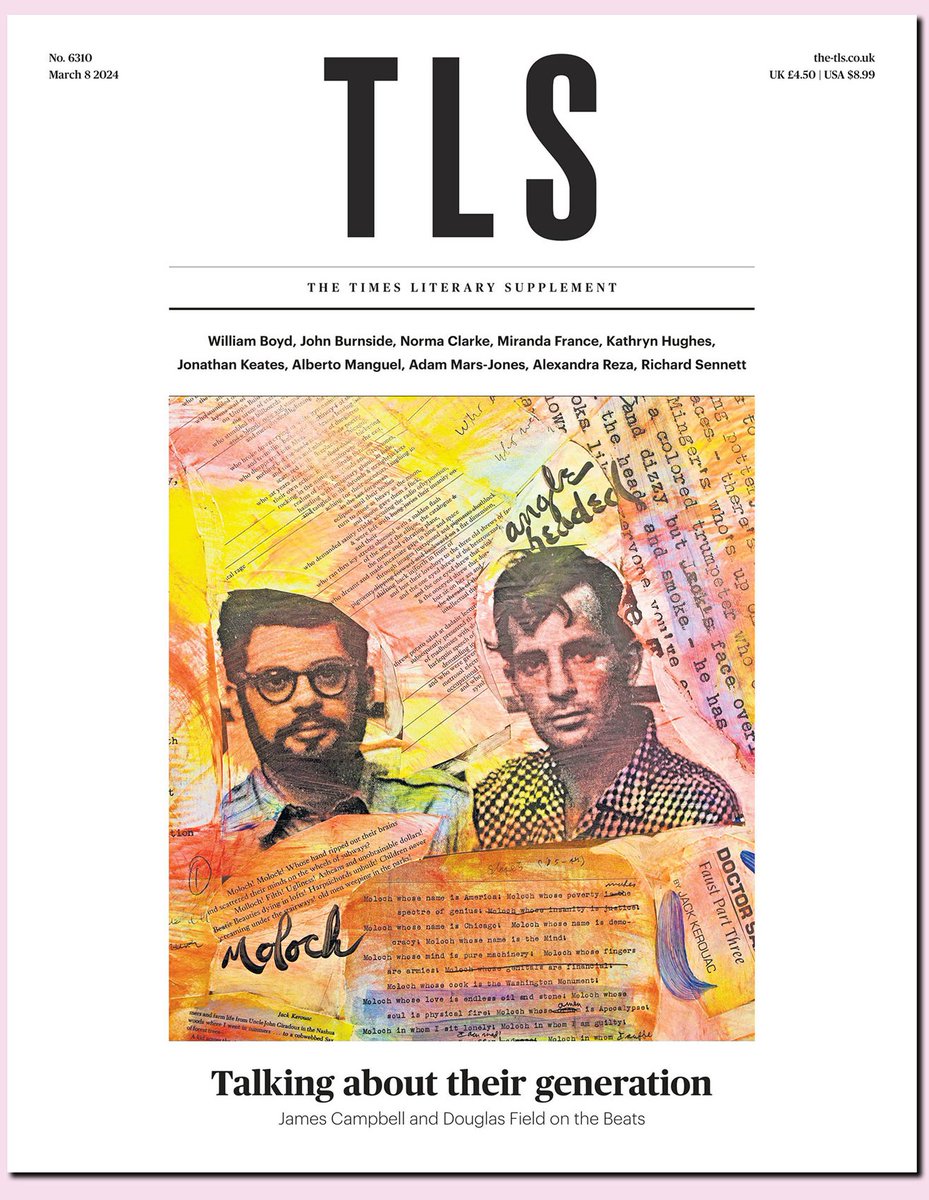
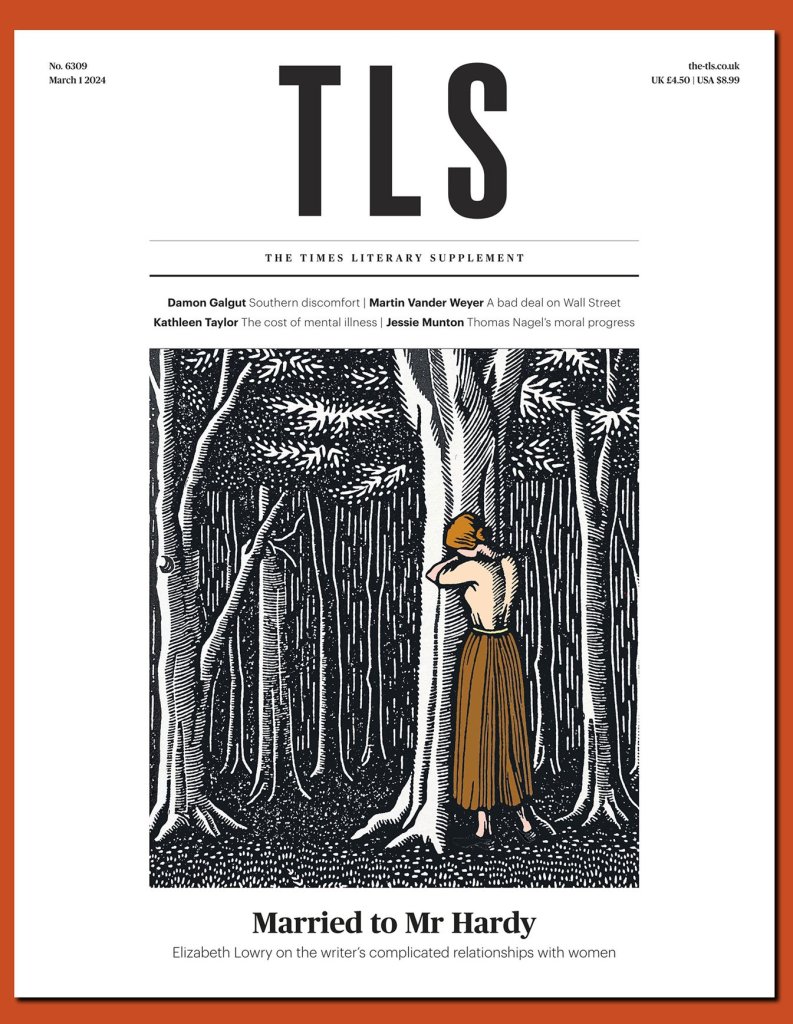
Times Literary Supplement (May 19, 2023) – Portrait of a Marriage: The Mandelas; The Return of Inflation; Doing Justice to John Rawls; The Greatest Italian Novel and Heaney’s translations.

Nature Reviews: Top New Science Books – May 2023

nature Magazine Science Book Reviews – May 15, 2023: Prejudice in technology, and the necessity of time. Andrew Robinson reviews five of the best science picks.

More Than a Glitch

Meredith Broussard – MIT Press (2023)

An artificial-intelligence (AI) ‘glitch’ is a problem neither expected nor consequential. Bias, by contrast, is baked in and disastrous, argues data scientist Meredith Broussard, one of very few Black women in this field, who focuses on AI and journalism. “Tech is racist and sexist and ableist because the world is so,” she says. Vivid examples in her disturbing book include that of a man arrested by US police using facial-recognition technology — purely because both he and the suspect in a blurry surveillance photo were Black.

Assyria

Eckart Frahm – Basic (2023)

The world’s first empire flourished in Assyria in the eighth and seventh centuries bc, and has long been seen as the epitome of barbarism. But, as Assyriologist Eckart Frahm reveals in his deeply informed, challenging history, Assyria produced many features of the modern world. Its innovations included long-distance trade, sophisticated communications networks, mass deportations and widespread political surveillance. Unlike most later empires, he writes, it was at least honest in its “open celebration of plunder, torture, and murder”.

Hands of Time

Rebecca Struthers –  Hodder & Stoughton (2023)

‘Time’ is “the most commonly used noun” in English, according to Rebecca Struthers, the first professional watchmaker in the United Kingdom to earn a PhD in horology. Each chapter of her exquisitely crafted history explores a pivotal moment in watchmaking from the past 500 years. Mechanical timekeepers, she argues, have influenced human culture as much as the printing press. Imagine trying to catch a train by depending on the Sun’s position, or to perform an organ transplant without measuring the patient’s heart rate precisely.

The Deep Ocean

Michael Vecchione et al. Princeton Univ. Press (2023)

“For most people, the deep ocean is out of sight and out of mind,” write three zoologists and an oceanographer. The zone starts where penetration of sunlight can no longer support photosynthesis, about 200 metres down. This guidebook dissipates ignorance with superb colour photographs of astonishing organisms, accompanied by detailed captions and brief essays. For example, the vampire squid (Vampyroteuthis infernalis) is neither vampire nor squid, but was so named because its black ‘cloak’ reminded scientists of Dracula.

Tenacious Beasts

Christopher J. Preston –  MIT Press (2023)

Humans and domestic animals make up 96% of the mass of the world’s mammals. The outlook for wildlife “remains dire”, writes philosopher Christopher Preston. But he describes signs of hope in his well-travelled, thoughtful study of recoveries. Populations of humpback whales in the western Indian Ocean have surged since the mid-twentieth century; those of Californian black bears have quadrupled in a few decades. He visits farmland, prairie, river, forest and ocean, exploring why only certain species are recovering.

The New York Times Book Review-Sunday May 14, 2023

Image

THE NEW YORK TIMES BOOK REVIEW – MAY 14, 2023

Abraham Verghese’s Sweeping New Fable of Family and Medicine

This illustration, in shades of deep green, shows a young woman standing at the edge of a lush landscape with ferns or palm fronds surrounding her and joining above her head.

“The Covenant of Water” follows three generations of a close-knit and haunted family in southwestern India.

Pablo Picasso, the Pariah of Paris

This sepia photograph of a young Picasso shows him standing in front of a run-down Parisian building.

As Annie Cohen-Solal shows in “Picasso the Foreigner,” the Spanish master was always under suspicion in France, simply for being not-French.

By Holland Cotter

Arts/Books: Times Literary Supplement – May 12, 2023

Image

Times Literary Supplement (May 12, 2023) – This week’s @TheTLS, features Peter Thonemann on The Triumph of the West; @joemoransblog on imagination; @michaelscaines on The Motive and the Cue; @DrAliceKelly on graphic novelizations of Gatsby; @helenlpgordon on stones; @rinireg on surveillance – and more.

Preview: London Review Of Books — May 18, 2023

Image

London Review of Books (LRB) – May 18, 2023 issue: The War in Khartoum, Vermeer’s Waywardness, Palestinians in Paraguay and Claire Hall on Anaximander.

Julian Bell at the Rijksmuseum

In London​, I had taken A Young Woman Standing at a Virginal for a dependable rest point on strolls around the National Gallery. In Amsterdam, relocated to join 27 other Vermeers in the Rijksmuseum exhibition, its strangeness re-emerged. This canvas, executed towards the end of Vermeer’s relatively brief career (some four years, perhaps, before he died aged 43 in 1675), commits to a tactic he had earlier only toyed with: to set an internal picture as a wholly self-contained block within his own composition, uninterrupted by foreground forms. 

The New York Times Book Review- Sunday May 7, 2023

THE NEW YORK TIMES BOOK REVIEW – MAY 7, 2023

Face to Face With Culture’s ‘Monsters’

An illustration of a grid of different faces of monsters, with the labels “polymath,” “genius,” “Nobel laureate,” “virtuoso,” “Pulitzer Prize winner,” “artist’s artist,” “best painter ever,” “visionary” and “comedy legend.”

Claire Dederer’s deft and searching book surfaces a “fan’s dilemma” over such figures as Vladimir Nabokov, Woody Allen, Willa Cather and Roman Polanski.


By Alexandra Jacobs

Expanding on a popular essay published in The Paris Review a month after the exposure of Harvey Weinstein’s sexual predation, “Monsters” sustains an essayistic, sometimes aphoristic tone throughout 250-odd pages.

Dark Shadows, Dark Times

Welcome to three novels set in locales where life is exceedingly difficult.

This is an illustration in shades of red, white and blue, of two women pressing their hands against a wall and peering at each other as if through a mirror.

By Alida Becker

AT THE HOUR BETWEEN DOG AND WOLF by Tara Ison

The title comes from a French expression for twilight. Sure enough, her novel sends us to the dusk that borders the familiar and the wild, the known and the unknown. It’s where our beliefs and suspicions can cast dark shadows over our lives. And, of course, the lives of others.

One Man’s Foray Into the Heartland of the Far Right

Alarmed by the country’s political divisions, Jeff Sharlet embarked on an anguished quest to understand the rise of antidemocratic extremism. In “The Undertow,” he documents his findings.

In this color photo, a group of men and women, including a man holding a baby, an older woman in glasses, and Representative Marjorie Taylor Greene, stand alongside what appears to be the wall of a red barn, pledging allegiance to the American flag. Several people in the group hold their right hands over their hearts as they make the pledge.

By Joseph O’Neill

THE UNDERTOW: Scenes From a Slow Civil War, by Jeff Sharlet


The premise of “The Undertow,” Jeff Sharlet’s anguished new book of reportage, is that the United States is “coming apart.” The disintegration is political. It involves the rise of the autocratically inclined Donald Trump; the attempt by members of the Republican Party to overthrow the election of Joe Biden in January 2021; and, during the Biden presidency, the overturning by the Supreme Court of Roe v Wade.

The New York Review Of Books – May 25, 2023

Image

The New York Review of Books – May 25, 2023 issue: Michael Hofmann on Goethe’s last years, Jerome Groopman on the business of biotech, Joan Acocella on Balanchine, Jed S. Rakoff on William O. Douglas’s environmentalism, Adam Hochschild on 1619 and 1776, Willa Glickman on grassroots labor unions, Brenda Wineapple on Susanna Moore, Ian Johnson on art looters, Jenny Uglow on Samuel Pepys and the wreck of the HMS Gloucester, Nicholas Guyatt on financing the Civil War, Elaine Blair on how we talk about sexual assault, poems by Eugene Ostashevsky, D. Nurske, and Ama Codjoe, and much more.

Bewitched by Goethe

In Johann Eckermann, Goethe found an amanuensis made in heaven.

Conversations with Goethe: In the Last Years of His Life by Johann Peter Eckermann, translated from the German by Allan Blunden, with an introduction and notes by Ritchie Robertson

A strange time to publish—strange time to publish anything—a translation of Eckermann’s  Conversations with Goethe (or should that be Goethe’s Conversations with Eckermann?), in six hundred static, major-key pages that can easily feel like twice as many. The big man, himself by now somewhat fallen on hard times, recorded by the little acolyte.

Saving Lives and Making a Killing

A new book reveals the split personality of the biotech industry: an altruistic enterprise that creates breakthrough treatments for patients in need, and a bare-knuckle business that seeks to generate astronomic profits and stop competitors from developing better treatments.

For Blood and Money: Billionaires, Biotech, and the Quest for a Blockbuster Drug by Nathan Vardi

A research scientist for Pharmacyclics working in a lab, Sunnyvale, California

A research scientist for Pharmacyclics, Sunnyvale, California, 2013. In For Blood and Money, Nathan Vardi writes that when Pharmacyclics—which developed ibrutinib, a treatment for chronic lymphocytic leukemia—was bought by the pharmaceutical giant AbbVie in 2015 for $21 billion, ‘the deal…set the new high-water mark for success in the biotechnology industry.’