We Are Free to Change the World: Hannah Arendt’s Lessons in Love and Disobedience By Lyndsey Stonebridge
When Hannah Arendt looked at the man wearing an ill-fitting suit in the bulletproof dock inside a Jerusalem courtroom in 1961, she saw something different from everybody else. The prosecution, writes Lyndsey Stonebridge, ‘saw an ancient crime in modern garb, and portrayed Eichmann as the latest monster in the long history of anti-Semitism who had simply used novel methods to take hatred for Jews to a new level’. Arendt thought otherwise.
Hardy Women: Mother, Sisters, Wives, Muses By Paula Byrne
The title of Paula Byrne’s Hardy Women is a pun on Thomas Hardy’s name and a gesture to the enthusiasm that greeted Hardy’s fictional women. Bathsheba Everdene in Far from the Madding Crowd, Tess Durbeyfield in Tess of the d’Urbervilles and Sue Bridehead in Jude the Obscure were new kinds of women, and Hardy’s fame, which was immense and began with the publication of Far from the Madding Crowd, rested to a large extent on the heroines he created. One young reader wrote to him of Tess, ‘I wonder at your complete understanding of a woman’s soul.’ Hardy’s discontented wife Emma wondered at it too. She observed, ‘He understands only the women he invents – the others not at all.’
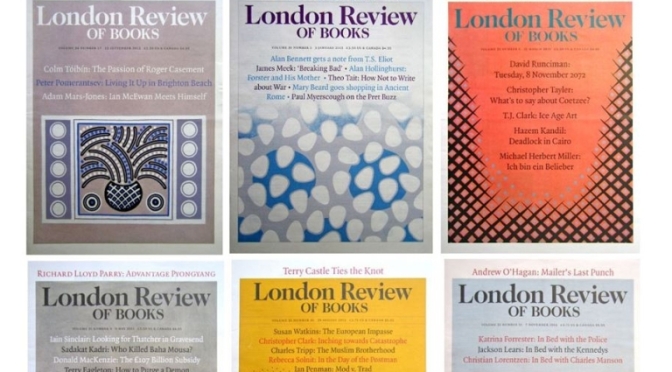
London Review of Books (LRB) – February 1, 2024: The latest issue features Origins of the Gay Novel; Protest, what is it good for?; Poems of Enheduana; Caspar David Friedrich, Israel’s War and more….
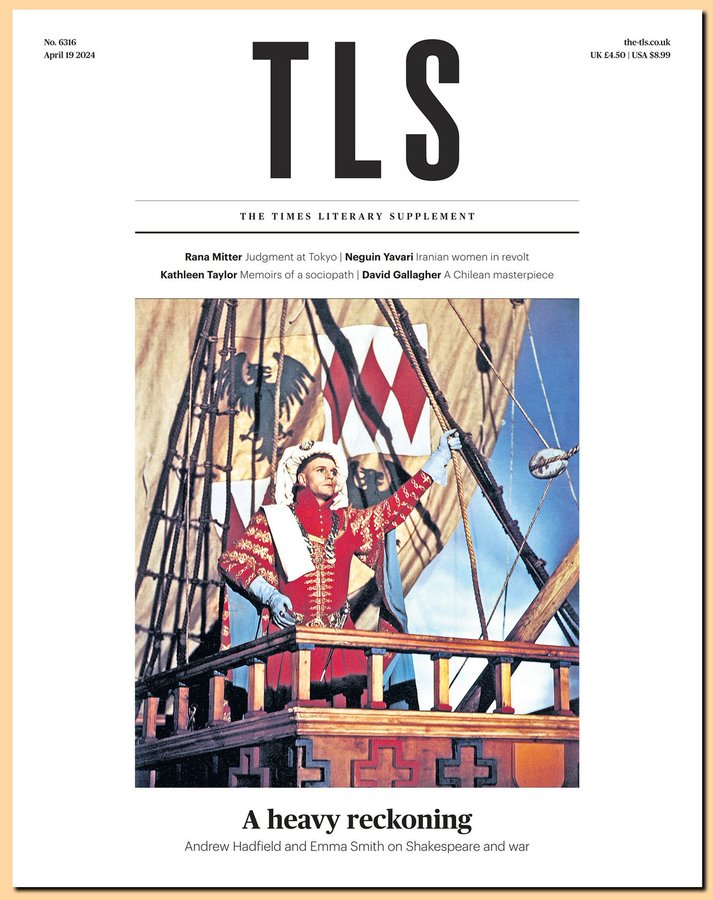
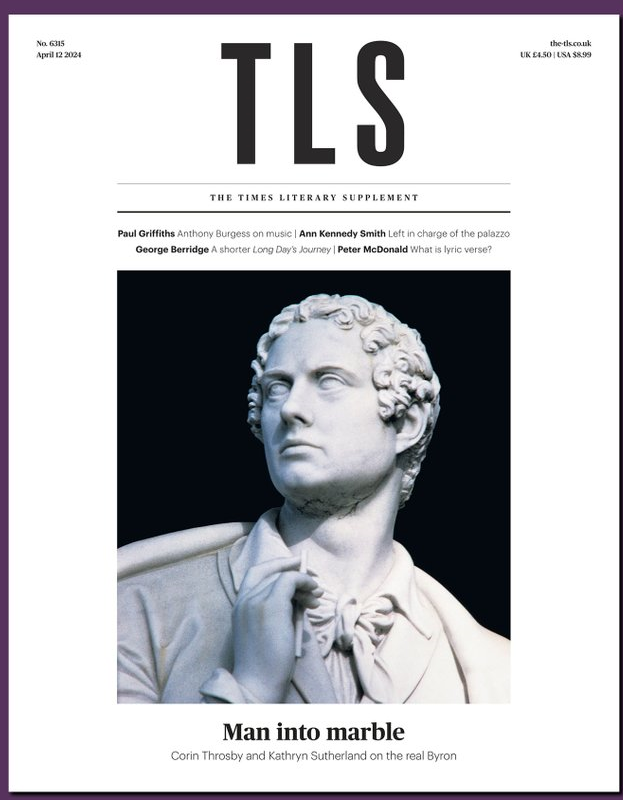
Times Literary Supplement (January 31 2024): The latest issue features ‘Back to Nature’ – The counterculture begins with Thoreau; Enlightenment dimmed; The secret state and the IRA; Homosexuality in early modern Europe and A family haunting….
This week’s @TheTLS, featuring Ritchie Robertson on the end of the Enlightenment; Costica Bradatan on Thoreau; Adam Mars-Jones on All of Us Strangers; @tylercowen on the Clinton years; @georgie_cat_ on Werner Herzog; Sarah Foot on Bede – and more pic.twitter.com/bxcIN8OUFu
Times Literary Supplement (January 24, 2024): The latest issue features ‘The Rich Are Always With Us’ – Ferdinand Mount on taming the plutocrats; Empire’s balance sheet; Who is Charles III?; Silvia Townsend Warner’s revival and ChatGPT goes to college…
THE NEW YORK TIMES BOOK REVIEW (January 19, 2024): The latest issue features the excitement over advance copy reviews of a January novel, Kaveh Akbar’s “Martyr!” …“You’ve got to read this,” one editor said. “One of the most electric novels I’ve read in a long while,” another said. This kind of thing — everyone thrilled by the same book — is unusual at the TBR, and explains why “Martyr!,” about a grieving young man’s search for meaning, graces our cover this week.
In “Martyr!,” the poet Kaveh Akbar turns a grieving young man’s search for meaning into a piercing family saga.
Martyr!, by Kaveh Akbar
Reviewed by By Junot Díaz
Cyrus Shams, the aching protagonist at the heart of Kaveh Akbar’s incandescent first novel, is a veritable Rushdiean multitude: an Iranian-born American, a “bad” immigrant, a recovering addict, a straight-passing queer, an almost-30 poet who rarely writes, an orphan, a runner of open mics, an indefatigable logophile, a fiery wit, a self-pitying malcontent. But above all else Cyrus is sad; profoundly, inconsolably, suicidally sad.
Here are the books discussed in this week’s episode:
“Knife,” by Salman Rushdie
“James,” by Percival Everett
“The Book of Love,” by Kelly Link
“Martyr,” by Kaveh Akbar
“The Demon of Unrest,” by Erik Larson
“The Hunter,” by Tana French
“Wandering Stars,” by Tommy Orange
“Anita de Monte Laughs Last,” by Xochitl Gonzalez
“Splinters,” by Leslie Jamison
“Neighbors and Other Stories,” by Diane Oliver
“Funny Story,” by Emily Henry
“Table for Two,” by Amor Towles
“Grief Is for People,” by Sloane Crosley
“One Way Back: A Memoir,” by Christine Blasey Ford
“The House of Hidden Meanings: A Memoir,” by RuPaul
The importance of Homer by Joshua T. Katz Galaxy brains by Gary Saul Morson The Thames: river of destinies by Jeremy Black “Breakfast Special”: a new story by Woody Allen
New poems by Nicholas Friedman, Jessica Hornik & Michael Spence
Spies: The Epic Intelligence War Between East and West by Calder Walton
Spying Through a Glass Darkly: The Ethics of Espionage and Counter-Intelligence by Cécile Fabre
On October 7, as Hamas fighters roared into southern Israel from Gaza, bringing terror and death to anyone they encountered—Israeli soldiers, Bedouins, young people dancing and getting high together, kibbutzniks scooping up small children into desperate arms—I was sleeping in a comfortable hotel room in Georgia. All around me in the sultry darkness of a beautiful resort, many of the US intelligence community’s finest minds were also slumbering. We awoke with the expectation that we would be addressed by CIA director William Burns at the opening of the Cipher Brief’s annual Threat Conference, a yearly gathering of national security professionals from the private and public sectors, plus a few academics and journalists.
London Review of Books (LRB) – January 17, 2024: The latest issue features ‘Living With Keats’ – A Brief Life in Nine Poems and One Epitaph; Congress vs Harvard; The West’s Fight to Reverse the Russian Revolution, and more…
Looking back to September 1820, when things had gone badly wrong but not yet so grotesquely as to be visibly beyond repair, we can see how few and how poor Keats’s options were. Surely it was better that (in the absence of other volunteers) the young artist Joseph Severn agreed to travel with the dying poet to Rome that autumn than that he had refused.
Times Literary Supplement (January 17, 2024): The latest issue features ‘Power Failure’ – The retreat from net zero; Canon wars; The end of literary criticism; Empires imprint on the Middle East; Harvard and plagarism….