Tag Archives: Antibiotics

Studies: High Usage Of Commonly Used Oral Antibiotics Increases Risk Of Parkinson’s Disease

From a Neuroscience News & Research online article:
International Parkinson and Movement Disorder Society“The link between antibiotic exposure and Parkinson’s disease fits the current view that in a significant proportion of patients the pathology of Parkinson’s may originate in the gut, possibly related to microbial changes, years before the onset of typical Parkinson motor symptoms such as slowness, muscle stiffness and shaking of the extremities. It was known that the bacterial composition of the intestine in Parkinson’s patients is abnormal, but the cause is unclear. Our results suggest that some commonly used antibiotics, which are known to strongly influence the gut microbiota, could be a predisposing factor,” says research team leader, neurologist Filip Scheperjans MD, Ph.D. from the Department of Neurology of Helsinki University Hospital.

Higher exposure to commonly used oral antibiotics is linked to an increased risk of Parkinson’s disease according to a recently published study by researchers from the Helsinki University Hospital, Finland.

The strongest associations were found for broad-spectrum antibiotics and those that act against anaerobic bacteria and fungi. The timing of antibiotic exposure also seemed to matter.

The study suggests that excessive use of certain antibiotics can predispose to Parkinson’s disease with a delay of up to 10 to 15 years. This connection may be explained by their disruptive effects on the gut microbial ecosystem.


To read more: https://www.technologynetworks.com/neuroscience/news/high-antibiotic-use-linked-to-parkinsons-disease-327574?utm_campaign=NEWSLETTER_TN_Breaking%20Science%20News&utm_source=hs_email&utm_medium=email&utm_content=79860634&_hsenc=p2ANqtz–_nnD-InNAm660b4dNIgEv57uzmLlk_LytFh7Scy9VWyekeywrdb7g2Be0Cp5uO7DoNsRuPF76EvY99oZ2rHBR9M1iEw&_hsmi=79860634

Top Science Podcasts: A New Antibiotic From Nematodes, “Grants” Thru Lotteries (Nature)

Nature PodcastBenjamin Thompson brings you the latest science news. This week, an antibiotic that targets difficult to treat bacteria, and a roundup of the latest science news.
In this episode:

00:49 Discovering darobactin

Researchers looked inside nematode guts and have identified a new antibiotic with some useful properties. Research Article: Imai et al.

05:45 Research Highlights

Using urine as a health metric, and sniffing out book decay with an electronic nose. Research Article: Miller et al.Research Article: Veríssimo et al.

07:54 News Chat

Adding an element of chance to grant funding, a continental butterfly-sequencing project, and tracking endangered animals via traces of their DNA. News: Science funders gamble on grant lotteriesNews: Every butterfly in the United States and Canada now has a genome sequenceNews: Rare bird’s detection highlights promise of ‘environmental DNA’

To read more: https://www.nature.com/articles/d41586-019-03588-z

Health Reports: CDC Finds That 35,000 Americans Die Of Antibiotic-Resistant Infections Each Year

CDC Antibiotic Resistance Threats in the United States 2019More than 2.8 million antibiotic-resistant infections occur in the United States each year, and more than 35,000 people die as a result. In addition, nearly 223,900 people in the United States required hospital care for C. difficile and at least 12,800 people died in 2017.

Germs continue to spread and develop new types of resistance, and progress may be undermined by some community-associated infections that are on the rise. More action is needed to address antibiotic resistance. While the development of new treatments is one of these key actions, such investments must be coupled with dedicated efforts toward preventing infections in the first place, slowing the development of resistance through better antibiotic use, and stopping the spread of resistance when it does develop to protect American lives now and in the future.

CDC’s Antibiotic Resistance Threats in the United States, 2019 (2019 AR Threats Report) includes updated national death and infection estimates that underscore the continued threat of antibiotic resistance in the United States. New CDC data show that while the burden of antibiotic-resistance threats in the United States was greater than initially understood, deaths are decreasing since the 2013 report. This suggests that U.S. efforts—preventing infections, stopping spread of bacteria and fungi, and improving use of antibiotics in humans, animals, and the environment—are working, especially in hospitals. Vaccination, where possible, has also shown to be an effective tool of preventing infections, including those that can be resistant, in the community.

To read the report: https://www.cdc.gov/drugresistance/pdf/threats-report/2019-ar-threats-report-508.pdf

Drug Reviews: Top Ten Antiobiotics Used For Patients In Hospital ER’s

From a Becker’s Hospital Review online release:

Ceftriaxone and azithromycin are the top two most commonly administered antibiotics in U.S. emergency rooms for patients who are not admitted to the hospital, according to a study published in the American Journal of Health-System Pharmacy.

American Journal of Health System PharmacyThe top 10 most commonly administered antibiotics in the ER for nonadmitted patients were:
• ceftriaxone: 30.6 percent
• azithromycin: 10.8 percent
• clindamycin: 6.6 percent
• levofloxacin: 5.8 percent
• cephalexin: 5.3 percent
• metronidazole: 4.5 percent
• sulfamethoxazole-trimethoprim: 4.2 percent
• ciprofloxacin: 3.9 percent
• amoxicillin: 3.8 percent
• penicillin: 3.3 percent

The researchers also found that most common emergency room diagnoses were urinary tract infections and cellulitis, and that prescribing practices generally aligned with treatment guidelines for these diagnoses.

To read more: https://www.beckershospitalreview.com/quality/10-most-common-antibiotics-administered-in-the-er.html?oly_enc_id=9129H5611090H0N

Health: Asymptomatic Bacteriuria Diagnosis In Older Patients Should Not Require Antibiotics

From a New York Times online article:

Asymtomatic Bacteriuria DefinitionAt Dr. Soong’s hospital, withholding the results of urine cultures, unless doctors actually called the microbiology lab to request them, reduced prescriptions for asymptomatic bacteriuria to 12 percent from 48 percent of non-catheterized patients, with no loss of safety.

“The extra step of having the clinician call eliminated a lot of frivolous testing,” Dr. Soong said.

In patients who have none of the typical symptoms of a urinary tract infection — no painful or frequent urination, no blood in the urine, no fever or lower abdominal tenderness — lab results detecting bacteria in the urine don’t indicate infection and thus shouldn’t trigger treatment.

Older people, and nursing home residents in particular, often have urinary systems colonized by bacteria; they will have a positive urine test almost every time, but they’re not sick.

To read more: https://www.nytimes.com/2019/10/14/health/urine-tests-elderly.html

Studies: Antibiotics Impair Microbiome Composition, Reducing Flu Immunity

From a Science Magazine online article:

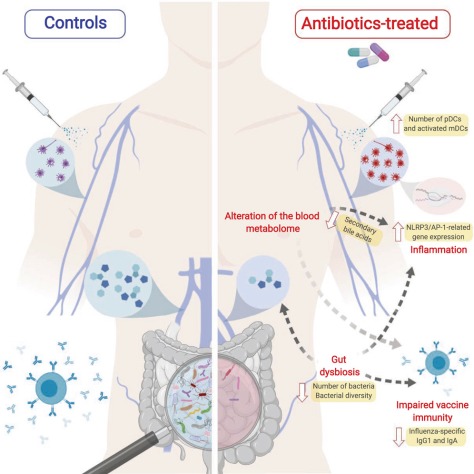
Antibiotic use diminished the gut microbiome composition and impaired the ability of the immune system to generate antibodies. Treatment with antibiotics also disturbed bile acid metabolism and caused inflammatory responses.

From the original findings the Journal “Cell.com”:

Emerging evidence indicates a central role for the microbiome in immunity. However, causal evidence in humans is sparse. Here, we administered broad-spectrum antibiotics to healthy adults prior and subsequent to seasonal influenza vaccination. Despite a 10,000-fold reduction in gut bacterial load and long-lasting diminution in bacterial diversity, antibody responses were not significantly affected. However, in a second trial of subjects with low pre-existing antibody titers, there was significant impairment in H1N1-specific neutralization and binding IgG1 and IgA responses.

Web

In addition, in both studies antibiotics treatment resulted in (1) enhanced inflammatory signatures (including AP-1/NR4A expression), observed previously in the elderly, and increased dendritic cell activation; (2) divergent metabolic trajectories, with a 1,000-fold reduction in serum secondary bile acids, which was highly correlated with AP-1/NR4A signaling and inflammasome activation. Multi-omics integration revealed significant associations between bacterial species and metabolic phenotypes, highlighting a key role for the microbiome in modulating human immunity.