Tag Archives: American Writers

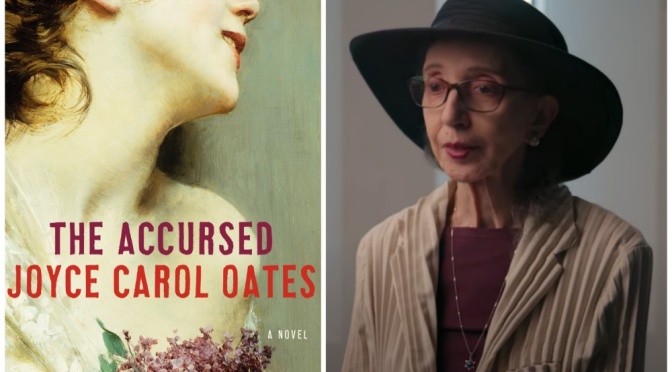
Interviews: Novelist Joyce Carol Oates ‘Storytelling’

Louisiana Channel (January 4, 2024) – When writing, Joyce Carol Oates writes about people, often about a family, because “the family unit to me is like the nexus of all emotion, and people derive their meaning from the position in families,” she says.

Video timeline: 0:00 On preferred subjects for writing 3:20 On Karen Blixen /Isak Dinesen 4:24 On families 6:54 On the mother figure 9:00 On the novel ‘Babysitter’ 17:27 On the novel ‘Night. Sleep. Death. And the Stars’ 22:48 How traveling resembles writing 28:47 On Donald Trump

“What is so exciting about the novel is that it mimics life and that you end up doing something you never thought you would do,” says Joyce Carol Oates, one of America’s greatest living novelists, when looking back on a life of writing.

It might be a violent event or something politically relevant, or it could be a racist experience that sets off a novel. In her storytelling, Oates finds it interesting to focus on girls at the beginning of puberty: “There’s a kind of wonderful neutrality of childhood that gets conditioned out when girls get to be 12 – 14 years old. And then, from that point on, when they’re so shaped by what we call the male gaze and the expectations of others that they grow into being someone who is this female image.”

But today, the family is very different and there are all kinds of families: “There are families of same-sex couples who got married and they may adopt a child or they may have a child of their own, but then there may be families that are like communes where people are living, sharing a house, but they are a family and they may have dogs and cats who know who they are. […] The so-called nuclear family – which is just a father, mother, and children – still exists, of course, but it’s not the only example of any longer, which is wonderful. It all begins with the emancipation of women”, Joyce Carol Oates concludes.

Oates feels attracted to writing because writing is storytelling and “what’s interesting about storytelling is that you have to have revelations. That you start off with a situation, and a little bit of a mystery evolves, and then you have to follow the tendrils and the roots of that mystery, like an investigator. And then there has to be a revelation.” This means that Oates focuses a lot in her writing on the pacing and the suspense and the movement, like “how long is a paragraph, how short is the dialogue, and how much dialogue is there in proportion to the exposition, and the craftsman side of writing is actually where many people write.“
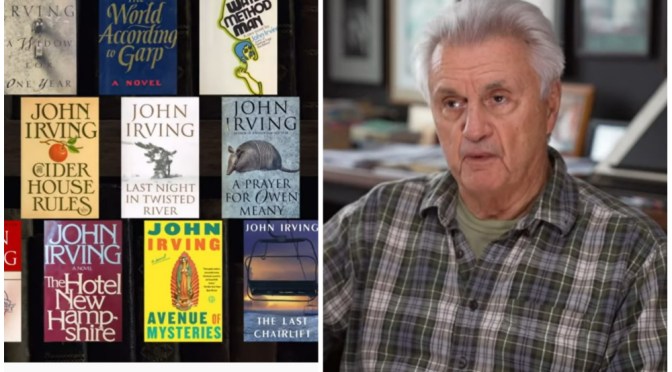
Interviews: Author John Irving – “A Writer’s Life”

CBS Sunday Morning – Author John Irving has mined his personal history and obsessions as the starting point for such acclaimed works of fiction as “The World According to Garp” and “The Cider House Rules.” Now 80, he has published his first novel in seven years, “The Last Chairlift,” a tale of sexual politics and ghosts. He talks with correspondent Rita Braver about inspiration, Charles Dickens, and acceptance.

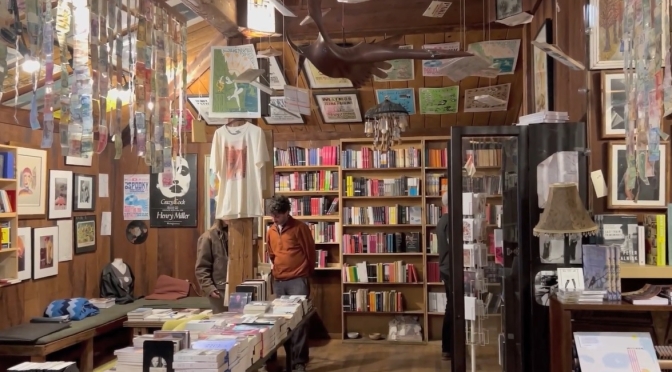
Big Sur Views: The Henry Miller Memorial Library

The Henry Miller Memorial Library is a nonprofit arts center, bookstore, and performance venue in Big Sur, California, documenting the life of the late writer, artist, and Henry Miller. Emil White built the house for Miller in the mid-1960s.

Henry Valentine Miller was an American novelist. He broke with existing literary forms and developed a new type of semi-autobiographical novel that blended character study, social criticism, philosophical reflection, stream of consciousness, explicit language, sex, surrealist free association, and mysticism.

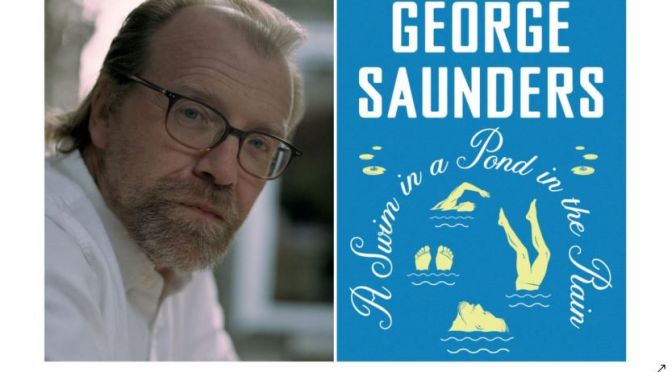
Interviews: Writer George Saunders – A Swim In A Pond In The Rain (Podcast)

On a special LARB Book Club episode of the Radio Hour, Boris Dralyuk and Medaya Ocher are joined by George Saunders, author of four collections of virtuosic short stories and of the novel Lincoln in the Bardo, which won the 2017 Man Booker Prize. 

His latest work is A Swim in a Pond in the Rain: In Which Four Russians Give a Master Class on Writing, Reading, and Life. Examining individual works by Leo Tolstoy, Anton Chekhov, Ivan Turgenev, and Nikolai Gogol from a variety of angles, Saunders teases out lessons for writers and readers alike. During the conversation, he discusses what fiction can teach us about ourselves and each other, shares his experiences teaching these stories over the past two decades, and reflects on the role of humor in his work.

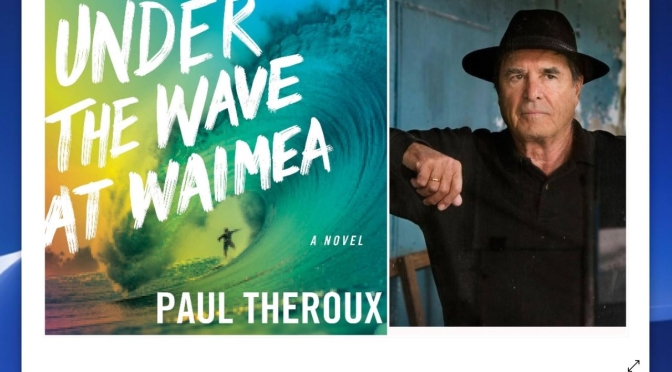
Interview: Writer Paul Theroux – ‘Under The Wave At Waimea’ (Podcast)

What can a travel writer learn from staying at home? Anne McElvoy asks the prolific travel author Paul Theroux about the virtues of being homebound during the pandemic. 

The author of “Under the Wave at Waimea” reveals that his friend and one-time foe V.S. Naipaul inspired a character in his new book about big-wave surfing in Hawaii. Also, verbal fencing with his sons Louis and Marcel and his ultimate travel destination.

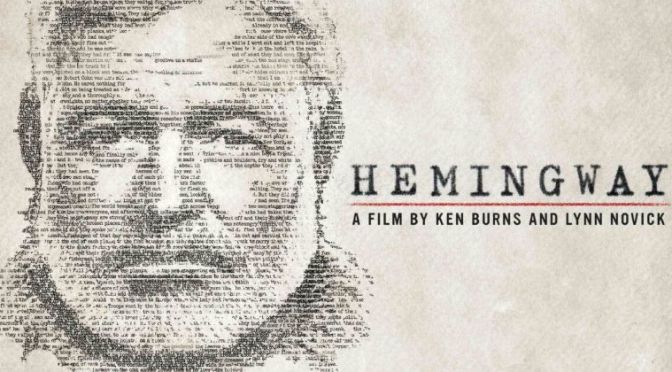
Documentaries: Behind The Scenes Of ‘Hemingway’

Ken Burns, Lynn Novick and Sarah Botstein give us a behind-the-scenes look at the production of Hemingway. We explore where Ernest Hemingway lived and traveled as the team visits his home in Cuba, learn about his writing process through manuscripts housed at the JFK Library, and the impact of fame on his art. Hemingway from Ken Burns and Lynn Novick premieres April 5, 2021 on PBS.

Video Trailer: ‘Exploring Hemingway’ – A Film By Ken Burns & Lynn Novick (PBS)

Get an inside look at Hemingway and discover why Ken Burns and Lynn Novick chose to explore the complex and iconic writer. Hemingway premieres April 5, 2021 on PBS.

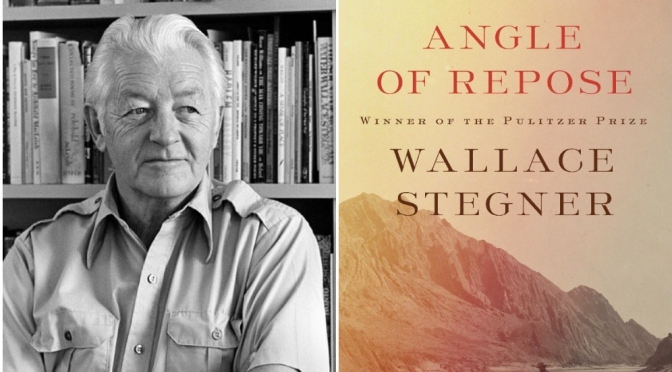
Podcast Essays: American Western Writer Wallace Stegner (1909-1993) By NY Times Critic A.O. Scott

Scott discusses his first in a series of essays about American writers, Wallace Stegner, and David Kamp talks about “Sunny Days: The Children’s Television Revolution That Changed America.”

Wallace Earle Stegner (February 18, 1909 – April 13, 1993) was an American novelist,  short story writer, environmentalist,  and historian, often called “The Dean of Western Writers”. He won the Pulitzer Prize in 1972 and the U.S. National Book Award in 1977.