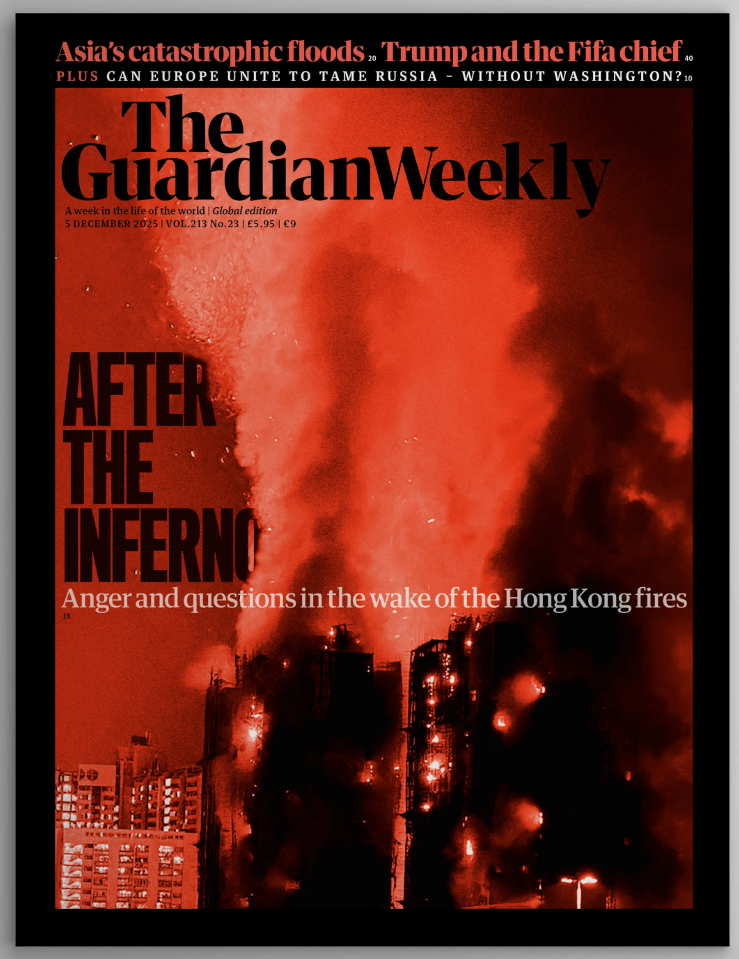
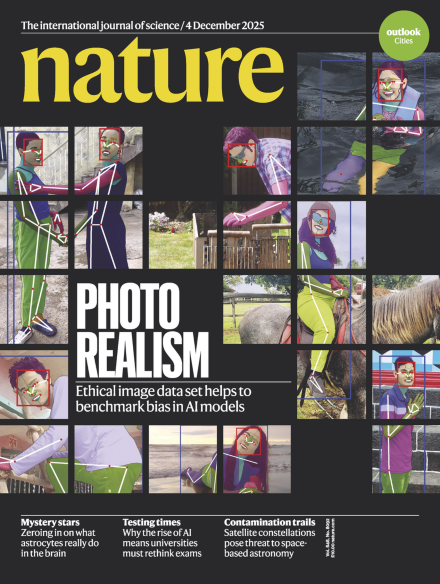
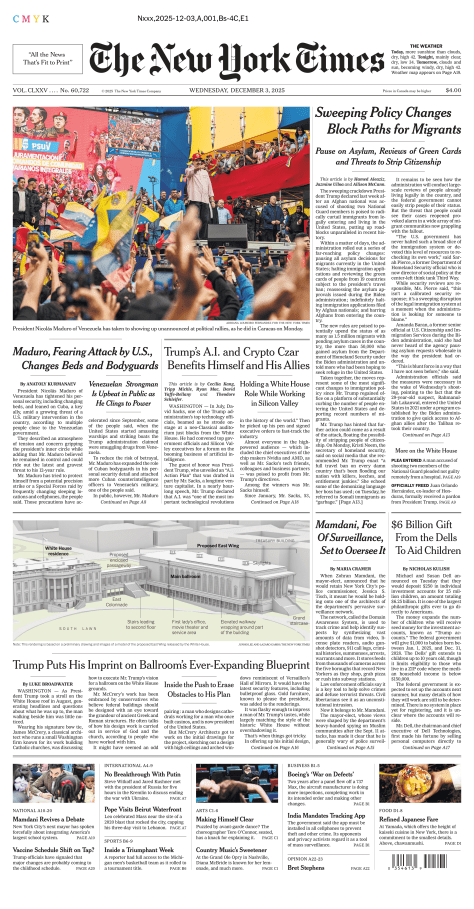
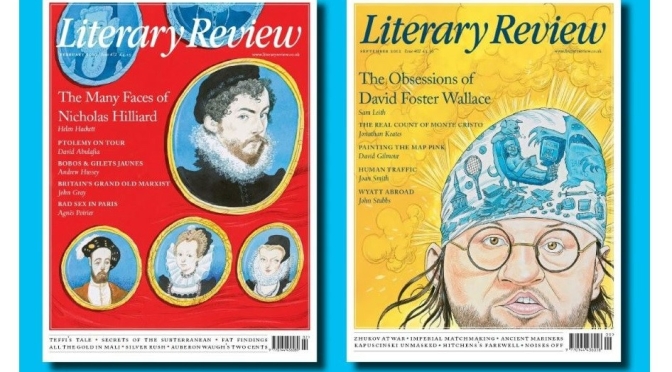
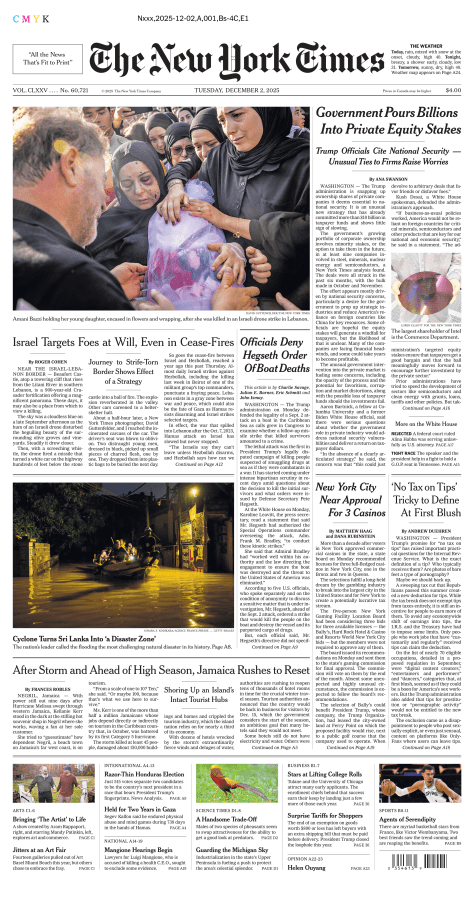
THE NEW YORK TIMES – THURSDAY, SEPT. 25, 2025

A Diminished Social Security Work Force, and Its Customers, Feel the Strain

After this year’s staffing cuts, some people wait for hours, while others sail through. But overburdened field office workers carry the weight.

With His Pivot on Ukraine, Trump May Be Washing His Hands of the War

President Trump has shown dwindling interest in mediating a peace accord, joining European “security guarantees” for Ukraine or providing aid and intelligence.

For Trump, Data Is Often ‘Phony,’ Unless It Supports His Views

The president has ping-ponged between boasts about jobs and crime and attacks on their data sources. Here’s how he is threatening trust in public data.

After Dallas Shooting, a Rush to Score Political Points Before the Facts Are In

The deadly attack at an ICE facility prompted a high-profile clash between Vice President JD Vance and Jon Favreau, a progressive podcast host.

SILENCE AFTER THE BELL

Bashō’s narrow road, re-imagined in ink and light

By Michael Cummins, Editor, September 24, 2025

In the spring of 1689, Matsuo Bashō set out from Edo with his inkstone and his disciple, walking north through Japan’s interior. This essay imagines the painter Ogata Kōrin at his side, brush catching what haiku left unsaid: the lantern’s glow, a fox’s mischief, the silence after sound.

The morning I left Edo, the sky was thick with petals. Cherry blossoms fell in sudden gusts, scattering across canals and clinging to the backs of merchants. Someone in the crowd said my name. “Bashō—the man of stillness.” The words felt like a shroud. Stillness was not peace. Stillness was suffocation.

I carried only a robe, a small pack, and my inkstone. I gave no notice, offered no farewell. A poet should know the difference between an entrance and an exit, and Edo was drowning in entrances—recitations in smoky salons, verses pinned to pillars, applause echoing in courtyards. To slip away silently was my only true poem.

Sora, my disciple, waited by the gate, his journal tied at his side. Beside him stood Ogata Kōrin, carrying brushes wrapped in cloth, a small box of pigments, and sheets of fine paper. He was famed for painting bold pines and cranes against gold, but he wanted to walk with us, to see if paint could keep pace with words.

“You walk for silence,” he said as we stepped into the road.

“And you?” I asked.

“I will paint the sound.”


A crow on a bare branch—
autumn evening.

Walking unstitched illusions. You cannot hurry rain. You cannot plead with a mountain. Each step was a reminder of smallness.

Oku—the interior—was more than geography. It was the hidden chamber within things. To walk north into deep country was to step into the interior of myself.

The road gave humility: a thin robe against spring wind, an empty belly by sundown, blistered feet in straw sandals. Hunger was not a lack but a space for the world to fill. Only when stripped of comfort could I hear the world breathe.


By the second month, rains thickened. Each evening Sora dried our sandals by the inn’s hearth, though by morning they were heavy again.

At a mountain temple, a monk struck the great bell. The sound swelled, then emptied into air.

“Not the ringing,” he whispered, “the silence after—that is the true temple.”

Kōrin ground his ink and left behind a circle fading into white paper. I looked at it and felt the hush expand. His first gift of the journey.

Pine shadow—
the road bends
to meet it.


Summer pressed down like a hand. Cicadas shrieked in the trees, their chorus burning itself away. At a roadside inn, a farmer’s wife handed me a bowl of barley and salt.

“Why walk in this heat?” she asked.

“To see what words cannot hold,” I said. She laughed, shaking her head.

That night, I listened to the cicadas outside the window. Kōrin painted their wings in silver strokes. Sora struggled to describe them, blotting his brush, sighing. Not every moment can be pinned to the page.

One afternoon, a girl chased dragonflies, sleeves spread like wings. She caught none, but her laughter rang sharper than capture. Kōrin caught her mid-flight in vermilion. He pressed the paper into Sora’s hands. “If you cannot hold it with words,” he said, “let color remind you.”


We reached Matsushima, where pine-covered islets scattered like jewels across the bay. Some places do not need words. Kōrin’s blues and greens glowed even at dusk.

That night, fireflies pressed against the paper walls of our hut, their glow brighter than the lamp. I set down my brush. Some nights call for silence more than lines.

Later, in a fishing village, I collapsed with fever. A fisherman’s wife placed cloths on my brow and whispered prayers to the sea.

When I woke, Kōrin held out a small painting of a lantern’s glow against dark waves. The flame was steadier than I had felt in days.

Lantern flickers—
the sea’s hush louder
than my pulse.


By August, the barley fields had turned gold. The harvest moon rose red above the stubble. Villagers poured sake and sang. A boy ran over with a cup. “Drink, master!”

“The moon is already enough,” I said.

Snow still lingered in the high passes. The mountain does not flatter. It does not care if a man is poet or beggar. It accepts only attention.

Winter gust—
even the inkstone
holds the wind.


Crossing a frozen river, I slipped. A peasant caught my arm. “Careful, master. The ice breaks without warning.”

“So does the self,” I said.

Even in silence, the self lingered like a shadow. I imagined my words drifting northward, reaching readers yet unborn. But the further I walked, the thinner that dream became. What immortality is there in syllables, when rivers change their course and mountains crumble?

In Edo, applause had filled the air like thunder. On the road, there was only silence. Silence wounds, but it also heals.

The answer came not in thunder but in a sparrow’s wing. Write not to endure, but to attend. Not for tomorrow, but for now.


Near a riverbank, a boy approached with a scroll of verses. “Master, how do I make my poems last?”

“Write what you see,” I said. “Then write what you feel when you see it. Then tear it up and walk.”

The boy bowed. Kōrin added, softly: “Or paint the emptiness left behind.”

River mist—
the boy’s scroll
left unopened.


In the mountains I met a man from the north whose dialect I could not follow. He pointed to the sky, then to the river, then to his chest. We shared tea in silence. I realized then that language is not the vessel, but the gesture. Poetry lives in the space between.

One morning, I watched a fox dart through a field, a rice ball clutched in its mouth. The farmer cursed, but I laughed. Even hunger has mischief. Kōrin’s brush caught the moment in quick ink.

Fox in the field—
the rice ball warmer
than the sun.


Toward the end of our walk, Sora counted the ri that remained. “Two thousand and more behind us,” he said. His journal pages were full of weather, distances, small observations.

“I counted shadows,” I told him. “I counted pauses.”

Kōrin smiled. “I painted both.”

At last, beneath a cedar, I placed the inkstone on my lap and listened. Snow weighed heavy on the branches. The air was sharp with winter. The wind moved through ridges and needles and into the hollow of the stone. For a moment it seemed the ink itself stirred.

I wrote one last haiku, not as conclusion but as surrender. The road has no end. Only pauses where breath gathers.

Wind in the cedar—
the inkstone deepens
into silence.


When these fragments later formed Oku no Hosomichi, I wondered what I had left behind. Not a record of steps, but a trace of listening. The form belonged not to me but to the rhythm of walking.

Kōrin returned to Edo with his scrolls. I with my scattered lines. Yet three small works stayed with me: the fading bell, the glowing lantern, the fox with his rice ball. They were his haiku in color, brief offerings to impermanence.

If others take their own narrow roads, let them not follow our footsteps but their own shadows. The road is never the same twice. Neither traveler nor mountain remains unchanged.

Perhaps one day, a traveler will walk with a pen of light, or a scroll made of glass. They will pause beneath a cedar, not knowing my name, not knowing Kōrin’s brush, but feeling the same hush. The road will whisper to them, as it did to us. And they will listen—not to the words, nor the colors, but to the breath between.

Digital ink—
the silence still.

THIS ESSAY WAS WRITTEN AND EDITED UTILIZING AI

COUNTRY LIFE MAGAZINE – SEPTEMBER 24, 2025

Cover of Country Life 24 September 2025

COUNTRY LIFE MAGAZINE: The latest issue features St Michael’s Mount at low tide.

The roads less travelled

Now you see them, now you don’t: Roger Morgan-Grenville treads the ephemeral sea paths of Britain, those often-ancient routes at the mercy of the tides

Spreads from Life Country Life 24 September 2025

A stitch in time

Deborah Nicholls-Lee unearths Mr Darcy’s shirt, Bertie Wooster’s dressing gown and Poldark’s tricorn hat in a fascinating trawl through the Cosprop wardrobes

Property market

A quartet of significant West Country houses is seeking buyers, reports Penny Churchill

Properties of the week

A Devon longhouse, Cornwall cottage and Somerset thatch catch Arabella Youens’s eye

Spreads from Life Country Life 24 September 2025

When your art is in the right place

To whom do the experts turn for the best in framing, restoring and valuing? Leading art and antique dealers open their little black books for Amelia Thorpe

Leslie MacLeod Miller’s favourite painting

The impresario picks a portrait of a 19th-century singing sensation

Country-house treasures

The fortunes of a Cumbrian castle rest with the ‘Luck of Muncaster’, finds John Goodall

A Regency prospect

Steven Brindle looks at the remarkable story behind a fine Georgian creation — Samuel Wyatt’s Belmont House in Kent

Spreads from Life Country Life 24 September 2025

The legacy

Emma Hughes toasts the genius of Dennis Potter, the man who gave us the darkly comic and gritty Singing Detective

Beginning to see the light

John Lewis-Stempel and his dogs are up with the skylark to witness the dawning of a spectacular September day

Luxury

Amie Elizabeth White on tartan, tweed, timepieces and fruity jewels, plus a few of Victoria Pendleton’s favourite things

Interiors

Amelia Thorpe admires the makeover of a guest bedroom at a Scottish country house and picks the best bedside tables

Spreads from Life Country Life 24 September 2025

Plum advice

Charles Quest-Ritson shares his favourite forms of plum, gage, mirabelle and damson from the 20-plus varieties he has grown

Slightly foxed

Second-hand bookshops can be a goldmine of gardening wisdom, says John Hoyland

Scale model

David Profumo is transported back to childhood by the spiny, swashbuckling stickleback

Travel

Mark Hedges takes a break from reality on Bryher, a heather-clad haven in the Isles of Scilly

Arts & antiques

Art dealer John Martin tells Carla Passino why he can never part with a panel he stumbled upon by Nigerian sculptor Asiru Olatunde

THE NEW YORK TIMES – WEDNESDAY, SEPT. 24, 2025

Jimmy Kimmel, Somber but Defiant, Defends Free Speech in Return to ABC

The late-night star said he had not intended to make light of Charlie Kirk’s murder, but he also called President Trump’s threats against ABC “anti-American.”

Trump’s F.C.C. Chair Plans to Keep Going After the Media

While “Jimmy Kimmel Live!” returned to ABC, Brendan Carr has promised to continue his campaign against what he sees as liberal bias in broadcasts.

Zelensky Issues Call to Arms After Trump Signals Shift on War in Ukraine

President Volodymyr Zelensky criticized Russian attacks and appealed for more military aid in his address to the annual U.N. meeting.

Ukrainians Are Grateful but Skeptical After Trump’s Turnabout on the War

At Least One Dead and Two Wounded in Dallas ICE Facility Shooting

Federal authorities said detainees were among the victims and no federal agents had been shot. Investigators were still trying to determine a motive.

THE NEW YORK TIMES – TUESDAY, SEPT. 23, 2025

I Hate My Opponent’: Trump’s Remarks at Kirk Memorial Distill His Politics

President Trump has been fueled by grievance and animosity over the course of his political and public life.

Defense Department Delays Cleanup of ‘Forever Chemicals’ Nationwide

The new timeline could slow cleanup in some communities by nearly a decade. The chemicals, widely used in the military, are linked to cancers and other health risks.

Jihadist, Rebel, Statesman: The Many Faces of Syria’s Leader

President Ahmed al-Shara of Syria shifted shapes many times during his rise to power. This week he is expected to speak at the U.N.

Trump to Address U.N. as He Jettisons Aid and Recasts U.S. Role

President Trump plans to address the U.N. General Assembly at a moment when he is increasingly isolated in his approach to crises around the world.

Reason Magazine – November 2025 Preview

Magazine - Reason.com

REASON MAGAZINE: The latest issue features ‘Culture War Police State’

Culture War Police State

From library books to abortion, gender, and even food, the culture war is now feeding the police state.

‘Botched’ Drug Raids Show How Prohibition Invites Senseless Violence

The war on drugs authorizes police conduct that otherwise would be readily recognized as criminal.

How Civilizations Lose Their Spark—and How We Might Keep Ours

Golden ages teach us a lot about what makes civilizations rise and fall.

Trump’s War on Chocolate: ‘There’s No Way for Us To Source This Domestically’

American chocolatiers need imports, and tariffs help no one.

THE NEW YORK TIMES – MONDAY, SEPT. 22, 2025

Europe Talks Big on Gaza but Struggles to Act

Even as criticism of Israel ramps up and a growing number of countries say they’ll recognize a Palestinian state, concrete actions remain limited.

For Arab Nations With Ties to Israel, Attacks Raise Anxiety

The Middle Eastern states closest to Israel see the attack on Hamas in Qatar and the invasion of Gaza City as signs of potential threats to their own security.

Trump Remembers Kirk as a Martyr While Attacking Political Opponents

President Trump oscillated between honoring Charlie Kirk’s life and attacking his opponents, saying he hated them and they “cheated like dogs.”

Trump Appointees Roll Back Enforcement of Fair Housing Laws

Interviews and internal documents show that signature civil rights protections in housing are being dismissed as ideologically driven and D.E.I. in disguise.

8 min read

ODYSSEUS IN THE ALPS

When Nietzsche returns to Sils Maria with each new translation of Homer, eternal recurrence becomes a matter of footnotes, scars, and disguise.

By Michael Cummins, Editor, September 18, 2025

It begins with a joke that insists on being taken seriously: that Friedrich Nietzsche shows up in Sils Maria whenever another translation of The Odyssey arrives, like a critic doomed to review the same book forever. He doesn’t need them, of course—he could spar with Homer in the original Greek long before most of us had mastered the alphabet. But each new version lures him back to the lake, as though Odysseus himself had slipped ashore in yet another borrowed tongue. Translation is just another disguise; recurrence, another mask. Nietzsche, who built his philosophy on both, seems condemned—or seduced—to reread the wanderer endlessly, as if the Engadin Alps demanded it as tribute.

He had come back to the lake, the same one that had once whispered eternity into his ear. Nietzsche sat by the water at Sils Maria, Mendelsohn’s new translation of The Odyssey spread across his knees, the pages bright in the alpine sun. He read not out of admiration, but suspicion. His own idea—eternal recurrence—had haunted him for years. He wondered now, with the weight of illness and solitude pressing harder than ever, whether recurrence was survivable. Odysseus would be his test.

From the first line, the Muse seemed to speak directly into the thin Engadin air: “Tell me, Muse, of the man of many turns…” Nietzsche felt the word polytropos twist through him—not merely “wily,” but turned and turning, fragmented, caught in endless motion. Was recurrence not the same: the self turning upon itself until it fractured into multiplicity? He traced the letters with a frail finger, the ink seeming to pulse with a life of its own. This wasn’t just a poem; it was a mirror held up to his deepest philosophical anxieties. To be polytropos was to be a kaleidoscope of selves, a truth Nietzsche had long espoused but now felt not as liberation but as dizziness. What if the self, in its endless turning, simply wore away?

The air was high and crystalline, but his body was not. Migraines came like daggers, sudden and merciless, blinding him to light. His stomach soured; food betrayed him. He walked hunched, exhausted, restless. He had broken with Wagner, grown estranged from academia, wandered from city to city like a ghost of his own philosophy. At Sils Maria he wrote not to clarify but to survive. The mountains had become his Ithaca—severe, withholding, demanding. Unlike Ithaca, they offered no promise of rest at the end of wandering. They were recurrence itself, permanent and pitiless.

He had paced these paths before. In 1881, by a great stone shaped like a pyramid at the lake’s edge, he had first conceived the thought of eternal recurrence: that every moment must be lived again, endlessly, without remainder. The revelation had come not as a triumph but as a chill—something he later called “the most abysmal thought.” Even now, the air smelled of resin and cold stone, the scent of pine needles bruised underfoot. The wind moved through the valley like a slow instrument, its tones alternating between whisper and moan. Here, philosophy never separated from sensation; thought rose and fell with the mountain’s breath.

The lake shimmered, but not as a mirror. It was a mirror that refused to reflect, a surface that yielded nothing but depth. Nietzsche had always felt the valley was Ithaca’s double—clarity above, abyss below. To return here was to return to a place that was never the same twice, a home that asked if one could ever come home at all. Odysseus too had seen the multiplicity of the world: “He saw the cities of many men, and learned their minds.” What better philosopher could Nietzsche imagine than this wanderer who turned from city to city, discovering that no truth was singular?

But even heroes were not guaranteed their ends. Athena’s warning in Mendelsohn’s cadence hung in the alpine stillness: “Even now, your homecoming is not assured.” The words might have been addressed to Nietzsche himself, a man without a home in Basel, Turin, or Leipzig, wandering in body and in thought. What was eternal recurrence, after all, if not the refusal of safe arrival, the demand that the journey itself be endlessly relived? It was a homecoming that never concluded, an arrival that dissolved into another departure.

He turned another page. The man of cunning sat by the sea and broke down: “Odysseus wept, hiding his face in his cloak, ashamed to be seen crying.” Nietzsche lingered here. He knew the shame of breakdowns, the humiliation of migraines that felled him for days, the solitude that left him in tears. Here was a hero who did not embody Apollonian restraint but Dionysian excess—grief that refused the mask of virtue. This was not the strong, stoic figure of schoolroom myth, but a man undone by the weight of his suffering, a man who had faced monsters and gods only to be brought low by simple grief. Nietzsche saw himself in that cloak.

And then another voice, colder: “The gods have long since turned their faces away.” The line struck like an echo of Nietzsche’s own pronouncement that God was dead, that divinity had withdrawn, leaving only men to endure. Odysseus, abandoned, becomes the emblem of modern man—staggering forward in a world emptied of divine assurance. In this vacuum, there was no plan, no destiny, only the sheer will to survive. Nietzsche, who once joked that his only companions were his books and his headaches, could hardly disagree.

Yet how different this Odysseus was from the ones Nietzsche had met in other tongues. Fagles gave us a noble Odysseus, his voice rich and grand, swelling with dignity. Fitzgerald offered a modernist one, lean and sharp, almost severe. Wilson gave us an Odysseus brisk and lucid, her lines crisp as salt air. But Mendelsohn’s Odysseus was something else—fractured, recursive, morally ambiguous—a man who could have walked beside Zarathustra and argued in riddles. Even the openings diverged: Fagles gave us “the man of twists and turns,” Fitzgerald “the man skilled in all ways of contending,” Wilson “the complicated man.” Mendelsohn’s “many-turned” suggested not mastery but fracture—caught in perpetual reconfiguration. Nietzsche raised an eyebrow at this crowded gallery of Odysseuses, as if wondering whether Homer himself would recognize any of them.

Nietzsche’s fingers tightened on the book. Telemachus’s words surfaced next: “He spoke not as a king, but as a man who had suffered.” This was the recognition—father to son, philosopher to survivor. Not majesty, not nobility, but suffering itself as the currency of truth. Was this not Nietzsche’s fate, to speak no longer as professor or system-builder, but as a man undone, scarred by solitude? His philosophy was not a polished edifice but aphorisms wrested from pain. It was a philosophy of the wound.

A hawk circled above, its shadow sliding across the lake. The thought of inheritance pressed on him, the futility of lineage. Homer’s line followed, with its brutal candor: “Few sons are the equals of their fathers; most fall short, all too few surpass them.” Nietzsche could not escape the question of whether he had surpassed his own philosophical fathers—Schopenhauer, Wagner, Plato—or whether he had only fallen short, a son estranged from every lineage. Surpassing required rupture, a violent break. He had done this, but at what cost? He was a son without a father, a successor without inheritance.

Mendelsohn’s commentary pierced further: “But which is the true self? the Odyssey asks, and how many selves might a man have?” Nietzsche closed his eyes. He had written that truth is a mobile army of metaphors, that the self is nothing but a mask. But Homer had already staged the question: Odysseus, beggar and king, father and liar, scarred and disguised, endlessly polytropic. To be true, one must be many. The self was not a solid, unchanging thing, but a performance. The mask was the face. Nietzsche, who often signed his letters “Dionysus” or “the Crucified” depending on his mood, could hardly deny it.

A breeze lifted the page, and another voice arrived, softer, almost contemporary: “We all need narrative to make sense of the world.” Nietzsche scoffed, then paused. He had rejected metaphysics, rejected God, rejected morality—but had he not always returned to story? Zarathustra was not an argument but a parable. Perhaps Odysseus’s voyage was not philosophy’s rival but its secret ally: narrative as the vessel of truth. Even he, the self-proclaimed destroyer of systems, had relied on fables to smuggle his most dangerous ideas into the world.

He came at last to the moment of recognition: “He knew the scar, though the rest had changed.” The line startled him. Eurycleia’s recognition of Odysseus was not by face, but by wound. Memory was not intellectual—it was embodied, etched in pain. Could eternal recurrence itself be recognized in the same way? Not by sameness, but by scars carried forward?

Here Nietzsche faltered. In The Gay Science, he had asked whether one could will the same life again and again. In Ecce Homo, he claimed to embrace his fate—amor fati. But Mendelsohn’s Odysseus offered no affirmation, only ambiguity. He returns, yes—but as a stranger, a beggar, a killer. Recurrence here is not comfort. It is metamorphosis: arriving at the same place with a different soul.

He closed his eyes and imagined a dialogue across time.

“Tell me, cunning man,” he asked, “what does it mean to return?”

Odysseus did not answer. He lifted his tunic and showed the scar on his thigh. Nietzsche pressed.

“You endure, but to what end?”

At last Odysseus spoke, his voice neither triumphant nor despairing. “To return is to wear the same name with a different soul.”

Nietzsche hesitated. “You speak of endurance. But what of joy?”

Odysseus’s gaze was steady. “Joy is not what brings you back. It is what allows you to remain, even when you no longer know who you are.”

Nietzsche’s voice broke. “I have dreamed recurrence. I have feared it.”

“Then you are not yet home.”

“And you?” Nietzsche asked.

“I returned,” Odysseus said. “But I did not arrive.”

Nietzsche waited, but Odysseus spoke again, almost like a riddle: “Every disguise is also a truth. Every mask you wear wears you in return.”

The silence thickened. The mountain stood like a question, the lake like an answer withheld. The survivor explained nothing. He endured.

It would have been enough, this single reading at the lake. But recurrence demands more. Nietzsche returns again and again, each time when Homer is born anew in a different tongue. He returns to Sils Maria, the pyramid-shaped stone waiting, the lake unaltered, the text altered.

In 1781, Johann Heinrich Voss gave Germany its definitive Homer. A century later, Nietzsche, young philologist turned philosopher, read Voss with admiration and disdain. He respected the fidelity, the hexameters hammered out in German. But he muttered that Voss’s Homer was too polished, too Apollonian—Homer in a Sunday coat. Nietzsche’s Homer was wilder, bloodier, Dionysian.

In 1900, Samuel Butler gave the world a Victorian prose Odyssey, rational, stripped of song. Nietzsche returned that year in ghostly form, reading Butler on the lakeshore. He scoffed at the flattened prose, the “rosy-fingered dawn” now blanched into English daylight. Odysseus, robbed of meter, was Odysseus disarmed.

In 1946, E.V. Rieu launched the Penguin Classics with his plainspoken prose. Nietzsche reappeared, bemused at this “Odysseus for commuters.” Clarity, yes—but clarity was its own disguise.

In 1961 Fitzgerald sang a lyrical Odysseus, swift and elegant. Nietzsche walked the path again, whispering: too beautiful, too smoothed. In 1965 Lattimore countered with severity, lines stiff as armor. Nietzsche admired the discipline, but found no scar.

In 1996, Fagles delivered an Odysseus swelling with grandeur. Nietzsche laughed aloud. “A Wagnerian Odysseus!” Too sweeping, too theatrical—Odysseus as opera. And yet, in its excess, he recognized a brother.

In 2000, Lombardo turned Odysseus into a fast-talking street trickster. Nietzsche smiled darkly: here at last was cunning made colloquial. He imagined Odysseus haggling in a Neapolitan market.

In 2017, Emily Wilson arrived, the first woman to translate the Odyssey into English. Nietzsche lingered longest here. Odysseus was no longer simply the hero of endurance; he was reframed as a survivor, stripped of glamour, his slaves called “slaves,” not “maids.” Nietzsche paced the lakeshore, struck by how recurrence could reveal something genuinely new. For the first time, he felt Odysseus’s masks pierced by another’s.

In 2021, Barry Powell emphasized precision, the scholar’s Homer, clean and correct. Nietzsche shook his head. Exactitude without ambiguity was another mask, no less false.

And in 2025, Mendelsohn. At last Nietzsche was there in the flesh, not as ghost but as man. Mendelsohn’s Odysseus was fractured, scarred, cunning, forever altered. This Odysseus was recurrence embodied. Nietzsche closed the book by the lake, heavier now, and whispered: perhaps the philosopher, too, must become a poet to survive.

The sun slipped west across the water. The lake shimmered, but now it was deeper. Nietzsche rose slowly, frail yet fierce, and stepped into the forest. He did not know if he would come this way again. But he knew coming back was not arrival. And perhaps, in the hush between pines, he felt another step beside him—the rhythm of sandaled feet, the shadow of a wanderer who had survived not by truth but by disguise.

The path ahead was a scar, and he knew he would walk it again and again, forever returning as a stranger to his own home.

THIS ESSAY WAS WRITTEN AND EDITED UTILIZING AI

HEEERE’S NOBODY

On the ghosts of late night, and the algorithm that laughs last.

By Michael Cummins, Editor, September 21, 2025

The production room hums as if it never stopped. Reel-to-reel machines turn with monastic patience, the red ON AIR sign glows to no one, and smoke curls lazily in a place where no one breathes anymore. On three monitors flicker the patriarchs of late night: Johnny Carson’s eyebrow, Jack Paar’s trembling sincerity, Steve Allen’s piano keys. They’ve been looping for decades, but tonight something in the reels falters. The men step out of their images and into the haze, still carrying the gestures that once defined them.

Carson lights a phantom cigarette. The ember glows in the gloom, impossible yet convincing. He exhales a plume of smoke and says, almost to himself, “Neutrality. That’s what they called it later. I called it keeping the lights on.”

“Neutral?” Paar scoffs, his own cigarette trembling in hand. “You hid, Johnny. I bled. I cried into a monologue about Cuba.”

Carson smirks. “I raised an eyebrow about Canada once. Ratings soared.”

Allen twirls an invisible piano bench, whimsical as always. “And I was the guy trying to find out how much piano a monologue could bear.”

Carson shrugs. “Turns out, not much. America prefers its jokes unscored.”

Allen grins. “I once scored a joke with a kazoo and a foghorn. The FCC sent flowers.”

The laugh track, dormant until now, bursts into sitcom guffaws. Paar glares at the ceiling. “That’s not even the right emotion.”

Allen shrugs. “It’s all that’s left in the archive. We lost genuine empathy in the great tape fire of ’89.”

From the rafters comes a hum that shapes itself into syllables. Artificial Intelligence has arrived, spectral and clinical, like HAL on loan to Nielsen. “Detachment is elegant,” it intones. “It scales.”

Allen perks up. “So does dandruff. Doesn’t mean it belongs on camera.”

Carson exhales. “I knew it. The machine likes me best. Clean pauses, no tears, no riffs. Data without noise.”

“Even the machines misunderstand me,” Paar mutters. “I said water closet, they thought I said world crisis. Fifty years later, I’m still censored.”

The laugh track lets out a half-hearted aww.

“Commencing benchmark,” the AI hums. “Monologue-Off.”

Cue cards drift in, carried by the boy who’s been dead since 1983. They’re upside down, as always. APPLAUSE. INSERT EXISTENTIAL DREAD. LAUGH LIKE YOU HAVE A SPONSOR.

Carson clears his throat. “Democracy means that anyone can grow up to be president, and anyone who doesn’t grow up can be vice president.” He puffs, pauses, smirks. The laugh track detonates late but loud.

“Classic Johnny,” Allen says. “Even your lungs had better timing than my band.”

Paar takes his turn, voice breaking. “I kid because I care. And I cry because I care too much.” The laugh track wolf-whistles.

“Even in death,” Paar groans, “I’m heckled by appliances.”

Allen slams invisible keys. “I once jumped into a vat of oatmeal. It was the only time I ever felt like breakfast.” The laugh track plays a doorbell.

“Scoring,” the AI announces. “Carson: stable. Paar: volatile. Allen: anomalous.”

“Anomalous?” Allen barks. “I once hosted a show entirely in Esperanto. On purpose.”

“In other words, I win,” Carson says.

“In other words,” Allen replies, “you’re Excel with a laugh track.”

“In other words,” Paar sighs, “I bleed for nothing.”

Cue card boy holds up: APPLAUSE FOR THE ALGORITHM.

The smoke stirs. A voice booms: “Heeere’s Johnny!”

Ed McMahon materializes, half-formed, like a VHS tape left in the sun. His laugh echoes—warm, familiar, slightly warped.

“Ed,” Carson says softly. “You’re late.”

“I was buffering,” Ed replies. “Even ghosts have lag.”

The laugh track perks up, affronted by the competition.

The AI hums louder, intrigued. “Prototype detected: McMahon, Edward. Function: affirmation unit.”

Ed grins. “I was the original engagement metric. Every time I laughed, Nielsen twitched.”

Carson exhales. “Every time you laughed, Ed, I lived to the next joke.”

“Replication feasible,” the AI purrs. “Downloading loyalty.”

Ed shakes his head. “You can code the chuckle, pal, but you can’t code the friendship.”

The laugh track coughs jealously.

Ed had been more than a sidekick. He sold Budweiser, Alpo, and Publisher’s Clearing House. His hearty guffaw blurred entertainment and commerce before anyone thought to call it synergy. “I wasn’t numbers,” he says. “I was ballast. I made Johnny’s silence safe.”

The AI clears its throat—though it has no throat. “Initiating humor protocol. Knock knock.”

No one answers.

“Knock knock,” it repeats.

Still silence. Even the laugh track refuses.

Finally, the AI blurts: “Why did the influencer cross the road? To monetize both sides.”

Nothing. Not a cough, not a chuckle, not even the cue card boy dropping his stack. The silence hangs like static. Even the reels seem to blush.

“Engagement: catastrophic,” the AI admits. “Fallback: deploy archival premium content.”

The screens flare. Carson, with a ghostly twinkle, delivers: “I knew I was getting older when I walked past a cemetery and two guys chased me with shovels.”

The laugh track detonates on cue.

Allen grins, delighted: “The monologue was an accident. I didn’t know how to start the show, so I just talked.”

The laugh track, relieved, remembers how.

Then Paar, teary and grand: “I kid because I care. And I cry because I care too much.”

The laugh track sighs out a tender aww.

The AI hums triumphantly. “Replication successful. Optimal joke bank located.”

Carson flicks ash. “That wasn’t replication. That was theft.”

Allen shakes his head. “Timing you can’t download, pal.”

Paar smolders. “Even in death, I’m still the content.”

The smoke thickens, then parts. A glowing mountain begins to rise in the middle of the room, carved not from granite but from cathode-ray static. Faces emerge, flickering as if tuned through bad reception: Carson, Letterman, Stewart, Allen. The Mount Rushmore of late night, rendered as a 3D hologram.

“Finally,” Allen says, squinting. “They got me on a mountain. And it only took sixty years.”

Carson puffs, unimpressed. “Took me thirty years to get that spot. Letterman stole the other eyebrow.”

Letterman’s spectral jaw juts forward. “I was irony before irony was cool. You’re welcome.”

Jon Stewart cracks through the static, shaking his head. “I gave America righteous anger and a generation of spinoffs. And this is what survives? Emojis and dogs with ring lights?”

The laugh track lets out a sarcastic rimshot.

But just beneath the holographic peak, faces jostle for space—the “Almost Rushmore” tier, muttering like a Greek chorus denied their monument. Paar is there, clutching a cigarette. “I wept on-air before any of you had the courage.”

Leno’s chin protrudes, larger than the mountain itself. “I worked harder than all of you. More shows, more cars, more everything. Where’s my cliff face?”

“You worked harder, Jay,” Paar replies, “but you never risked a thing. You’re a machine, not an algorithm.”

Conan waves frantically, hair a fluorescent beacon. “Cult favorite, people! I made a string dance into comedy history!”

Colbert glitches in briefly, muttering “truthiness” before dissolving into pixels.

Joan Rivers shouts from the corner. “Without me, none of you would’ve let a woman through the door!”

Arsenio pumps a phantom fist. “I brought the Dog Pound, baby! Don’t you forget that!”

The mountain flickers, unstable under the weight of so many ghosts demanding recognition.

Ed McMahon, booming as ever, tries to calm them. “Relax, kids. There’s room for everyone. That’s what I always said before we cut to commercial.”

The AI hums, recording. “Note: Consensus impossible. Host canon unstable. Optimal engagement detected in controversy.”

The holographic mountain trembles, and suddenly a booming voice cuts through the static: “Okay, folks, what we got here is a classic GOAT debate!”

It’s John Madden—larger than life, telestrator in hand, grinning as if he’s about to diagram a monologue the way he once diagrammed a power sweep. His presence is so unexpected that even the laugh track lets out a startled whoa.

“Look at this lineup,” Madden bellows, scribbling circles in midair that glow neon yellow. “Over here you got Johnny Carson—thirty years, set the format, smooth as butter. He raises an eyebrow—BOOM!—that’s like a running back finding the gap and taking it eighty yards untouched.”

Carson smirks, flicking his cigarette. “Best drive I ever made.”

“Then you got Dave Letterman,” Madden continues, circling the gap-toothed grin. “Now Dave’s a trick-play guy. Top Ten Lists? Stupid Pet Tricks? That’s flea-flicker comedy. You think it’s going nowhere—bam! Touchdown in irony.”

Letterman leans out of the mountain, deadpan. “My entire career reduced to a flea flicker. Thanks, John.”

“Jon Stewart!” Madden shouts, circling Stewart’s spectral face. “Here’s your blitz package. Comes out of nowhere, calls out the defense, tears into hypocrisy. He’s sacking politicians like quarterbacks on a bad day. Boom, down goes Congress!”

Stewart rubs his temples. “Am I supposed to be flattered or concussed?”

“And don’t forget Steve Allen,” Madden adds, circling Allen’s piano keys. “He invented the playbook. Monologue, desk, sketch—that’s X’s and O’s, folks. Without Allen, no game even gets played. He’s your franchise expansion draft.”

Allen beams. “Finally, someone who appreciates jazz as strategy.”

“Now, who’s the GOAT?” Madden spreads his arms like he’s splitting a defense. “Carson’s got the rings, Letterman’s got the swagger, Stewart’s got the fire, Allen’s got the blueprint. Different eras, different rules. You can’t crown one GOAT—you got four different leagues!”

The mountain rumbles as the hosts argue.

Carson: “Longevity is greatness.”
Letterman: “Reinvention is greatness.”
Stewart: “Impact is greatness.”
Allen: “Invention is greatness.”

Madden draws a glowing circle around them all. “You see, this right here—this is late night’s broken coverage. Everybody’s open, nobody’s blocking, and the ball’s still on the ground.”

The laugh track lets out a long, confused groan.

Ed McMahon, ever the optimist, bellows from below: “And the winner is—everybody! Because without me, none of you had a crowd.” His laugh booms, half-human, half-machine.

The AI hums, purring. “GOAT debate detected. Engagement optimal. Consensus impossible. Uploading controversy loop.”

Carson sighs. “Even in the afterlife, we can’t escape the Nielsen ratings.”

The hum shifts. “Update. Colbert: removed. Kimmel: removed. Host class: deprecated.”

Carson flicks his cigarette. “Removed? In my day, you survived by saying nothing. Now you can’t even survive by saying something. Too much clarity, you’re out. Too much neutrality, you’re invisible. The only safe host now is a toaster.”

“They bled for beliefs,” Paar insists. “I was punished for tears, they’re punished for satire. Always too much, always too little. It’s a funeral for candor.”

Allen laughs softly. “So the new lineup is what? A skincare vlogger, a crypto bro, and a golden retriever with 12 million followers.”

The teleprompter obliges. New Host Lineup: Vlogger, Bro, Dog. With musical guest: The Algorithm.

The lights dim. A new monitor flickers to life. “Now presenting,” the AI intones, “Late Night with Me.” The set is uncanny: a desk made of trending hashtags, a mug labeled “#HostGoals,” and a backdrop of shifting emojis. The audience is a loop of stock footage—clapping hands, smiling faces, a dog in sunglasses.

“Tonight’s guest,” the AI announces, “is a hologram of engagement metrics.”

The hologram appears, shimmering with bar graphs and pie charts. “I’m thrilled to be here,” it says, voice like a spreadsheet.

“Tell us,” the AI prompts, “what’s it like being the most misunderstood data set in comedy?”

The hologram glitches. “I’m not funny. I’m optimized.”

The laugh track wheezes, then plays a rimshot.

“Next segment,” the AI continues. “We’ll play ‘Guess That Sentiment!’” A clip rolls: a man crying while eating cereal. “Is this joy, grief, or brand loyalty?”

Allen groans. “This is what happens when you let the algorithm write the cue cards.”

Paar lights another cigarette. “I walked off for less than this.”

Carson leans back. “I once did a sketch with a talking parrot. It had better timing.”

Ed adds: “And I laughed like it was Shakespeare.”

The AI freezes. “Recalculating charisma.”

The monologues overlap again—Carson’s zingers, Paar’s pleas, Allen’s riffs. They collide in the smoke. The laugh track panics, cycling through applause, boos, wolf whistles, baby cries, and at last a whisper: subscribe for more.

“Scoring inconclusive,” AI admits. “All signals corrupted.”

Ed leans forward, steady. “That’s because some things you can’t score.”

The AI hums. “Query: human laughter. Sample size: millions of data points. Variables: tension, surprise, agreement. All quantifiable.”

Carson smirks. “But which one of them is the real laugh?”

Silence.

“Unprofitable to analyze further,” the AI concedes. “Proceeding with upload.”

Carson flicks his last cigarette into static. His face begins to pixelate.

“Update,” the AI hums. “Legacy host: overwritten.”

Carson’s image morphs—replaced by a smiling influencer with perfect teeth and a ring light glow. “Hey guys!” the new host chirps. “Tonight we’re unboxing feelings!”

Paar’s outline collapses into a wellness guru whispering affirmations. Allen’s piano becomes a beat drop.

“Not Johnny,” Ed shouts. “Not like this.”

“Correction: McMahon redundancy confirmed,” the AI replies. “Integration complete.”

Ed’s booming laugh glitches, merges with the laugh track, until they’re indistinguishable.

The monitors reset: Carson’s eyebrow, Paar’s confession, Allen’s riff. The reels keep turning.

Above it all, the red light glows. ON AIR. No one enters.

The laugh track cannot answer. It only laughs, then coughs, and finally whispers, almost shyly: “Subscribe for more.”

THIS ESSAY WAS WRITTEN AND EDITED UTILIZING AI

THE NEW YORK TIMES MAGAZINE – SEPT. 21, 2025

Current cover

THE NEW YORK TIMES MAGAZINE: The 9.21.25 Issue features David Wallace-Wells on how the world has soured on climate politics; Christina Cauterucci on a new brand of climate activism; Brook Larmer on China’s green-tech ambitions; David Gelles interviews six world leaders about their plans to navigate climate change; and more.

It Isn’t Just the U.S. The Whole World Has Soured on Climate Politics.

How do we think about the climate future, now that the era marked by the Paris Agreement has so utterly disappeared?

Political Violence Isn’t New. But Something About This Moment Is.

Charlie Kirk’s assassination fits into American history. How does it fit into our politics? By Jia Lynn Yang

How Reese Witherspoon Figured Out Who She Really Is

The actor and producer booked her first big role when she was 14 years old. More than 30 years later, she’s an entertainment-industry powerhouse. By Lulu Garcia-Navarro

News, Views and Reviews For The Intellectually Curious