Category Archives: Research

Ideas: Scientific American Magazine – September 2024

Image

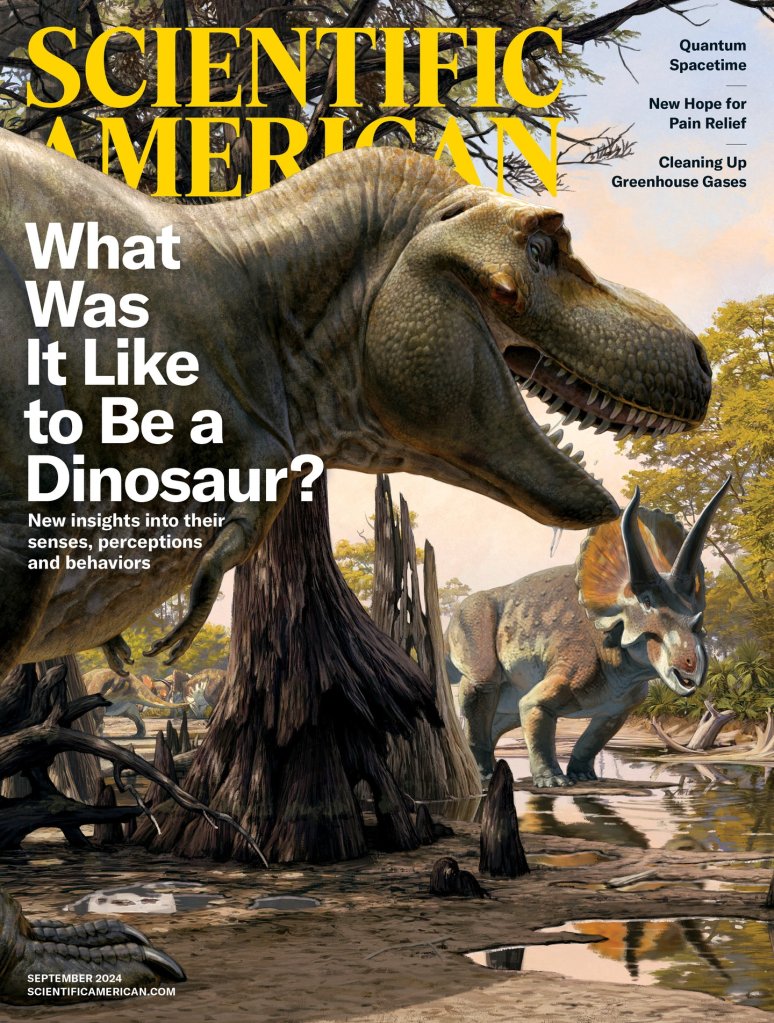
Scientific American (August 21, 2024)The September 2024 issue featuresWhat Was It Like To Be A Dinosaur? – New insights into their senses, perceptions and behaviors…

What Was It Like to Be a Dinosaur?

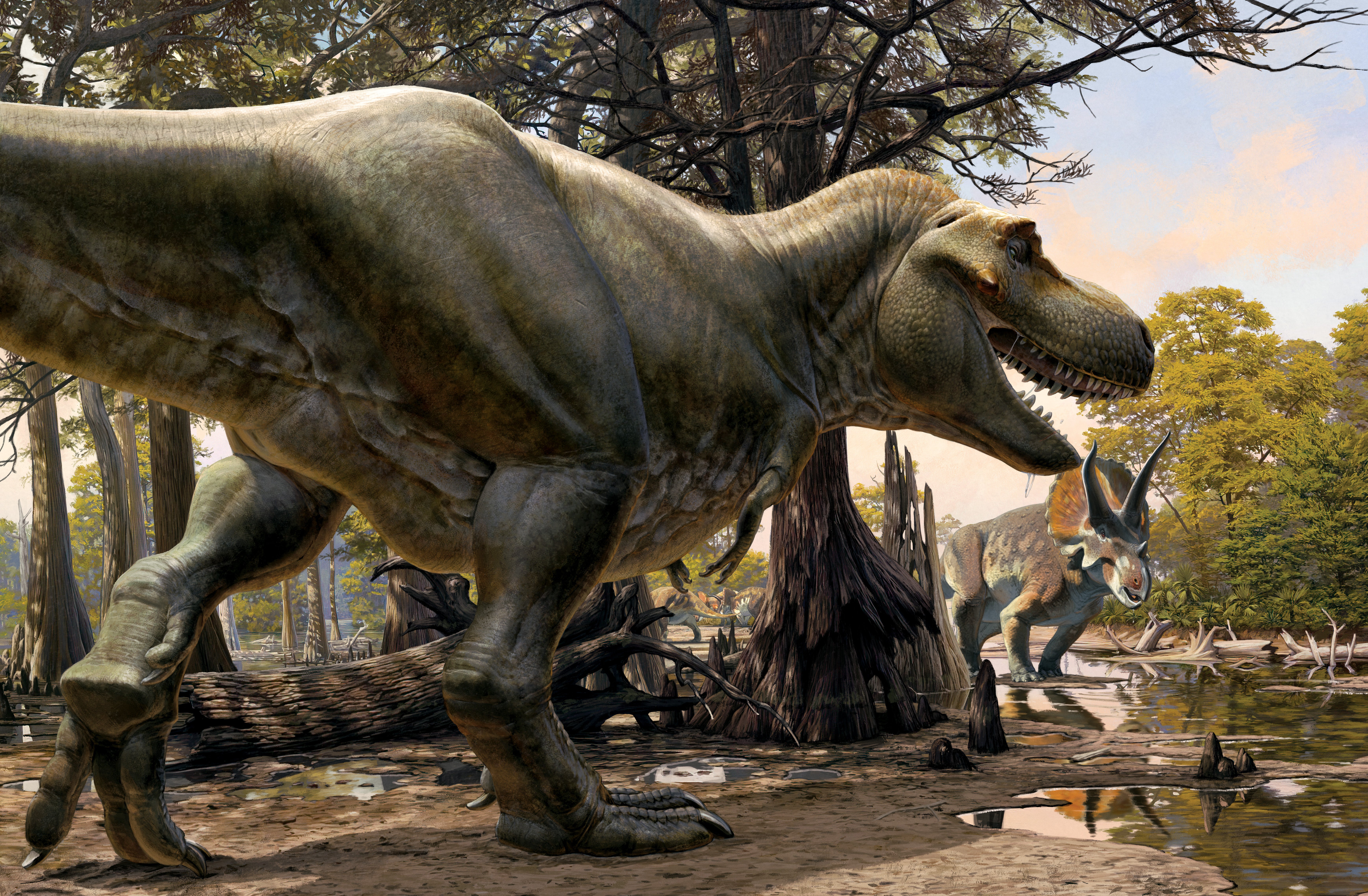
Illustration depicting a t-rex

New fossils and analytical tools provide unprecedented insights into dinosaur sensory perception by Amy M. Balanoff, Daniel T. Ksepka

Alone Tyrannosaurus rexsniffs the humid Cretaceous air, scenting a herd of Triceratops grazing beyond the tree line. As the predator scans the floodplain, its vision suddenly snaps into focus. A single Triceratops has broken off from the herd and wandered within striking distance. Standing motionless, the T. rex formulates a plan of attack, anticipating the precise angle at which it must intersect its target before the Triceratops can regain the safety of the herd. The afternoon silence is shattered as the predator crashes though the low branches at the edge of the forest in hot pursuit.

T. rex has hunted Triceratops in so many books, games and movies that the encounter has become a cliché. But did a scene like this one ever unfold in real life? Would T. rex identify its prey by vision or by smell? Would the Triceratops be warned by a loudly cracking branch or remain oblivious because it was unable to locate the source of the sound? Could T. rex plan its attack like a cat, or would it lash out indiscriminately like a shark?

What If We Never Find Dark Matter?

The inside of a plant facility with gray and yellow equipment

Dark matter has turned out to be more elusive than physicists had hoped by Tracy R. Slatyer, Tim M. P. Tait

Can Pulling Carbon from Thin Air Slow Climate Change?

Alec Luhn

The End of the Lab Rat?

Rachel Nuwer

New Painkiller Could Bring Relief to Millions—Without Addiction Risk

Marla Broadfoot

Can Space and Time Exist as Two Shapes at Once? Mind-Bending Experiments Aim to Find Out

Nick Huggett, Carlo Rovelli

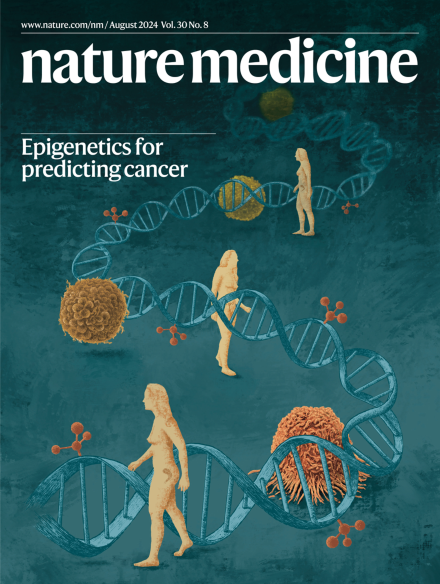
Nature Medicine Journal – September 2024 Preview

Volume 30 Issue 8

Nature Medicine (August 19, 2024): The latest issue features…

Every baby deserves access to genetic screening

Genomics-based newborn screening has the potential to revolutionize healthcare, but new solutions are needed to ensure that the benefits are equitably available.

How mRNA is powering a personalized vaccine revolution

Dozens of clinical trials are testing new mRNA vaccines, using machine learning to identify antigens, and embracing new technologies such as self-amplifying RNA.

Women’s health is on the ballot in 2024

Politics affects women’s health, from abortion access to funding for health systems, and voters should choose their politicians accordingly.

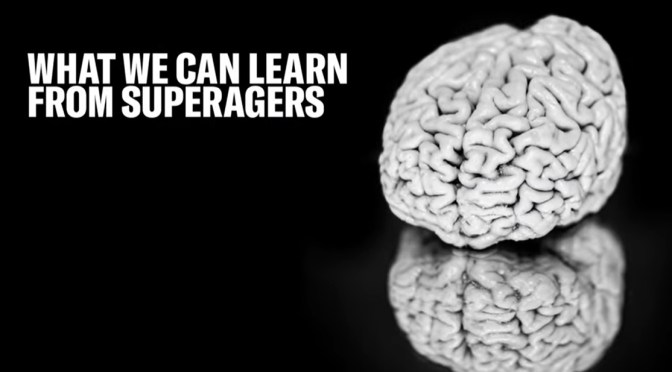
Old Age: What We Can Learn From SuperAgers

Northwestern University (August 19, 2024): By studying older individuals with exceptional memories, the Northwestern SuperAging Program advances our understanding of the aging brain — and why some stay younger than their peers. 

Tamar Gefen, Molly Mather, Robert Vassar and many more at Feinberg’s Mesulam Center are on a mission to end Alzheimer’s disease and combat all forms of neurodegenerative disease.

To learn more, visit Northwestern Magazine: https://magazine.northwestern.edu/fea…

Preview: MIT Technology Review – September 2024

MIT Technology Review (August 17, 2024): The 125th Anniversary issue features ‘Greetings from the Future’ – Personalized AI, Genetically-Engineered Immunity and Digital Immortaility. We’ll see it all in the next century.

Research Preview: Science Magazine – August 16, 2024

Current Issue Cover

Science Magazine – August 15, 2024: The new issue features ‘Transmission Event’ – Digital contact tracing for Covid-19; What kind of asteroid killed the dinosaurs; Access to safe drinking water is far from universal; Lessons from nonhuman primates on speech evolution…

Research Preview: Nature Magazine – August 15, 2024

Volume 632 Issue 8025

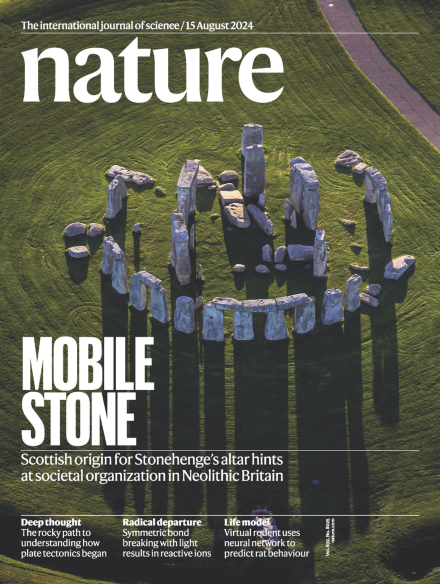
Nature Magazine – July 24, 2024: The latest issue features Mobile Stone – Scottish origin for Stonehenge’s altar hints at societal organization in Neolithic Britain…

Cobras and mambas and coral snakes, oh my! DNA shows their origins

A snake family that includes many venomous species arose in Asia, despite fossil evidence pointing to an African origin.

How expert skateboarders use physics on the half-pipe

Athletes can achieve greater speed with just the right ‘pumping’ motion, modelling shows.

Engineered brain parasite ferries useful proteins into neurons

Microbe found in cat poo could be harnessed to deliver large, complex proteins across the blood–brain barrier.

Research Preview: Science Magazine – August 9, 2024

Current Issue Cover

Science Magazine – August 8, 2024: The new issue features ‘Righting Old Wrongs’ – How science is shedding a colonial legacy…

Explosive claim about ancient burials challenged

Controversy over intentional burial by Homo naledi extends to new publishing models

Eliminating a gut microbe could slash gastric cancers

Mammoth study in Chinese villages shows antibiotics that kill Helicobacter pylori reduced cancer risk

Fire-against-fire HIV therapy passes key test in monkeys

A stripped-down HIV genome can interfere with normal virus replication

In sweeping geological theory, mantle waves lift up plateaus

Underground churn from ancient continental breakups can explain highlands in Brazil, India, and South Africa

Research Preview: Science Magazine – August 2, 2024

Current Issue Cover

Science Magazine – August 1, 2024: The new issue features ‘Prickly Plants’ – Pruning thorns through gene editing…

Is it the humidity, or just the heat?

Scientists debate the role of humidity in rising heat deaths

Mid-Pleistocene climate transition triggered by Antarctic Ice Sheet growth

Recent tropical Andean glacier retreat is unprecedented in the Holocene

Lessons from ancient pathogens

A chemogenetic screen reveals that Trpv1-expressing neurons control regulatory T cells in the gut

Research Preview: Science Magazine – July 26, 2024

Current Issue Cover

Science Magazine – July 18, 2024: The new issue features smoke from wildfires burning in Canada enveloped New York City, New York, in June of 2023, shown here in a photo of the Chrysler Building on 7 June.

U.S. back in the race to forge unknown elements

Atoms of element 116 show path to create element 120 and extend the periodic table

Fully built water-hunting Moon rover killed by NASA

VIPER cancellation shocks planetary scientists and puts commercial lunar delivery program on edge

Can scientists help corals by killing starfish?

Culling crown-of-thorns boosted coral cover on Australia’s Great Barrier Reef

Burned-up satellites are tainting the atmosphere

As private fleets grow, so do concerns about ozone-destroying effects of metal particles

Research: New Scientist Magazine – July 27, 2024

New Scientist Magazine (July 24, 2024): This issue features ‘The Smart Guide To Exercise’ – What is the quickest way to get fit?; How much exercise is too much?; What is lost and gained by working out online?; When is the best time to workout?….

What is the optimal amount of exercise and how much is too much?

If your gym instructor is an iPad, what is lost – and gained?

How to use psychology to hack your mind and fall in love with exercise

How fast do we get out of shape and is there a way to slow the loss?

How much exercise do children really need – and what type?

Watch bees defend their nest by slapping ants with their wings

Zombie galaxy came back to life after 20 million years

Chinese nuclear reactor is completely meltdown-proof

Shock discovery reveals deep sea nodules are a source of oxygen

Universe’s missing matter may be explained by galaxies leaking gas