
From a The Week online article:
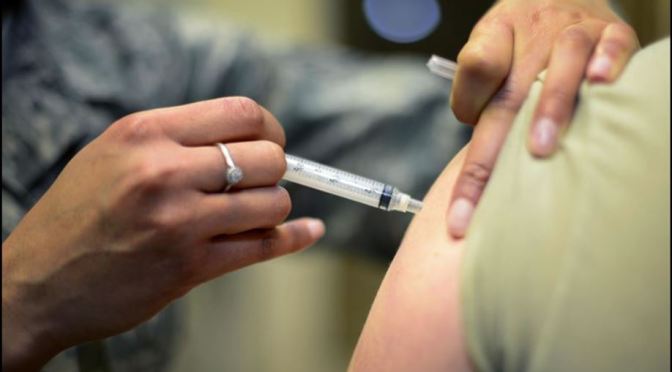
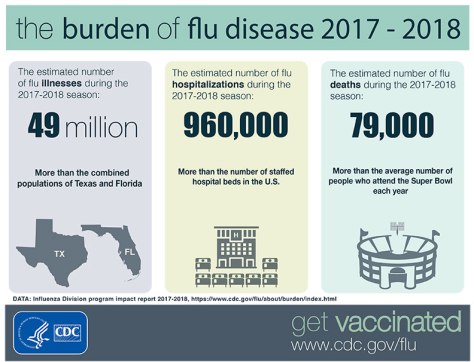
The disease kills 12,000 Americans during mild flu seasons and up to 56,000 in severe ones, with 90 percent of the victims over 65 years old.
Although the U.S. has one of the highest vaccination rates in the world, only 45 percent of adults and 63 percent of children get flu shots each year. Scientists estimate that if the vaccination rates were boosted to between 80 and 90 percent, it could effectively stop seasonal flu from spreading because of herd immunity.
How does the vaccine work?
The flu vaccine contains inactive or weakened versions of three or four different strains of the influenza virus. Most people receive the vaccine via injection, but there is also a nasal spray available. The weakened viruses can’t cause serious illness, but they trigger and train the immune system to fight off the invading microorganisms. White blood cells generate an army of antibodies, which attack and destroy the vaccine viruses by attaching themselves to parts of the virus known as antigens. The vaccine antigens have the same shape as real flu antigens, so the immune system now has antibodies that match up with the real flu virus. That experience teaches the immune system to recognize future flu infections and quickly make antibodies to attack the invading viruses. It takes about two weeks after receiving the vaccine to develop immunity, which is why doctors recommend getting it early in the flu season, which begins in October and can last as late as May.
To read more: https://theweek.com/articles/874101/flu-vaccine-everything-need-know

 NPR’s Tamara Keith and Amy Walter of the Cook Political Report join Judy Woodruff to discuss the latest political news, including what the death of ISIS leader al-Baghdadi means for President Trump and how the impeachment inquiry might shift after the House takes a formal vote on it this week.
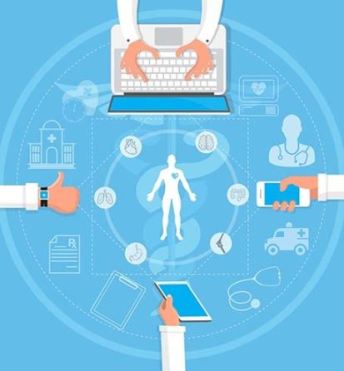 First place prize awarded to MapHabit: This mobile software provides behavior prompts with customizable picture and keyword visual maps to assist memory-impaired people with accomplishing activities of daily living. The care management platform employs different interfaces depending on whether the user is a person with impaired memory, caregiver or long-term care community manager. Caregivers can monitor adherence to medication schedules or track other activities.
 Syndicated columnist Mark Shields and New York Times columnist David Brooks join Judy Woodruff to discuss the latest political news, including trends around the federal judges President Trump is appointing, the Department of Justice’s criminal probe of the Russia investigation, how the impeachment inquiry is evolving and campaign anxiety regarding 2020 Democratic candidates.
 This week in Science,
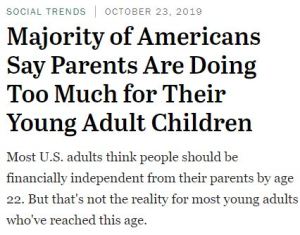 There’s a sense among a majority of Americans that parents are doing too much for their young adult children these days – 55% of all adults say this, while only 10% say parents are doing too little for their young adult children. About a third (34%) say parents are doing about the right amount.
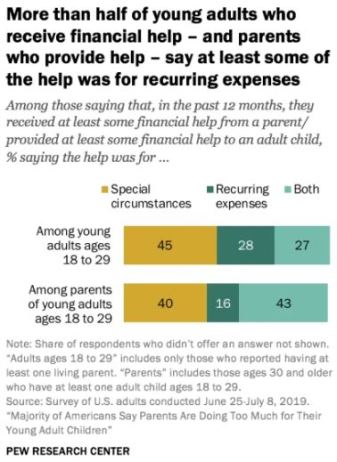 Among adults ages 18 to 29, 45% say they received a lot of (24%) or some (21%) financial help from their parents in the past 12 months. About one-in-five (21%) say they received only a little financial help, and 34% say they received none.
 Listen to the latest from the world of science, with Nick Howe and Shamini Bundell. This week, a milestone in quantum computing, and rethinking early mammals.
 But greater use of biosimilars could create significantly more savings. If biosimilars obtained a 75 percent market share, less than the share of these medicines in many European Union nations, the resulting annual savings for the U.S. healthcare system could be nearly $7 billion, based on Winegarden’s analysis.
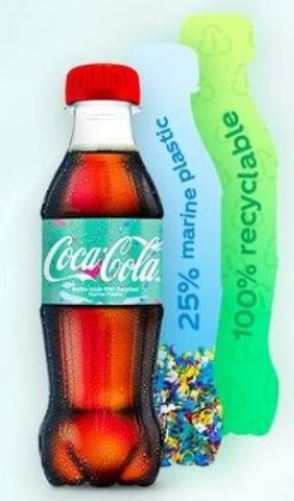 the recycling technology is the result of a partnership between coca-cola, the dutch startup ioniqa technologies and indorama ventures, one of
  Boomers Daily