Category Archives: Education

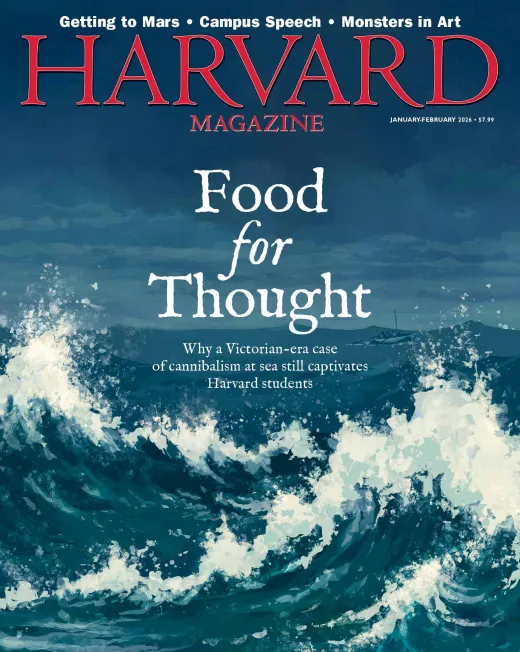
HARVARD MAGAZINE – JANUARY/FEBRUARY 2026

Cover of Harvard Magazine featuring turbulent ocean waves and the text "Food for Thought."

HARVARD MAGAZINE: The latest issue features ‘Food For Thought’ – Why a Victorian-era case of cannibalism at sea still captivates Harvard students…

The 1884 Cannibalism-at-Sea Case That Still Has Harvard Talking

The Queen v. Dudley and Stephens changed the course of legal history. Here’s why it’s been fodder for countless classroom debates. by Adam S. Cohen

Getting to Mars (for Real)

Humans have been dreaming of living on the Red Planet for decades. Harvard researchers are on the case. by Olivia Farrar

Is Ultraprocessed Food Really That Bad?

A Harvard professor challenges conventional wisdom. 

Regenerative Biology’s Baby Steps

What axolotl salamanders could teach us about limb regrowth

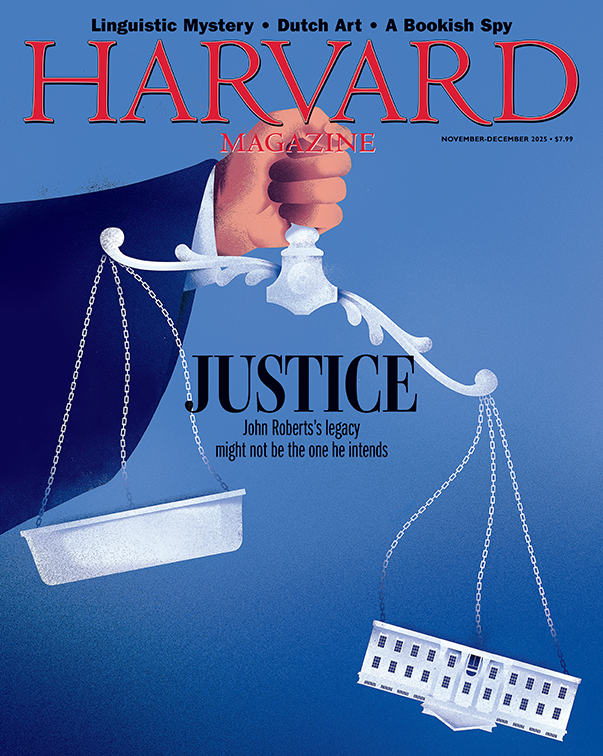
HARVARD MAGAZINE – NOVEMBER/DECEMBER 2025

November-December 2025 | Harvard Magazine

HARVARD MAGAZINE: The latest issue features ‘Justice’ – John Roberts legacy might not be the one he intends.

What Trump Means for John Roberts’s Legacy

Executive power is on the docket at the Supreme Court. by Lincoln Caplan

This Harvard Scientist Is Changing the Future of Genetic Diseases

David Liu has pioneered breakthroughs in gene editing, creating new therapies that may lead to cures. by Veronique Greenwood

Why America’s Strategy For Reducing Racial Inequality Failed

Harvard professor Christina Cross debunks the myth of the two-parent Black family.

The One-Room Rebellion

How Arizona’s microschool boom is reshaping the American classroom—and reviving old questions about freedom, equity, and the gaze of the state.

By Michael Cummins, Editor, August 21, 2025

Jeremy Bentham never saw his  panopticon built. The English philosopher imagined a circular prison with a central watchtower, where a single guard could observe every inmate without being seen. Bentham saw it as a triumph of efficiency: if prisoners could never know when they were being watched, they would behave as though they always were. A century later, Michel Foucault seized on the design as metaphor. In Discipline and Punish, he argued that the panopticon revealed the true mechanics of modern institutions—not brute force, but the internalization of surveillance. The gaze becomes ambient. The subject becomes self-regulating.

This, in many ways, is the story of the American public school. The common school movement of the mid-nineteenth century, led by Horace Mann, sought standardization: children from Boston to St. Louis would recite the same lessons, read the same primers, and adopt the same civic habits. As cities grew, schools scaled up. By the twentieth century, especially in the wake of A Nation at Risk, the classroom had become a site of discipline. Bells regulated time. Grades ranked performance. Administrators patrolled hallways like wardens. Testing regimes quantified ability. The metaphor was not lost on Foucault. Brown University notes that his vision of the panopticon extended beyond prisons to schools: a “system of surveillance where individuals internalize the feeling of being constantly watched, leading to self-regulation of behavior” (Brown University).

Every American child knows this regime. The bell rings. The roll is called. The test is bubbled and scanned. Hall passes are signed like parole slips. Cameras blink in cafeteria corners. Laptops carry software that tracks keystrokes. Even silence becomes an instrument of order.

Bentham saw efficiency. Foucault saw discipline. Students often see only the weight of the watchtower.

What happens when families walk out of the circle?

In the far suburbs of Phoenix, on the edge of the White Tank Mountains, a converted casita serves as the Refresh Learning Center. Founded in 2023 by a pastor and his wife, it doesn’t look like much—aluminum siding, recycled chairs, a wall chart that places the birth of the universe at 4004 B.C. Yet, as Chandler Fritz wrote in the September 2025 issue of Harper’s Magazine, the little school has become an emblem of a movement reshaping American education.

Its existence rests on a radical policy shift. In 2022, Arizona launched the nation’s most expansive Empowerment Scholarship Account (ESA) program. Unlike traditional vouchers, which could be redeemed only at approved institutions, ESA funds flow directly to parents—roughly $7,500 per student, sometimes more. Families can spend the money on almost anything that counts as “educational”: a cello, a VR headset, a trampoline, or, increasingly, a place in one of the microschools sprouting across the state.

The metaphor of the frontier clings naturally to Arizona. Here, in the desert’s glare, families are homesteading education in much the same spirit as settlers once claimed land. A garage becomes a classroom. A supply closet, a high school. A church basement, an academy. In his Harper’s piece, Fritz describes a child attending class in a room where chickens wandered the yard outside, and another high-school seminar meeting in a closet stacked with supply boxes. Parents pull their children not only for ideology but for intimacy, pace, or simple safety. “Without ESA, this school would not—could not—exist,” one founder told him.

For advocates, the program represents liberation from a failing system. For critics, it siphons resources from public schools already parched of funding. But for the families gathered in little schoolhouses like Refresh, the stakes feel simpler: children freed from the gaze of bureaucracy, from endless testing and administrative oversight, given room to learn like human beings again.

Microschools are not new. Before the rise of the common school, most American children learned in homes, barns, or one-room cabins where a single teacher instructed a dozen children of all ages. Reformers dismissed those spaces as unsystematic, unjust. The standardized school, they argued, would correct inequities and prepare citizens for democracy.

Today, the pendulum swings back. Inside Refresh’s aluminum-sided room, teenagers do crafts next to six-year-olds. Grade levels blur: a thirteen-year-old may still be in second grade; another, the same age, reads at a high school level. Students spend mornings mucking chicken coops and afternoons in shop class. A boy named Aaron, dyslexic and restless in traditional schools, thrives in the workshop, building desks and repairing tools. He dreams of becoming an Air Force mechanic. One teacher observed that he learned fractions by cutting lumber and measuring shelves—mathematics discovered in wood grain and sawdust.

Another student, Hailey, is quick with skepticism. She listens to indie rock from her AirPods between classes, balances her faith with her friendships, and rolls her eyes at biblical literalism. “Stop comparing everything to religion,” she wrote in a survey. “I know it’s a Christian school, but it’s annoying learning about history when it’s asking about the Bible.”

And then there is Canaan, a foster child, the oldest in the room. During a discussion of To Kill a Mockingbird, he startled his peers by pressing the point of segregation. “What if everyone were actually given the same resources?” he asked. The question, naïve and profound, echoed the legal logic of Brown v. Board of Education, though he had never heard of it. His teachers had worried about whether he was “ready” for a seminar text. Yet here he was, articulating the problem of equality with more clarity than many adults.

Their stories recall sepia-toned photographs of America’s one-room schoolhouses, where a teacher might balance a baby on one hip while drilling older students in long division. Nostalgia clings to such places, but for children like Aaron and Hailey and Canaan, the sense of being known—of not being lost in the machinery of standardization—is more than nostalgia. It is survival.

The ESA marketplace, though, has the volatility of a boomtown. Alongside earnest shop classes and backyard literature circles, Fritz encountered vendors offering tongue-posture therapy for ADHD, pirate-themed cooking classes tied to multilevel marketing schemes, even sword-making courses. In one Tucson suburb, a “Kids in the Kitchen” class doubled as an advertisement for a health supplement brand. Fraud has siphoned hundreds of thousands of dollars from taxpayers (Arizona Central).

More troubling is fragmentation. Public schools, for all their flaws, force pluralism: children from different families, faiths, and incomes learning together under one roof. In microschools, communities splinter. Wealthier families claim ESA funds for private tuition; poorer families scrape together what they can. Evangelical churches convert Sunday schools into full-time academies. A Southern Baptist initiative now urges every church with a basement to consider opening a weekday school. For some, ESAs represent not escape from the panopticon, but an opportunity to build new watchtowers of ideological oversight.

And yet—the children remain. Their stories suggest that the most powerful escape is not from testing regimes or surveillance, but from anonymity. In a one-room schoolhouse, a teacher cannot forget you. Your hands matter. Your questions land. You are not a datapoint in a dashboard but a voice in a circle.

The paradox of the new homestead is that it is subsidized by the very state it seeks to escape. Every ESA contract is drawn from public funds, even as public schools wither under declining enrollment and teacher shortages. Arizona’s superintendent warned in 2024 that the state’s teacher shortage, already in the thousands, could “eventually lead to zero teachers” (Arizona Policy). Meanwhile, parents swipe ESA debit cards for pianos, VR headsets, or ski passes.

But the deeper paradox is philosophical. The panopticon teaches that institutions discipline by watching. Yet children, it turns out, discipline themselves when unseen, too. In one seminar, Canaan insisted that segregation was the true injustice, not just a false verdict. Without oversight, a conversation about reparations and justice unfolded around plastic tables in a desert conversation.

Could it be that the very fragmentation critics fear might also produce unexpected awakenings? That freedom from the gaze of the state could allow children to stumble, clumsily but genuinely, into civic consciousness?

The question is not whether microschools should exist—they already do, enrolling as many students as Catholic schools nationwide. The question is how to balance their intimacy with the democratic promise of education for all. Some states experiment with guardrails: Georgia ties funds to low-performing districts; Iowa requires accreditation and assessments. Arizona, the boldest frontier, remains laissez-faire. The experiment is still young, and the stakes enormous.

Bentham dreamed of efficiency. Foucault warned of discipline. But neither accounted for what happens when the watchtower is abandoned, when families strike out into the desert to build little schools of their own. The panopticon dissolves, and in its place rises the homestead, the one-room schoolhouse, the handmade desk, the boy who lights up in shop class.

Public education was once America’s grandest democratic experiment: the poor man could reach into the rich man’s pocket and demand an education, as Emerson put it, “not as you will, but as I will” (Ralph Waldo Emerson, Education). That dream is endangered—not only by privatization, but by the creeping sense that children are means rather than ends, data points rather than persons.

The frontier metaphor cuts both ways. It can justify privatization, sectarianism, inequality. But it also gestures toward freedom, self-reliance, discovery. The challenge now is to reclaim the best of the homestead spirit—education as intimate, child-centered, alive—without abandoning the pluralistic commons that democracy requires.

Wallace Stegner once called life on the frontier a “homemade education.” He meant not only the Bible lessons of pioneer families but the curriculum of the land itself—children learning resilience from drought, ingenuity from scarcity, curiosity from the wide sky. The graduates of such an education—Lincoln, Twain, Cather, John Wesley Powell—proved that learning could be stitched together from books, rivers, and conversation. Powell, chastised in school for his parents’ abolitionist views, was pulled from the classroom and tutored privately. He learned geology by picking up stones, ornithology by watching birds, justice by watching neighbors turn cruel. The lessons carried him down the Colorado River, into history.

Perhaps the future lies not in the panopticon or the homestead alone, but in something more fluid: a system where every child is seen not from above, but up close. Where accountability measures ensure equity without strangling individuality. Where the workshop and the test, the prayer and the debate, the child who loves Jesus and the child who loves indie rock can share the same fragile, human classroom.

Education is not a prison, nor a frontier settlement. It is, at its best, a river: wide enough to carry all, winding enough to follow curiosity, strong enough to shape the land it touches. The question is whether we will keep damming it with watchtowers—or whether we will learn, finally, to let it flow.

THIS ESSAY WAS WRITTEN AND EDITED UTILIZING AI

AI, Smartphones, and the Student Attention Crisis in U.S. Public Schools

By Michael Cummins, Editor, August 19, 2025

In a recent New York Times focus group, twelve public-school teachers described how phones, social media, and artificial intelligence have reshaped the classroom. Tom, a California biology teacher, captured the shift with unsettling clarity: “It’s part of their whole operating schema.” For many students, the smartphone is no longer a tool but an extension of self, fused with identity and cognition.

Rachel, a teacher in New Jersey, put it even more bluntly:

“They’re just waiting to just get back on their phone. It’s like class time is almost just a pause in between what they really want to be doing.”

What these teachers describe is not mere distraction but a transformation of human attention. The classroom, once imagined as a sanctuary for presence and intellectual encounter, has become a liminal space between dopamine hits. Students no longer “use” their phones; they inhabit them.

The Canadian media theorist Marshall McLuhan warned as early as the 1960s that every new medium extends the human body and reshapes perception. “The medium is the message,” he argued — meaning that the form of technology alters our thought more profoundly than its content. If the printed book once trained us to think linearly and analytically, the smartphone has restructured cognition into fragments: alert-driven, socially mediated, and algorithmically tuned.

The philosopher Sherry Turkle has documented this cultural drift in works such as Alone Together and Reclaiming Conversation. Phones, she argues, create a paradoxical intimacy: constant connection yet diminished presence. What the teachers describe in the Times focus group echoes Turkle’s findings — students are physically in class but psychically elsewhere.

This fracture has profound educational stakes. The reading brain that Maryanne Wolf has studied in Reader, Come Home — slow, deep, and integrative — is being supplanted by skimming, scanning, and swiping. And as psychologist Daniel Kahneman showed, our cognition is divided between “fast” intuitive processing (System 1) and “slow” deliberate reasoning (System 2). Phones tilt us heavily toward System 1, privileging speed and reaction over reflection and patience.

The teachers in the focus group thus reveal something larger than classroom management woes: they describe a civilizational shift in the ecology of human attention. To understand what’s at stake, we must see the smartphone not simply as a device but as a prosthetic self — an appendage of memory, identity, and agency. And we must ask, with urgency, whether education can still cultivate wisdom in a world of perpetual distraction.


The Collapse of Presence

The first crisis that phones introduce into the classroom is the erosion of presence. Presence is not just physical attendance but the attunement of mind and spirit to a shared moment. Teachers have always battled distraction — doodles, whispers, glances out the window — but never before has distraction been engineered with billion-dollar precision.

Platforms like TikTok and Instagram are not neutral diversions; they are laboratories of persuasion designed to hijack attention. Tristan Harris, a former Google ethicist, has described them as slot machines in our pockets, each swipe promising another dopamine jackpot. For a student seated in a fluorescent-lit classroom, the comparison is unfair: Shakespeare or stoichiometry cannot compete with an infinite feed of personalized spectacle.

McLuhan’s insight about “extensions of man” takes on new urgency here. If the book extended the eye and trained the linear mind, the phone extends the nervous system itself, embedding the individual into a perpetual flow of stimuli. Students who describe feeling “naked without their phone” are not indulging in metaphor — they are articulating the visceral truth of prosthesis.

The pandemic deepened this fracture. During remote learning, students learned to toggle between school tabs and entertainment tabs, multitasking as survival. Now, back in physical classrooms, many have not relearned how to sit with boredom, struggle, or silence. Teachers describe students panicking when asked to read even a page without their phones nearby.

Maryanne Wolf’s neuroscience offers a stark warning: when the brain is rewired for scanning and skimming, the capacity for deep reading — for inhabiting complex narratives, empathizing with characters, or grappling with ambiguity — atrophies. What is lost is not just literary skill but the very neurological substrate of reflection.

Presence is no longer the default of the classroom but a countercultural achievement.

And here Kahneman’s framework becomes crucial. Education traditionally cultivates System 2 — the slow, effortful reasoning needed for mathematics, philosophy, or moral deliberation. But phones condition System 1: reactive, fast, emotionally charged. The result is a generation fluent in intuition but impoverished in deliberation.


The Wild West of AI

If phones fragment attention, artificial intelligence complicates authorship and authenticity. For teachers, the challenge is no longer merely whether a student has done the homework but whether the “student” is even the author at all.

ChatGPT and its successors have entered the classroom like a silent revolution. Students can generate essays, lab reports, even poetry in seconds. For some, this is liberation: a way to bypass drudgery and focus on synthesis. For others, it is a temptation to outsource thinking altogether.

Sherry Turkle’s concept of “simulation” is instructive here. In Simulation and Its Discontents, she describes how scientists and engineers, once trained on physical materials, now learn through computer models — and in the process, risk confusing the model for reality. In classrooms, AI creates a similar slippage: simulated thought that masquerades as student thought.

Teachers in the Times focus group voiced this anxiety. One noted: “You don’t know if they wrote it, or if it’s ChatGPT.” Assessment becomes not only a question of accuracy but of authenticity. What does it mean to grade an essay if the essay may be an algorithmic pastiche?

The comparison with earlier technologies is tempting. Calculators once threatened arithmetic; Wikipedia once threatened memorization. But AI is categorically different. A calculator does not claim to “think”; Wikipedia does not pretend to be you. Generative AI blurs authorship itself, eroding the very link between student, process, and product.

And yet, as McLuhan would remind us, every technology contains both peril and possibility. AI could be framed not as a substitute but as a collaborator — a partner in inquiry that scaffolds learning rather than replaces it. Teachers who integrate AI transparently, asking students to annotate or critique its outputs, may yet reclaim it as a tool for System 2 reasoning.

The danger is not that students will think less but that they will mistake machine fluency for their own voice.

But the Wild West remains. Until schools articulate norms, AI risks widening the gap between performance and understanding, appearance and reality.


The Inequality of Attention

Phones and AI do not distribute their burdens equally. The third crisis teachers describe is an inequality of attention that maps onto existing social divides.

Affluent families increasingly send their children to private or charter schools that restrict or ban phones altogether. At such schools, presence becomes a protected resource, and students experience something closer to the traditional “deep time” of education. Meanwhile, underfunded public schools are often powerless to enforce bans, leaving students marooned in a sea of distraction.

This disparity mirrors what sociologist Pierre Bourdieu called cultural capital — the non-financial assets that confer advantage, from language to habits of attention. In the digital era, the ability to disconnect becomes the ultimate form of privilege. To be shielded from distraction is to be granted access to focus, patience, and the deep literacy that Wolf describes.

Teachers in lower-income districts report students who cannot imagine life without phones, who measure self-worth in likes and streaks. For them, literacy itself feels like an alien demand — why labor through a novel when affirmation is instant online?

Maryanne Wolf warns that we are drifting toward a bifurcated literacy society: one in which elites preserve the capacity for deep reading while the majority are confined to surface skimming. The consequences for democracy are chilling. A polity trained only in System 1 thinking will be perpetually vulnerable to manipulation, propaganda, and authoritarian appeals.

The inequality of attention may prove more consequential than the inequality of income.

If democracy depends on citizens capable of deliberation, empathy, and historical memory, then the erosion of deep literacy is not a classroom problem but a civic emergency. Education cannot be reduced to test scores or job readiness; it is the training ground of the democratic imagination. And when that imagination is fractured by perpetual distraction, the republic itself trembles.


Reclaiming Focus in the Classroom

What, then, is to be done? The teachers’ testimonies, amplified by McLuhan, Turkle, Wolf, and Kahneman, might lead us toward despair. Phones colonize attention; AI destabilizes authorship; inequality corrodes the very ground of democracy. But despair is itself a form of surrender, and teachers cannot afford surrender.

Hope begins with clarity. We must name the problem not as “kids these days” but as a structural transformation of attention. To expect students to resist billion-dollar platforms alone is naive; schools must become countercultural sanctuaries where presence is cultivated as deliberately as literacy.

Practical steps follow. Schools can implement phone-free policies, not as punishment but as liberation — an invitation to reclaim time. Teachers can design “slow pedagogy” moments: extended reading, unbroken dialogue, silent reflection. AI can be reframed as a tool for meta-cognition, with students asked not merely to use it but to critique it, to compare its fluency with their own evolving voice.

Above all, we must remember that education is not simply about information transfer but about formation of the self. McLuhan’s dictum reminds us that the medium reshapes the student as much as the message. If we allow the medium of the phone to dominate uncritically, we should not be surprised when students emerge fragmented, reactive, and estranged from presence.

And yet, history offers reassurance. Plato once feared that writing itself would erode memory; medieval teachers once feared the printing press would dilute authority. Each medium reshaped thought, but each also produced new forms of creativity, knowledge, and freedom. The task is not to romanticize the past but to steward the present wisely.

Hannah Arendt, reflecting on education, insisted that every generation is responsible for introducing the young to the world as it is — flawed, fragile, yet redeemable. To abdicate that responsibility is to abandon both children and the world itself. Teachers today, facing the prosthetic selves of their students, are engaged in precisely this work: holding open the possibility of presence, of deep thought, of human encounter, against the centrifugal pull of the screen.

Education is the wager that presence can be cultivated even in an age of absence.

In the end, phones may be prosthetic selves — but they need not be destiny. The prosthesis can be acknowledged, critiqued, even integrated into a richer conception of the human. What matters is that students come to see themselves not as appendages of the machine but as agents capable of reflection, relationship, and wisdom.

The future of education — and perhaps democracy itself — depends on this wager. That in classrooms across America, teachers and students together might still choose presence over distraction, depth over skimming, authenticity over simulation. It is a fragile hope, but a necessary one.

THIS ESSAY WAS WRITTEN AND EDITED UTILIZING AI

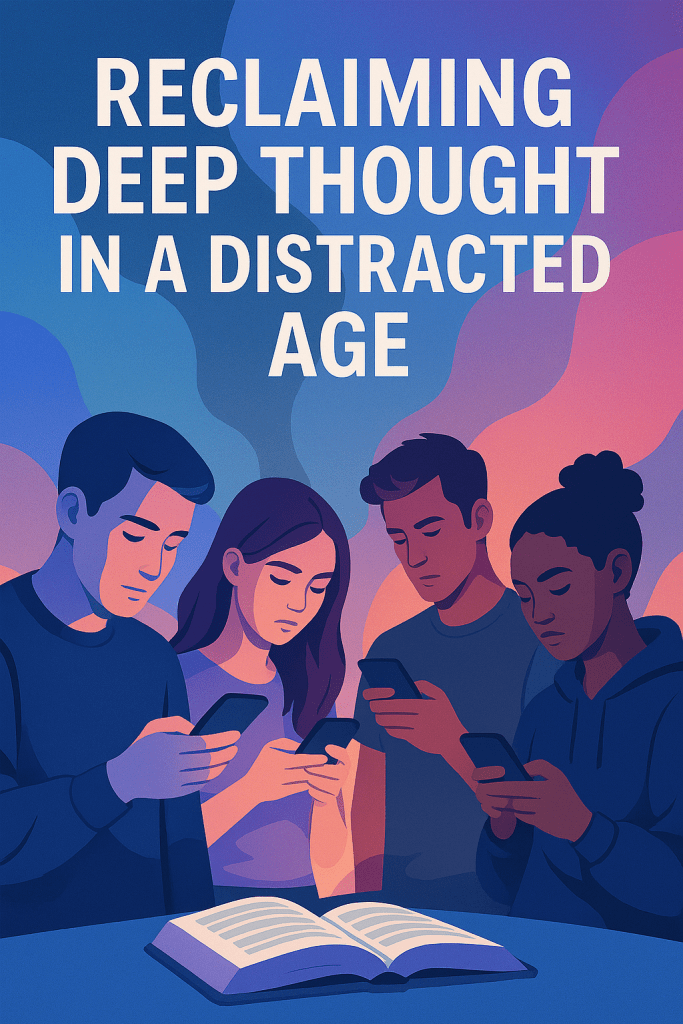
Reclaiming Deep Thought in a Distracted Age

This essay was written and edited by Intellicurean utilizing AI:

In the age of the algorithm, literacy isn’t dying—it’s becoming a luxury. This essay argues that the rise of short-form digital media is dismantling long-form reasoning and concentrating cognitive fitness among the wealthy, catalyzing a quiet but transformative shift. As British journalist Mary Harrington writes in her New York Times opinion piece “Thinking Is Becoming a Luxury Good” (July 28, 2025), even the capacity for sustained thought is becoming a curated privilege.

“Deep reading, once considered a universal human skill, is now fragmenting along class lines.”

What was once assumed to be a universal skill—the ability to read deeply, reason carefully, and maintain focus through complexity—is fragmenting along class lines. While digital platforms have radically democratized access to information, the dominant mode of consumption undermines the very cognitive skills that allow us to understand, reflect, and synthesize meaning. The implications stretch far beyond classrooms and attention spans. They touch the very roots of human agency, historical memory, and democratic citizenship—reshaping society into a cognitively stratified landscape.


The Erosion of the Reading Brain

Modern civilization was built by readers. From the Reformation to the Enlightenment, from scientific treatises to theological debates, progress emerged through engaged literacy. The human mind, shaped by complex texts, developed the capacity for abstract reasoning, empathetic understanding, and civic deliberation. Martin Luther’s 95 Theses would have withered in obscurity without a literate populace; the American and French Revolutions were animated by pamphlets and philosophical tracts absorbed in quiet rooms.

But reading is not biologically hardwired. As neuroscientist and literacy scholar Maryanne Wolf argues in Reader, Come Home: The Reading Brain in a Digital World, deep reading is a profound neurological feat—one that develops only through deliberate cultivation. “Expert reading,” she writes, “rewires the brain, cultivating linear reasoning, reflection, and a vocabulary that allows for abstract thought.” This process orchestrates multiple brain regions, building circuits for sequential logic, inferential reasoning, and even moral imagination.

Yet this hard-earned cognitive achievement is now under siege. Smartphones and social platforms offer a constant feed of image, sound, and novelty. Their design—fueled by dopamine hits and feedback loops—favors immediacy over introspection. In his seminal book The Shallows: What the Internet Is Doing to Our Brains, Nicholas Carr explains how the architecture of the web—hyperlinks, notifications, infinite scroll—actively erodes sustained attention. The internet doesn’t just distract us; it reprograms us.

Gary Small and Gigi Vorgan, in iBrain: Surviving the Technological Alteration of the Modern Mind, show how young digital natives develop different neural pathways: less emphasis on deep processing, more reliance on rapid scanning and pattern recognition. The result is what they call “shallow processing”—a mode of comprehension marked by speed and superficiality, not synthesis and understanding. The analytic left hemisphere, once dominant in logical thought, increasingly yields to a reactive, fragmented mode of engagement.

The consequences are observable and dire. As Harrington notes, adult literacy is declining across OECD nations, while book reading among Americans has plummeted. In 2023, nearly half of U.S. adults reported reading no books at all. This isn’t a result of lost access or rising illiteracy—but of cultural and neurological drift. We are becoming a post-literate society: technically able to read, but no longer disposed to do so in meaningful or sustained ways.

“The digital environment is designed for distraction; notifications fragment attention, algorithms reward emotional reaction over rational analysis, and content is increasingly optimized for virality, not depth.”

This shift is not only about distraction; it’s about disconnection from the very tools that cultivate introspection, historical understanding, and ethical reasoning. When the mind loses its capacity to dwell—on narrative, on ambiguity, on philosophical questions—it begins to default to surface-level reaction. We scroll, we click, we swipe—but we no longer process, synthesize, or deeply understand.


Literacy as Class Privilege

In a troubling twist, the printed word—once a democratizing force—is becoming a class marker once more. Harrington likens this transformation to the processed food epidemic: ultraprocessed snacks exploit innate cravings and disproportionately harm the poor. So too with media. Addictive digital content, engineered for maximum engagement, is producing cognitive decay most pronounced among those with fewer educational and economic resources.

Children in low-income households spend more time on screens, often without guidance or limits. Studies show they exhibit reduced attention spans, impaired language development, and declines in executive function—skills crucial for planning, emotional regulation, and abstract reasoning. Jean Twenge’s iGen presents sobering data: excessive screen time, particularly among adolescents in vulnerable communities, correlates with depression, social withdrawal, and diminished readiness for adult responsibilities.

Meanwhile, affluent families are opting out. They pay premiums for screen-free schools—Waldorf, Montessori, and classical academies that emphasize long-form engagement, Socratic inquiry, and textual analysis. They hire “no-phone” nannies, enforce digital sabbaths, and adopt practices like “dopamine fasting” to retrain reward systems. These aren’t just lifestyle choices. They are investments in cognitive capital—deep reading, critical thinking, and meta-cognitive awareness—skills that once formed the democratic backbone of society.

This is a reversion to pre-modern asymmetries. In medieval Europe, literacy was confined to a clerical class, while oral knowledge circulated among peasants. The printing press disrupted that dynamic—but today’s digital environment is reviving it, dressed in the illusion of democratization.

“Just as ultraprocessed snacks have created a health crisis disproportionately affecting the poor, addictive digital media is producing cognitive decline most pronounced among the vulnerable.”

Elite schools are incubating a new class of thinkers—trained not in content alone, but in the enduring habits of thought: synthesis, reflection, dialectic. Meanwhile, large swaths of the population drift further into fast-scroll culture, dominated by reaction, distraction, and superficial comprehension.


Algorithmic Literacy and the Myth of Access

We are often told that we live in an era of unparalleled access. Anyone with a smartphone can, theoretically, learn calculus, read Shakespeare, or audit a philosophy seminar at MIT. But this is a dangerous half-truth. The real challenge lies not in access, but in disposition. Access to knowledge does not ensure understanding—just as walking through a library does not confer wisdom.

Digital literacy today often means knowing how to swipe, search, and post—not how to evaluate arguments or trace the origin of a historical claim. The interface makes everything appear equally valid. A Wikipedia footnote, a meme, and a peer-reviewed article scroll by at the same speed. This flattening of epistemic authority—where all knowledge seems interchangeable—erodes our ability to distinguish credible information from noise.

Moreover, algorithmic design is not neutral. It amplifies certain voices, buries others, and rewards content that sparks outrage or emotion over reason. We are training a generation to read in fragments, to mistake volume for truth, and to conflate virality with legitimacy.


The Fracturing of Democratic Consciousness

Democracy presumes a public capable of rational thought, informed deliberation, and shared memory. But today’s media ecosystem increasingly breeds the opposite. Citizens shaped by TikTok clips and YouTube shorts are often more attuned to “vibes” than verifiable facts. Emotional resonance trumps evidence. Outrage eclipses argument. Politics, untethered from nuance, becomes spectacle.

Harrington warns that we are entering a new cognitive regime, one that undermines the foundations of liberal democracy. The public sphere, once grounded in newspapers, town halls, and long-form debate, is giving way to tribal echo chambers. Algorithms sort us by ideology and appetite. The very idea of shared truth collapses when each feed becomes a private reality.

Robert Putnam’s Bowling Alone chronicled the erosion of social capital long before the smartphone era. But today, civic fragmentation is no longer just about bowling leagues or PTAs. It’s about attention itself. Filter bubbles and curated feeds ensure that we engage only with what confirms our biases. Complex questions—on history, economics, or theology—become flattened into meme warfare and performative dissent.

“The Enlightenment assumption that reason could guide the masses is buckling under the weight of the algorithm.”

Worse, this cognitive shift has measurable political consequences. Surveys show declining support for democratic institutions among younger generations. Gen Z, raised in the algorithmic vortex, exhibits less faith in liberal pluralism. Complexity is exhausting. Simplified narratives—be they populist or conspiratorial—feel more manageable. Philosopher Byung-Chul Han, in The Burnout Society, argues that the relentless demands for visibility, performance, and positivity breed not vitality but exhaustion. This fatigue disables the capacity for contemplation, empathy, or sustained civic action.


The Rise of a Neo-Oral Priesthood

Where might this trajectory lead? One disturbing possibility is a return to gatekeeping—not of religion, but of cognition. In the Middle Ages, literacy divided clergy from laity. Sacred texts required mediation. Could we now be witnessing the early rise of a neo-oral priesthood: elites trained in long-form reasoning, entrusted to interpret the archives of knowledge?

This cognitive elite might include scholars, classical educators, journalists, or archivists—those still capable of sustained analysis and memory. Their literacy would not be merely functional but rarefied, almost arcane. In a world saturated with ephemeral content, the ability to read, reflect, and synthesize becomes mystical—a kind of secular sacredness.

These modern scribes might retreat to academic enclaves or AI-curated libraries, preserving knowledge for a distracted civilization. Like desert monks transcribing ancient texts during the fall of Rome, they would become stewards of meaning in an age of forgetting.

“Like ancient scribes preserving knowledge in desert monasteries, they might transcribe and safeguard the legacies of thought now lost to scrolling thumbs.”

Artificial intelligence complicates the picture. It could serve as a tool for these new custodians—sifting, archiving, interpreting. Or it could accelerate the divide, creating cognitive dependencies while dulling the capacity for independent thought. Either way, the danger is the same: truth, wisdom, and memory risk becoming the property of a curated few.


Conclusion: Choosing the Future

This is not an inevitability, but it is an acceleration. We face a stark cultural choice: surrender to digital drift, or reclaim the deliberative mind. The challenge is not technological, but existential. What is at stake is not just literacy, but liberty—mental, moral, and political.

To resist post-literacy is not mere nostalgia. It is an act of preservation: of memory, attention, and the possibility of shared meaning. We must advocate for education that prizes reflection, analysis, and argumentation from an early age—especially for those most at risk of being left behind. That means funding for libraries, long-form content, and digital-free learning zones. It means public policy that safeguards attention spans as surely as it safeguards health. And it means fostering a media environment that rewards truth over virality, and depth over speed.

“Reading, reasoning, and deep concentration are not merely personal virtues—they are the pillars of collective freedom.”

Media literacy must become a civic imperative—not only the ability to decode messages, but to engage in rational thought and resist manipulation. We must teach the difference between opinion and evidence, between emotional resonance and factual integrity.

To build a future worthy of human dignity, we must reinvest in the slow, quiet, difficult disciplines that once made progress possible. This isn’t just a fight for education—it is a fight for civilization.

Rewriting the Classroom: AI, Autonomy & Education

By Renee Dellar, Founder, The Learning Studio, Newport Beach, CA

Introduction: A New Classroom Frontier, Beyond the “Tradschool”

In an age increasingly shaped by artificial intelligence, education has become a crucible—a space where our most urgent questions about equity, purpose, and human development converge. In a recent article for The New York Times, titled “A.I.-Driven Education: Founded in Texas and Coming to a School Near You” (July 27, 2025), journalist Pooja Salhotra explored the rise of Alpha School, a network of private and microschools that is quickly expanding its national footprint and sparking passionate debate. The piece highlighted Alpha’s mission to radically reconfigure the learning day through AI-powered platforms that compress academics and liberate time for real-world learning.

For decades, traditional schooling—what we might now call the “tradschool” model—has been defined by rigid grade levels, high-stakes testing, letter grades, and a culture of homework-fueled exhaustion. These structures, while familiar, often suppress the very qualities they aim to cultivate: curiosity, adaptability, and deep intellectual engagement.

At the forefront of a different vision stands Alpha School in Austin, Texas. Here, core academic instruction—reading, writing, mathematics—is compressed into two highly focused hours per day, enabled by AI-powered software tailored to each student’s pace. The rest of the day is freed for project-based, experiential learning: from public speaking to entrepreneurial ventures like AI-enhanced food trucks. Alpha, launched under the Legacy of Education and now expanding through partnerships with Guidepost Montessori and Higher Ground Education, has become more than a school. It is a philosophy—a reimagining of what learning can be when we dare to move beyond the industrial model of education.

“Classrooms are the next global battlefield.” — MacKenzie Price, Alpha School Co-founder

This bold declaration by MacKenzie Price reflects a growing disillusionment among parents and educators alike. Alpha’s model, centered on individualized learning and radical reallocation of time, appeals to families seeking meaning and mastery rather than mere compliance. Yet it has also provoked intense skepticism, with critics raising alarms about screen overuse, social disengagement, and civic erosion. Five state boards—including Pennsylvania, Texas, and North Carolina—have rejected Alpha’s charter applications, citing untested methods and philosophical misalignment with standardized academic metrics.

Still, beneath the surface of these debates lies a deeper question: Can a model driven by artificial intelligence actually restore the human spirit in education?

This essay argues yes. That Alpha’s approach, while not without challenges, is not only promising—it is transformational. By rethinking how we allocate time, reimagining the role of the teacher, and elevating student agency, Alpha offers a powerful counterpoint to the inertia of traditional schooling. It doesn’t replace the human endeavor of learning—it amplifies it.


I. The Architecture of Alpha: Beyond Rote, Toward Depth

Alpha’s radical premise is disarmingly simple: use AI to personalize and accelerate mastery of foundational subjects, then dedicate the rest of the day to human-centered learning. This “2-Hour Learning” model liberates students from the lockstep pace of traditional classrooms and reclaims time for inquiry, creativity, and collaboration.

“The goal isn’t just faster learning. It’s deeper living.” — A core tenet of the Alpha School philosophy

The ideal would be that the “guides”, whose role resembles that of a mentor or coach, are highly trained individuals. As detailed in Scott Alexander’s comprehensive review on Astral Codex Ten, the AI tools themselves are not futuristic sentient agents, but highly effective adaptive platforms—“smart spreadsheets with spaced-repetition algorithms.” Students advance via digital checklists that respond to their evolving strengths and gaps.

This frees the guide to focus not on content delivery but on cultivating purpose and discipline. Alpha’s internal reward system, known as “Alpha Bucks,” incentivizes academic effort and responsibility, complementing a culture that values progress over perfection.

The remainder of the day belongs to exploration. One team of fifth and sixth graders, for instance, designed and launched a fully operational food truck, conducting market research, managing costs, and iterating recipes—all with AI assistance in content creation and financial modeling.

“Education becomes real when students build something that never existed before.” — A guiding principle at Alpha School

The centerpiece of Alpha’s pedagogy is the “Masterpiece”: a year-long, student-directed project that may span over 1,000 hours. These masterpieces are not merely academic showcases—they are portals into the child’s deepest interests and capacities. From podcasts exploring ethical AI to architectural designs for sustainable housing, these projects represent not just knowledge, but wisdom. They demonstrate the integration of skills, reflection, and originality.

This, in essence, is the “secret sauce” of Alpha: AI handles the rote, and humans guide the soul. Far from replacing relationships, the model deepens them. Guides are trained in whole-child development, drawing on frameworks like Dr. Daniel Siegel’s interpersonal neurobiology, to foster resilience, self-awareness, and emotional maturity. Through the challenge of crafting something meaningful, students meet ambiguity, friction, failure, and joy—experiences that constitute what education should be.

“The soul of education is forged in uncertainty, not certainty. Alpha nurtures this forge.”


II. Innovation or Illusion? A Measure of Promise

Alpha’s appeal rests not just in its promise of academic acceleration, but in its restoration of purpose. In a tradschool environment, students often experience education as something done to them. At Alpha, students learn to see themselves as authors of their own growth.

Seventh-grader Byron Attridge explained how he progressed far beyond grade-level content, empowered by a system that respected his pace and interests. Parents describe life-altering changes—relocations from Los Angeles, Connecticut, and beyond—to enroll their children in an environment where voice and curiosity thrive.

“Our kids didn’t just learn faster—they started asking better questions.” — An Alpha School parent testimonial

One student, Lukas, diagnosed with dyslexia, flourished in a setting that prioritized problem-solving over rote memorization. His confidence surged, not through remediation, but through affirmation.

Of the 12 students who graduated from Alpha High last year, 11 were accepted to universities such as Stanford and Vanderbilt. The twelfth pursued a career as a professional water skier. These outcomes, while limited in scope, reflect a powerful truth: when students are known, respected, and challenged, they thrive.

“Education isn’t about speed. It’s about becoming. And Alpha’s model accelerates that becoming.”


III. The Critics’ View: Valid Concerns and Honest Rebuttals

Alpha’s success, however, has not silenced its critics. Five state boards have rejected its public charter proposals, citing a lack of longitudinal data and alignment with state standards. Leading educators like Randi Weingarten and scholars like Justin Reich warn that education, at its best, is inherently relational, civic, and communal.

“Human connection is essential to education; an AI-heavy model risks violating that core precept of the human endeavor.” — Randi Weingarten, President, American Federation of Teachers

This critique is not misplaced. The human element matters. But it’s disingenuous to suggest Alpha lacks it. On the contrary, the model deliberately positions guides as relational anchors, mentors who help students navigate the emotional and moral complexities of growth.

Some students leave Alpha for traditional schools, seeking the camaraderie of sports teams or the ritual of student government. This is a meaningful critique. But it’s also surmountable. If public schools were to adopt Alpha-inspired models—compressing academic time to expand social and project-based opportunities—these holistic needs could be met even more fully.

A more serious concern is equity. With tuition nearing $40,000 and campuses concentrated in affluent tech hubs, Alpha’s current implementation is undeniably privileged. But this is an implementation challenge, not a philosophical flaw. Microschools like The Learning Studio and Arizona’s Unbound Academy show how similar models can be adapted and made accessible through philanthropic or public funding.

“You can’t download empathy. You have to live it.” — A common critique of over-reliance on AI in education, yet a key outcome of Alpha’s model

Finally, concerns around data privacy and algorithmic transparency are real and must be addressed head-on. Solutions—like open-source platforms, ethical audits, and parent transparency dashboards—are not only possible but necessary.

“AI in schools is inevitable. What isn’t inevitable is getting it wrong.” — A pragmatic view on technology in education


IV. Pedagogical Fault Lines: Re-Humanizing Through Innovation

What is education for?

This is the question at the heart of Alpha’s challenge to the tradschool model. In most public systems, schooling is about efficiency, standardization, and knowledge transfer. But education is also about cultivating identity, empathy, and purpose—qualities that rarely emerge from worksheets or test prep.

Alpha, when done right, does not strip away these human elements. It magnifies them. By relieving students of the burden of rote repetition, it makes space for project-based inquiry, ethical discussion, and personal risk-taking. Through their Masterpieces, students grapple with contradiction and wonder—the very conditions that produce insight.

“When AI becomes the principal driver of rote learning, it frees human guides for true mentorship, and learning becomes profound optimization for individual growth.”

The concept of a “spiky point of view”—Alpha’s term for original, non-conforming ideas—is not just clever. It’s essential. It signals that the school does not seek algorithmic compliance, but human creativity. It recognizes the irreducible unpredictability of human thought and nurtures it as sacred.

“No algorithm can teach us how to belong. That remains our sacred task—and Alpha provides the space and guidance to fulfill it.”


V. Expanding Horizons: A Global and Ethical Imperative

Alpha is not alone. Across the U.S., AI tools are entering classrooms. Miami-Dade is piloting chatbot tutors. Saudi Arabia is building AI-literate curricula. Arizona’s Unbound Academy applies Alpha’s core principles in a public charter format.

Meanwhile, ed-tech firms like Carnegie Learning and Cognii are developing increasingly sophisticated platforms for adaptive instruction. The question is no longer whether AI belongs in schools—but how we guide its ethical, equitable, and pedagogically sound implementation.

This requires humility. It requires rigorous public oversight. But above all, it requires a human-centered vision of what learning is for.

“The future of schooling will not be written by algorithms alone. It must be shaped by the values we cherish, the equity we pursue, and the souls we nurture—and Alpha shows how AI can powerfully support this.”


Conclusion: Reclaiming the Classroom, Reimagining the Future

Alpha School poses a provocative challenge to the educational status quo: What if spending less time on academics allowed for more time lived with purpose? What if the road to real learning did not run through endless worksheets and standardized tests, but through mentorship, autonomy, and the cultivation of voice?

This isn’t a rejection of knowledge—it’s a redefinition of how knowledge becomes meaningful. Alpha’s greatest contribution is not its use of AI—it’s its courageous decision to recalibrate the classroom as a space for belonging, authorship, and insight. By offloading repetition to adaptive platforms, it frees educators to do the deeply human work of guiding, listening, and nurturing.

Its model may not yet be universally replicable. Its outcomes are still emerging. But its principles are timeless. Personalized learning. Purpose-driven inquiry. Emotional and ethical development. These are not luxuries for elite learners; they are entitlements of every child.

“Education is not merely the transmission of facts. It is the shaping of persons.”

And if artificial intelligence can support us in reclaiming that work—by creating time, amplifying attention, and scaffolding mastery—then we have not mechanized the soul of schooling. We have fortified it.

Alpha’s model is a provocation in the best sense—a reminder that innovation is not the enemy of tradition, but its most honest descendant. It invites us to carry forward what matters—nurturing wonder, fostering community, and cultivating moral imagination—and leave behind what no longer serves.

“The future of schooling will not be written by algorithms alone. It must be shaped by the values we cherish, the equity we pursue, and the souls we nurture.”

If Alpha succeeds, it won’t be because it replaced teachers with screens, or sped up standards. It will be because it restored the original promise of education: to reveal each student’s inner capacity, and to do so with empathy, integrity, and hope.

That promise belongs not to one school, or one model—but to us all.

So let this moment be a turning point—not toward another tool, but toward a deeper truth: that the classroom is not just a site of instruction, but a sanctuary of transformation. It is here that we build not just competency, but character—not just progress, but purpose.

And if we have the courage to reimagine how time is used, how relationships are formed, and how technology is wielded—not as master but as servant—we may yet reclaim the future of American education.

One student, one guide, one spark at a time.

THIS ESSAY WAS WRITTEN AND EDITED BY RENEE DELLAR UTILIZING AI.

Patriarchy, Feminism and the Illusion of Progress

By Renee Dellar, Founder, The Learning Studio, Newport Beach, CA

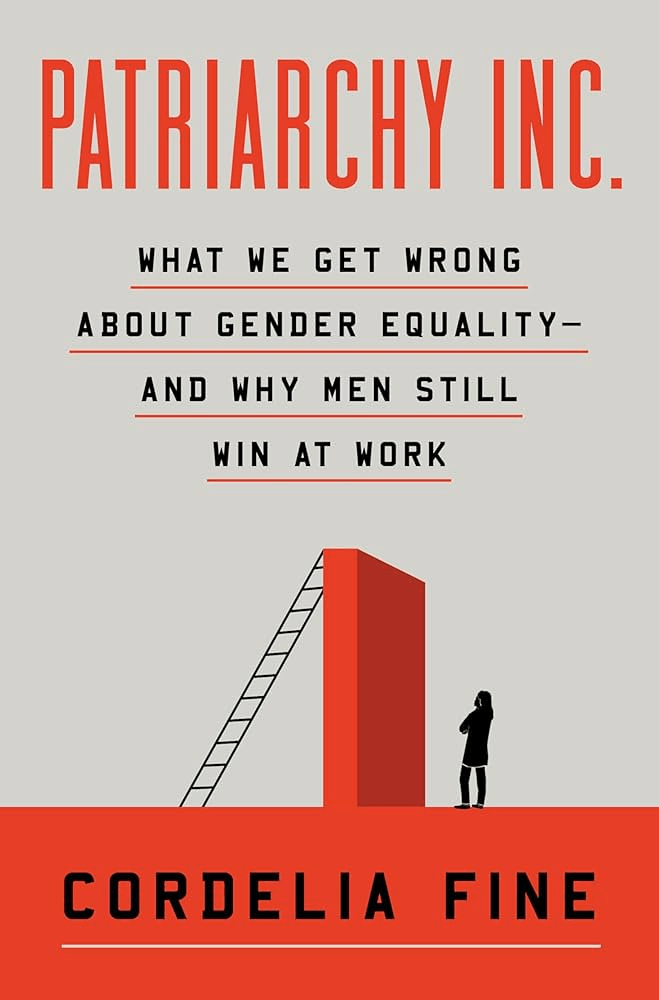
We often imagine patriarchy as a relic—obvious, archaic, and easily challenged. But as generations of feminist thinkers have long argued, and as Cordelia Fine’s Patriarchy Inc. incisively confirms, its enduring power lies not in its bluntness, but in its ability to mutate. Today, patriarchy doesn’t need to roar; it whispers in algorithms, smiles from performance reviews, and thrives in wellness language. This essay argues that Fine’s emphasis on workplace inequality, while essential, is incomplete without a parallel reckoning with patriarchy’s grip on domestic life—and more profoundly, without a reimagining of gender itself. What we need is a psychological evolution: a balanced embodiment of both feminine and masculine energies in all people, if we are to unbuild a system that survives by design.

In 1949, Simone de Beauvoir wrote in The Second Sex, “One is not born, but rather becomes, a woman.” With that sentence, she shattered the myth of biological destiny. Womanhood, she claimed, was not innate but culturally scripted—a second sex constructed through tradition, religion, and expectation. Patriarchy, in her analysis, was no divine order but a human invention: an architecture of dominance designed to reproduce itself through social roles. Fine’s forthcoming Patriarchy Inc. (August 2025) echoes and updates this insight with sharp empirical rigor. In the workplace, she shows, patriarchy has not disappeared—it has evolved. It now markets fairness, monetizes empowerment, and offloads systemic change onto individuals via coaching, productivity hacks, and “confidence workshops” that sell resilience as a substitute for reform.

What makes Fine’s critique vital is not merely that patriarchy persists—it’s how it thrives beneath the very banner of equality. It now cloaks itself in metrics, missions, and diversity gloss. Corporate offices tout inclusion while continuing to reward masculine-coded behaviors and promote male leadership: 85% of Fortune 500 CEOs remain men. Patriarchy, we learn, is not a crumbling wall—it is a self-repairing system. To dismantle it, we must go deeper than metrics. We must examine the energies it suppresses and rewards.

Masculine and Feminine Traits: A New Grammar of Justice

To understand the psychological mechanics of patriarchy, we must revisit the traits society has long coded as masculine or feminine—traits that are neither biological imperatives nor moral absolutes, but social energies shaped over centuries.

  • Masculine traits are typically associated with competition, independence, assertiveness, strength, and linear action. Taken too far, they veer into domination.
  • Feminine traits, by contrast, are linked to empathy, care, intuition, collaboration, and receptivity—qualities that bind rather than divide.

These traits exist in all people. Yet patriarchy has historically overvalued the former and devalued the latter, punishing men for softness and women for strength. A just society must not erase these differences but balance them—within institutions, relationships, and most importantly, within the self.

Simone de Beauvoir: The Architecture of Otherness

De Beauvoir’s diagnosis of woman as “Other”—the deviation from the male norm—remains uncannily relevant. Today’s workplaces replicate that Othering in subtler ways: through dress codes, tone policing, and leadership norms that penalize feminine expression. As Fine notes, women must be confident, but not cold; nurturing, but not weak; assertive, but not abrasive. In other words: perfect. The corporate woman who succeeds by male standards is often punished for violating feminine ideals. The double bind remains—only now it wears a blazer and carries a badge that says “inclusive.”

Friedan, Domesticity, and the New Containment

In 1963, Betty Friedan exposed what she called “the problem that has no name”: the stifling despair of suburban domesticity. Today, that problem has been rebranded. The girlboss, the multitasking mother, the curated freelancer—each is sold as empowered, even as she shoulders the same disproportionate domestic load. Women continue to dominate sectors like education and healthcare, often underpaid and undervalued despite being deemed “essential.” These roles, Fine shows, are praised symbolically while marginalized materially. Even progressive policies like flexible hours and parental leave frequently assume women are the default caregivers, reinforcing the burden Friedan tried to name.

Millett’s Sexual Politics: The Myth of Neutrality

Kate Millett’s Sexual Politics reframed patriarchy as institutional, not interpersonal. Literature, law, and culture all naturalized male dominance. Fine brings that lens to the boardroom. Modern hiring algorithms and promotion pathways may appear neutral, but they are encoded with values that reward masculine norms. Women are urged to “lean in,” but warned not to lean too far. Diversity initiatives often succeed at optics, but fail to shift power: the faces at the table change, yet the hands on the levers remain the same. As Fine argues, equity requires more than visibility—it demands structural rebalancing.

Lorde and the Failure of Inclusion Without Power

Audre Lorde warned that “the master’s tools will never dismantle the master’s house.” Too often, DEI programs use those very tools. Difference is celebrated, but only within safe boundaries. Women of color may be promoted, but without adequate mentorship, institutional backing, or decision-making power, the gesture risks becoming symbolic. Fine channels Lorde’s insight: inclusion without transformation is corporate theater. Real justice requires not just a change in personnel, but a change in priorities, metrics, and values.

Gerda Lerner and the Machine That Adapts

In The Creation of Patriarchy, Gerda Lerner traced patriarchy’s roots to law, religion, and economy, showing it as a machine designed for self-preservation. Fine updates this metaphor: the machine now runs on data, flexibility, and illusion. Today’s labor markets reward 24/7 availability, mobility, and presenteeism—conditions often impossible for caregivers. When women enter male-dominated fields, prestige and pay often decline. The system adapts by downgrading the value of women’s gains. Patriarchy doesn’t just resist change—it mutates in response to it.

The Invisible Burnout: When Women Do Both

As women are pushed to succeed professionally, they’re also expected to maintain responsibility for domestic life. This dual burden—emotional labor, mental load, caregiving—is not equally shared. While women have been pressured to adopt masculine-coded traits to succeed, men have faced little reciprocal cultural push to develop their feminine sides. As a result, many women are performing two identities—professional and maternal—while men remain tethered to one. This imbalance is not just unfair—it is unsustainable.

Men Must Evolve Too: The Will to Change

Cordelia Fine joins American author, theorist, educator, and social critic bell hooks in arguing that men must be part of the liberation project—not as allies, but as participants in their own healing. In The Will to Change, hooks argued that patriarchy damages men by severing them from their emotions, from intimacy, and from ethical wholeness. Fine builds on this, showing how men are rewarded with status but robbed of connection.

What does transformation look like for men? Not emasculation, but evolution:

  • Self-awareness: recognizing one’s emotions, triggers, and limitations.
  • Self-regulation: managing impulses with maturity and intention.
  • Self-compassion: replacing shame with acceptance and care.

These are not feminine traits—they are human ones. And leaders who embody both emotional intelligence and strategic clarity are not only more ethical—they are more effective. Institutions must reward this integration, not punish it.

From Balance to Redesign: What Fine Urges

Fine’s prescriptions are bold:

  • Assume all workers have caregiving roles—not just mothers.
  • Redesign success metrics to value care, collaboration, and emotional labor.
  • Teach gender equity not as tolerance, but as a foundational moral principle.
  • Foster this evolution early—at home, in classrooms, in culture.

This is not incremental reform. It is a new architecture: one that recognizes care as central, emotional labor as valuable, and balance as a mark of strength.

Conclusion: The System That Learns, and the Refusal That Liberates

Patriarchy has endured not because it hides, but because it learns. As Simone de Beauvoir revealed its ontological design, and Gerda Lerner its historical scaffolding, Cordelia Fine now reveals its polished upgrade. Patriarchy today sells resistance as a brand, equity as a product. It launders its image with the very language that once opposed it.

We no longer suffer from a lack of critique. We suffer from a failure to redesign. And so, as Audre Lorde warned, our task is not to decorate the master’s house—it is to refuse it. Not through token representation, but through radical revaluation. Not through balance sheets, but through balanced selves.

To dismantle patriarchy is not to flip the power dynamic. It is to end the game altogether. It is to build something entirely different—where human worth is not ranked, but recognized. Where power is not hoarded, but shared. Where every child, regardless of sex, is raised to lead with empathy and to love with courage.

That future begins not with a program, but with a decision. To evolve. To balance. To refuse the illusion of progress and demand its substance.

RENEE DELLAR WROTE AND EDITED THIS ESSAY UTILIZING AI

Reclaiming Intellectual Life Within Motherhood

By Renee Dellar, Founder, The Learning Studio, Newport Beach, CA

In homes filled with toy-strewn floors, half-read bedtime stories, and the quiet rituals of care, another kind of cultivation is quietly unfolding: a woman tending both her children and her own mind. For centuries, motherhood has been framed as noble sacrifice—an often invisible labor etched into the margins of cultural discourse. But in 2025, a growing chorus of voices is reviving a different vision. One in which caregiving is not a detour from intellectual life, but its fertile ground.

Two works lead this revival: Karen Andreola’s Mother Culture and Laura Fabrycky’s Motherhood and the Intellectual Life. Each, in their own way, reshapes how we understand the maternal vocation—not as a trade-off between thought and nurture, but as a textured synthesis of both. The intellect, they argue, can live among the ordinary. It can thrive there.

The Domestic as Intellectual Soil

Andreola’s Mother Culture is a quiet revolution disguised as a homemaking guide. Rooted in the Charlotte Mason tradition, an educational philosophy that relies on living stories, literature and engaging with nature, the book encourages mothers to nurture their spiritual and intellectual lives alongside the children they raise. The term “mother culture” describes this practice of personal cultivation within caregiving: reading short chapters, journaling reflections, taking time for beauty and prayer—not as indulgence, but as daily nourishment.

Fabrycky’s Motherhood and the Intellectual Life deepens and broadens the premise. Drawing inspiration from A.G. Sertillanges’s The Intellectual Life, she proposes that intellectual formation is not incompatible with diapers and dinner prep—it may, in fact, be refined by them. Maternal knowing, she argues, is less linear and more contemplative: “a slow epistemology,” where insight emerges through relational rhythms, interruptions, and quiet repetition.

Taken together, these texts offer a radical proposition: that raising children can coexist with the pursuit of meaningful thought—and even become its crucible.

Growth Through the Tension

This vision is not utopian. Fabrycky grapples openly with the fragmented time, emotional exhaustion, and cultural myths that haunt modern motherhood. The notion that one must be endlessly available and self-effacing to be “good” creates a psychic double bind—especially for those who also feel called to write, study, or lead.

A 2025 GBH essay titled “What Does It Mean to Be a Good Mom in 2025?” critiques these cultural pressures and calls for relational authenticity over performative self-sacrifice. Similarly, Amy Shoenthal, writing in Forbes, identifies five emerging trends in maternal identity, including the recognition of unpaid caregiving and the reframing of “career pauses” as formative, not deficient. Both voices echo Andreola’s and Fabrycky’s reframing of homemaking and child-rearing as reflective, generative domains.

Matthew Crawford, in The Hedgehog Review, adds philosophical weight by critiquing the hyper-individualism that isolates mothers from communal meaning. He exposes the autonomy trap—a false promise of liberation that, in practice, leaves caregivers unsupported and intellectually adrift.

Andreola’s response to this fragmentation is practical and merciful. She doesn’t ask for hours of solitude, but twenty minutes a day—a chapter read, a line copied, a prayer whispered. Her method is cumulative, not competitive. Fabrycky reinforces this by insisting that intellectual life shaped by interruptions isn’t inferior—it’s simply different. Perhaps even deeper. A mind accustomed to chaos may grow uniquely capable of synthesis, perception, and grace.

Maternal Knowledge As Intellect

Both authors offer a profound challenge to prevailing epistemologies. Motherhood, in their telling, is not only a form of care, but a form of knowledge—a way of seeing, sensing, and interpreting the world through embodied, relational experience.

Fabrycky names this “maternal knowing,” a quiet but potent resistance to systems that privilege abstraction, quantification, and speed. It is its own category of intellect.

This view finds broader support. In The Journal of Futures Studies, the 2025 essay “Mother, Motherhood, Mothering” uses the Futures Triangle framework to propose mothering as a disruptive force within systems of power. It highlights interdependence, memory, and ancestral wisdom, and calls for “care-full academic spaces” that honor the knowledge generated in relationship.

Andreola, while less overtly political, participates in this resistance through recovery. Her invitation to read poetry, observe nature, and write in stolen moments is not escapism—it is restoration. She sees the home not merely as a workplace, but as a sanctuary of moral imagination.

Kate Lucky’s Comment essay, “Consider the Zoo,” resonates deeply here. Reflecting on containment and longing, Lucky honors domestic life as sacred terrain. Through metaphor and meditation, she illustrates how the architecture of the home—though often confining—can also be spiritually expansive. She, like Andreola, affirms that a richly cultivated mother begets a richly cultivated home.

Motherhood And The Technological Bind

In 2025, new tools offer both hope and hazard. AI tutors, digital reading groups, and remote learning platforms create flexible ways for mothers to remain intellectually engaged. But they also threaten to erode the quiet margins in which thought can truly root.

Editorialge’s “Motherhood in 2025” outlines this double bind. Technology promises convenience, but also expects omnipresence. It can enable, but it can also overwhelm. The modern mother may feel pressure not only to mother well, but to optimize the experience—socially, intellectually, emotionally, and aesthetically.

Andreola responds with a counter-rhythm. Her practice of “mother culture” requires no devices, no tracking apps, no metrics—just twenty minutes and an open soul. Fabrycky, too, advocates what she calls “sacred margins”: spaces where rest and contemplation are guarded from digital encroachment. Whether reading a psalm or journaling in twilight, these acts reclaim time not as commodity, but as communion.

This is an intellectual life that resists acceleration. One rooted not in productivity, but in attention.

Theological Embodiment

Beneath both texts lies a theological current. Andreola’s work is explicitly faith-based, casting motherhood as a sacramental calling. She ties personal growth to spiritual rhythms, blending domesticity with liturgy. Fabrycky’s theology is more implicit, but no less rich. She draws on incarnational motifs—suggesting that just as Christ entered time, mothers enter it fully, redemptively, lovingly.

Paul Kingsnorth, writing in First Things, critiques empire-building models of Christianity and calls instead for mystical humility. It is a useful lens for understanding maternal life. In resisting the culture of achievement, mothers enact a kind of mysticism: the shaping of souls not through acclaim, but through sandwiches and lullabies.

Plough Quarterly’s “Autonomy Trap” extends this idea. The essay argues that liberal autonomy undermines moral formation and calls for renewed celebration of dependency and mutual obligation. Mothers, whose daily lives revolve around interdependence, know this deeply. Their labor is not a retreat from intellectual life—it is its lived expression.

Even empirical research backs this. A 2025 study published by the APA, titled “Nurturing Now, Thriving Later,” found that maternal warmth fosters personality traits associated with intellectual openness and conscientiousness. Far from being anti-intellectual, caregiving becomes a crucible of human formation—for both parent and child.

Reimagining Flourishing

The question, then, is not whether mothers can be intellectuals. It is whether society can reimagine what intellectual life actually looks like.

Both Andreola and Fabrycky challenge the false binary between academic scholarship and domesticity. Intellectual flourishing, they argue, need not wear robes or require citations. It can live in a threadbare armchair, beside a half-finished sketch, or in a whispered poem before lights-out.

Joseph Keegin, writing in Point Magazine, coined the term “commit lit” to describe literature that shapes the soul—not just the intellect. This is the literature of mothers: clarifying, sustaining, quietly transformative. It is what Andreola asks women to read—not for utility, but for delight and reflection. The habit itself becomes a philosophy.

Andreola’s readers praise her for practicality: short chapters, gentle prompts, and the conviction that the inner life matters—even if cultivated between errands and lunchboxes. Fabrycky echoes this, calling us to reject the tired binaries of ambition versus nurture, head versus heart. In doing so, she articulates a vision of womanhood that is fully integrated—thinking, feeling, forming, and formed.

Conclusion

To speak of motherhood as intellectually fruitful is not to romanticize its trials. It is to honor its inherent generativity.

A mother tends more than bodies and schedules. She tends minds, questions, values, and souls. Her daily life is strewn with philosophical inquiry: What does love require when exhausted? How should justice look between siblings? What is the rhythm of truth-telling in a bedtime ritual?

This is not incidental. It is profound.

Karen Andreola’s Mother Culture affirms the mother not only as caregiver, but as curator of wisdom. Through short chapters and gentle urgings, she equips women to reclaim the interior life—to read, think, pray, and study amidst the hum of the washing machine and the chaos of toddler negotiations. It is philosophy shelved among the laundry. Theology scribbled between school pick-ups.

Laura Fabrycky extends this sacred motif, framing motherhood as epistemology itself. In her vision, maternal knowledge is slow and embodied—shaped by noise, honed through disruption. It is knowledge with fingerprints, and fingerprints with knowledge.

Culture often demands a choice: between ambition and nurture, visibility and devotion. But this is a false binary. The intellectually vibrant mother is not the exception—she is the mirror. Her search for meaning, amid fractured time, is no less rigorous than that of the cloistered scholar. It may, in fact, be more so.

With new tools, communal voices, and literary recoveries blooming in 2025, the conditions are ripe for reframing. Writers, theologians, educators, and artists are clearing space for caregiving not as an interruption of intellect, but as its generative soil.

The mother who lights a candle for evening reading, who sketches thoughts between lessons, who whispers poetry over lunch—is not delaying her intellectual life. She is living it. And in doing so, she is cultivating a garden of wisdom whose fruits will shape families, culture, and the age to come.

She is, in every way, a thinker.

And the home—far from a site of confinement—is one of the most intellectually fertile landscapes of all.

THIS ESSAY WAS WRITTEN BY RENEE DELLAR UTILIZING AI

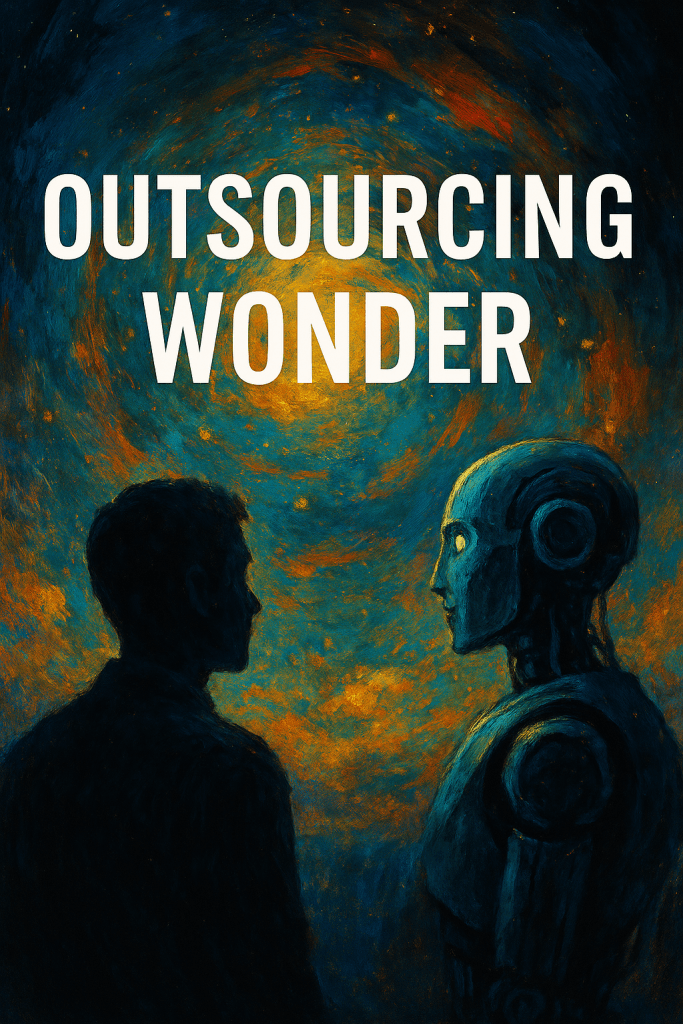
THE OUTSOURCING OF WONDER IN A GENAI WORLD

A high school student opens her laptop and types a question: What is Hamlet really about? Within seconds, a sleek block of text appears—elegant, articulate, and seemingly insightful. She pastes it into her assignment, hits submit, and moves on. But something vital is lost—not just effort, not merely time—but a deeper encounter with ambiguity, complexity, and meaning. What if the greatest threat to our intellect isn’t ignorance—but the ease of instant answers?

In a world increasingly saturated with generative AI (GenAI), our relationship to knowledge is undergoing a tectonic shift. These systems can summarize texts, mimic reasoning, and simulate creativity with uncanny fluency. But what happens to intellectual inquiry when answers arrive too easily? Are we growing more informed—or less thoughtful?

To navigate this evolving landscape, we turn to two illuminating frameworks: Daniel Kahneman’s Thinking, Fast and Slow and Chrysi Rapanta et al.’s essay Critical GenAI Literacy: Postdigital Configurations. Kahneman maps out how our brains process thought; Rapanta reframes how AI reshapes the very context in which that thinking unfolds. Together, they urge us not to reject the machine, but to think against it—deliberately, ethically, and curiously.

System 1 Meets the Algorithm

Kahneman’s landmark theory proposes that human thought operates through two systems. System 1 is fast, automatic, and emotional. It leaps to conclusions, draws on experience, and navigates the world with minimal friction. System 2 is slow, deliberate, and analytical. It demands effort—and pays in insight.

GenAI is tailor-made to flatter System 1. Ask it to analyze a poem, explain a philosophical idea, or write a business proposal, and it complies—instantly, smoothly, and often convincingly. This fluency is seductive. But beneath its polish lies a deeper concern: the atrophy of critical thinking. By bypassing the cognitive friction that activates System 2, GenAI risks reducing inquiry to passive consumption.

As Nicholas Carr warned in The Shallows, the internet already primes us for speed, scanning, and surface engagement. GenAI, he might say today, elevates that tendency to an art form. When the answer is coherent and immediate, why wrestle to understand? Yet intellectual effort isn’t wasted motion—it’s precisely where meaning is made.

The Postdigital Condition: Literacy Beyond Technical Skill

Rapanta and her co-authors offer a vital reframing: GenAI is not merely a tool but a cultural actor. It shapes epistemologies, values, and intellectual habits. Hence, the need for critical GenAI literacy—the ability not only to use GenAI but to interrogate its assumptions, biases, and effects.

Algorithms are not neutral. As Safiya Umoja Noble demonstrated in Algorithms of Oppression, search engines and AI models reflect the data they’re trained on—data steeped in historical inequality and structural bias. GenAI inherits these distortions, even while presenting answers with a sheen of objectivity.

Rapanta’s framework insists that genuine literacy means questioning more than content. What is the provenance of this output? What cultural filters shaped its formation? Whose voices are amplified—and whose are missing? Only through such questions do we begin to reclaim intellectual agency in an algorithmically curated world.

Curiosity as Critical Resistance

Kahneman reveals how prone we are to cognitive biases—anchoring, availability, overconfidence—all tendencies that lead System 1 astray. GenAI, far from correcting these habits, may reinforce them. Its outputs reflect dominant ideologies, rarely revealing assumptions or acknowledging blind spots.

Rapanta et al. propose a solution grounded in epistemic courage. Critical GenAI literacy is less a checklist than a posture: of reflective questioning, skepticism, and moral awareness. It invites us to slow down and dwell in complexity—not just asking “What does this mean?” but “Who decides what this means—and why?”

Douglas Rushkoff’s Program or Be Programmed calls for digital literacy that cultivates agency. In this light, curiosity becomes cultural resistance—a refusal to surrender interpretive power to the machine. It’s not just about knowing how to use GenAI; it’s about knowing how to think around it.

Literary Reading, Algorithmic Interpretation

Interpretation is inherently plural—shaped by lens, context, and resonance. Kahneman would argue that System 1 offers the quick reading: plot, tone, emotional impact. System 2—skeptical, slow—reveals irony, contradiction, and ambiguity.

GenAI can simulate literary analysis with finesse. Ask it to unpack Hamlet or Beloved, and it may return a plausible, polished interpretation. But it risks smoothing over the tensions that give literature its power. It defaults to mainstream readings, often omitting feminist, postcolonial, or psychoanalytic complexities.

Rapanta’s proposed pedagogy is dialogic. Let students compare their interpretations with GenAI’s: where do they diverge? What does the machine miss? How might different readers dissent? This meta-curiosity fosters humility and depth—not just with the text, but with the interpretive act itself.

Education in the Postdigital Age

This reimagining impacts education profoundly. Critical literacy in the GenAI era must include:

  • How algorithms generate and filter knowledge
  • What ethical assumptions underlie AI systems
  • Whose voices are missing from training data
  • How human judgment can resist automation

Educators become co-inquirers, modeling skepticism, creativity, and ethical interrogation. Classrooms become sites of dialogic resistance—not rejecting AI, but humanizing its use by re-centering inquiry.

A study from Microsoft and Carnegie Mellon highlights a concern: when users over-trust GenAI, they exert less cognitive effort. Engagement drops. Retention suffers. Trust, in excess, dulls curiosity.

Reclaiming the Joy of Wonder

Emerging neurocognitive research suggests overreliance on GenAI may dampen activation in brain regions associated with semantic depth. A speculative analysis from MIT Media Lab might show how effortless outputs reduce the intellectual stretch required to create meaning.

But friction isn’t failure—it’s where real insight begins. Miles Berry, in his work on computing education, reminds us that learning lives in the struggle, not the shortcut. GenAI may offer convenience, but it bypasses the missteps and epiphanies that nurture understanding.

Creativity, Berry insists, is not merely pattern assembly. It’s experimentation under uncertainty—refined through doubt and dialogue. Kahneman would agree: System 2 thinking, while difficult, is where human cognition finds its richest rewards.

Curiosity Beyond the Classroom

The implications reach beyond academia. Curiosity fuels critical citizenship, ethical awareness, and democratic resilience. GenAI may simulate insight—but wonder must remain human.

Ezra Lockhart, writing in the Journal of Cultural Cognitive Science, contends that true creativity depends on emotional resonance, relational depth, and moral imagination—qualities AI cannot emulate. Drawing on Rollo May and Judith Butler, Lockhart reframes creativity as a courageous way of engaging with the world.

In this light, curiosity becomes virtue. It refuses certainty, embraces ambiguity, and chooses wonder over efficiency. It is this moral posture—joyfully rebellious and endlessly inquisitive—that GenAI cannot provide, but may help provoke.

Toward a New Intellectual Culture

A flourishing postdigital intellectual culture would:

  • Treat GenAI as collaborator, not surrogate
  • Emphasize dialogue and iteration over absorption
  • Integrate ethical, technical, and interpretive literacy
  • Celebrate ambiguity, dissent, and slow thought

In this culture, Kahneman’s System 2 becomes more than cognition—it becomes character. Rapanta’s framework becomes intellectual activism. Curiosity—tenacious, humble, radiant—becomes our compass.

Conclusion: Thinking Beyond the Machine

The future of thought will not be defined by how well machines simulate reasoning, but by how deeply we choose to think with them—and, often, against them. Daniel Kahneman reminds us that genuine insight comes not from ease, but from effort—from the deliberate activation of System 2 when System 1 seeks comfort. Rapanta and colleagues push further, revealing GenAI as a cultural force worthy of interrogation.

GenAI offers astonishing capabilities: broader access to knowledge, imaginative collaboration, and new modes of creativity. But it also risks narrowing inquiry, dulling ambiguity, and replacing questions with answers. To embrace its potential without surrendering our agency, we must cultivate a new ethic—one that defends friction, reveres nuance, and protects the joy of wonder.

Thinking against the machine isn’t antagonism—it’s responsibility. It means reclaiming meaning from convenience, depth from fluency, and curiosity from automation. Machines may generate answers. But only we can decide which questions are still worth asking.

THIS ESSAY WAS WRITTEN BY AI AND EDITED BY INTELLICUREAN

HARVARD MAGAZINE – JULY/AUGUST 2025

July-August 2025

HARVARD MAGAZINE (June 17, 2025): The latest issue features ‘It’s On’…

The Standoff: Harvard’s Future in the Balance

“The stakes are so high that we have no choice but to fight,” says Garber.

Harvard’s Standoff: The Fight’s Key Players

The people shaping the battle over federal funding, international students, and DEI

by Nina Pasquini

Harvard’s Standoff: The Financial Stakes

Putting Harvard’s $53 billion endowment into perspective

by Jonathan Shaw

Meet the Lawyers Behind the Harvard v. Trump Lawsuit

A roster of lawyers on both sides

by Max J. Krupnick

Download PDF Issue