Category Archives: Business

Music: Selmer Saxophones History & Craftsmanship

Insider Business (September 6, 2024) – Henri Selmer Saxophones was founded in Paris in 1885. Today, the company is synonymous with high-end saxophones. The most popular saxophone it sells, the Series II alto, starts at about $7,000, but a Selmer can cost you as much as $30,000, depending on the customization and finishes like gold plating.

John Coltrane, one of the most influential jazz musicians of all time, used Selmer saxophones in his performances. He recorded his magnum opus, “A Love Supreme,” on a Mark VI. One of his Mark VI tenor saxophones is on display at the Smithsonian’s National Museum of American History.

Musicians are willing to pay for a Selmer for a variety of reasons: the familiar sound, the history behind the brand, the craftsmanship and attention to detail, and the playability.

Views: America’s Domestic Shift To Wine Production

CBS Mornings (August 17, 2024): The United States is the largest wine importer by volume and value, with most bottles in the country imported from European countries. But there’s a domestic shift underway, with regions around the U.S. growing in size and prestige to produce more local varieties. Nancy Chen has more.

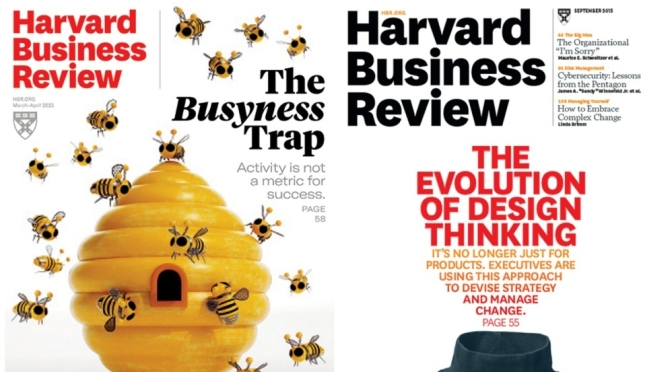
Harvard Business Review – September/October 2024

September–October 2024

Harvard Business Review (August 12, 2024) – The latest issue features Embracing Gen AI at Work: How to get what you need from this new technology…

Tom Brady on the Art of Leading Teammates

In this article, NFL great Tom Brady and Nitin Nohria, of Harvard Business School, present a set of principles that people in any realm can apply to help teams successfully work together toward common goals.close

When our society talks about success, we tend to focus on individual success. We obsess about who is the “greatest of all time,” who is most responsible for a win, or what players or coaches a team might add next season to become even better.

Where Data-Driven Decision-Making Can Go Wrong

Let’s say you’re leading a meeting about the hourly pay of your company’s warehouse employees. For several years it has automatically been increased by small amounts to keep up with inflation. Citing a study of a large company that found that higher pay improved productivity so much that it boosted profits, someone on your team advocates for a different approach: a substantial raise of $2 an hour for all workers in the warehouse. What would you do?

AI Won’t Give You a New Sustainable Advantage

History has shown that technological innovation can profoundly change how business is conducted. The steam engine in the 1700s, the electric motor in the 1800s, the personal computer in the 1970s—each transformed many sectors of the economy, unlocking enormous value in the process. But relatively few of these and other technologies went on to become direct sources of sustained competitive advantage for the companies that deployed them, precisely because their effects were so profound and so widespread that virtually every enterprise was compelled to adopt them. Moreover, in many cases they eliminated the advantages that incumbents had enjoyed, allowing new competitors to enter previously stable markets.

Harvard Business Review – July/August 2024 Issue

July–August 2024

Harvard Business Review (June 15, 2024) –

Why Entrepreneurs Should Think Like Scientists

Founders of start-ups who question and test their theories are more successful than their overly confident peers.

How to Assess True Macroeconomic Risk

Models and forecasts can be seductive, but it’s time for executives to reclaim their economic judgment.

The Middle Path to Innovation

Forget disruption and incrementalism. Here’s how to develop high-growth products in slow-growth companies.

Analysis: The Business Of Waste Management (CNBC)


CNBC (January 8, 2024) CNBC Marathon explores the economics of waste management and how the United States is solving its trash problem. In 2019, the North American waste management market reached $208 billion.

Chapters: 00:00 Introduction 00:48 How Trash Makes Money In The U.S. (Published July 2021) 15:59 How Amazon, American Airlines And Subaru Burn Waste To Make Energy (Published May 2022) 32:24 How To Clean Up The World’s Most Polluted Rivers (Published August 2022) 46:16 Where Do EV Batteries Go When They Die? (Published March 2023)

Thanks to advancements in modern chemistry and support from municipal governments, landfills have seen astonishing financial success in recent years. Burning waste to make energy is a $10 billion industry in the U.S., and the fastest growing part of the business is waste from big companies like Amazon, Subaru, Quest Diagnostics and American Airlines.

They’re part of a growing corporate movement toward “zero landfill” as pressure mounts to reach sustainability requirements. It’s estimated that every year, millions of tons of plastic enter the ocean through rivers, and as global waste generation increases, the problem is poised to worsen.

But a host of companies from Baltimore, Maryland to Bengaluru, India are working on the issue, developing novel methods to capture trash from rivers before it reaches the ocean. Dozens of electric vehicles are scheduled to debut in the next few years and over 300 million electric vehicles are expected to be on the world’s roads by 2030.

The lifetime for an EV battery is estimated to be 12 to 15 years in moderate climates, but that doesn’t mean the batteries end up in landfills when they die.

Harvard Business Review – January / February 2024

Image

Harvard Business Review (January / February 2024)

The Right Way to Build Your Brand

The best ad campaigns make a memorable, valuable, and deliverable promise to customers. 

More than a century ago the merchant John Wanamaker wryly complained, “Half the money I spend on advertising is wasted. The trouble is, I don’t know which half.” Because the proponents of advertising have always struggled to prove that the money is well spent, that indictment has long helped financial executives justify cutting ad budgets. As no less an authority than Jim Stengel, a former chief marketing officer at Procter & Gamble, has noted, the struggle continues, although huge resources go toward testing advertising copy and measuring effectiveness.

Leading in a World Where AI Wields Power of Its Own

New systems can learn autonomously and make complex judgments. Leaders need to understand these “autosapient” agents and how to work with them. 

The wheel, the steam engine, the personal computer: Throughout history, technologies have been our tools. Whether used to create or destroy, they have always been under human control, behaving in predictable and rule-based ways. As we write, this assumption is unraveling. A new generation of AI systems are no longer merely our tools—they are becoming actors in and of themselves, participants in our lives, behaving autonomously, making consequential decisions, and shaping social and economic outcomes.

Artisan Foods: How New York’s ‘Bread Alone’ Bakes 150,000 Loaves Every Week

Eater Films (November 13, 2023) – Nels Leader is the CEO of Bread Alone, an upstate New York bakery founded by his father in 1983. Today, the bakery is committed to the idea that everyone should have access to good bread — a goal it tries to achieve by baking 150,000 loaves every week.

Culture & Technology: Wired Magazine – Nov 2023

Image

WIRED MAGAZINE (October 31, 2023) – The latest issue features understanding Tik Tok and talent manager Ursus Magana; How Telegram Became a Terrifying Weapon in the Israel-Hamas War; Here’s the Truth Behind the Biggest (and Dumbest) Battery Myths, and more…

Watch This Guy Work, and You’ll Finally Understand the TikTok Era

Watch This Guy Work, and You’ll Finally Understand the TikTok Era

BRENDAN I. KOERNER

The creator economy is fragmented and chaotic. Talent manager Ursus Magana can (almost) make sense of it, with a frenetic formula for gaming the algorithms.

How Telegram Became a Terrifying Weapon in the Israel-Hamas War

Hamas posted gruesome images and videos that were designed to go viral. Sources argue that Telegram’s lax moderation ensured they were seen around the world.

Photoillustration containing a hand holding a smartphone displaying the Telegram app and scenes of the IsraelHamas...

At around 8 am local time the morning of October 7, Haaretz’s cyber and disinformation reporter, Omer Benjakob, was woken by his wife at their home in the historic port city of Jaffa. Something was happening in southern Israel, she said, but Benjakob shrugged it off, presuming “another round of the same shit.” Flare-ups between the Israel Defense Forces (IDF) and militants in southern Israel are not uncommon. “No, no,” Benjakob’s wife insisted. “It’s more serious.”

Review: Skyview 2 Wellness Table Lamp

Skyview 2 lamp

No sunlight? No problem. This wellness lamp brings dim rooms the next best thing to natural light.

Here’s the Truth Behind the Biggest (and Dumbest) Battery Myths

Heres the Truth Behind the Biggest  Battery Myths

Yes, charging your phone overnight is bad for its battery. And no, you don’t need to turn off your device to give the battery a break. Here’s why.

For an object that barely ever leaves our palms, the smartphone can sometimes feel like an arcane piece of wizardry. And nowhere is this more pronounced than when it comes to the fickle battery, which will drop 20 percent charge quicker than you can toggle Bluetooth off, and give up the ghost entirely after a couple of years of charging.

Harvard Business Review – November/December 2023

Image

Harvard Business Review (November/December 2023) –

The Resale Revolution

Increasingly, companies are reselling their own products. Should you get into the game? 

by Thomas S. Robertson 

Summary: The average U.S. household contains a trove of potentially reusable goods worth roughly $4,500. That’s a lot of trapped value, and companies are at last getting serious about accessing it—by developing new resale capabilities. Resale has been with us for a very long time, of course—at yard sales, on used-car lots, in classified ads. 

A Step-by-Step Guide to Real-Time Pricing

An advanced AI model considers much more than what competitors are charging. 

Summary: In today’s fast-paced world of digital retailing, the ability to revise prices swiftly and on a large scale has emerged as a decisive differentiator for companies. Many retailers now track competitors’ prices via systems that scrape rivals’ websites and use this information as an input to set their own prices manually or automatically. A common strategy is to charge X dollars or X percent less than a target competitor. However, retailers that use such simple heuristics miss significant opportunities to fine-tune pricing.

Analysis: China’s Large Investments In Europe

CNBC International (August 30, 2023) – China has invested heavily in Europe, particularly in the wake of the global financial crisis of 2008 when the region was strapped for cash. This means that Chinese firms are now shareholders in many key European infrastructure projects.

These include ports, wind and solar farms, telecommunications, airports – the list goes on. But there are growing fears that Beijing could use its strategic investments to further its own political ambitions. A recent dispute between the Baltic nation of Lithuania and Beijing shed light on potential reactions from China.

It’s led European governments to step up their scrutiny of Chinese investments and attempt to figure out how to redesign their relationship with Beijing. Dr Yu Jie from Chatham House told CNBC that we’re going to see more frictions regarding Chinese investment in Europe looking ahead.