
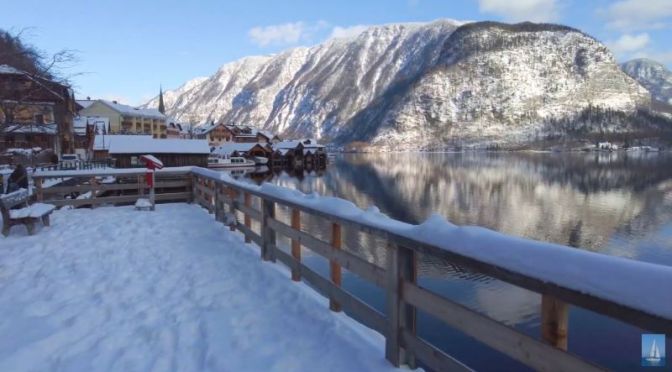
Hallstatt is a village on Lake Hallstatt’s western shore in Austria’s mountainous Salzkammergut region. Its 16th-century Alpine houses and alleyways are home to cafes and shops. A funicular railway connects to Salzwelten, an ancient salt mine with a subterranean salt lake, and to Skywalk Hallstatt viewing platform. A trail leads to the Echern Valley glacier garden with glacial potholes and Waldbachstrub Waterfall.
Tag Archives: Walking Tour Videos
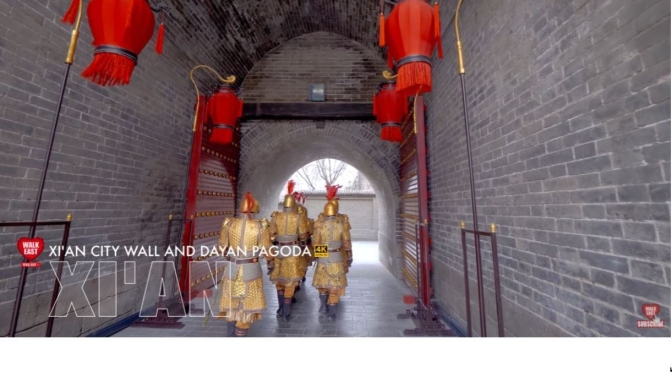
Walks In China: ‘Xi’an City Wall And Giant Wild Goose Pagoda’ (4K Video)
When Zhu Yuanzhang, the first Emperor of the Ming Dynasty (1368-1644), captured Huizhou, a hermit named Zhu Sheng admonished him that he should ‘built high walls, store abundant food supplies and take time to be an Emperor,’ so that he could fortify the city and unify the other states. After the establishment of the Ming dynasty, Zhu Yuanzhang followed his advice and began to enlarge the wall built initially during the old Tang dynasty (618 -907), creating the modern Xian City Wall. It’s the most complete city wall that has survived in China, as well being one of the largest ancient military defensive systems in the world.
As the symbol of the old-line Xi’an, Giant Wild Goose Pagoda (also called Big Wild Goose Pagoda) is a well-preserved ancient building and a holy place for Buddhists. It is located in the southern suburb of Xi’an City, about 4 kilometers (2.5 miles) from the downtown of the city. Standing in the Da Ci’en Temple complex, it attracts numerous visitors for its fame in the Buddhist religion and its simple but appealing style of construction. Giant Wild Goose Pagoda is rated as a National Key Cultural Relic Preserve as well as an AAAA Tourist Attraction.
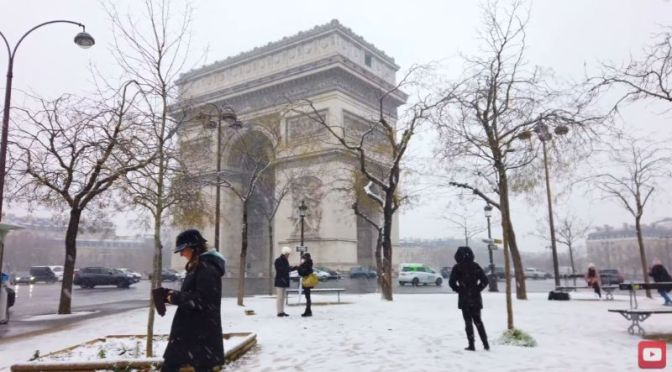
Winter Walks: ‘Arc de Triomphe & Champs-Élysées In Paris’ (Video)
Paris Snowfall 2021 – Arc de triomphe de l’Étoile , Avenue des Champs-Élysées Video filmed , January 16, 2021.
The Arc de Triomphe de l’Étoile is one of the most famous monuments in Paris, France, standing at the western end of the Champs-Élysées at the centre of Place Charles de Gaulle, formerly named Place de l’Étoile—the étoile or “star” of the juncture formed by its twelve radiating avenues.

Walking Tour: ‘American Revolution Landmarks In New York City’ (Video)
New York City LIVE: Downtown Manhattan in the American Revolution with Karen Q’s Patriot Tours.
Karen Q is a Revolutionary War and Founding Era historian. She is the author of Theodosia Burr: Teen Witness to the Founding of a New Nation, 21st Century Imprints, Lerner Books. She also appears in area Revolutionary War reenactments as “Mrs. Q”. Karen is a regular cast member of the Travel Channel’s *Mysteries at the Museum* and has appeared on more than twenty episodes. You can see a full list of episodes here.

Walking Tour: ‘Dortmund – Germany’ (4K Video)
Dortmund is a city in Germany’s North Rhine-Westphalia region. It’s known for its Westfalen Stadium, home to the Borussia soccer team. Nearby Westfalen Park is marked by the Florian Tower, with its observation platform. The Dortmund U-Tower is topped by a huge letter U and houses Museum Ostwall’s contemporary art exhibits. Rombergpark botanical garden has local trees and greenhouses with cacti and tropical plants.

Walks: ‘Ortigia Island, Syracuse In Sicily’ (Video)
Ortygia is a small island which is the historical centre of the city of Syracuse, Sicily. The island, also known as the Città Vecchia, contains many historical landmarks. The name originates from the ancient Greek ortyx, which means “Quail”.
Video timeline: 0:00 Drone intro and Map 1:59 Walk begins at Ponte Umbertino 3:41 Archimedes Statue 6:59 Temple of Apollo 8:26 Outdoor Market 15:42 Temple of Apollo 18:24 Via Cavour 22:58 Piazza Duomo 23:43 Cathedral of Syracuse 31:24 Piazza Minerva 33:21 Via Roma 34:56 Piazza Archimede 36:53 Fish House Art Gallery 41:06 Porta Marina 42:07 Foro Vittorio Emanuele II 48:43 Giardino Aretusa 50:54 Lungomare and Arethusa Spring 57:30 Ortigia Promenade 1:07:35 Forte Vigliena 1:15:40 Jewish Quarter 1:20:24 Piazza Minerva 1:24:58 Largo Aretusa 1:26:59 Lungomare and Arethusa Spring

Walks: ‘Lloret De Mar Beach’, Costa Brava, Spain
Walking from the viewpoint of Dona Marinera along the Platja de Lloret de Mar Beach and boulevard.
Lloret de Mar is a Mediterranean coastal town in Catalonia, Spain. It is 40 kilometres (25 miles) south of Girona and 75 kilometres (47 miles) northeast of Barcelona. With a population of 39,364 in 2009, it is the second largest town in the Selva comarca of Catalonia.
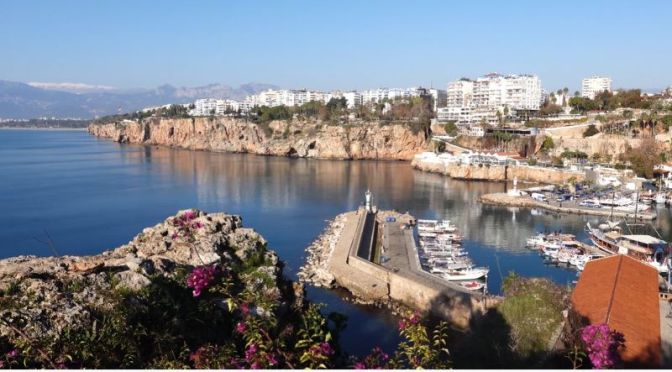
Walking Tours: ‘Antalya – Turkey’ (4K Video)
Antalya is a Turkish resort city with a yacht-filled Old Harbor and beaches flanked by large hotels. It’s a gateway to Turkey’s southern Mediterranean region, known as the Turquoise Coast for its blue waters. Remnants remain from Antalya’s time as a major Roman port. These include Hadrian’s Gate, built to honor the Roman emperor’s visit in 130 A.D and 2nd-century Hidirlik Tower, with harbor views.
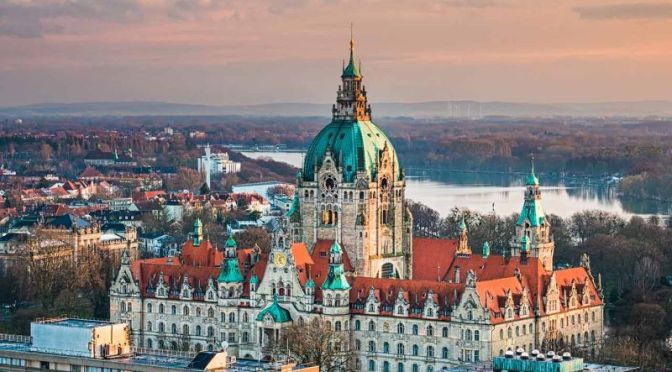
Walking Tour: ‘Hanover – Germany’ (4K UHD Video)
Hanover is the capital and largest city of the German state of Lower Saxony. Its 535,061 inhabitants make it the 13th-largest city in Germany as well as the third-largest city in Northern Germany after Hamburg and Bremen.
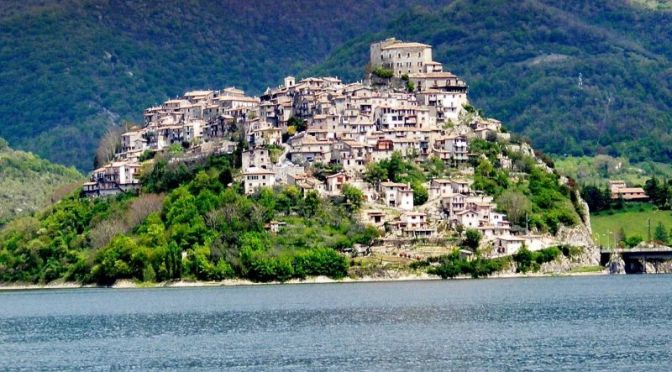
Hilltop Village Walks: ‘Castel di Tora, Italy’
Castel di Tora is a comune in the Province of Rieti in the Italian region Lazio, located about 50 kilometres northeast of Rome and about 20 kilometres southeast of Rieti. Castel di Tora borders the following municipalities: Ascrea, Colle di Tora, Pozzaglia Sabina, Rocca Sinibalda, Varco Sabino.
The first historical evidence of this village dates back to 1035, when in some chronicles there is talk of a Castrum Vetus de Ophiano, and up to 1864 in fact the village had Castelvecchio as its name. The current name was intended to be linked to an ancient Roman settlement called Tora, where in 251 AD. the martyrdom of Santa Anatolia took place. For centuries it was called “Castelvecchio”, a name changed after the unification of Italy in 1864 to that of Castel di Tora, in memory of an ancient Roman Sabine pagus called Thora Thiora. The Abbey of Farfa owned the territory of Castel di Tora. Subsequently the property belonged to the Buzi – Brancaleoni and then to the Mareri, to whom it was confiscated in 1241 by Frederick II of Swabia. In 1440 the fief of Castelvecchio passed to the Orsini and from 1558 to 1570 to the Estouteville and then passed to the Borghese. From this period there remains the testimony of a painting (1601) by the Flemish painter Paul Bril, with a harsh landscape with two castles guarding the gorge formed by the Turano. In the years 1935-38 the Posticciola dam was built and the Turano artificial lake was created which submerged the most fertile soils of the valley, causing a strong emigration of the local population. In recent years, there has been a complete transformation of the local economy, which from agriculture and pastoralism is progressively transforming and moving towards the tertiary sector of trade and tourism.
 Boomers Daily