
Tag Archives: The Economist Magazine

Previews: The Economist Magazine – July 22, 2023

Image

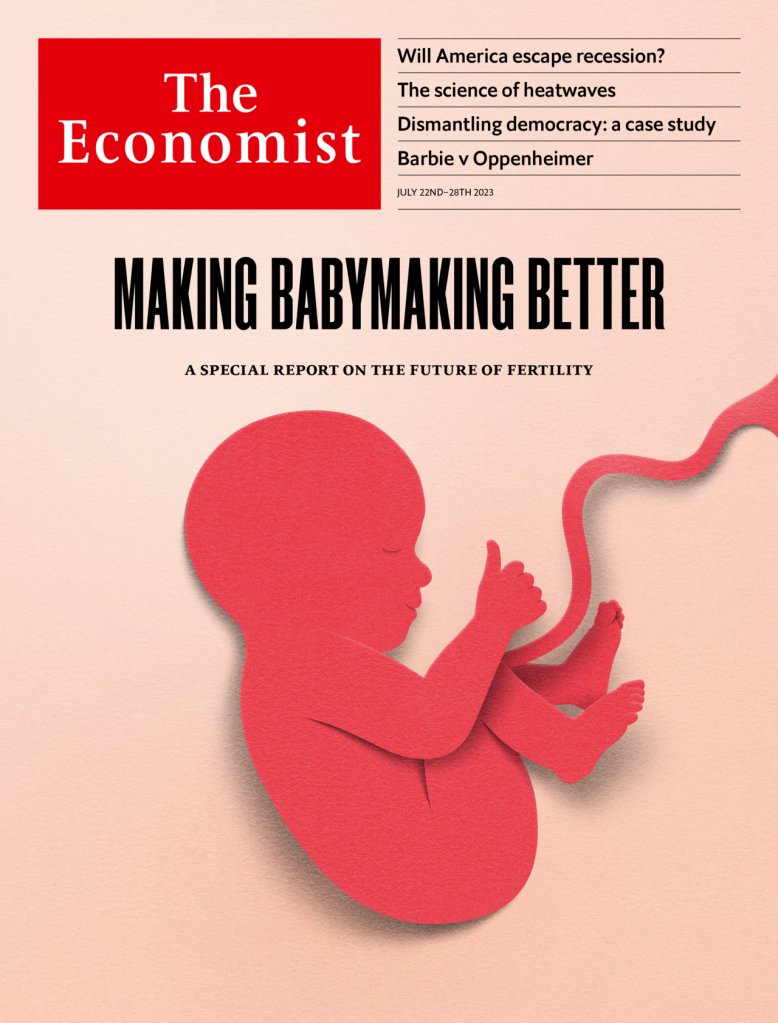
The Economist Magazine- July 22, 2023 issue: Making babymaking better – A special report on the future of fertility; How Cities can respond to Extreme Heat; The World Economy is still in danger, and more…

IVF is failing most women. But new research holds out hope

Fertility is still poorly understood

A smiling fetus with it's thumb up

After louise brown was born in Manchester in July 1978, her parents’ neighbours were surprised to see that the world’s first “test-tube baby” was “normal”: two eyes, ten fingers, ten toes. In the 45 years since, in vitro fertilisation has become the main treatment for infertility around the world. At least 12m people have been conceived in glassware. An ivf baby takes its first gulp of air roughly every 45 seconds. ivf babies are just as healthy and unremarkable as any others. Yet to their parents, most of whom struggle with infertility for months or years, they are nothing short of miraculous.

How cities can respond to extreme heat

Officials from Beijing to Phoenix are grappling with unbearable temperatures

A man pours water on his head to cool off amid searing heat in Phoenix, Arizona.

The best thing that has happened in Phoenix, Arizona, since the beginning of July is that the electricity grid has kept functioning.

This has meant that during a record-breaking run of daily maximum temperatures above 43°C (110°F), still in progress as The Economist went to press, the houses, indoor workplaces and publicly accessible “cooling stations” in the city have been air-conditioned. There have been deaths from heat stroke and there will be more; there has been a lot of suffering; and there will have been real economic losses. But if Arizona’s grid had gone out, according to an academic quoted in “The Heat Will Kill You First”, a new book, America would have seen “the Hurricane Katrina of extreme heat”.
Previews: The Economist Magazine – July 1, 2023

Image

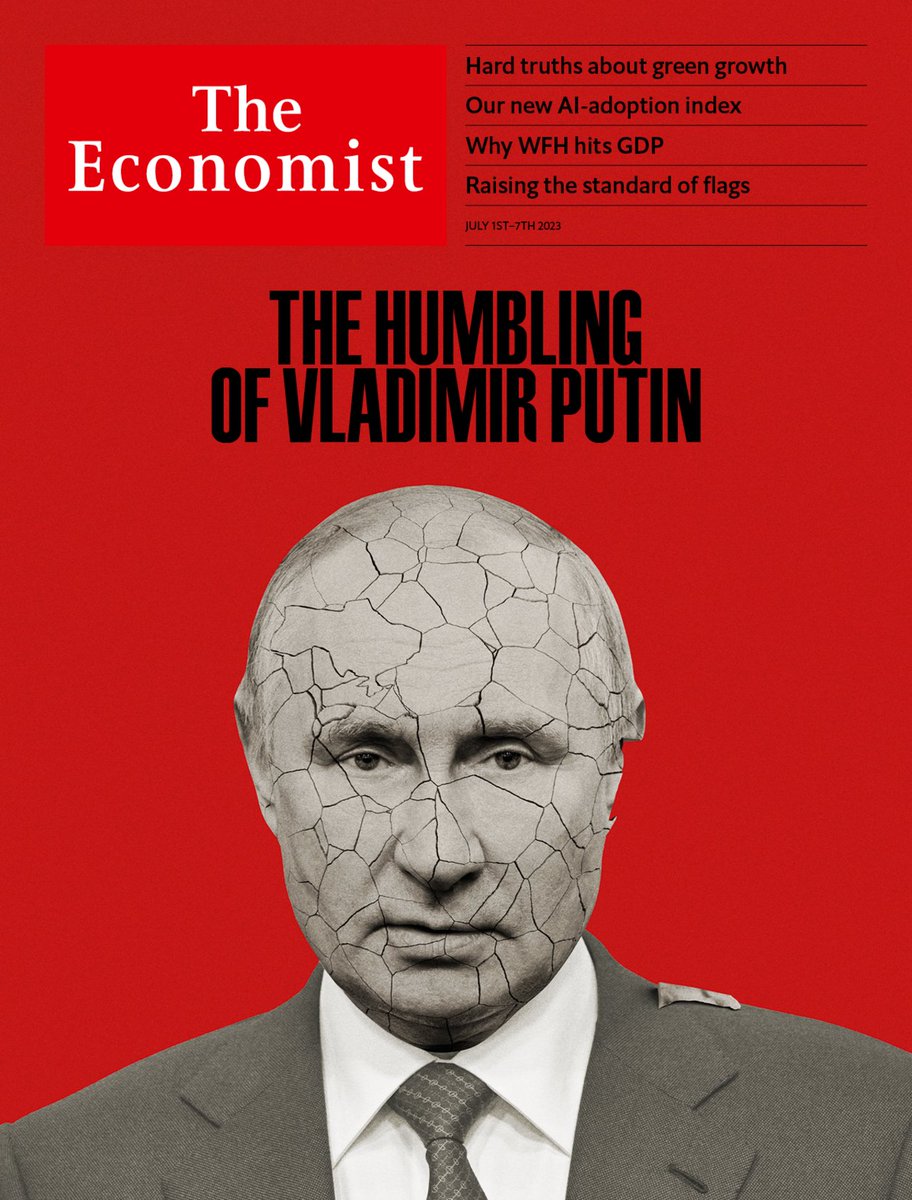
The Economist Magazine- June 24, 2023 issue: The humbling of Vladimir Putin; The Wagner mutiny has left Vladimir Putin looking dangerously exposed; Can Ukraine capitalise on chaos in Russia?

The humbling of Vladimir Putin

The Wagner mutiny exposes the Russian tyrant’s growing weakness. But don’t count him out yet

Can Ukraine capitalise on chaos in Russia?

Ukrainian militaries supervise as a M142 HIMARS launches a rocket towards Bakhmut Ukraine

Ukraine’s counter-offensive is going slowly

The Wagner mutiny has left Putin dangerously exposed

Factions close to the Russian president are thinking about life after him

Previews: The Economist Magazine – June 24, 2023

Image

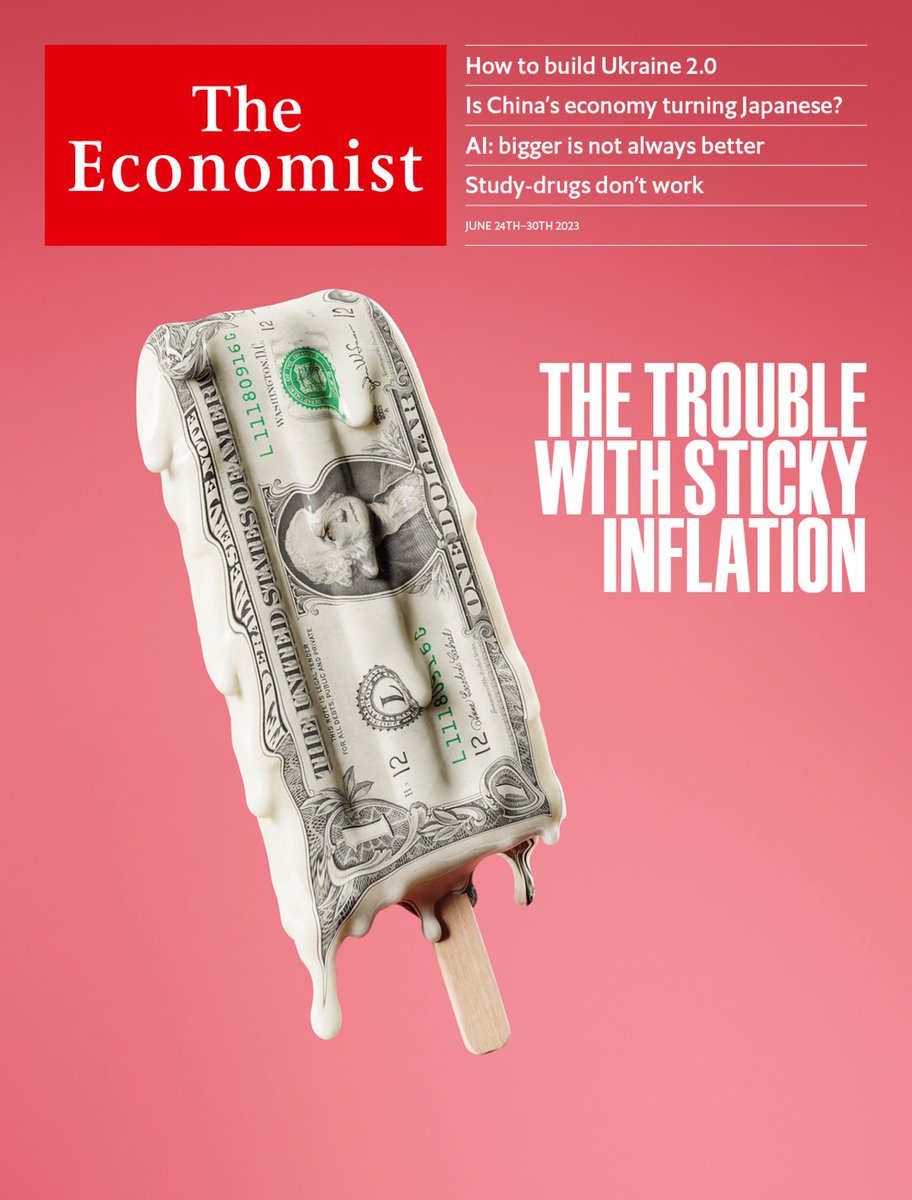
The Economist Magazine- June 24, 2023 issue:

Investors must prepare for sustained higher inflation

The costs of taming price rises could prove too unpalatable for central banks

At first glance the world economy appears to have escaped from a tight spot. In the United States annual inflation has fallen to 4%, having approached double digits last year. A recession is nowhere in sight and the Federal Reserve has felt able to take a break from raising interest rates. After a gruesome 2022, stockmarkets have been celebrating: the s&p 500 index of American firms has risen by 14% so far this year, propelled by a resurgence in tech stocks. Only in Britain does inflation seem to be worryingly entrenched.

Building Ukraine 2.0

For Russia’s war to fail, Ukraine must emerge prosperous, democratic and secure

Ukraine’s war is raging on two fronts. On the 1,000km battlefront its armies are attacking the Russians’ deep defences. At the same time, on the home front Ukraine is defining what sort of country it will be when the fighting stops. Both matter, and both will pose a severe test for Ukraine and its backers.

America wants to lower tensions with Iran. Good

Now is the time to buy some time

Iran cannot rival Ukraine and Taiwan for headlines, but it could soon prove as dangerous as either. Its nuclear-weapons programme has put its regime in a position to dash for a bomb. Because full-blown negotiations are impossible, the threat could yet draw the Middle East into war—including through American strikes on Iranian nuclear facilities. That is why it is good that the Biden administration is seeking to lower tensions.

Previews: The Economist Magazine – June 17, 2023

Image

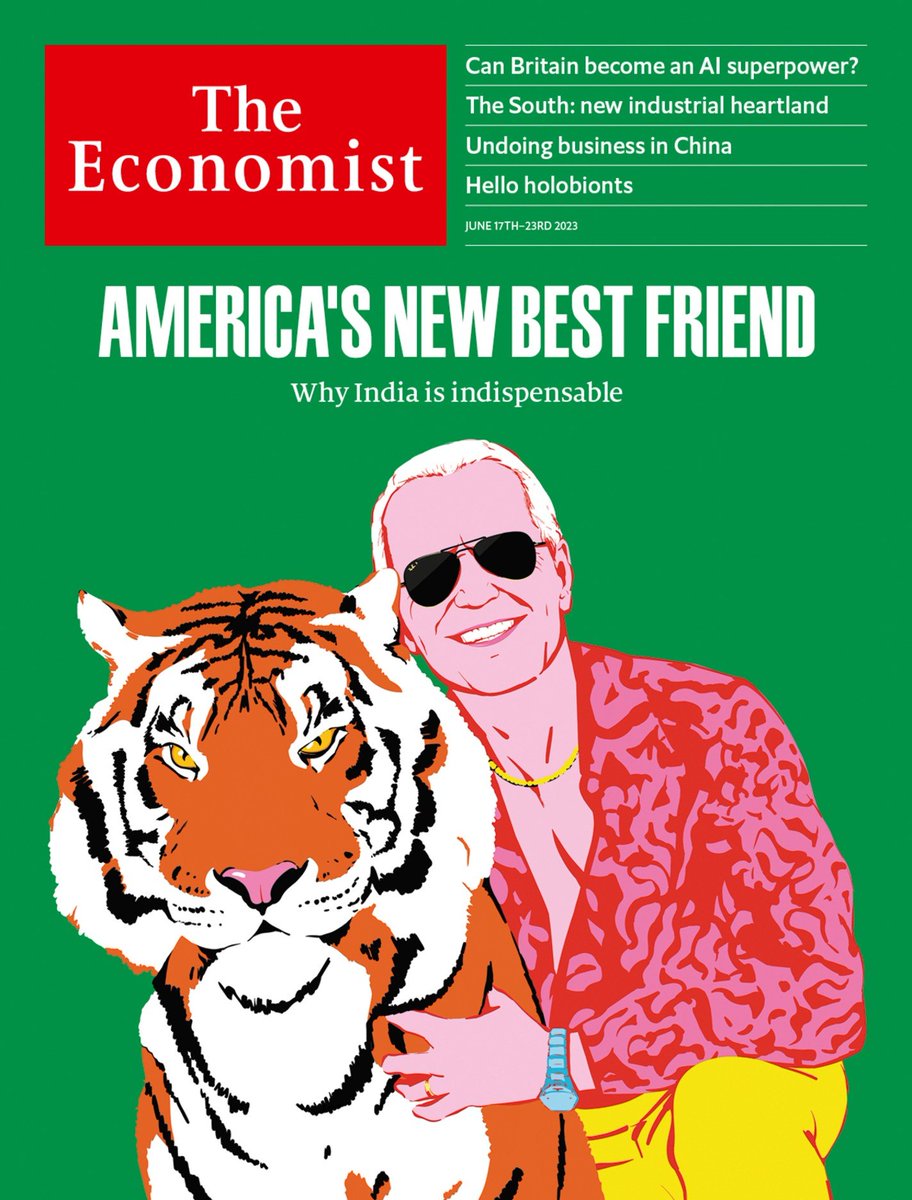
The Economist Magazine– June 17, 2023 issue: America’s new best friend – Why India is indispensable.

Joe Biden and Narendra Modi are drawing their countries closer

India does not love the West, but it is indispensable to America

No country except China has propped up Russia’s war economy as much as oil-thirsty India. And few big democracies have slid further in the rankings of democratic freedom. But you would not guess it from the rapturous welcome Narendra Modi will receive in Washington next week. India’s prime minister has been afforded the honour of a state visit by President Joe Biden. The Americans hope to strike defence deals.

Lula’s ambitious plans to save the Amazon clash with reality

The Brazilian president faces resistance from Congress, the state oil company and agribusiness

Ukraine’s counter-offensive is making mixed progress

Its real test will come when it hits Russia’s prepared defences

Charlemagne: Why Europe’s asylum policy desperately needs rebooting

A deadly shipwreck in Greek waters highlights its dangers

Previews: The Economist Magazine – June 10, 2023

Image

The Economist Magazine– June 10, 2023 issue:

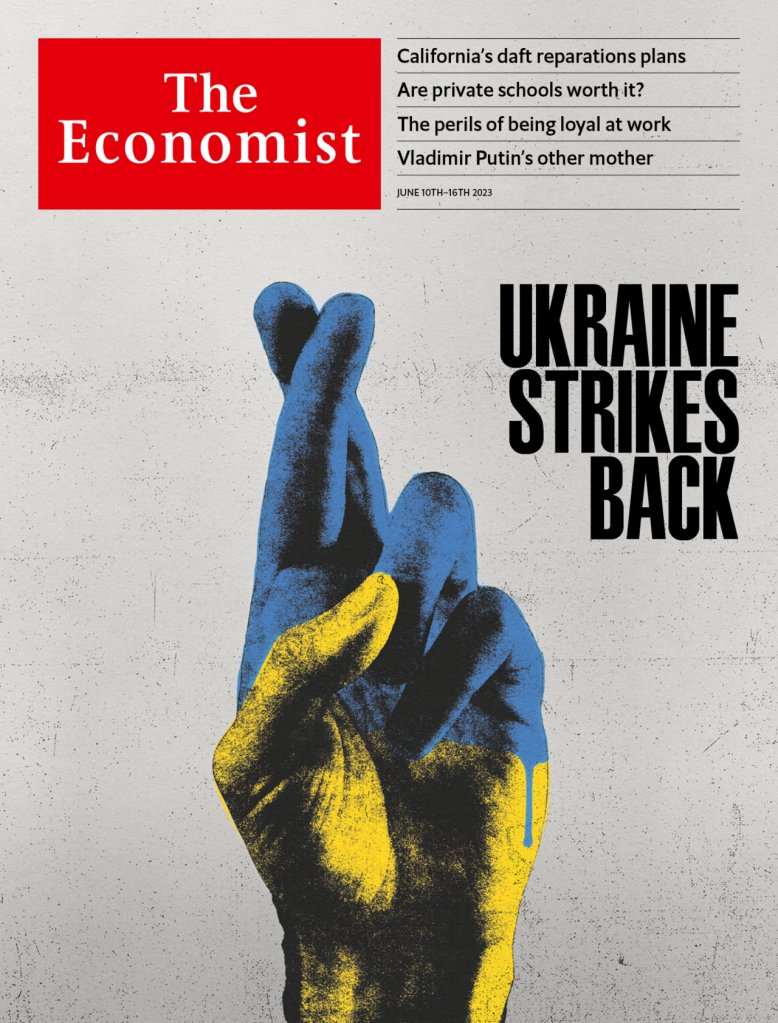
Ukraine strikes back


The counter-offensive is getting under way. The next few weeks will be critical

Trailed ten days early with a blood-stirring video in which Ukrainian troops asked God to bless their “sacred revenge”, Ukraine’s counter-offensive is under way. For weeks its armed forces have conducted probing and shaping operations along the 1,000km front line, looking for weaknesses and confusing the Russians. Now Ukraine is testing enemy defences with an intensity not seen for months, with attacks against the occupiers in a series of positions in the east and south. The apparent demolition of the Kakhovka dam on June 6th, if it was indeed Russian sabotage as Western military sources believe, would be clear evidence that they are already feeling the pressure.

Apple’s Vision Pro is an incredible machine. Now to find out what it is for

The meaning of “spatial computing”

No one shows off a new gadget quite like Apple. But the device that Tim Cook unveiled on June 5th was billed as something more significant. The Vision Pro, a pair of sleek glass goggles, represents “an entirely new spatial-computing platform”, said Apple’s boss, comparing its launch to that of the Macintosh and the iPhone. Apple’s message is clear: after desktop and mobile computing, the next big tech era will be spatial computing—also known as augmented reality—in which computer graphics are overlaid on the world around the user.

California’s reparations scheme is bad policy and worse politics

Democrats should ditch it in favour of ideas that Americans actually support

Previews: The Economist Magazine – June 3, 2023

Image

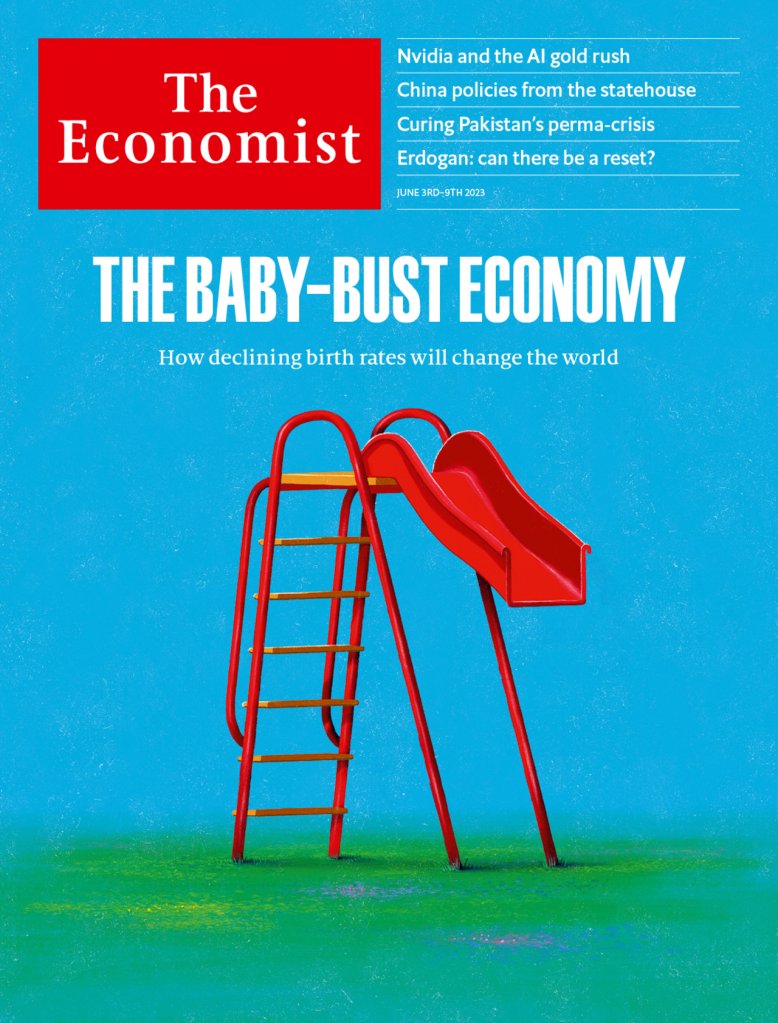
The Economist Magazine– June 3, 2023 issue: The baby-bust economy: How declining birth rates will change the world.

Global fertility has collapsed, with profound economic consequences

What might change the world’s dire demographic trajectory?

In the roughly 250 years since the Industrial Revolution the world’s population, like its wealth, has exploded. Before the end of this century, however, the number of people on the planet could shrink for the first time since the Black Death. The root cause is not a surge in deaths, but a slump in births. Across much of the world the fertility rate, the average number of births per woman, is collapsing. Although the trend may be familiar, its extent and its consequences are not. Even as artificial intelligence (ai) leads to surging optimism in some quarters, the baby bust hangs over the future of the world economy.

How to make the re-election of Recep Tayyip Erdogan less bad news

Turkish President and People's Alliance's presidential candidate Recep Tayyip Erdogan gestures to supporters at the presidential palace, in Ankara, Turkey, Sunday, May 28, 2023. Turkey President Recep Tayyip Erdogan won reelection Sunday, extending his increasingly authoritarian rule into a third decade as the country reels from high inflation and the aftermath of an earthquake that leveled entire cities. (AP Photo/Ali Unal)

There is a chance for a partial reset

It certainly wasn’t fair. Nor was it entirely free. But, like it or not, the victory on May 28th of Recep Tayyip Erdogan in Turkey’s presidential election is a fact. For the next five years Turkey, Europe and the wider world will have to deal with a prickly and authoritarian populist. That is bad news on many fronts: economically, democratically and regionally. And yet pragmatists have a duty to search for chinks of light in the gloom.

It’s not just a fiscal fiasco: greying economies also innovate less

That compounds the problems of shrinking workforces and rising bills for health care and pensions

“Adam is a special child,” says the voice-over, as the camera pans across abandoned classrooms and deserted maternity wards. “He’s the last child born in Italy.” The short film made for Plasmon, an Italian brand of baby food owned by Kraft-Heinz, a giant American firm, is set in 2050. It imagines an Italy where babies are a thing of the past. It is exaggerating for effect, of course, but not by as much as you might imagine. The number of births in Italy peaked at 1m in 1964; by 2050, the un projects, it will have shrunk by almost two-thirds, to 346,000.

Previews: The Economist Magazine – May 27, 2023

Image

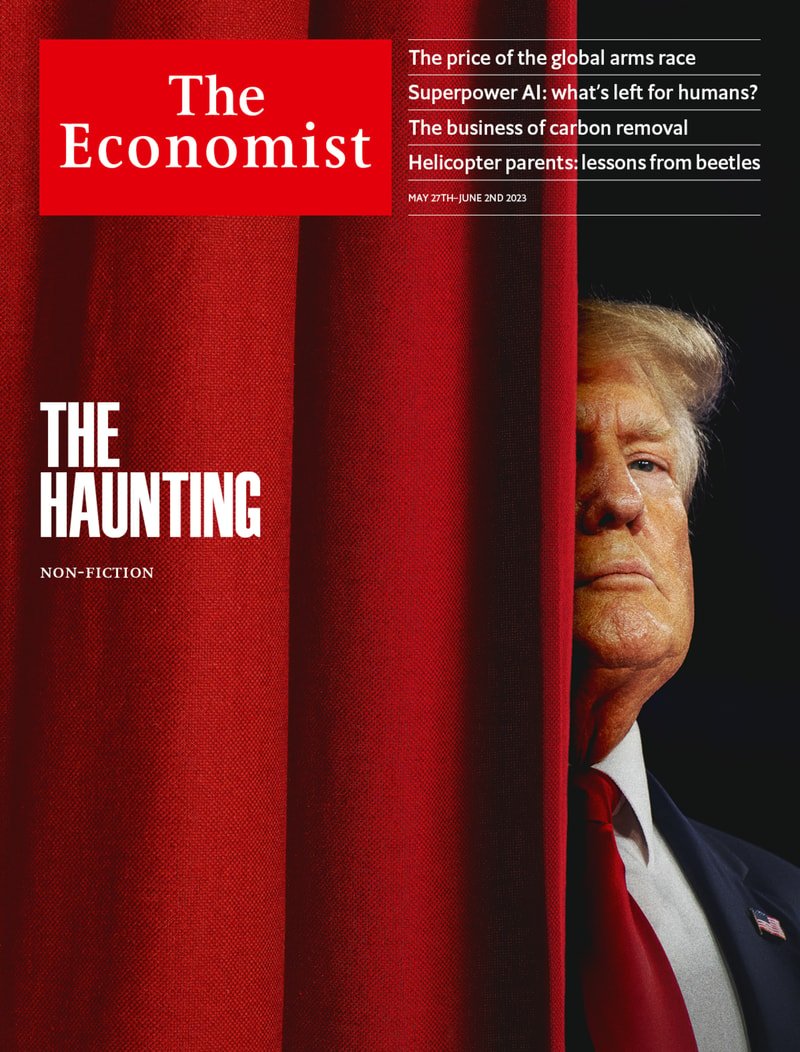
The Economist Magazine– May 27, 2023 issue: The race to become the Republican nominee for the presidential election in America next year is properly under way. And Donald Trump has a huge, perhaps insurmountable, lead. 

Ron DeSantis has little chance of beating Donald Trump

Hopes of depriving the former president of the Republican nomination are fading

Belatedly and nervously, the would-be assassins have been lining up. On May 22nd Tim Scott, a senator from South Carolina, became the latest Republican to announce a run for president. Greater fanfare accompanied the official declaration (on Twitter) on May 24th that Ron DeSantis, the governor of Florida, is joining the race for the Republican nomination. He has been widely heralded as the candidate with the best chance of defeating the favourite, Donald Trump. But even as more plotters step forward, the chances of a successful coup to overthrow Mr Trump are growing slimmer by the day.

What would humans do in a world of super-AI?

A thought experiment based on economic principles

In “wall-e”, a film released in 2008, humans live in what could be described as a world of fully automated luxury communism. Artificially intelligent robots, which take wonderfully diverse forms, are responsible for all productive labour. People get fat, hover in armchairs and watch television. 

Hungary is becoming more important to China

Viktor Orban and Xi Jinping bond over their anti-Americanism

To ears accustomed to a swelling chorus of China-scepticism in the European Union, the language of Hungarian diplomats is striking. Not for them the common talk of European officials about the need to “de-risk” relations with China and to treat it as a “systemic rival”. Co-operation between Hungary and China presents “opportunities rather than risks”, said Hungary’s foreign minister, Peter Szijjarto, in Beijing on May 15th. Wang Yi, China’s foreign-affairs overlord, told him that relations between the countries had entered their “best period in history”.

Previews: The Economist Magazine – May 20, 2023

Business | May 20th 2023 Edition

The Economist – May 20, 2023 issue:

Joe Biden’s global vision is too timid and pessimistic

The president underestimates America’s strengths and misunderstands how it acquired them

In the 1940s and early 1950s America built a new world order out of the chaos of war. For all its shortcomings, it kept the peace between superpowers and underpinned decades of growth that lifted billions out of poverty. Today that order, based on global rules, free markets and an American promise to uphold both, is fraying. Toxic partisanship at home has corroded confidence in America’s government. 

China and the West take a step to ease Africa’s debt crisis

A deal for Ghana is the first test case for a new approach

A man holds a 100 cedis, the Ghana currency, note in Accra, Ghana, on December 1, 2022. - Ghana is battling its worst economic crisis in decades.The government on December 14, 2022 signed a $3 billion bailout deal with the International Monetary Fund in a bid to shore up its public finances, but economic stability is still a way off.Once applauded as a haven of economic stability and security in a region plagued by coups and jihadist wars, Ghana has steadily lost investor confidence as its economy slipped into crisis. (Photo by Nipah Dennis / AFP) (Photo by NIPAH DENNIS/AFP via Getty Images)

Ghana made history when it led the wave of sub-Saharan African countries that won independence more than six decades ago. It may now be making history again, as the first test case for a new approach to debt relief. China and Western governments may have overcome one barrier to restructuring the billions of dollars owed by countries with unsustainable debts.

Previews: The Economist Magazine – May 13, 2023

Is Chinese power about to peak? | The Economist

The Economist – May 6, 2023 issue:

Is Chinese power about to peak?

The country’s historic ascent is levelling off. That need not make it more dangerous

The rise of China has been a defining feature of the world for the past four decades. Since the country began to open up and reform its economy in 1978, its gdp has grown by a dizzying 9% a year, on average. That has allowed a staggering 800m Chinese citizens to escape from poverty. Today China accounts for almost a fifth of global output. The sheer size of its market and manufacturing base has reshaped the global economy. Xi Jinping, who has ruled China for the past decade, hopes to use his country’s increasing heft to reshape the geopolitical order, too.

Small, sensible steps could help ease America’s border woes

The art of the practical in dealing with migrants, drugs and gangs

The rehabilitation of Syria’s dictator raises awkward questions for the West

Clearer principles about how and when to ease sanctions are needed

Previews: The Economist Magazine – May 6, 2023

Much of the Earth remains unexplored | The Economist

The Economist – May 6, 2023 issue:

Governments are living in a fiscal fantasyland

The world over, they are failing to confront the dire state of their finances

If Turkey sacks its strongman, democrats everywhere should take heart

After 20 years of increasingly autocratic rule, Recep Tayyip Erdogan risks eviction by voters

Time to engage (very carefully) with the Taliban

Isolating the mullahs is not working. The West needs a more constructive approach