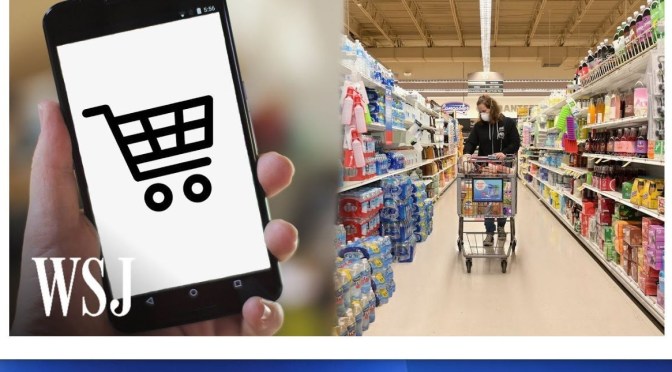
Will the coronavirus pandemic lead to long-term changes in how we shop for food? To better understand the challenges facing grocery stores, WSJ’s Alexander Hotz spoke with an industry insider, a store owner and a Walmart executive.

Will the coronavirus pandemic lead to long-term changes in how we shop for food? To better understand the challenges facing grocery stores, WSJ’s Alexander Hotz spoke with an industry insider, a store owner and a Walmart executive.
 Food and medicine shopping is essential during the COVID-19 pandemic, but requires getting out and standing close to strangers at a time when social distancing and sheltering-in-place are recommended to slow spread of disease.
David Aronoff, MD, director of the Division of Infectious Diseases at Vanderbilt University in Nashville, explains how to minimize COVID-19 risk while shopping.

From and Albertson Companies online news release:
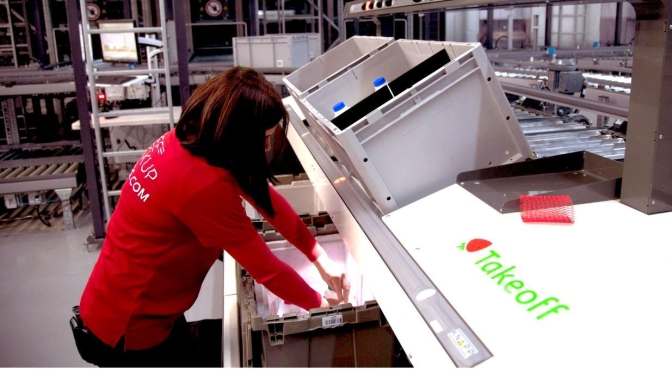
 “The micro-fulfillment center model is a key element in the store of the future,” said Vivek Sankaran, Albertsons Companies President and Chief Executive Officer. “It combines the efficiency of automation with the ease of meeting customers when and how they want to shop. In working with Takeoff, we can evolve how the MFC ties into our store and e-commerce ecosystems and accelerate our path to best serve our customers.”
December 12, 2019 – Albertsons Companies and Takeoff Technologies are teaming up to collaborate on the future of grocery micro-fulfillment centers (MFC). The two companies have decided to form a strategic partnership with dedicated teams to collaborate on the evolution of the microfulfillment capabilities to drive the future of e-commerce order fulfillment.
 Albertsons Cos., which operates stores in 8 out of 10 of the largest MSA’s in the United States, has also agreed to purchase additional MFCs from Takeoff and is evaluating market expansion opportunities. Albertsons Cos. and Takeoff worked closely together on the successful implementation of the company’s first MFC in South San Francisco in October 2019.
To read more: https://www.albertsonscompanies.com/newsroom/12-12-19-albertsons-companies-takeoff-develop-strategic-partnership.html
From a RetailDive.com online article:
 ThredUp, which sells brands ranging from American Eagle Outfitters to Burberry, may prove to be a beneficial partner to many retailers. A separate report from Accenture Strategy and Fashion For Good found that recommerce operating margin for the luxury, premium and mid-market sectors was 39%, 28% and 22%, respectively.
This year could be considered the year the circular economy really took hold, particularly the resale space, and a major force leading the charge was e-commerce  platform ThredUp.
Resale grew 21 times faster than the apparel market over the past three years, by ThredUp’s own measures. The resale platform also projects the market to grow from $24 billion to $51 billion by 2023.
To read more: https://www.retaildive.com/news/disruptor-thredup-dive-awards/566185/
From a Grocery Dive online review:
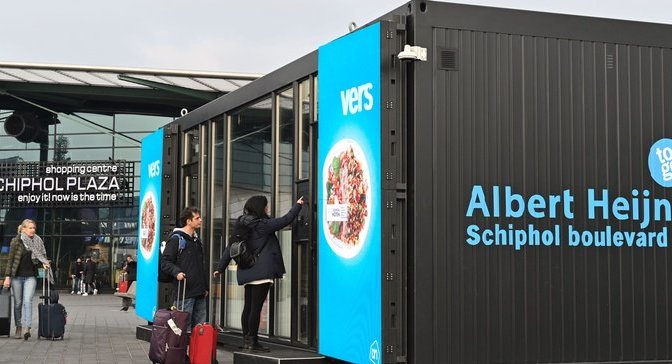
 Shoppers have to use a debit card at the door to gain entry to the store. Then they can shop for products and just walk out. Upon exit, customers can verify their purchases against the receipt. No cash is accepted.
“This speaks to the original design thinking behind NanoStore: to make a plug-and-play modular store so it can be easily placed and moved where people need it the most,”
Albert Heijn first unveiled the fully digital store under its AH To Go name in September at its headquarters in Zaandam in the Netherlands, where it was open only to employees. The move to Schiphol Airport gives the company an opportunity to pilot the technology with consumers in a highly trafficked area.
To read more: https://www.grocerydive.com/news/ahold-delhaizes-nanostore-heads-to-the-airport/568170/
From a RetailDive.com online release:
 In addition to the pop-up Worn Wear store, Patagonia also has Worn Wear mobile repair stations, which visit a variety of locations, including Patagonia stores, specialty retailers, ski resorts and colleges to offer up their refurbishment capabilities. The mobile stations have been to over 135 locations so far, according to the release, and will fix products from any brand.
 Patagonia on Thursday opened its first ever physical store for Worn Wear, Patagonia’s resale business. The store is a pop-up in Boulder, Colorado, which will stay open until February 2020, according to a press release emailed to Retail Dive.
The pop-up will be stocked with only Worn Wear products, as well as the outdoor retailer’s ReCrafted Collection, which sells clothes made from apparel that was beyond repair. In addition to selling used gear, the pop-up shop will host repair and upcycling workshops.
To read more: https://www.retaildive.com/news/patagonia-opens-first-worn-wear-store/567533/

 Boomers Daily