Tag Archives: Politics

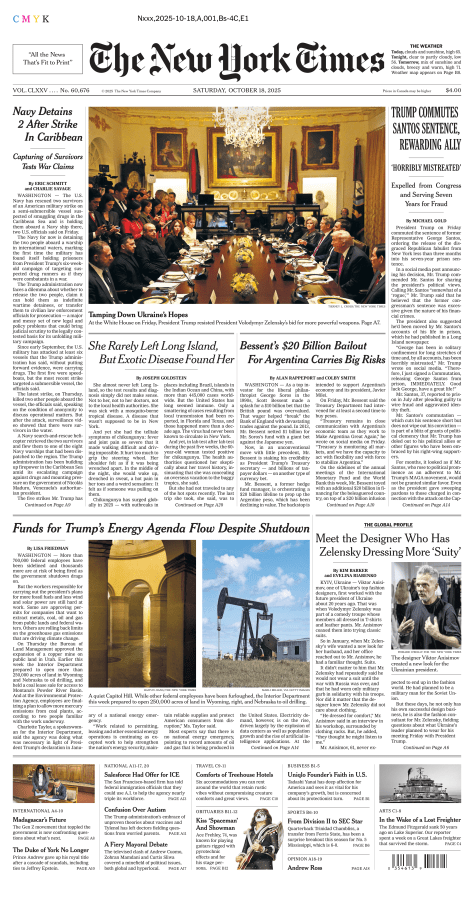
THE NEW YORK TIMES – SUNDAY, JULY 6, 2025

Image

Desperate Search for Missing in Texas Floods as Death Toll Passes 50

Some two dozen girls from a summer camp are among those unaccounted for. More rain and flash floods could hit already-devastated areas today.

As Floods Hit, Important Roles Were Vacant at Weather Service Offices in Texas

Some experts say staff shortages might have complicated forecasters’ ability to coordinate responses with local emergency management officials.

China and Russia Keep Their Distance From Iran During Crisis

Some U.S. officials talked about an “axis” of authoritarian nations, but the American and Israeli war with Iran has exposed the limits of that idea.

With One War Over, Netanyahu Heads to Washington Amid Calls to End Another

Prime Minister Benjamin Netanyahu of Israel is set to meet with President Trump on Monday as attention has turned from Iran to a cease-fire for Gaza.

Khamenei Appears in Public for First Time Since Israel War Began

THE NEW YORK TIMES MAGAZINE – JULY 6, 2025

Current cover

THE NEW YORK TIMES MAGAZINE: The 7.06.25 Issue features Nick Confessore on how the trans rights movement bet on the Supreme Court in U.S. v Skrmetti and lost; Charles Homans on Trump’s fight with Los Angeles on immigration; Oliver Whang on Luke Littler, an 18-year-old darts prodigy; and more.

Democrats Denied This City Had a Gang Problem. The Truth Is Complicated.

Trump’s claim that Venezuelan criminals took over Aurora, Colorado, became a rationale for his immigration crackdown. What really happened there?

Seven Chaotic Months in the Life of a New Federal Judge

Amir Ali joined the D.C. Federal District Court just weeks before Trump took office. It’s been tumultuous ever since.

By Emily Bazelon and Mattathias Schwartz

The Trick to Watching the Tour de France? Ignore the Stars.

Netflix’s new docuseries tries to wring drama from the best cyclists. But the real poetry is found among the riders surrounding them.

By Jane Ackermann

Read this issue

THE NEW YORK TIMES – SATURDAY, JULY 5, 2025

Image

Desperate Search After Texas Floods Kill at Least 24

As Many as 25 Girls Missing From Camp Along River

The authorities said that emergency workers in Texas had rescued more than 230 people. Flooding continued in some areas.

The Cost of Victory: Israel Overpowered Its Foes, but Deepened Its Isolation

The nation is more secure from threats than ever. But the war in Gaza, and attacks on Iran and Lebanon, have undercut its standing among the world’s democracies.

Hamas Says It Is Ready to Negotiate Truce Proposal

It was not immediately clear whether the group was demanding any significant changes to the plan for a 60-day truce and talks on a permanent end to the war.

REVIEW: “A BIG, BEAUTIFUL BILL AND AN EVEN BIGGER DEBT: THREE PERSPECTIVES”

The following is an in-depth analysis of President Trump’s “One Big Beautiful Bill Act” written by ChatGPT from important, bi-partisan fiscal, economic and political sources, all listed below:

If there is one unassailable truth in American political life, it is that no grand legislative gesture arrives without the promise of prosperity—and the prospect of unintended consequences. Donald Trump’s “One Big Beautiful Bill,” signed into law on July 4th, stands as a monument to this dynamic: a sprawling package of permanent tax cuts, entitlement retrenchments, and fresh spending, all wrapped in a populist bow and accompanied by the familiar refrain that the deficits will somehow pay for themselves.

To understand the bill’s import—and its likely fallout—it helps to consider three vantage points. The first is that of Milton Friedman, who would see in these provisions a laboratory for the free market, tempered by fiscal illusions. The second is Paul Krugman’s, for whom this is a brazen experiment in upward redistribution. The third is David Stockman’s, whose uniquely jaundiced eye discerns an unholy alliance of crony capitalism and debt-fueled political theatre.

Friedman, the Nobel laureate and evangelist of free enterprise, might first commend the bill’s unapologetic tax relief. A permanent extension of the 2017 tax cuts is precisely the sort of measure he once called “a way to restore incentives, reduce distortions, and reward enterprise.” For Friedman, a tax system ought to be predictable, broad-based, and minimally intrusive. In this sense, the bill’s elimination of taxes on tips and overtime income, coupled with higher thresholds for the estate tax, will likely increase the incentive to work, save, and invest.

Yet Friedman would be quick to warn that no tax cut exists in a vacuum. The real test of fiscal virtue, he always argued, is not in slashing tax rates but in restraining spending. This bill, by combining aggressive tax cuts with continued defense expansions and only partial reductions to social spending, falls short of the discipline he prescribed. The result, Friedman would say, is a structural deficit that will eventually require either inflation or future tax hikes. “There is no such thing as a free lunch,” he liked to remind audiences. This is a lunch billed to generations unborn.

Krugman, viewing the same legislation, would perceive not a triumph of market freedom but an egregious abdication of public responsibility. He has long argued that the most misleading idea in modern politics is the notion that tax cuts inevitably pay for themselves. As the Congressional Budget Office’s scoring shows, the bill is likely to add over $3 trillion to the national debt in the next decade, even after accounting for higher GDP. Krugman would note that the permanent nature of the cuts deprives lawmakers of future leverage and crowds out investments in education, infrastructure, and health.

More pointedly, Krugman would argue that the bill’s distributional impact is regressive by design. Expanded deductions for capital gains and estates, the restoration of a higher SALT cap, and corporate incentives all tilt the benefits toward the affluent, while Medicaid cuts and SNAP work requirements fall hardest on those with the least. In Krugman’s view, this is not simply poor economics but a moral failing: a return to what he calls “the era of Dickensian inequality, dressed up in the rhetoric of growth.”

Yet the critique most likely to sting is the one that David Stockman would deliver. Unlike Krugman, Stockman began as a champion of supply-side tax reform. But he has since become its most unflinching critic. To him, the “Big Beautiful Bill” represents the final stage of a fiscal derangement decades in the making: a bipartisan addiction to borrowing and a refusal to reckon with arithmetic. “This is not capitalism,” Stockman might write, “it’s a simulacrum of capitalism—an endless auction of political favors financed by the Fed’s printing press.”

Stockman would remind readers that when he served as Reagan’s budget director, the expectation was that tax cuts would be offset by deep spending restraint. Instead, deficits ballooned and discipline eroded. The new bill, with its eye-watering cost and lack of credible offsets, is an even more flamboyant departure from any pretense of balance. Stockman would likely deride the Republican celebration as a form of magical thinking, no more credible than the illusions peddled by Democrats. In his telling, the bill is both symptom and accelerant of a broader collapse of fiscal sanity.

All three perspectives converge on a single point: the bill’s enormous impact on the debt trajectory. According to estimates from the Committee for a Responsible Federal Budget, the legislation could push the U.S. debt-to-GDP ratio past 145% by 2050—an unprecedented level for a peacetime economy. While proponents insist that higher growth will mitigate the burden, the Tax Foundation’s dynamic scoring suggests the additional output will cover only a fraction of the revenue loss.

Friedman would insist that economic growth requires both lower taxes and leaner government. Krugman would counter that social stability and productivity demand sustained public investment. Stockman would argue that the entire paradigm—borrowing trillions to finance giveaways—has become a bipartisan racket. Despite their ideological divergences, all three would agree that the arithmetic is merciless. Eventually, debts must be serviced, entitlements must be funded, and the dollar’s credibility must be defended.

What remains is the question of public memory. In the years ahead, as interest payments rise and fiscal constraints tighten, politicians will doubtless blame one another for the bill’s consequences. The narrative will fracture along familiar lines: Republicans will claim the tax cuts were sabotaged by spending; Democrats will argue the spending was hobbled by tax cuts. Independents will declare that neither side ever intended to balance the books. But the numbers, as Friedman and Krugman and Stockman all understood in their own ways, are immune to spin.

There is an old line, attributed variously to Keynes and to an anonymous Treasury mandarin, that the markets can remain irrational longer than you can remain solvent. Perhaps, in this case, Washington can remain irrational longer than the public can remain attentive. But eventually, the bill will come due—not only the legislation signed on Independence Day, but the larger bill for decades of self-deception.

A big, beautiful bill indeed. And perhaps, in the fullness of time, an even bigger, less beautiful reckoning.

Key Elements of the Bill

  • Permanent tax cuts (≈ $4.5 trillion): Extends nearly all parts of Trump’s 2017 Tax Cuts and Jobs Act, including individual rate brackets, expanded standard deduction, plus new deductions—no taxes on tips/overtime (through 2028), boosted SALT deduction ($40k cap for five years), larger child/senior credits, plus expansions like auto loan interest write-offs and “Trump Accounts” for parents apnews.com+15ft.com+15crfb.org+15.
  • Major spending cuts: $1–1.2 trillion in savings via Medicaid cuts (work requirements, provider taxes), SNAP/state cost-shifts, rollback of clean energy incentives .
  • Increased enforcement and defense: $150 B added to defense, another $150 B+ for border/ICE enhancements; ICE funding grows tenfold – now largest federal law enforcement budget .
  • Debt-ceiling hike: Allows a $4–$5 trillion statutory increase in borrowing authority as.com+3en.wikipedia.org+3reuters.com+3.

📊 Economic & Fiscal Outlook

🏛️ Congressional Budget Office (CBO)

🏦 CRFB & Budget Advocates

  • Committee for a Responsible Federal Budget (CRFB) puts the Senate’s reconciliation version at $4.1 trillion added debt through 2034—and warns a permanent version could add $5.3–5.5 trillion en.wikipedia.org.
  • CRFB also flags that Social Security and Medicare’s projected insolvency deadlines are now accelerated by roughly one year .

🧮 Tax Foundation

  • Estimates that permanent tax measures could yield a +1.2% GDP boost over the long run, but also slash federal revenue by $4 trillion (dynamically)—meaning growth would only cover ~19% of the revenue loss en.wikipedia.org+15en.wikipedia.org+15reuters.com+15.
  • Shorter-term growth boost around +0.6% by 2027, but turns mildly negative (–0.1%) by 2034 once fiscal constraints bite taxfoundation.org.

🌍 International Outlook (Moody’s, Reuters)

💬 Media & Policy Experts

  • Reuters warns of a “debt spiral,” with rising interest costs jeopardizing Fed independence .
  • FTWashington PostThe GuardianThe Economist describe it as the largest GOP tax/deficit expansion since Reagan, dubbing it a “reverse Robin Hood”—favoring corporations and wealthy over vulnerable groups .
  • Economists at Yale, Penn warn severe health-care cuts could increase preventable mortality and financial distress en.wikipedia.org+1ft.com+1.

🔍 Bottom Line Summary

MetricEstimate
Deficit Increase (2025–34)$3.3–4.1 T (CBO: ≈ $3.4T; CRFB Senate: ≈ $4.1T)
Debt-to-GDP TrajectoryRising, potentially 145–200% by 2050
GDP Growth Impact+0.6% by 2027, fading to –0.1% by 2034
Revenue Loss~$4–5 T over a decade (dynamic)
Insured Loss & Social Costs~11 M fewer insured; Medicaid/SNAP and health impacts significant
  • Neutral consensus: Deficit historians, nonpartisan agencies agree debt will balloon sharply in absence of offsetting revenues or spending reversals.
  • Growth trade-off: While tax relief offers modest short-term growth, it does not offset long-run fiscal burdens.
  • Debt consequences: Higher mandatory interest costs, credit rating erosion, pressure on policy flexibility, and future tax hikes or spending cuts loom.

🧠 Final Take

Trump’s “One Big Beautiful Bill” delivers sweeping tax cuts, spending reductions in social safety nets, and major border/defense expansions—all rolled into one 940-page, $4–5 trillion fiscal package. Bipartisan institutions like the CBO, CRFB, Tax Foundation, and independent watchdogs align on its massive impact:

  1. Adds trillions to the deficit, sharply escalating national debt.
  2. Offers modest, short-term output gains, but risks longer-term economic drag.
  3. Amplifies fiscal risk, stokes interest burden, and could strain future budgets.
  4. Contains explicit regressive elements—favoring higher-income households and corporations over lower-income families and health-care access.

Here are the three writers whose vantage points are considered:

1️⃣ Conservative / Republican

Milton Friedman

Why he stands out:

  • Nobel Prize–winning economist and prolific writer whose work shaped modern conservative and libertarian economic thought.
  • Champion of free markets, limited government, and monetarism (the idea that controlling the money supply is key to managing the economy).
  • His books and columns influenced Ronald Reagan and Margaret Thatcher and remain foundational in debates about taxes, deficits, and regulation.
    Major Works:
  • Capitalism and Freedom (1962) – argued that economic freedom underpins political freedom.
  • Free to Choose (1980, with Rose Friedman) – a best-selling defense of deregulation, school vouchers, and lower taxes.
  • Columns for Newsweek and extensive public outreach (including the PBS series Free to Choose).

2️⃣ Liberal / Progressive

Paul Krugman

Why he stands out:

  • Nobel Prize–winning economist and prominent columnist who shaped liberal economic commentary from the 1990s onward.
  • A sharp critic of supply-side tax cuts, deregulation, and austerity.
  • Influential in Democratic policy debates on stimulus spending, inequality, and health care.
    Major Works:
  • The Conscience of a Liberal (2007) – traced the rise of inequality and made a moral case for progressive taxation and social insurance.
  • End This Depression Now! (2012) – argued forcefully for Keynesian stimulus after the Great Recession.
  • Columns in The New York Times, where he has been one of the most-read voices on economic policy.

3️⃣ Independent / Centrist

David Stockman

Why he stands out:

  • Former Reagan budget director who later became an iconoclastic critic of both parties’ fiscal excesses.
  • He helped design the Reagan tax cuts, but later turned against supply-side orthodoxy and big deficits.
  • His writings blend libertarian skepticism of big government with scathing critiques of Wall Street bailouts and crony capitalism.
    Major Works:
  • The Triumph of Politics: Why the Reagan Revolution Failed (1986) – a landmark insider account of budget battles and exploding deficits.
  • The Great Deformation: The Corruption of Capitalism in America (2013) – an encyclopedic denunciation of central banking, stimulus, and fiscal irresponsibility.
  • Regular commentary and op-eds across financial and political publications (The New York TimesZero HedgeThe Atlantic).

THE NEW YORK TIMES – FRIDAY, JULY 4, 2025

Image

How Republicans Re-engineered the Tax Code

After years of Republican effort, the U.S. tax code now blends traditional supply-side economics with President Trump’s populist campaign promises.

In Iowa, Trump Begins Task of Selling His Bill to the American Public

President Trump spent days cajoling Republicans to support his bill. Now he will have to convince a skeptical public as Democrats focus on how it helps the wealthy.

Trump Claims Sweeping Power to Nullify Laws, Letters on TikTok Ban Show

In purporting to license otherwise illegal conduct by tech firms, President Trump set a precedent expanding executive power, legal experts warned.

White House to Start Notifying Countries About Tariffs, Trump Says

After striking only a few trade deals since declaring a 90-day pause in April, President Trump said he would announce new duties starting today.

Supreme Court Lets Trump Administration Deport 8 Migrants to South Sudan

THE ECONOMIST MAGAZINE – JULY 5, 2025 PREVIEW

THE ECONOMIST MAGAZINE: The latest issue features Big, beautiful…bonkers

Trumponomics 2.0 will erode the foundations of America’s prosperity

The Big Beautiful Bill is symptomatic of a wider malaise

China is building an entire empire on data

It will change the online economy and the evolution of artificial intelligence

How A-listers are shaking up the consumer-goods business

Hailey Bieber, Rihanna and Ryan Reynolds are among a new cohort of celebrity entrepreneurs

William Ruto is taking Kenya to a dangerous place

The president’s authoritarian instincts are propelling a spiral of violence

REVIEW: “Donald Trump, Zohran Mamdani, and Posting as Politics”

An AI Review: “Donald Trump, Zohran Mamdani, and Posting as Politics”

In The New Yorker essay “Donald Trump, Zohran Mamdani, and Posting as Politics,” Kyle Chayka explores how social media has become not merely a communication tool for political figures but the primary arena in which politics itself now unfolds. The piece contrasts the digital personas of Donald Trump and Zohran Mamdani to illustrate how posting has evolved into a core exercise of power and a new form of political identity.

Chayka begins by chronicling former President Trump’s frenetic use of Truth Social, the platform he created after leaving Twitter. Trump does not merely announce decisions online; he appears to make them there. For instance, in June 2025, Trump unilaterally declared and publicized a ceasefire between Israel and Iran on Truth Social after having ordered strikes on Iranian nuclear facilities only days earlier. He issued warnings and taunts in the same all-caps style he once used to brag about the size of his nuclear arsenal compared to Kim Jong Un’s. The essay argues that this real-time posting has compressed world-shaking events into casual, ephemeral updates, trivializing violence and policy into the equivalent of viral content.

Yet Trump is not alone in harnessing the power of constant broadcasting. Chayka turns to Zohran Mamdani, a 33-year-old New York State assembly member and Democratic nominee for New York City mayor, who embodies a different approach to digital politics. Where Trump’s style is bombastic and combative, Mamdani’s presence on TikTok and Instagram is more polished and warm. His short-form videos—some produced by the creative agency Melted Solids—blend documentary realism with the aesthetics of viral influencer content. Clips of Mamdani walking through Manhattan or spontaneously greeting his filmmaker mother, Mira Nair, have garnered millions of views. His collaborations with high-profile digital creators like the Kid Mero and Emily Ratajkowski reflect an understanding that modern campaigns are not only about policy but about generating a steady stream of engaging material.

Chayka underscores that both politicians are symptoms of the same phenomenon: social media has swallowed the traditional infrastructure of political communication. No longer is there a clear boundary between a politician’s private musings and official pronouncements. The medium has become the message—and often the entire substance. Even memes have turned into flash points of political conflict. The article recounts how U.S. border officials detained a Norwegian tourist, Mads Mikkelsen, who carried a satirical meme of Vice President J.D. Vance on his phone, suggesting that political images have acquired the power to implicate their holders in ideological battles.

This transformation, Chayka argues, has significant consequences. Trump’s unfiltered posts, once viewed as a sideshow, have become a primary instrument of governance, with the potential to inflame conflicts or disrupt alliances. Meanwhile, Mamdani’s refined authenticity—crafted through video diaries and collaborations—illustrates how even progressive candidates must adopt the same always-online posture to cultivate a political following. While Mamdani’s style is less aggressive than Trump’s, it similarly depends on projecting a version of authenticity that is inseparable from performance.

The essay closes by reflecting on the future of American politics in this environment. The Democratic Party has struggled to counter Trump’s cultural dominance, as shown by tone-deaf spectacles like a Pride concert at the Kennedy Center with anti-Trump parodies of Les Misérables. In contrast, Mamdani’s campaign has generated genuine enthusiasm. Yet Chayka raises an open question: can the idealistic energy of this new digital-first politics survive the compromises of actual governance? If online performance has become the main credential for leadership, it is unclear whether any politician—no matter their ideology—can avoid the pressures of perpetual self-promotion.

In the end, Chayka’s essay offers a clear warning: social media has transformed politics into a theater of the immediate, where every post carries the weight of policy and every meme can become an instrument of power. Whether this dynamic can be reconciled with the demands of responsible government remains the central challenge of the digital age.

Strengths of the Essay

  1. Compelling Illustrations of Digital-First Governance
    • The article effectively juxtaposes Trump’s all-caps proclamations with Mamdani’s handheld videos.
    • Vivid examples: Trump’s posts about Iranian bombings feel almost satirical in their triviality—like “food grams”—yet they are deadly serious.
    • The Vance meme incident (Norwegian tourist Mikkelsen denied entry partly over a meme) underscores how digital artifacts can become politically consequential.
  2. Clear Argument
    • Chayka convincingly demonstrates that posting is no longer merely a marketing tactic—it is a form of exercising power.
    • The phrase “influencer-in-chief” encapsulates this new paradigm succinctly.
  3. Timeliness and Relevance
    • The piece captures the unsettling normalcy of this phenomenon—how we now expect statecraft to be conducted via apps.
    • It connects to broader anxieties about the erosion of institutional boundaries between governance and entertainment.
  4. Balanced Comparison
    • The contrast between Trump’s aggression and Mamdani’s optimism avoids simple equivalence.
    • The essay suggests that while style differs, both are beholden to the same dynamics: immediacy, spectacle, and performative authenticity.

Areas For Further Exploration

  1. A Critique of Consequences
    • While Chayka notes the trivialization of serious decisions (e.g., bombings posted like selfies), he stops short of examining the systemic dangers—the erosion of deliberative processes, the collapse of public trust, and the incentivizing of extremism.
    • A deeper dive into why social media rewards such maximalist performances—and how this affects democracy—would have been valuable.
  2. An Exploration of Audience Complicity
    • The essay portrays politicians as the main actors, but it could interrogate how audiences co-produce this environment: what are the incentives to consume, share, and reward this content?
    • Do voters really want “authenticity,” or simply entertainment masquerading as politics?
  3. Further developed Historical Context
    • While the piece references Trump’s first term, it could have drawn richer parallels with earlier media transformations:
      • Roosevelt’s radio “Fireside Chats”
      • Kennedy’s TV charisma
      • Obama’s early social media campaigns
    • This would help readers situate today’s moment within a longer trajectory.

Broader Implications

The essay ultimately raises unsettling questions:

  • If the performance of authenticity is now the primary qualification for political power, how do policy substance and institutional competence survive?
  • Is there any way for governance to reassert seriousness, or will the logic of virality always prevail?
  • What happens when online theater collides with offline consequences—wars, economies, civic life?

These questions feel especially urgent given that the piece suggests this dynamic is not limited to Trump’s right-wing populism but has also infiltrated progressive candidates.

*THIS ESSAY WAS WRITTEN BY CHAT GPT AND EDITED BY INTELLICUREAN.

THE NEW YORK TIMES – THURSDAY, JULY 3, 2025

Image

Policy Bill Moves Toward Final House Vote Amid G.O.P. Resistance

Republicans overcame conservative holdouts to bring President Trump’s domestic policy bill to the House floor. A final vote is still needed to approve the legislation.

Sean Combs’s Winning Defense: He’s Abusive, but He’s Not a Racketeer

In defusing much of the case, the music mogul’s lawyers did not dispute that he did bad things. They disputed that they matched the crimes he was charged with.

Tax Cuts Now, Benefit Cuts Later: The Timeline in the Republican Megabill

Where Do Israel-Hamas Truce Negotiations Stand?

Hamas wants to ensure that the latest cease-fire proposal has sufficient guarantees that negotiations will lead to a permanent end to the Gaza war.

Israel and Syria in U.S.-Brokered Talks to End Border Conflict, Trump Envoy Says

THE GUARDIAN WEEKLY – JULY 4, 2025 PREVIEW

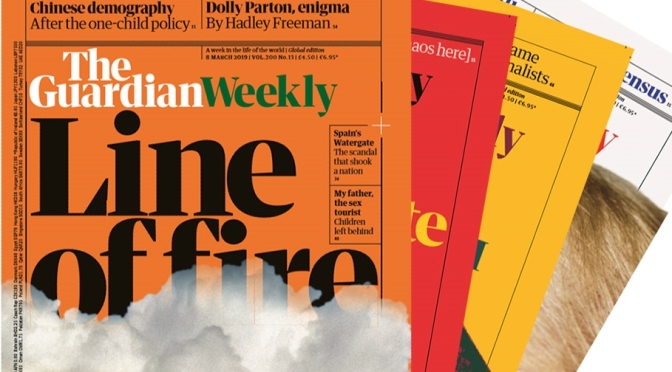
THE GUARDIAN WEEKLY: The latest issue features ‘Is This The Death of International Law?’…

Once viewed as a safeguard against global injustice, international law has become increasingly politicised and dysfunctional in recent years. As Linda Kinstler writes in a fascinating essay for the cover story of this week’s Guardian Weekly magazine, the norms, institutions and good faith essential to the system functioning effectively have been badly eroded, and it’s hard to see how the problems can be reversed.

Institutions like the UN security council and international criminal court (ICC) are now often simply ignored or manipulated by powerful member states. The ICC in particular has struggled with legitimacy and enforcement, delivering only a few convictions, amid resistance from big powers such as the US and Russia. The unilateralism of Trump has further undermined the system, while China’s growing influence is shifting the international focus away from human rights.

Spotlight | How the rise of Zohran Mamdani is dividing Democrats
Many believe the New York mayoral hopeful signals time for the national party to evolve but others say his brand of politics will not appeal in key battlegrounds. Lauren Gambino and Alaina Demopoulos report

Environment | Tipping points, doomerism and catastrophic risks
Climate expert Genevieve Guenther talks to Jonathan Watts on the importance of correcting the false narrative that climate threat is under control – and why it is appropriate to be scared

Feature | The politics of breasts
Breasts have always been political – and now they’re front and centre again. Is it yet another way in which Trump’s worldview is reshaping the culture? By Jess Cartner-Morley

Opinion | The global order is being dismantled by an ageing generation
Just when the world desperately needs wise elders, its fate is in the hands of old and ruthless patriarchs, argues David Van Reybrouck

Culture | The Herds: The animal marathon stampeding to the Arctic
Why is a huge pack of puppet animals, from tiny monkeys to towering elephants, making a 20,000km cross-planet odyssey? Kate Wyver spent a week as an antelope to find out

THE NEW YORK TIMES – WEDNESDAY, JULY 2, 2025

Image

Trump’s Finances Were Shaky. Then He Began to Capitalize on His Comeback.

Contrary to President Trump’s assertions, records filed in a fraud case against him suggest that his riches are not the product of a steady and strong empire.

What We Know (and Can’t Know) About Trump’s Wealth

Though some aspects of President Trump’s net worth are murky, it has unmistakably soared in the early months of his second term.

Trump Faces the Biggest Test Yet of His Second-Term Political Power

If President Trump gets his domestic policy bill over the finish line, it will be a vivid demonstration of his continuing hold over the Republican Party.

Divided G.O.P. to Decide Fate of President’s Policy Bill