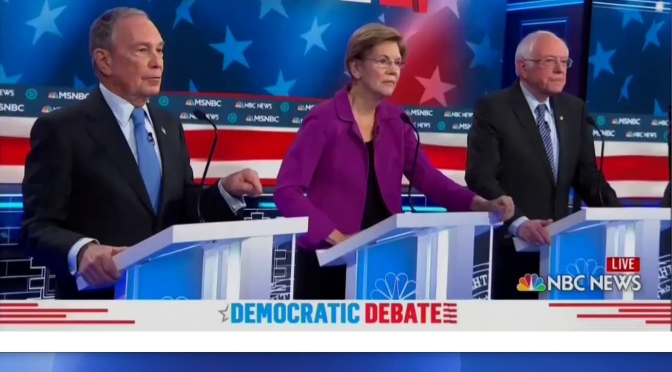
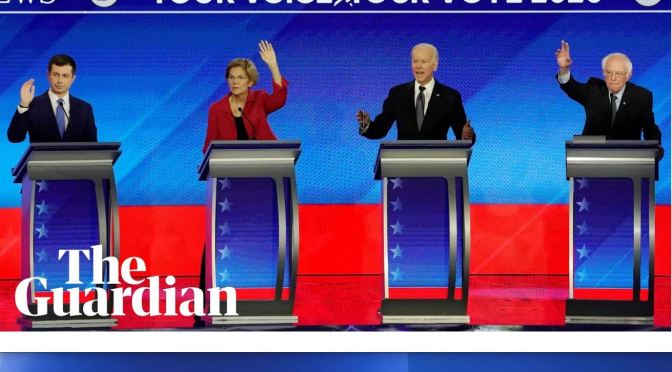
Elizabeth Warren, Bernie Sanders, Joe Biden, Amy Klobuchar and Pete Buttigieg fiercely attacked Mike Bloomberg on his first Democratic debate appearance. Senator Warren led the assault, challenging the former New York mayor to release women at his company from non-disclosure agreements they signed while settling lawsuits. Bloomberg defended his record, saying: ‘In my company, lots and lots of women have big responsibilities.’ Here are the key clashes from the ninth Democratic presidential debate in Las Vegas
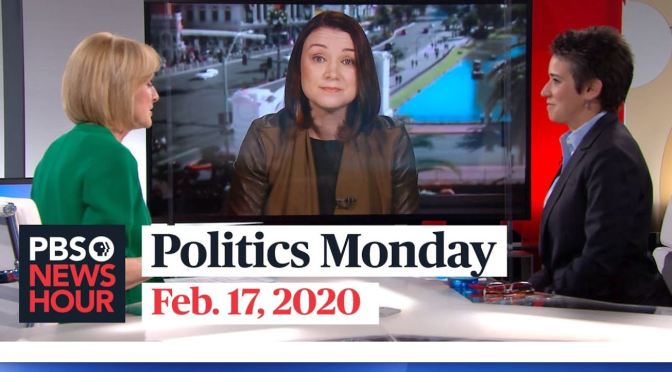
NPR’s Tamara Keith and Amy Walter of the Cook Political Report join Judy Woodruff to discuss the latest political news, including the stakes for 2020 Democrats in the upcoming Nevada caucuses, technical concerns for tabulating caucus results after Iowa’s confusion and whether Mike Bloomberg’s advertising blitz is delivering him voter support.
Bloomberg Opinion columnist Barry Ritholtz interviews economist, bestselling author and New York Times columnist Paul Krugman, whose most recent book is “Arguing With Zombies: Economics, Politics, and the Fight for a Better Future.”
Paul Robin Krugman (born February 28, 1953) is an American economist who is the Distinguished Professor of Economics at the Graduate Center of the City University of New York, and a columnist for The New York Times. In 2008, Krugman was awarded the Nobel Memorial Prize in Economic Sciences for his contributions to New Trade Theory and New Economic Geography. The Prize Committee cited Krugman’s work explaining the patterns of international trade and the geographic distribution of economic activity, by examining the effects of economies of scale and of consumer preferences for diverse goods and services.
Krugman was previously a professor of economics at MIT, and later at Princeton University. He retired from Princeton in June 2015, and holds the title of professor emeritus there. He also holds the title of Centenary Professor at the London School of Economics. Krugman was President of the Eastern Economic Association in 2010, and is among the most influential economists in the world. He is known in academia for his work on international economics (including trade theory and international finance),economic geography, liquidity traps, and currency crises.
Krugman is the author or editor of 27 books, including scholarly works, textbooks, and books for a more general audience, and has published over 200 scholarly articles in professional journals and edited volumes. He has also written several hundred columns on economic and political issues for The New York Times, Fortune and Slate. A 2011 survey of economics professors named him their favorite living economist under the age of 60.[13] As a commentator, Krugman has written on a wide range of economic issues including income distribution, taxation, macroeconomics, and international economics. Krugman considers himself a modern liberal, referring to his books, his blog on The New York Times, and his 2007 book The Conscience of a Liberal. His popular commentary has attracted widespread attention and comments, both positive and negative. According to the Open Syllabus Project, Krugman is the second most frequently cited author on college syllabi for economics courses.
Syndicated columnist Mark Shields and Washington Post columnist Michael Gerson join Judy Woodruff to discuss the week in politics, including Sen. Bernie Sanders’ victory in the New Hampshire primary and how it shapes the race for the 2020 Democratic presidential nomination, President Trump’s strategy for reelection and the political conflict surrounding the Justice Department.
New Hampshire Public Radio’s Lauren Chooljian and James Pindell of the Boston Globe join Judy Woodruff to discuss the latest political news ahead of the New Hampshire Democratic primary, including voters’ levels of excitement and indecision, which candidates have momentum after the confusing Iowa caucuses and President Trump’s objective with rallying in New Hampshire the night before the election.
Democratic presidential candidates clashed in a televised debate in New Hampshire on Friday night at the end of a week dominated by the Iowa caucuses chaos and Donald Trump’s acquittal. Attacks were focused against Pete Buttigieg and Bernie Sanders, the two candidates who declared victory in Iowa, as the hottest topics discussed were healthcare and race.
Syndicated columnist Mark Shields and New York Times columnist David Brooks join Judy Woodruff to discuss the week’s political news, including the Senate’s decision to acquit President Trump on both articles of impeachment, Trump’s State of the Union address, the messy Iowa Democratic caucus results and which 2020 Democrats have momentum going into the New Hampshire primary.
Amy Walter of the Cook Political Report and Radio Iowa’s O. Kay Henderson join John Yang in Iowa to discuss the latest political news, including what voters in Iowa’s first-in-the-nation 2020 Democratic caucuses are considering as they make their selections, polling updates on a “fluid” and “volatile” race and the ongoing pace of campaigning in Iowa.
New York Times columnist David Brooks and Washington Post columnist Ruth Marcus join Judy Woodruff to discuss the week’s political news, including the Senate’s decision not to call witnesses in President Trump’s impeachment trial, Republicans’ varying defenses of Trump’s conduct around Ukraine and what recent polling trends among 2020 Democrats suggest about Monday’s Iowa caucuses.
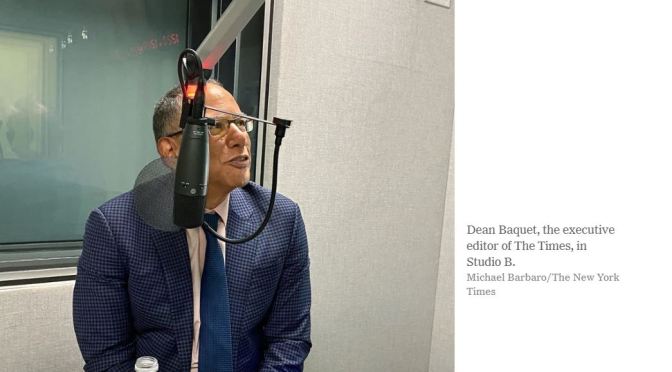
With voting for 2020 set to begin in Iowa on Monday, “The Daily” sat down with Dean Baquet, the executive editor of The New York Times, to discuss the lessons he — and the organization — learned from 2016. For more information on today’s episode, visit nytimes.com/thedaily.
The media’s coverage of the 2016 presidential campaign has come to be criticized for operating under three key assumptions: that Hillary Clinton was certain to be the Democratic nominee, that Donald Trump was unlikely to be the Republican nominee, and that once Clinton and Trump had become their party’s nominees, she would win.
Dean P. Baquet is an American journalist. He has been the executive editor of The New York Times since May 14, 2014. Between 2011 and 2014 Baquet was managing editor under the previous executive editor Jill Abramson. He is the first black American to serve as executive editor. Wikipedia
News, Views and Reviews For The Intellectually Curious

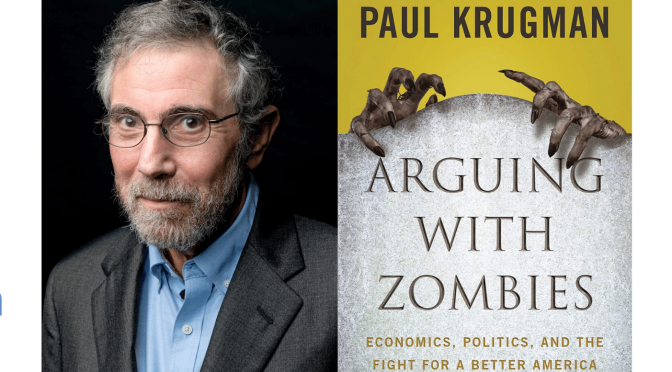
 Bloomberg Opinion columnist Barry Ritholtz interviews economist, bestselling author and New York Times columnist Paul Krugman, whose most recent book is “Arguing With Zombies: Economics, Politics, and the Fight for a Better Future.”
 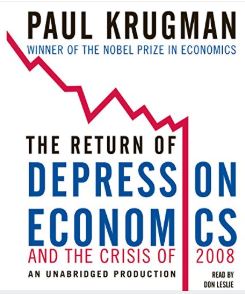 Paul Robin Krugman (born February 28, 1953) is an American economist who is the Distinguished Professor of Economics at the Graduate Center of the City University of New York, and a columnist for The New York Times. In 2008, Krugman was awarded the Nobel Memorial Prize in Economic Sciences for his contributions to New Trade Theory and New Economic Geography. The Prize Committee cited Krugman’s work explaining the patterns of international trade and the geographic distribution of economic activity, by examining the effects of economies of scale and of consumer preferences for diverse goods and services.



 Amy Walter of the Cook Political Report and Radio Iowa’s O. Kay Henderson join John Yang in Iowa to discuss the latest political news, including what voters in Iowa’s first-in-the-nation 2020 Democratic caucuses are considering as they make their selections, polling updates on a “fluid” and “volatile” race and the ongoing pace of campaigning in Iowa.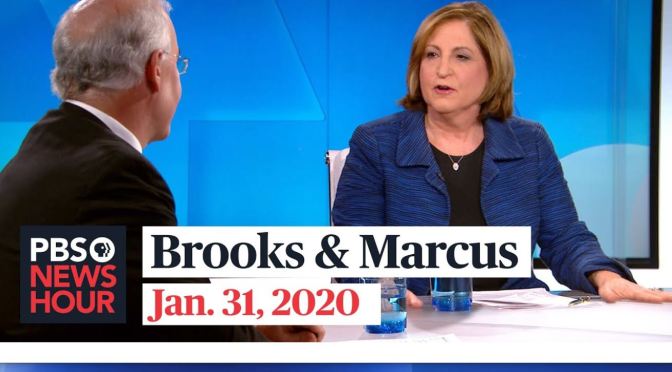
 With voting for 2020 set to begin in Iowa on Monday, “The Daily” sat down with
 Boomers Daily