Tag Archives: Philosophy

Arts & Culture: The New Criterion -October 2024

The New Criterion – The October 2024 issue features

Democracy in America: a symposium

Tocqueville’s limitations by Glenn Ellmers

Democracy in America: an introduction by Roger Kimball

Our Athenian American democracy by Victor Davis Hanson

Tocqueville versus progressive democracy by Daniel J. Mahoney

The Washington octopus by James Piereson

Arts & Culture: The New Criterion – Sept 2024

Image

The New Criterion – The September 2024 issue features ‘The red star returns’; The trouble with Delmore; Churchill endures; Charles Ive’s “let out” souls; Theater, Arts, Music and The Media….

Arresting scenes

On John Constable’s The Hay Wain & the foundations of the West.

We write as The New Criterion’s annual period of aestivation enters its home stretch. The cicadas are buzzing, the days are noticeably shorter, and the leaves—some of them—are already edged with brown. Certain summers feature quiet expanses of lazy days. This one was different. In July, Donald Trump, except for the tip of his right ear, dodged a would-be assassin’s bullet; Joe Biden dropped (or, we now know, was pushed) out of the 2024 presidential race but, as of this writing, remains president; Kamala Harris, Biden’s vice president, stepped into the vacancy and magically became the new candidate for president, choosing the Minnesota governor Tim Walz as her running mate. 

Preview: Philosophy Now Magazine Aug/Sept 2024

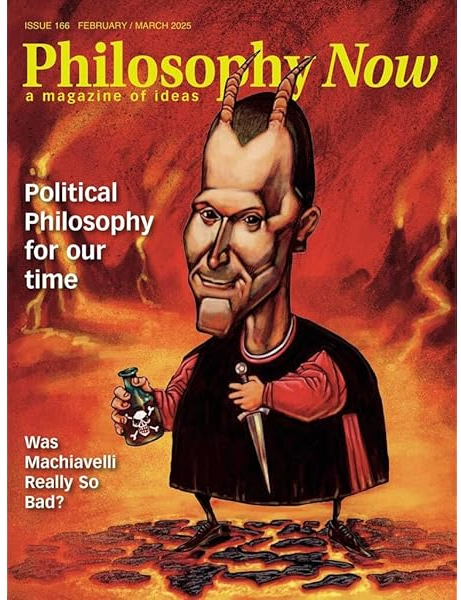
Philosophy Now Magazine (August 12,2024)The new issue features ‘The Politics of Freedom’…

The Politics of Freedom

by Rick Lewis

News: August/September 2024

Elixir of extended life for mice • Nicholas Rescher mini obituary • Nietzsche exhibition in his childhood home — News reports by Anja Steinbauer

Freedom & State Intervention

Audren Layeux follows the doomed quest for state emancipation of the self.

Value Pluralism & Plurality of Choice

Christophe Bruchansky looks at maximising the diversity of choice.

The Unfreedom of Liberty

Arianna Marchetti reflects on the limits of political freedom.

On Retributive Punishment

Oliver Waters asks, is retributive justice justified in a modern society?

The Domesticated Foxes of Bastøy

Veronique Aïcha considers the ideology of imprisonment.

Preview: Philosophy Now Magazine June/July 2024

Image

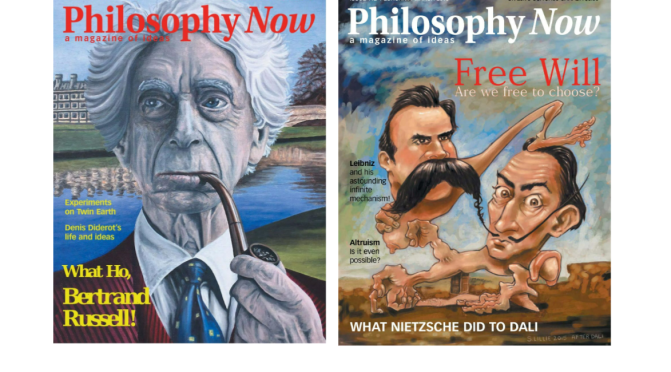
Philosophy Now Magazine (June/July 2024)The new issue features ‘The Meaning Issue’…

The Search for Meaning

by Rick Lewis

A famous parable dating back to ancient India involves some blind monks encountering an elephant. The monks each touch just one part of the elephant, and afterwards they compare notes. One declares that the creature feels like a snake, another that it has a shape like a tree trunk and so on. Like many parables, you can interpret it in different ways, but it seems to be saying that even for something that is an objectively real part of the world, like an elephant, it is possible to have different subjective views of it, all of which may be valid.

Luce Irigaray interviewed by Octave Larmagnac-Matheron and translated by Mélanie Salvi.

Philosophers Exploring The Good Life

Jim Mepham quests with philosophers to discover what makes a life good.

The Present Is Not All There Is To Happiness

Rob Glacier says don’t just live in the now.

What Is Life Worth?

Michael Allen Fox wonders whether life really is ‘a precious gift’.

The New Criterion – June 2024 Arts/Culture Preview

The New Criterion – The June 2024 issue features:

Protecting America’s promise

by Ronald S. Lauder

On combating anti-Semitism & anti-Americanism.

All the rage

by Victor Davis Hanson

On White Rural Rage by Tom Schaller & Paul Waldman.

The masterpiece of our time

by Gary Saul Morson

On The Gulag Archipelago at fifty.

Building Palm Beach

by Benjamin Riley

On the town’s history & architecture.

Preview: Philosophy Now Magazine April/May 2024

Image

Philosophy Now Magazine (April/May 2024)The new issue features ‘Philosophy & Literature’ – Celebrate Immanuel Kant’s 300th Birthday….

How to Have a Good Life

Meena Danishmal asks if Seneca’s account of the good life is really practical.

According to the Oxford English Dictionary, the adjective ‘stoical’ means “resembling a Stoic in austerity, indifference, fortitude, repression of feeling and the like”. This gives us some idea of what it is like to be a Stoic. Indeed, the key teaching, arguably the fundamental point, of Stoicism, is that we should focus on controlling the things that are under our control, such as our thoughts, emotions, and actions, whilst accepting those things we cannot control, such as most things that are happening in the world. How did they get there?

To consider this question let’s look at the ideas of the Roman philosopher and statesman Lucius Annaeus Seneca the Younger (4 BCE-65 CE). As a top advisor to the paranoid and murderous Emperor Nero, he probably found Stoicism a particularly practical guide to life.

As a Stoic, Seneca believed the soul (Latin: anima or animus) to be a finer form of matter than the body; but matter it is. It was also described as a spark of the fire which had consumed the original matter. With such an understanding of the soul, where does the soul reside within the body? Stoics provided a rather simple answer: everywhere. The soul was considered to be a vital force that animates the whole body. The soul was also the source of reason, virtue, and moral character, which is what Stoic philosophy is built upon, as the rational soul guides individuals towards living in accordance with nature.

For us to understand this concept further, it’s vital to grasp the Stoic conception of reality. Stoics see the universe as interconnected and interwoven, and this unified cosmos as governed by rational principles. Within this holistic perspective, the soul is seen as part of the divine rational order of the universe. This understanding forms the basis of Stoic ethics, which emphasises the importance of cultivating reason and virtue in all aspects of life. This encouragement to align thoughts, actions, and desires with principles of reason, is a way for the soul to flourish.

The New Criterion – April 2024 Arts/Culture Preview

Image
The New Criterion – The April 2024 issue features:

Poetry a special section
Black poetry  by William Logan
Shakespeare’s words  by Amit Majmudar
Bachmann: the unspeakable spoken  by Peter Filkins
The new & the old  by Katie Hartsock
The answer to Lord Chandos  by Pascal Quignard

New translations  by Ryan Choi, Frederick Amrine, Patrick Whalen & Beverley Bie Brahic

The New Criterion – March 2024 Preview

The New Criterion – The March 2024 issue features:

Israel’s eternal dilemma  by Victor Davis Hanson
Enrique Gómez Carrillo  by Anthony Daniels
The singularity of speech  by Wilfred M. McClay
A life in ballet  by Peter Martins

New poems  by Amit Majmudar, James Matthew Wilson & Michael Casper

Preview: Philosophy Now Magazine February 2024

Image

Philosophy Now Magazine (February/March 2024)The new issue features ‘Irish Philosophy’ – Pure Philosophy, No Blarney; Steven Pinker – On Violence and Metaphors…

Steven Pinker

Steven Pinker is the Johnstone Family Professor of Psychology at Harvard University, and a popular writer on linguistics and evolutionary psychology. Angela Tan interviews him about politics, language, death, and reasons to be optimistic.

Thomas Duddy & Irish Philosophy

Tim Madigan travels through time to seek the essential nature of Irish thought.

Irish Philosophy & Me

Cathy Barry charts her journey through historical Irish thought.

Edmund Burke & the Politics of Reform

Jon Langford outlines conservative insights gained from revolutionary failures.

Philip Pettit & The Birth of Ethics

Peter Stone thinks about a thought experiment about how ethics evolved.

The New Criterion – February 2024 Preview

Image
The New Criterion – The February 2024 issue features:

The importance of Homer  by Joshua T. Katz
Galaxy brains  by Gary Saul Morson
The Thames: river of destinies  by Jeremy Black
“Breakfast Special”: a new story  by Woody Allen

New poems  by Nicholas Friedman, Jessica Hornik & Michael Spence