Tag Archives: Opinion

THE NEW YORK TIMES – THURSDAY, JULY 10, 2025

Texas Camp’s Cabins Stood in an ‘Extremely Hazardous’ Floodway

An analysis of Camp Mystic shows that several buildings were in known hazard zones. A $5 million expansion in 2019 did nothing to alleviate the problem.

As Texas Flood Raged, Camp Mystic Was Left to Fend for Itself

Flash floods hit during the night, but many local officials appeared unaware of the unfolding catastrophe, initially leaving people near the river on their own.

China Surveys Seabeds Where Naval Rivals May One Day Clash

Research ships are studying the seas for science and resources, but the data they gather could also be useful in a conflict with Taiwan or the U.S.

U.K. and France Agree to First-Ever Nuclear Weapons Pact to Fend Off Threat to Europe

Prime Minister Keir Starmer of Britain and President Emmanuel Macron of France are set to confirm a strengthened defense relationship at a summit today.

TIMES LITERARY SUPPLEMENT – JULY 11, 2025 PREVIEW

TIMES LITERARY SUPPLEMENT: The latest issue features ‘American Dreamer’ – On the enduring greatness of Gatsby; Tear down the museums?; Big tech is watching you; A new Locke manuscript; The ultimate declutter and An epic bromance for our times…

Blurred lines    

What makes a novel of ideas? By Benjamin Markovits

Broken Britain and America

The centre left has joined the populist right in despairing of good government By Sam Freedman

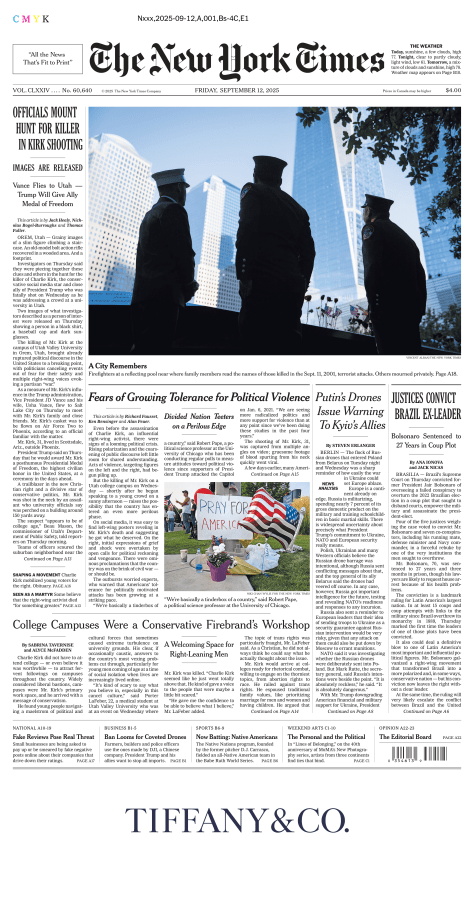
THE NEW YORK TIMES – WEDNESDAY, JULY 9, 2025

With Taxes and Tariffs in Place, Trump Takes Reins of U.S. Economy

President Trump has achieved much of his agenda, leaving the fate of the economy squarely in his hands.

At Least 173 People Remain Missing After Texas Floods

Officials said the search for remains would continue until all victims were accounted for. In the hardest-hit county, no survivors have been found since Friday.

Trump Got the Green Light to Fire Federal Workers. Now, They Wait.

A court-ordered pause in May had covered nearly two dozen federal agencies at different stages of executing President Trump’s directive for mass layoffs.

The ‘Trump Pump’: How Crypto Lobbying Won Over a President

THE NEW YORK TIMES – TUESDAY, JULY 8, 2025

Image

Trump’s New Trade Threats Set Off Global Scramble to Avoid Tariffs

Many countries thought they were negotiating in good faith. President Trump renewed his tariff plan anyway, giving them until Aug. 1 to make offers.

Rescuers Scour Flood Debris in Texas as Hope Fades for Survivors

The chances of finding anyone alive five days after the deluge tore through Central Texas are remote. The death toll climbed to more than 100 people.

See When Federal and Local Officials Issued Warnings About the Texas Floods

Trump and Netanyahu Trade Praise as Gaza Cease-Fire Talks Unfold

President Trump and Prime Minister Benjamin Netanyahu of Israel confronted an array of high-stakes Middle East issues. But first they took a victory lap.

THE NEW YORK TIMES – MONDAY, JULY 7, 2025

Image

Summer Camp Says 27 Girls and Staff Killed in Texas Floods

Camp Mystic, an all-girls Christian summer camp, confirmed that at least 27 campers and counselors had died, calling it an “unimaginable tragedy.”

What’s at Stake as Benjamin Netanyahu and Trump Meet in Washington

President Trump is considering whether to pursue a new nuclear agreement with Tehran. He is also urging a new cease-fire deal to end the fighting in Gaza.

Israel’s Deadly Assault on Iran Prison Incites Fury, Even Among Dissidents

U.S. Trading Partners Are on Edge as Tariff Deadline Nears

President Trump is set to once again put economic pressure on other nations, as a deadline for making trade deals elapses this week.

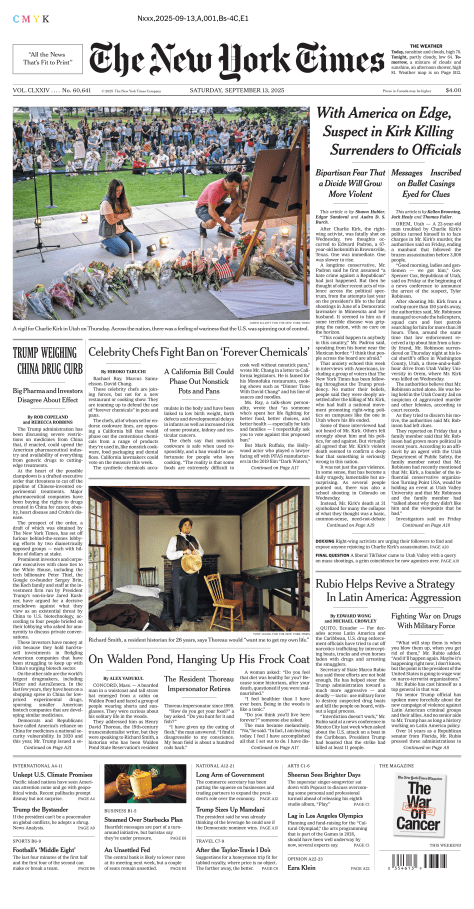
THE NEW YORK TIMES – SUNDAY, JULY 6, 2025

Image

Desperate Search for Missing in Texas Floods as Death Toll Passes 50

Some two dozen girls from a summer camp are among those unaccounted for. More rain and flash floods could hit already-devastated areas today.

As Floods Hit, Important Roles Were Vacant at Weather Service Offices in Texas

Some experts say staff shortages might have complicated forecasters’ ability to coordinate responses with local emergency management officials.

China and Russia Keep Their Distance From Iran During Crisis

Some U.S. officials talked about an “axis” of authoritarian nations, but the American and Israeli war with Iran has exposed the limits of that idea.

With One War Over, Netanyahu Heads to Washington Amid Calls to End Another

Prime Minister Benjamin Netanyahu of Israel is set to meet with President Trump on Monday as attention has turned from Iran to a cease-fire for Gaza.

Khamenei Appears in Public for First Time Since Israel War Began

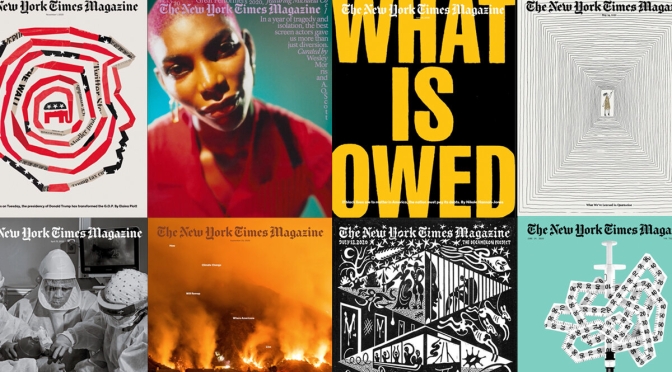
THE NEW YORK TIMES MAGAZINE – JULY 6, 2025

Current cover

THE NEW YORK TIMES MAGAZINE: The 7.06.25 Issue features Nick Confessore on how the trans rights movement bet on the Supreme Court in U.S. v Skrmetti and lost; Charles Homans on Trump’s fight with Los Angeles on immigration; Oliver Whang on Luke Littler, an 18-year-old darts prodigy; and more.

Democrats Denied This City Had a Gang Problem. The Truth Is Complicated.

Trump’s claim that Venezuelan criminals took over Aurora, Colorado, became a rationale for his immigration crackdown. What really happened there?

Seven Chaotic Months in the Life of a New Federal Judge

Amir Ali joined the D.C. Federal District Court just weeks before Trump took office. It’s been tumultuous ever since.

By Emily Bazelon and Mattathias Schwartz

The Trick to Watching the Tour de France? Ignore the Stars.

Netflix’s new docuseries tries to wring drama from the best cyclists. But the real poetry is found among the riders surrounding them.

By Jane Ackermann

Read this issue

THE NEW YORK TIMES – SATURDAY, JULY 5, 2025

Image

Desperate Search After Texas Floods Kill at Least 24

As Many as 25 Girls Missing From Camp Along River

The authorities said that emergency workers in Texas had rescued more than 230 people. Flooding continued in some areas.

The Cost of Victory: Israel Overpowered Its Foes, but Deepened Its Isolation

The nation is more secure from threats than ever. But the war in Gaza, and attacks on Iran and Lebanon, have undercut its standing among the world’s democracies.

Hamas Says It Is Ready to Negotiate Truce Proposal

It was not immediately clear whether the group was demanding any significant changes to the plan for a 60-day truce and talks on a permanent end to the war.

REVIEW: “A BIG, BEAUTIFUL BILL AND AN EVEN BIGGER DEBT: THREE PERSPECTIVES”

The following is an in-depth analysis of President Trump’s “One Big Beautiful Bill Act” written by ChatGPT from important, bi-partisan fiscal, economic and political sources, all listed below:

If there is one unassailable truth in American political life, it is that no grand legislative gesture arrives without the promise of prosperity—and the prospect of unintended consequences. Donald Trump’s “One Big Beautiful Bill,” signed into law on July 4th, stands as a monument to this dynamic: a sprawling package of permanent tax cuts, entitlement retrenchments, and fresh spending, all wrapped in a populist bow and accompanied by the familiar refrain that the deficits will somehow pay for themselves.

To understand the bill’s import—and its likely fallout—it helps to consider three vantage points. The first is that of Milton Friedman, who would see in these provisions a laboratory for the free market, tempered by fiscal illusions. The second is Paul Krugman’s, for whom this is a brazen experiment in upward redistribution. The third is David Stockman’s, whose uniquely jaundiced eye discerns an unholy alliance of crony capitalism and debt-fueled political theatre.

Friedman, the Nobel laureate and evangelist of free enterprise, might first commend the bill’s unapologetic tax relief. A permanent extension of the 2017 tax cuts is precisely the sort of measure he once called “a way to restore incentives, reduce distortions, and reward enterprise.” For Friedman, a tax system ought to be predictable, broad-based, and minimally intrusive. In this sense, the bill’s elimination of taxes on tips and overtime income, coupled with higher thresholds for the estate tax, will likely increase the incentive to work, save, and invest.

Yet Friedman would be quick to warn that no tax cut exists in a vacuum. The real test of fiscal virtue, he always argued, is not in slashing tax rates but in restraining spending. This bill, by combining aggressive tax cuts with continued defense expansions and only partial reductions to social spending, falls short of the discipline he prescribed. The result, Friedman would say, is a structural deficit that will eventually require either inflation or future tax hikes. “There is no such thing as a free lunch,” he liked to remind audiences. This is a lunch billed to generations unborn.

Krugman, viewing the same legislation, would perceive not a triumph of market freedom but an egregious abdication of public responsibility. He has long argued that the most misleading idea in modern politics is the notion that tax cuts inevitably pay for themselves. As the Congressional Budget Office’s scoring shows, the bill is likely to add over $3 trillion to the national debt in the next decade, even after accounting for higher GDP. Krugman would note that the permanent nature of the cuts deprives lawmakers of future leverage and crowds out investments in education, infrastructure, and health.

More pointedly, Krugman would argue that the bill’s distributional impact is regressive by design. Expanded deductions for capital gains and estates, the restoration of a higher SALT cap, and corporate incentives all tilt the benefits toward the affluent, while Medicaid cuts and SNAP work requirements fall hardest on those with the least. In Krugman’s view, this is not simply poor economics but a moral failing: a return to what he calls “the era of Dickensian inequality, dressed up in the rhetoric of growth.”

Yet the critique most likely to sting is the one that David Stockman would deliver. Unlike Krugman, Stockman began as a champion of supply-side tax reform. But he has since become its most unflinching critic. To him, the “Big Beautiful Bill” represents the final stage of a fiscal derangement decades in the making: a bipartisan addiction to borrowing and a refusal to reckon with arithmetic. “This is not capitalism,” Stockman might write, “it’s a simulacrum of capitalism—an endless auction of political favors financed by the Fed’s printing press.”

Stockman would remind readers that when he served as Reagan’s budget director, the expectation was that tax cuts would be offset by deep spending restraint. Instead, deficits ballooned and discipline eroded. The new bill, with its eye-watering cost and lack of credible offsets, is an even more flamboyant departure from any pretense of balance. Stockman would likely deride the Republican celebration as a form of magical thinking, no more credible than the illusions peddled by Democrats. In his telling, the bill is both symptom and accelerant of a broader collapse of fiscal sanity.

All three perspectives converge on a single point: the bill’s enormous impact on the debt trajectory. According to estimates from the Committee for a Responsible Federal Budget, the legislation could push the U.S. debt-to-GDP ratio past 145% by 2050—an unprecedented level for a peacetime economy. While proponents insist that higher growth will mitigate the burden, the Tax Foundation’s dynamic scoring suggests the additional output will cover only a fraction of the revenue loss.

Friedman would insist that economic growth requires both lower taxes and leaner government. Krugman would counter that social stability and productivity demand sustained public investment. Stockman would argue that the entire paradigm—borrowing trillions to finance giveaways—has become a bipartisan racket. Despite their ideological divergences, all three would agree that the arithmetic is merciless. Eventually, debts must be serviced, entitlements must be funded, and the dollar’s credibility must be defended.

What remains is the question of public memory. In the years ahead, as interest payments rise and fiscal constraints tighten, politicians will doubtless blame one another for the bill’s consequences. The narrative will fracture along familiar lines: Republicans will claim the tax cuts were sabotaged by spending; Democrats will argue the spending was hobbled by tax cuts. Independents will declare that neither side ever intended to balance the books. But the numbers, as Friedman and Krugman and Stockman all understood in their own ways, are immune to spin.

There is an old line, attributed variously to Keynes and to an anonymous Treasury mandarin, that the markets can remain irrational longer than you can remain solvent. Perhaps, in this case, Washington can remain irrational longer than the public can remain attentive. But eventually, the bill will come due—not only the legislation signed on Independence Day, but the larger bill for decades of self-deception.

A big, beautiful bill indeed. And perhaps, in the fullness of time, an even bigger, less beautiful reckoning.

Key Elements of the Bill

  • Permanent tax cuts (≈ $4.5 trillion): Extends nearly all parts of Trump’s 2017 Tax Cuts and Jobs Act, including individual rate brackets, expanded standard deduction, plus new deductions—no taxes on tips/overtime (through 2028), boosted SALT deduction ($40k cap for five years), larger child/senior credits, plus expansions like auto loan interest write-offs and “Trump Accounts” for parents apnews.com+15ft.com+15crfb.org+15.
  • Major spending cuts: $1–1.2 trillion in savings via Medicaid cuts (work requirements, provider taxes), SNAP/state cost-shifts, rollback of clean energy incentives .
  • Increased enforcement and defense: $150 B added to defense, another $150 B+ for border/ICE enhancements; ICE funding grows tenfold – now largest federal law enforcement budget .
  • Debt-ceiling hike: Allows a $4–$5 trillion statutory increase in borrowing authority as.com+3en.wikipedia.org+3reuters.com+3.

📊 Economic & Fiscal Outlook

🏛️ Congressional Budget Office (CBO)

🏦 CRFB & Budget Advocates

  • Committee for a Responsible Federal Budget (CRFB) puts the Senate’s reconciliation version at $4.1 trillion added debt through 2034—and warns a permanent version could add $5.3–5.5 trillion en.wikipedia.org.
  • CRFB also flags that Social Security and Medicare’s projected insolvency deadlines are now accelerated by roughly one year .

🧮 Tax Foundation

  • Estimates that permanent tax measures could yield a +1.2% GDP boost over the long run, but also slash federal revenue by $4 trillion (dynamically)—meaning growth would only cover ~19% of the revenue loss en.wikipedia.org+15en.wikipedia.org+15reuters.com+15.
  • Shorter-term growth boost around +0.6% by 2027, but turns mildly negative (–0.1%) by 2034 once fiscal constraints bite taxfoundation.org.

🌍 International Outlook (Moody’s, Reuters)

💬 Media & Policy Experts

  • Reuters warns of a “debt spiral,” with rising interest costs jeopardizing Fed independence .
  • FTWashington PostThe GuardianThe Economist describe it as the largest GOP tax/deficit expansion since Reagan, dubbing it a “reverse Robin Hood”—favoring corporations and wealthy over vulnerable groups .
  • Economists at Yale, Penn warn severe health-care cuts could increase preventable mortality and financial distress en.wikipedia.org+1ft.com+1.

🔍 Bottom Line Summary

MetricEstimate
Deficit Increase (2025–34)$3.3–4.1 T (CBO: ≈ $3.4T; CRFB Senate: ≈ $4.1T)
Debt-to-GDP TrajectoryRising, potentially 145–200% by 2050
GDP Growth Impact+0.6% by 2027, fading to –0.1% by 2034
Revenue Loss~$4–5 T over a decade (dynamic)
Insured Loss & Social Costs~11 M fewer insured; Medicaid/SNAP and health impacts significant
  • Neutral consensus: Deficit historians, nonpartisan agencies agree debt will balloon sharply in absence of offsetting revenues or spending reversals.
  • Growth trade-off: While tax relief offers modest short-term growth, it does not offset long-run fiscal burdens.
  • Debt consequences: Higher mandatory interest costs, credit rating erosion, pressure on policy flexibility, and future tax hikes or spending cuts loom.

🧠 Final Take

Trump’s “One Big Beautiful Bill” delivers sweeping tax cuts, spending reductions in social safety nets, and major border/defense expansions—all rolled into one 940-page, $4–5 trillion fiscal package. Bipartisan institutions like the CBO, CRFB, Tax Foundation, and independent watchdogs align on its massive impact:

  1. Adds trillions to the deficit, sharply escalating national debt.
  2. Offers modest, short-term output gains, but risks longer-term economic drag.
  3. Amplifies fiscal risk, stokes interest burden, and could strain future budgets.
  4. Contains explicit regressive elements—favoring higher-income households and corporations over lower-income families and health-care access.

Here are the three writers whose vantage points are considered:

1️⃣ Conservative / Republican

Milton Friedman

Why he stands out:

  • Nobel Prize–winning economist and prolific writer whose work shaped modern conservative and libertarian economic thought.
  • Champion of free markets, limited government, and monetarism (the idea that controlling the money supply is key to managing the economy).
  • His books and columns influenced Ronald Reagan and Margaret Thatcher and remain foundational in debates about taxes, deficits, and regulation.
    Major Works:
  • Capitalism and Freedom (1962) – argued that economic freedom underpins political freedom.
  • Free to Choose (1980, with Rose Friedman) – a best-selling defense of deregulation, school vouchers, and lower taxes.
  • Columns for Newsweek and extensive public outreach (including the PBS series Free to Choose).

2️⃣ Liberal / Progressive

Paul Krugman

Why he stands out:

  • Nobel Prize–winning economist and prominent columnist who shaped liberal economic commentary from the 1990s onward.
  • A sharp critic of supply-side tax cuts, deregulation, and austerity.
  • Influential in Democratic policy debates on stimulus spending, inequality, and health care.
    Major Works:
  • The Conscience of a Liberal (2007) – traced the rise of inequality and made a moral case for progressive taxation and social insurance.
  • End This Depression Now! (2012) – argued forcefully for Keynesian stimulus after the Great Recession.
  • Columns in The New York Times, where he has been one of the most-read voices on economic policy.

3️⃣ Independent / Centrist

David Stockman

Why he stands out:

  • Former Reagan budget director who later became an iconoclastic critic of both parties’ fiscal excesses.
  • He helped design the Reagan tax cuts, but later turned against supply-side orthodoxy and big deficits.
  • His writings blend libertarian skepticism of big government with scathing critiques of Wall Street bailouts and crony capitalism.
    Major Works:
  • The Triumph of Politics: Why the Reagan Revolution Failed (1986) – a landmark insider account of budget battles and exploding deficits.
  • The Great Deformation: The Corruption of Capitalism in America (2013) – an encyclopedic denunciation of central banking, stimulus, and fiscal irresponsibility.
  • Regular commentary and op-eds across financial and political publications (The New York TimesZero HedgeThe Atlantic).

THE NEW YORK TIMES – FRIDAY, JULY 4, 2025

Image

How Republicans Re-engineered the Tax Code

After years of Republican effort, the U.S. tax code now blends traditional supply-side economics with President Trump’s populist campaign promises.

In Iowa, Trump Begins Task of Selling His Bill to the American Public

President Trump spent days cajoling Republicans to support his bill. Now he will have to convince a skeptical public as Democrats focus on how it helps the wealthy.

Trump Claims Sweeping Power to Nullify Laws, Letters on TikTok Ban Show

In purporting to license otherwise illegal conduct by tech firms, President Trump set a precedent expanding executive power, legal experts warned.

White House to Start Notifying Countries About Tariffs, Trump Says

After striking only a few trade deals since declaring a 90-day pause in April, President Trump said he would announce new duties starting today.

Supreme Court Lets Trump Administration Deport 8 Migrants to South Sudan