

The delta variant of Covid-19 took the U.S. by surprise. Months after the first vaccines rolled out, Covid-19 infections surged as the delta variant overwhelmed the unvaccinated population and even broke through the immunity from the shots from Moderna, Pfizer and Johnson & Johnson. Now, the White House has a new plan to fight the delta variant, including booster shots and vaccine mandates. Here’s where we stand in the debate over booster shots, and in the fight against the delta variant.
Tag Archives: Moderna

Analysis: How Moderna & Pfizer-BioNTech Created Vaccines In Record Time
The decision to pivot an entire business to focus on the coronavirus is an obvious one in hindsight, at least for Moderna, BioNTech and Pfizer, which succeeded beyond anyone’s expectations — and will reap billions of dollars in sales of their vaccines this year alone.
It wasn’t such a clear decision in the early months of 2020, though that’s when Moderna’s chief executive, Stephane Bancel, and BioNTech’s chief, Ugur Sahin, starting turning their ships, they told CNBC in interviews for this documentary about the vaccine race, produced by CNBC senior health and science reporter Meg Tirrell and senior digital producer Sam Rega.
“The night that China locked down Wuhan, I’m like: ‘When was the last time I know a city has been locked down because of an infectious disease?’” Bancel recalled. “And what goes through my mind is: what do the Chinese know that we don’t know?“ Bancel said he awoke sweating at 4 a.m., realizing, “Jeez, there’s going to be a pandemic like 1918.” For Sahin, it was reading a paper in the Lancet in late January describing the outbreak in China.
“I did a number of calculations, fast calculations, and realized it had already spread,” Sahin said. “And it was clear that it was already too late to stop the disease.” But he was convinced BioNTech, then focused mainly on personalized cancer therapies, may be able to do something. His company reached out to Pfizer, he said, proposing to work on a vaccine for the novel coronavirus using the same technology, messenger RNA, on which they’d already partnered to try to tackle the flu.
“We had the first contact a few days after starting the project,” Sahin said. “At that time, Pfizer was not yet interested.” Albert Bourla, Pfizer’s CEO, confirmed Sahin’s account, saying in the earliest months of 2020, he was focused on maintaining the company’s operations in China. But by late February, he said, he’d determined Pfizer needed to work on a treatment and a vaccine.
“What is the best approach?” Bourla said he asked his team. Kathrin Jansen, head of Pfizer’s vaccine research and development, said they assessed all existing technologies, including protein-based vaccines and vaccines using viral vectors. “They all have too few pros and too many cons,” she said.
But messenger RNA was a risk; it had never been used before as an approved vaccine or drug. “I wrestled a little bit with the decision,” Bourla said. But after another meeting with the team, “they convinced me.” That’s when Sahin called a second time. The outbreak, by that point, was already in New York, he said. Reaching Jansen, he described the work that BioNTech already had underway, and asked if Pfizer would like to work together. “And I said: absolutely,” Jansen remembered. “Let’s talk about this.”
At Moderna, it was never a question that messenger RNA would be the way forward; that was the technology around which the company was founded in 2010. But that didn’t mean questions didn’t exist. “Even going into March, there were voices that said vaccines were false hope,” recalled Dr. Stephen Hoge, Moderna’s president.
“It did feel for a period of time that we needed to defend even the idea of trying.” “When we were thinking about how do we get into Phase 1, what does it look like to prepare for a pandemic, the eyes of the world felt as though they were looking at Moderna as this biotech … ‘what are they trying to do?’” said Hamilton Bennett, Moderna’s senior director of vaccine access and partnerships.
“It was only when we transitioned in that March notification from the WHO that this was a global pandemic, it’s an emergency, that I think people started to realize that what we’re doing isn’t playing in a sandbox trying to demonstrate our technology,” Bennett said. “We’re developing a vaccine that’s going to stop the pandemic.” The companies succeeded, in what became one of the greatest medical races in history. Here, they recall how it happened.
Covid-19: Race To Update Vaccines For Variants
Just two months ago, the incredible performance of new vaccines from Moderna and Pfizer had people cheering for an imminent end to the pandemic. But an onslaught of fast-spreading and potentially dangerous mutations of the virus changed that.
So now, even as pharma companies ramp up production in the early stages of a massive rollout, they are racing to retool their vaccine strategies. Robert Langreth reports that booster shots could give drugmakers a lucrative new revenue stream.

Covid-19: ‘The Rise Of The RNA Vaccines’ (Podcast)
Benjamin Thompson, Noah Baker and Elie Dolgin discuss RNA vaccines.
In this episode:
01:16 How RNA vaccines came to prominence
In less than a year, two RNA vaccines against COVID-19 were designed, tested and rolled out across the world. We discuss these vaccines’ pros and cons, how RNA technology lends itself to rapid vaccine development, and what this means for the fight against other diseases.
News feature: How COVID unlocked the power of RNA vaccines
09:20 The hurdles for trialling new COVID-19 vaccines
Multiple candidates for new COVID-19 vaccines are still being developed, which may offer advantages over the vaccines currently available. However, running placebo-controlled trials of these candidates is becoming increasingly difficult, so researchers are looking for different ways to evaluate them.
News: Search for better COVID vaccines confounded by existing rollouts
14:45 How long will COVID vaccines be effective?
There is much concern around the world about two faster-spreading variants of SARS-CoV-2. We get an update on whether these variants could render vaccines ineffective.
News: Could new COVID variants undermine vaccines? Labs scramble to find out
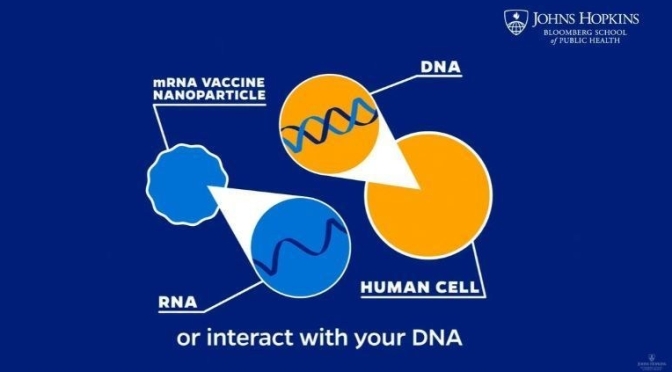
Covid-19: ‘How mRNA Vaccines Work’ (Video)
Messenger RNA—or mRNA—vaccines have been in development for decades, and are now approved for use against COVID-19. Here’s how they work and what you should know about them. Visit https://www.jhsph.edu/covid-19 for even more resources.

Covid-19 Infographic: Pfizer Vs Moderna


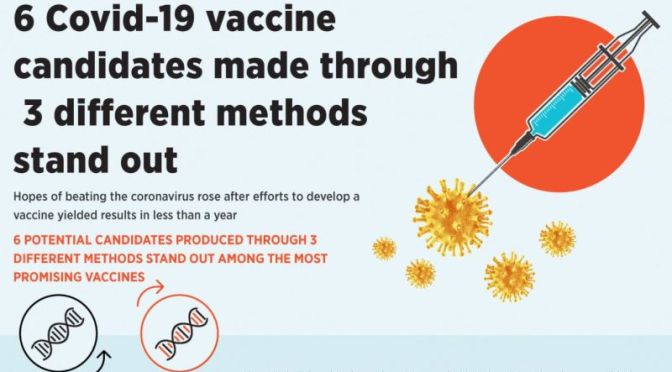
Infographic: The ‘3 Types Of Covid-19 Vaccines’

Health: ‘How The Covid-19 Vaccine Works’ (Video)
The U.S. began vaccinating the population against the coronavirus earlier this month, but mass adoption is not a guarantee. Roughly four in ten Americans say they would “definitely” or “probably” not get a vaccine, according to a recent survey by the Pew Research Center. Watch this video to find out how major stakeholders plan to convince the entire country to trust a vaccine made in record time, using mRNA technology that’s never before been licensed.

Morning News Podcast: Moderna Vaccine, Major Computer Hack, Stimulus

NPR reports: Another COVID-19 vaccine nears authorization. A major computer hack poses a ‘grave risk’ to the U.S. And, Congress gets closer to a new coronavirus relief package.
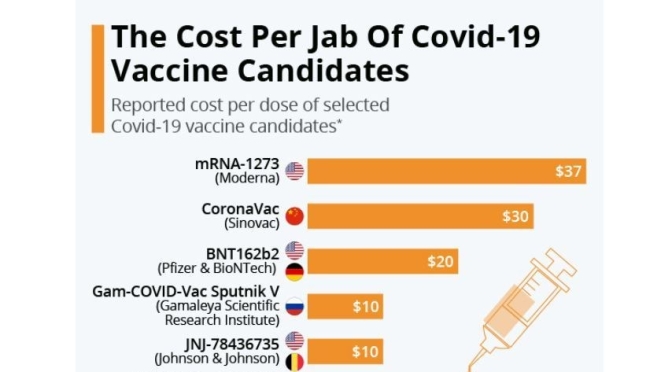
Infographic: Top Covid-19 Vaccines ‘Cost Per Dose’

 Boomers Daily