From a New York Times Magazine article:
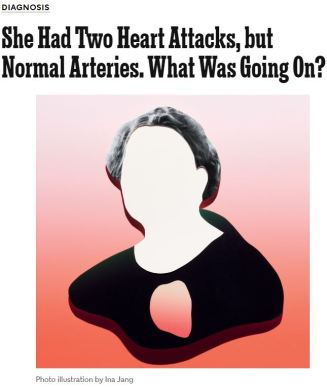 It was all horribly familiar — a rerun of an episode 15 months earlier, when she was with her family in River Vale, N.J. Back then, the burning pressure sent her to the emergency department, and she was told the same thing: She was having a heart attack. Immediately the cardiologist looked for blockages in the coronary arteries, which feed blood and oxygen to the hardworking muscles of her heart. That was the cause of most heart attacks. But they found no blockage.
Since childhood, she had frequent terrible canker sores that lasted for weeks. Sometimes it was hard to eat or even talk. Her mother, a nurse, told her everybody got them and thought she was being dramatic when she complained. So she had never brought them up with her doctors. Now the woman saw that her answer somehow made sense to the rheumatologist.
 Indeed, that was the clue that led the rheumatologist to a likely diagnosis: Behcet’s disease. It’s an unusual inflammatory disorder characterized by joint pains, muscle pains and recurrent ulcers in mucus membranes throughout the body. Almost any part of the body can be involved — the eyes, the nose and lungs, the brain, the blood vessels, even the heart. Behcet’s was named after a Turkish dermatologist who in 1937 described a triad of clinical findings including canker sores (medically known as aphthous ulcers), genital ulcers and an inflammatory condition of the eye.
To read more: https://www.nytimes.com/2019/11/20/magazine/heart-attack-diagnosis.html?te=1&nl=the-new%20york%20times%20magazine&emc=edit_ma_20191122?campaign_id=52&instance_id=14017&segment_id=19010&user_id=415092ec82728104b9ca7bbb44eeb7d3®i_id=7441254120191122


 The TACT Pivotal study of MRI-guided TULSA for whole-gland ablation in men with localized prostate cancer met its primary PSA endpoint in 96% of patients, with low rates of severe toxicity and residual GG2 disease. MRI at 12mo detected residual disease with NPV of 93%.



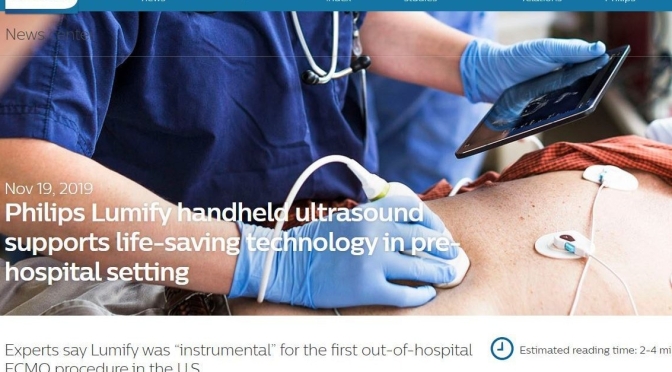
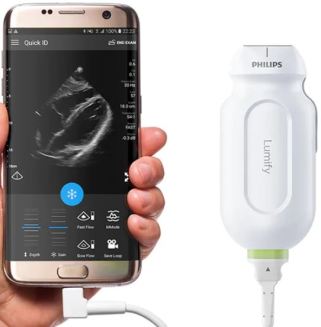 Philips Lumify ultrasound technology is an important component of the mobile ECMO unit. Members of the ECMO team use Lumify for real-time visual guidance when inserting tubes in veins and arteries in a process called ECMO cannulation.
 Listen to the latest from the world of science, with Nick Howe and Shamini Bundell. This week, a milestone in quantum computing, and rethinking early mammals.
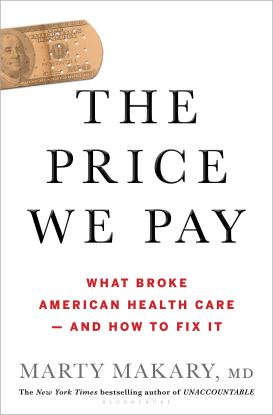 Dr. Makary examines the practice of performing unnecessary vascular procedures in a chapter of his new book, “The Price We Pay,” published Sept. 10. In it, he describes what seems to be the “predatory” practice of some doctors seeking out patients at health screenings in churches.

 Boomers Daily