
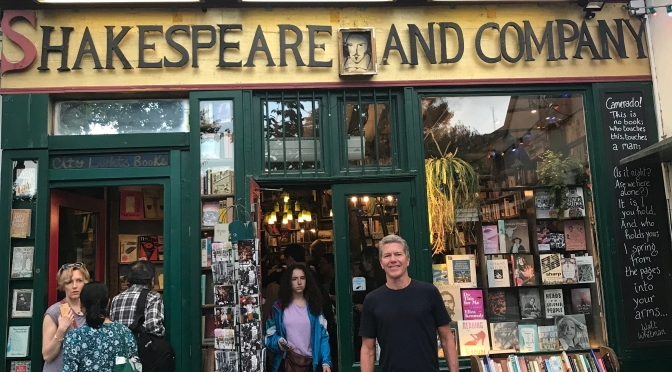
From a Shakespeare and Company email:
Dear Sylvia Beach,
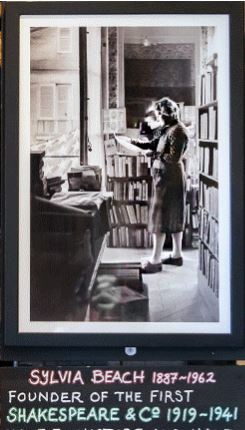 One hundred years ago this month, you opened the shutters of a small bookshop on rue Dupuytren. Its name was Shakespeare and Company. I often wonder if, on that first morning, you could ever have imagined how important your story would be.
You were only 32 but had already lived quite a life. Soulful and fearless, witty and energetic, you’d been active in the women’s suffrage movement, studied French poetry in Paris, and served with the Red Cross in Serbia during the First World War. You had also met Adrienne Monnier, one of the first women in France to found her own bookshop. Adrienne would be your companion for decades to come.
Your bookshop—first on rue Dupuytren, then around the corner on rue de l’Odéon—became a sanctuary for Anglophone and Francophone writers. T.S. Eliot, Gertrude Stein, Ezra Pound, James Joyce, Ernest Hemingway, Djuna Barnes, and F. Scott Fitzgerald, as well as André Gide, Paul Valéry, and Louis Aragon, among many others, all bought and borrowed books from you, and attended readings and parties at Shakespeare and Company. As André Chamson wrote about you: “Sylvia Beach carried pollen like a bee. She cross-fertilised these writers. She did more to link England, the United States, Ireland, and France than four great ambassadors combined.” I think of this whenever I ponder the role booksellers and bookshops can play during this age of political and ecological turbulence. When James Joyce couldn’t find anyone to publish Ulysses—his modernist masterpiece that had been condemned for obscenity—you stepped up. Even when you closed your bookshop in 1941, it was not an act of defeat but of defiance—you would rather see your life’s work shuttered forever than sell Finnegans Wake to a high-ranking Nazi officer.

When my father, George Whitman, opened this bookshop in 1951, you were not just a regular visitor but an inspiration. You had shown how a true bookseller must also be prepared to be a librarian, a publisher, a PO box, a banker, a hotelier, and—most importantly—a friend to writers and readers. For your belief that a love of reading is more important than the quest for profit, you have been called the patron saint of independent bookstores. We’re sure that your extraordinary memoir and your beautiful letters continue to embolden booksellers the world over, just as they embolden us. Particularly during hard times, your story stands like a beacon when we need direction, comfort, or inspiration.
Thank you, Sylvia, for everything you did and everything you stood for.
In loving homage,
Sylvia Whitman
Proprietor
Shakespeare And Company
https://shakespeareandcompany.com/

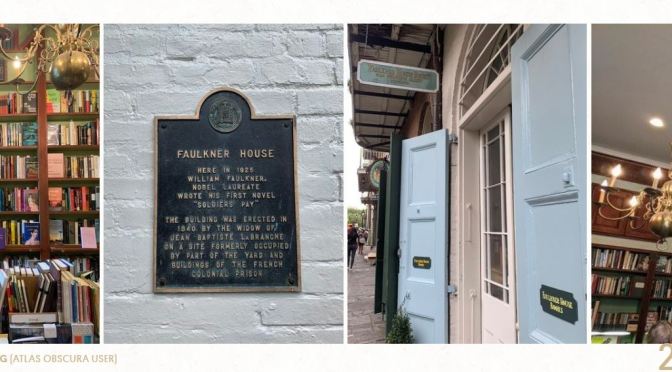
 Inside, the small store has a good selection of literary fiction ranging from classics to current publications. There is also a great selection of books about New Orleans and local culture. There is, of course, a dedicated area, almost shrine-like, for Faulkner’s works, and the shop owner will let you take a look at those more expensive books, “if you want to get in trouble with your wallet.”
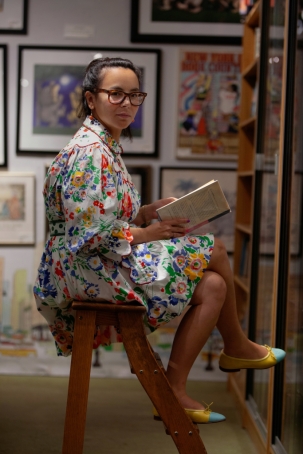 A Booklover’s Guide to New York, by Cleo Le-Tan, with drawings by Pierre Le-Tan (Rizzoli)
 “Agent Running in the Field” is narrated by Nat, a 47-year-old spy for British intelligence—known not as “the Circus” of yore but, more prosaically, as “the Office”.


 James Wood: These Etonians
 “Asking even seasoned chefs and truffle-industry insiders to describe what the fungus tastes or smells like,” Jacobs writes, “is a bit like asking a priest why he believes in God.” Readers not familiar with the pungent, one-of-a-kind flavor will come away even more intrigued. Those of us whose most frequent encounter with the fabled fungus is through truffle oil will also be disappointed. As Jacobs discovers, nearly all truffle butter and truffle oil sold in America is manufactured using chemicals rather than the real thing.

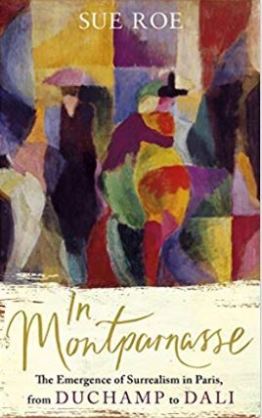 In Montparnasse begins on the eve of the First World War and ends with the 1936 unveiling of Dalí’s Lobster Telephone. As those extraordinary years unfolded, the Surrealists found ever more innovative ways of exploring the interior life, and asking new questions about how to define art. In Montparnasse recounts how this artistic revolution came to be amidst the salons and cafés of that vibrant neighborhood.
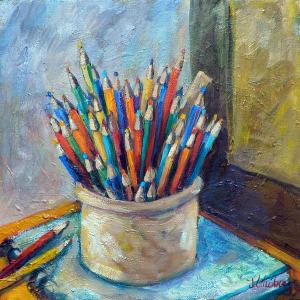 Pencils are discarded, as lighters and umbrellas are, because at some crucial moment they fail in their purpose. They refuse to ignite, quail before a shower, or simply snap. But pencils have merely suspended their usefulness. Their potential still lies within them. They can go on setting down by the thousand the words by which the world works.
 Boomers Daily