
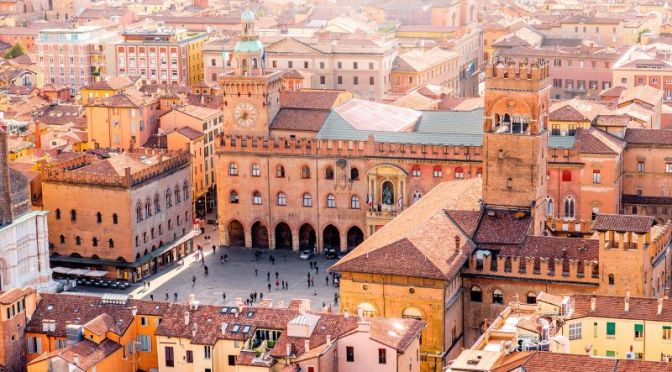
Bologna is the lively, historic capital of the Emilia-Romagna region, in northern Italy. Its Piazza Maggiore is a sprawling plaza lined with arched colonnades, cafes and medieval and Renaissance structures such as City Hall, the Fountain of Neptune and the Basilica di San Petronio. Among the city’s many medieval towers are the Two Towers, leaning Asinelli and Garisenda.
Tag Archives: Italy
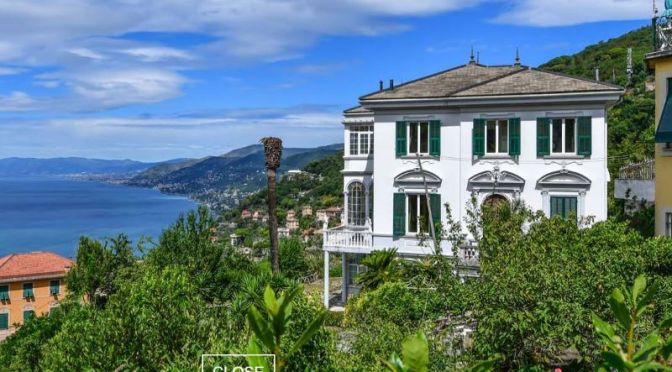
Italian Villas: ‘Camogli – Portofino Peninsula’
Located in a quiet residential area in the upper part of Camogli, with a beautiful view over the sea of Liguria, 600-sqm Liberty style villa with ample garden. The property, restored in 2015, offers a total of 6 (up to 11) bedrooms and 6 bathrooms and features beautiful living rooms with rich decorations. The villa could easily be split into two independent residential units.
Camogli is a fishing village and tourist resort located on the west side of the peninsula of Portofino, on the Golfo Paradiso in the Riviera di Levante, in the Metropolitan City of Genoa, Liguria, northern Italy. As of 30 April 2017 its population was of 5,332.
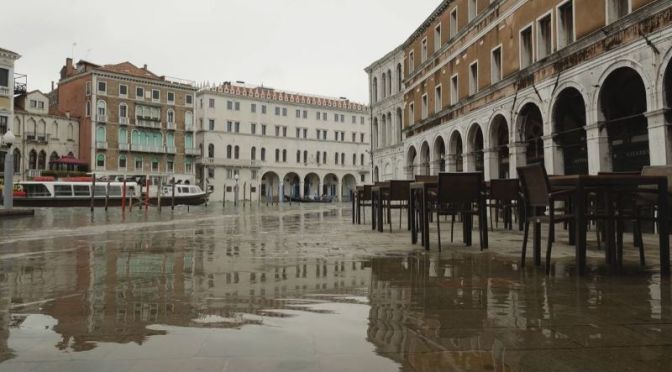
Poetic Short Films: ‘NELLA MIA CITTÀ (In my city)’ – A Tribute To Venice (Video)
Filmed, Edited and Directed by: Milton Kam
NELLA MIA CITTÀ (In my city) is my visual ode to Venice. The film observes the lagoon city and its residents during the relative scarcity of tourists in its streets. From the lustre of its famous spots to the anonymity of its quiet alleys, Venice feels as if ‘the future did not come,’ to borrow a line from the poem, which the film is based on.
Nella mia città is written by Anna Toscano and was taken from her book Doso la polvere, Milan, La Vita Felice, 2012
With music by Federico Toffano (cello), Liesl Odenweller (soprano), and Ivano Zanenghi (lute).
IN MY CITY by Anna Toscano
The future does not exist
the future does not come
in my city:
however long my step is
however much you have the favor of the wind
the number 2 does not go more than 22 km per hour.
How to get beyond the past
how not to look back
(at this speed)
with your neck always at three quarters:
time stops in piazzale Roma
so we live entangled
in the stories of peoples.
We stand, happy,
in a rearview mirror.

Walks: ‘Tiber Island’ In Rome, Italy (4K UHD Video)
The Tiber Island is the only island in the part of the Tiber which runs through Rome. Tiber Island is located in the southern bend of the Tiber. The island is boat-shaped, approximately 270 metres long and 67 metres wide, and has been connected with bridges to both sides of the river since antiquity.
Video timeline: 0:00 – [Brief Intro] 1:40 – [Tiber Island walk begins] 1:50 – [Fabricius Bridge – Oldest bridge in Rome of 62 a.C.] 4:00 – [Via di Ponte Quattro Capi] 4:28 – [S.Bartolomeo all’Isola Square] 5:16 – [View of Cestio Bridge] 5:46 – [St.John Hospital on the right] 8:00 – [Walking around the island] 15:41 – [The roman marble shape of the Boat that famously was used to bring Asclepius’ statue to the island – it’s still visible the symbol of the snake around the ship mast] 17:37 – [Southern bank of the island]
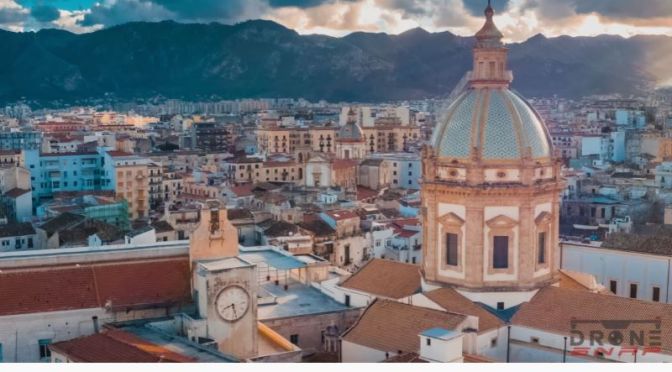
Aerial Views: ‘Sicily – Italy’
Places visited: Valley of the Temples with the Temple of Juno and the Temple of Concordia, the Cathedral of St. Agatha, the Cefalù Cathedral, the Capo Cefalù Lighthouse, the Port of Cefalù, the Etna Volcano and the beautiful old town.
Sicily, the largest Mediterranean island, is just off the “toe” of Italy’s “boot.” Its rich history is reflected in sites like the Valley of the Temples, the well-preserved ruins of 7 monumental, Doric-style Greek temples, and in the Byzantine mosaics at the Cappella Palatina, a former royal chapel in capital city Palermo. On Sicily’s eastern edge is Mount Etna, one of Europe’s highest active volcanoes.
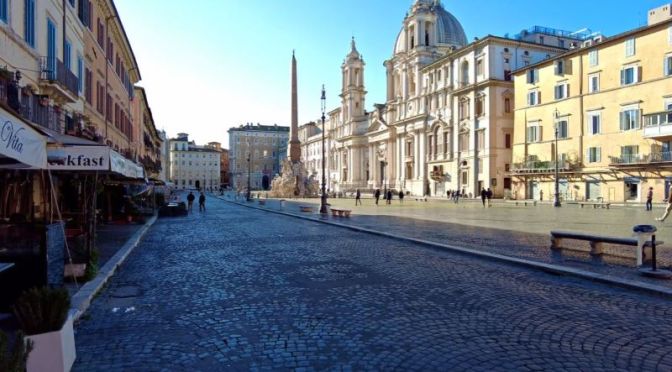
Walks: ‘Piazza Navona’ In Rome, Italy (4K UHD Video)
A walking in a Sunday morning in 𝗥𝗼𝗺𝗲 , Italy, in and around 𝗣𝗶𝗮𝘇𝘇𝗮 𝗡𝗮𝘃𝗼𝗻𝗮. Very quiet weekend day, good weather in this day of winter.
Piazza Navona is a public open space in Rome, Italy. It is built on the site of the Stadium of Domitian, built in the 1st century AD, and follows the form of the open space of the stadium. The ancient Romans went there to watch the agones, and hence it was known as “Circus Agonalis”.
Video timeline: 0:00 – [Brief Intro] 2:05 – [Piazza Navona] 4:36 – [Sant’Agnese in Agone Church *tour inside* – (info on subtitles)] 6:50 – [Piazza Navona] 8:00 – [*Fontain of Moro* – 1654 – (info on subtitles)] 9:32 – [Via della Cuccagna] 10:20 – [Piazza dei Massimi] 11:40 – [Piazza S.Andrea della Valle] 12:36 – [Corso VIttorio Emanuele II] 14:00 – [Piazza di S.Pantaleo] 14:30 – [Via della Cuccagna] 15:30 – [Via di Pasquino] 16:25 – [Via di S.Maria dell’Anima] 19:20 – [Vicolo della Pace] 22:43 – [Piazza del Fico] 23:10 – [Vicolo del Fico] 24:13 – [Via di Monte Giordano] 26:10 – [Via del Corallo] 27:31 – [Via del Governo Vecchio] 29:18 – [Via di Parione] 31:33 – [Via del Teatro Pace] 32:55 – [Vicolo dei Granari] 34:00 – [Via di S.Maria dell’Anima] 35:00 – [Piazza di Pasquino] 36:00 – [Via del Governo Vecchio] 37:30 – [Vicolo Savelli] 38:48 – [Corso Vittorio Emanuele II] 40:10 – [Via dei Leutari] 41:45 – [The *Talking Statue* of Pasquino – (info on subtitles) – it reads **This city, now old, by everyone is cheated, everyone says “great beauty”, but noone caresses you, it’s because they forgot, that in the past you founded them, My Rome, let them see, if you get enraged what can happen!*] 43:00 – [Piazza Navona]
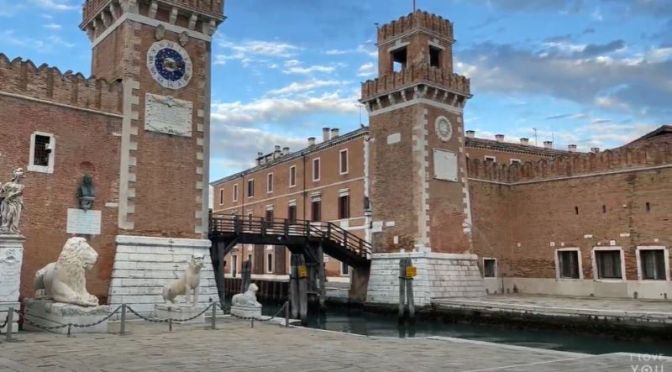
Walks: ‘Castello East In Venice, Italy’ (Video)
Castello covers a large vibrant area, with one section bordering St. Mark’s Square and dotted with luxury hotels. Farther from St. Mark’s, the neighborhood gets more laid-back, with casual bars where locals stop in for a glass of wine. Shops and eateries catering to all budgets line buzzing Via Garibaldi. In alternating years, the Giardini della Biennale park hosts the Biennale exhibition of contemporary art.
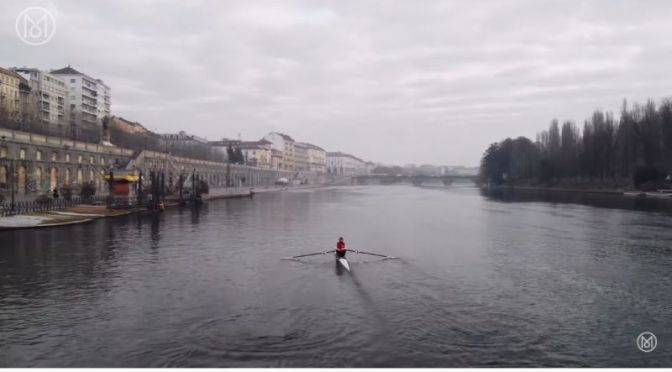
Outdoor Sports: ‘Urban Rowers On The River Po In Turin, Italy’ (Video)
We wake up bright and early to meet creative director Luca Ballarini at a rowing club on the banks of the river Po in Turin. We follow his slender boat and glide along the river beside charming palazzi, castles and bridges, while the rest of the city comes to life.
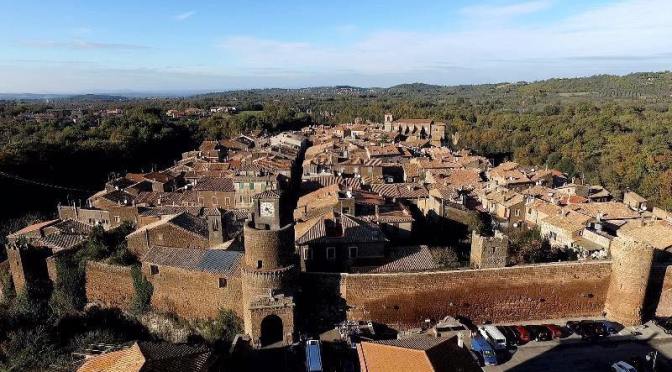
Village Walks: ‘Barbarano Romano – Italy’ (4K Video)
Barbarano Romano is a comune in the Province of Viterbo in the Italian region Latium, located about 50 kilometres northwest of Rome and about 20 kilometres south of Viterbo. Barbarano Romano borders the following municipalities: Blera, Capranica, Vejano, Vetralla, Villa San Giovanni in Tuscia.
Video timeline: 0:00 – [Brief Intro] 2:05 – [Tour begins] 2:28 – [*Roman Gate*] 7:50 – [*Church of St.Angel*] 12:44 – [Via Roma] 13:54 – [Largo di Porta Canale] 17:30 – [*Municipal Palace*] 18:28 – [*Church of St.Maria Assunta*] 26:00 – [Panormaa on the countryside] 26:30 – [Back into the town] 30:42 – [*Church of the Cross*] 33:00 – [Back into the town] 39:54 – [Via Garibaldi] 42:23 – [*City Walls*]
The town consists of a first nucleus probably dating back to the 10th century, to which are added various buildings, from the 13th to the 17th century. It constitutes an example of a medieval village, with a main central road flanked by two secondary parallels, stretched on the wedge between two gorges and closed by walls with quadrilateral open-gorge towers dating back to 14th century, further lined by a wall towards the end of the 15th century with the addition of circular towers. The volcanic hill on which the town stands was probably the seat of a village from the Ancient Bronze Age in prehistoric times, as attested by the numerous artefacts identified at the foot of the acrocoro. However, news of a permanent settlement only dates back to the Middle Ages. Almost at the end of the main street, Via Vittorio Emanuele, until 1930 stood a pentagonal tower that was left over from a Longobard fortress, known as Desiderio – the last Lombard King who around 771 fortified Viterbo and the nearby villages to counter the Franks of Charlemagne. An original marble plaque from 1280 – located at the entrance to the main church of S. Maria Assunta – indicates that it was built in 1280, during the vacant seat of the papacy following the death of Pope Nicholas III Orsini. Barbarano was therefore part of the Longobard Roman Duchy which, following the donation of Liutprando in 728, had then become a possession of the Church in the eighth century. Feud of the Anguillara family in the 14th century, then it passed to the Orsini and finally to the Borgias in the 15th century.

Walking Tour: ‘Agropoli – Southwestern Italy’ (4K)
Agropoli is a town and comune located in the Cilento area of the province of Salerno, Campania, Italy. It is situated at the start of the Cilentan Coast, on the Tyrrhenian Sea.
 Boomers Daily