Tag Archives: Foreign Affairs

THE ECONOMIST MAGAZINE – NOVEMBER 1, 2025 PREVIEW

THE ECONOMIST MAGAZINE: The latest issue featuresThe battle for New York

The battle for New York

A fight is brewing between Donald Trump and Zohran Mamdani 

Why funding Ukraine is a giant opportunity for Europe

The bill will be huge. It is also a historic bargain

America and China have only holstered their trade weapons

Neither country wants decoupling or confrontation—at least, not yet

Javier Milei’s chance to transform Argentina and teach the world

Lessons in public finance from the original sinner

THE ECONOMIST MAGAZINE – OCTOBER 25, 2025 PREVIEW

THE ECONOMIST MAGAZINE: The latest issue featuresWinning the trade war

Why China is winning the trade war

It has rebuffed America and rewritten the norms of global commerce

Javier Milei faces his most dangerous moment yet

He could still survive a currency run and knife-edge election

To save the world’s tropical forests, learn from Brazil

Last year it lost more rainforest than any other country. Yet there is hope

The migration schemes even populists love

Why temporary workers bring great benefits

Never mind your children’s screen time. Worry about your parents’ 

A new generation of pensioners are glued to their smartphones

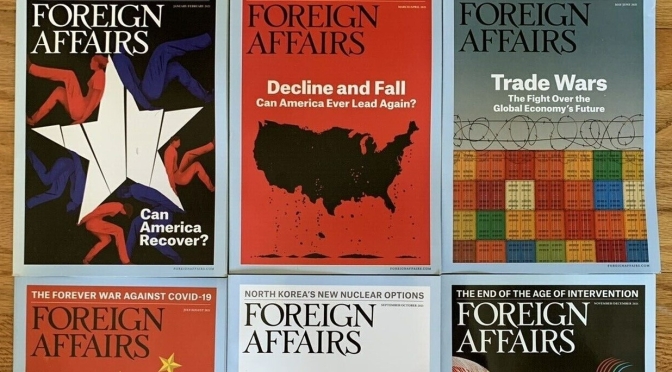
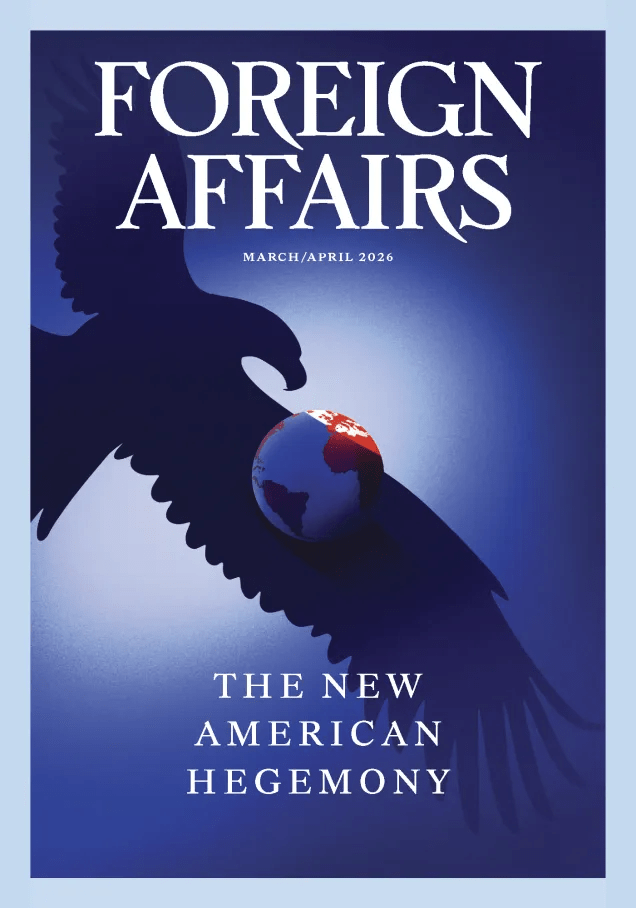
FOREIGN AFFAIRS MAGAZINE NOVEMBER/DECEMBER 2025

FOREIGN AFFAIRS MAGAZINE: The latest issue features ‘The New Tools of Power’

The Stagnant Order

And the End of Rising Powers by Michael Beckley

A Grand Strategy of Reciprocity

How to Build an Economic and Security Order That Works for America by Oren Cass

The New Supply Chain Insecurity

Fortress America Is Not a Safer America by Shannon K. O’Neil

The Return of the Energy Weapon

An Old Tool Creating New Dangers Jason Bordoff and Meghan L. O’Sullivan

The Economist Special Report: “Governments Going Broke” – 10.18.25

THE ECONOMIST SPECIAL REPORT: Governments going broke – In many of the world’s big economies, public finances are heading for a crisis. Henry Curr argues the consequences will be profound


→Across the rich world, fiscal crises loom

→How much public debt is too much?

→Fixing the welfare state looks electorally impossible

→Economic growth is unlikely to prevent fiscal crisis

→Big, rich countries have rarely repaid debt with surpluses

→How do some countries avoid debt?

→The case against holding bonds

THE ECONOMIST MAGAZINE – OCTOBER 18, 2025 PREVIEW

THE ECONOMIST MAGAZINE: The latest issue featuresThe coming debt emergency

The rich world faces a painful bout of inflation

Governments are living far beyond their means. Sadly, inflation is the most likely escape

Brute force is no match for today’s high-tech drug-runners

They are more inventive and adaptable than ever

The America v China spat reveals a dangerous dynamic

A balance of economic terror is no basis for stability

First Brands is a painful but necessary warning for Wall Street

Lessons from a $10bn panic on the prairie

Why Trump is looking the wrong way in the Arctic

Forget Greenland; worry about Alaska

ZENDEGI-E NORMAL

After the theocracy’s fall, the search for a normal life becomes Iran’s quietest revolution.

By Michael Cummins, Editor | October 16, 2025

This speculative essay, based on Karim Sadjadpour’s Foreign Affairs essay “The Autumn of the Ayatollahs,”  transforms geopolitical forecast into human story. In the imagined autumn of the theocracy, when the last sermons fade into static, the search for zendegi normal—a normal life—becomes Iran’s most radical act.

“They said the revolution would bring light. I learned to live in the dark.”

The city now keeps time by outages. Twelve days of war, then the silence that follows artillery—a silence so dense it hums. Through that hum the old voice returns, drifting across Tehran’s cracked frequencies, a papery baritone shaped by oxygen tanks and memory. Victory, he rasps. Someone in the alley laughs—quietly, the way people laugh at superstition.

On a balcony, a scarf lifts and settles on a rusted railing. Its owner, Farah, twenty-three, hides her phone under a clay pot to muffle the state’s listening apps. Across the street, a mural once blazed Death to America. Now the paint flakes into harmless confetti. Beneath it, someone has stenciled two smaller words: zendegi normal.

She whispers them aloud, tasting the risk. Life, ordinary and dangerous, returning in fragments.

Her father, gone for a decade to Evin Prison, was a radio engineer. He used to say truth lived in the static between signals. Farah believed him. Now she edits protest footage in the dark—faces half-lit by streetlamps, each one a seed of defiance. “The regime is weakening day by day,” the exiled activist on BBC Persian had said. Farah memorized the phrase the way others memorize prayers.

Her mother, Pari, hears the whispering and sighs. “Hope is contraband,” she says, stirring lentils by candlelight. “They seize it at checkpoints.”

Pari had survived every iteration of promise. “They say ‘Death to America,’” she liked to remind her students in 1983, “but never ‘Long Live Iran.’” The slogans were always about enemies, never about home. She still irons her scarf when the power flickers back, as if straight lines could summon stability. When darkness returns, she tells stories the censors forgot to erase: a poet who hid verses in recipes, a philosopher who said tyranny and piety wear the same cloak.

Now, when Farah speaks of change—“The Ayatollah is dying; everything will shift”—Pari only smiles, thinly. “Everything changes,” she says, “so that everything can remain the same.”


Farah’s generation remembers only the waiting. They are fluent in VPNs, sarcasm, and workaround hope. Every blackout feels like rehearsal for something larger.

Across town, in a military café that smells of burnt sugar and strategy, General Nouri stirs his fourth espresso and writes three words on a napkin: The debt is settled. Dust lies thick on the portraits of the Supreme Leader. Nouri, once a devout Revolutionary Guard, has outlived his faith and most of his rivals.

He decides that tanks run on diesel, not divinity. “Revelation,” he mutters, “is bad logistics.” His aides propose slogans—National Dignity, Renewal, Stability—but he wants something purer: control without conviction. “For a nation that sees plots everywhere,” he tells them, “the only trust is force.”

When he finally appears on television, the uniform is gone, replaced by a tailored gray suit. He speaks not of God but of bread, fuel, electricity. The applause sounds cautious, like people applauding themselves for surviving long enough to listen.

Nouri does not wait for the clerics to sanction him; he simply bypasses them. His first decree dissolves the Assembly of Experts, calling the aging jurists “ineffective ballast.” It is theater—a slap at the theocracy’s façade. The next decree, an anticorruption campaign, is really a seizure of rival IRGC cartels’ assets, centralizing wealth under his inner circle. This is the new cynicism: a strongman substituting grievance-driven nationalism for revolutionary dogma. He creates the National Oversight Bureau—a polite successor to the intelligence services—charged not with uncovering American plots but with logging every official’s loyalty. The old Pahlavi pathology returns: the ruler who trusts no one, not even his own shadow. A new app appears on every phone—ostensibly for energy alerts—recording users’ locations and contacts. Order, he demonstrates, is simply organized suspicion.


Meanwhile Reza, the technocrat, learns that pragmatism can be treason. He studied in Paris and returned to design an energy grid that never materialized. Now the ministries call him useful and hand him the Normalization Plan.

“Stabilize the economy,” his superior says, “but make it look indigenous.” Reza smiles the way one smiles when irony is all that remains. At night he writes memos about tariffs but sketches a different dream in the margins: a library without checkpoints, a square with shade trees, a place where arguments happen in daylight.

At home the refrigerator groans like an old argument. His daughter asks if the new leader will let them watch Turkish dramas again. “Maybe,” he says. “If the Internet behaves.”

But the Normalization Plan is fiction. He is trying to build a modern economy in a swamp of sanctioned entities. When he opens ports to international shipping, the IRGC blocks them—its generals treat the docks as personal treasuries. They prefer smuggling profits to taxable trade. Reza’s spreadsheets show that lifting sanctions would inject billions into the formal economy; Nouri’s internal reports show that the generals would lose millions in black-market rents. Iran, he realizes, is not China; it is a rentier state addicted to scarcity. Every reformist since 1979 has been suffocated by those who prosper from isolation. His new energy-grid design—efficient, global—stalls when a single colonel controlling illicit oil exports refuses to sign the permit. Pragmatism, in this system, is a liability.


When the generator fails, darkness cuts mid-sentence. The air tastes metallic. “They promised to protect us,” Pari says, fumbling for candles. “Now we protect ourselves from their promises.”

“Fattahi says we can rebuild,” Farah answers. “A secular Iran, a democratic one.”
“Child, they buried those words with your father.”
“Then I’ll dig them out.”

Pari softens. “You think rebellion is new. I once wrote freedom on a classroom chalkboard. They called it graffiti.”

Farah notices, for the first time, the quiet defiance stitched into daily life. Pari still irons her scarf, a habit of survival, but Farah ties hers loosely, a small deliberate chaos. At the bakery, she sees other acts of color—an emerald coat, a pop song leaking from a car, a man selling forbidden books in daylight. A decade ago, girls lined up in schoolyards for hijab inspections; now a cluster of teenagers stands laughing, hair visible, shoulders touching in shared, unspoken defiance. The contradiction the feminist lawyer once described—“the situation of women shows all the contradictions of the revolution”—is playing out in the streets, private shame becoming public confidence.

Outside, the muezzin’s call overlaps with a chant that could be mourning or celebration. In Tehran, it is often both.


Power, Nouri decides, requires choreography. He replaces Friday prayers with “National Addresses.” The first begins with a confession: Faith divided us. Order will unite us. For a month, it works. Trucks deliver bread under camera lights; gratitude becomes policy. But soon the whispering returns: the old Ayatollah lives in hiding, dictating verses. Nouri knows the rumor is false—he planted it himself. Suspicion, he believes, is the purest form of control. Yet even he feels its poison. Each morning he finds the same note in the intelligence reports: The debt is settled. Is it loyalty—or indictment?


Spring creeps back through cracks in concrete. Vines climb the radio towers. In a basement, Farah’s father’s transmitter still hums, knobs smoothed by fear. “Tonight,” she whispers into the mic, “we speak of normal life.”

She reads messages from listeners: a woman in Mashhad thanking the blackout for showing her the stars; a taxi driver in Shiraz who has stopped chanting anything at all; a child asking if tomorrow the water will run. As the signal fades, Farah repeats the question like a prayer. Somewhere, a neighbor mistakes her voice for revelation and kneels toward the sound. The scarf on her balcony stirs in the dark.


The old voice never returns. Rumor fills the vacuum. Pari hangs laundry on the balcony; the scarf flutters beside her, now simply weather. Below, children chalk zendegi normal across the pavement and draw birds around the words—wings in white dust. A soldier passes, glances, and does nothing. She remembers writing freedom on that school chalkboard, the silence that followed, the summons to the principal’s office. Now no one erases the word. She turns up the radio just enough to catch Farah’s voice, low and steady: “Tonight, we speak of normal life.” In the distance, generators pulse like mechanical hearts.


Nouri, now called Marshal, prefers silence to titles. He spends mornings signing exemptions, evenings counting enemies. Each new name feels like ballast. He visits the shrine city he once scorned, hoping faith might offer cover. “You have replaced revelation with maintenance,” a cleric tells him.
“Yes,” Nouri replies, “and the lights stay on.”

That night the grid collapses across five provinces. From his balcony he watches darkness reclaim the skyline. Then, through the static, a woman’s voice—the same one—rises from a pirated frequency, speaking softly of ordinary life. He sets down his glass, almost reaches for the dial, then stops. The scarf lifts somewhere he cannot see.


Weeks later, Reza finds a memory stick in his mail slot—no note, only the symbol of a scarf folded into a bird. Inside: the civic network he once designed, perfected by unseen hands. In its code comments one line repeats—The debt is settled. He knows activation could mean death. He does it anyway.

Within hours, phones across Iran connect to a network that belongs to no one. People share recipes, poetry, bread prices—nothing overtly political, only life reasserting itself. Reza watches the loading bar crawl forward, each pixel a quiet defiance. He thinks of his grandfather, who told him every wire carries a prayer. In the next room, his daughter sleeps, her tablet tucked beneath her pillow. The servers hum. He imagines the sound traveling outward—through routers, walls, cities—until it reaches someone who had stopped believing in connection. For the first time in years, the signal clears.


Farah leans toward the microphone. “Tonight,” she says, “we speak of water, bread, and breath.” Messages flood in: a baker in Yazd who plays her signal during morning prep; a soldier’s mother who whispers her words to her son before he leaves for duty; a cleric’s niece who says the broadcast reminds her of lullabies. Farah closes her eyes. The scarf rises once more. She signs off with the whisper that has become ritual: Every revolution ends in a whisper—the sound of someone turning off the radio. Then she waits, not for applause, but for the hum.


By late October, Tehran smells of dust and pomegranates. Street vendors return, cautious but smiling. The murals are being repainted—not erased but joined—Death to America fading beside smaller, humbler words: Work. Light. Air. No one claims victory; they have learned better. The revolution, it turns out, did not collapse—it exhaled. The Ayatollah became rumor, the general a footnote, and the word that endured was the simplest one: zendegi. Life. Fragile, ordinary, persistent—like a radio signal crossing mountains.

The scarf lifts once more. The signal clears. And somewhere, faint but unmistakable, the hum returns.

“From every ruin, a song will rise.” — Forugh Farrokhzad

THIS ESSAY WAS WRITTEN AND EDITED UTILIZING AI

THE ECONOMIST MAGAZINE – OCTOBER 11, 2025 PREVIEW

THE ECONOMIST MAGAZINE: The latest issue featuresA new beginning

A new beginning for the Middle East

The breakthrough in Gaza could open up a new approach to peace

Donald Trump’s fortress economy is starting to hurt America

The pain from trade and immigration restrictions cannot be postponed forever

Japanese politics enters its heavy-metal phase

Takaichi Sanae is a refreshing change—but problems loo

Cybercrime is afflicting big business. How to lessen the pain

Banning the payment of ransoms would be a start

Africa’s leaders-for-life offer a warning to the world

The longer autocrats stay in power, the worse they become

THE ECONOMIST MAGAZINE – OCTOBER 4, 2025 PREVIEW

THE ECONOMIST MAGAZINE: The latest issue featuresRussia tests the West

Vladimir Putin is testing the West—and its unity

NATO must resist Russia’s efforts to corrode it from within

The White House’s plan for Gaza deserves praise

America, Israel and perhaps Hamas have changed their positions

Donald Trump’s cure for drug prices is worse than the disease

The problem is not greedy pharma firms

The new SCOTUS term will reshape America’s constitution

If the justices do not check an overmighty president, the country will suffer

Unleash the robotaxi revolution

Across the West, safety rules are standing in the way of progress

THE ECONOMIST MAGAZINE – SEPTEMBER 27, 2025 PREVIEW

THE ECONOMIST MAGAZINE: The latest issue featuresFree speech in America‘…

Donald Trump is trying to silence his critics. He will fail

But the country could still lose

The desperate search for superstar talent

Too much potential goes to waste

Fixing the rot in Ukraine

Things are going wrong away from the front line. Europe needs to help

How to stop AI’s “lethal trifecta”

Coders need to start thinking like mechanical engineers

NATIONAL REVIEW – NOVEMBER 2025

NATIONAL REVIEW: The latest issue features ‘The Trump Effect’

“If President Donald Trump’s careers in real estate development, television, and now politics have taught us anything, it is that he likes to leave his mark (and his name) on everything he touches,” Christine Rosen writes in the new issue of National Review magazine. “Some of those marks, like the profusion of gilt ornaments and gold, Trump-branded coasters in the Oval Office, will almost certainly be removed by future presidents. Others, like the proposed construction of a White House ballroom or his plan to build a ‘Garden of Heroes’ featuring statues of great Americans, are more likely to become permanent parts of the White House and National Mall.”

The Trump Effect: On the Rule of Law

A country in which law is king asks not whether government hardball works but whether it is legal. Andrew C. McCarthy

The Trump Effect: On Our Alliances

U.S. interests aren’t advanced when America’s allies are less confident in Washington and more inclined to accommodate regional bullies. Noah Rothman

The Trump Effect: On Popular Culture

For much of the last decade, Hollywood has been making the same statement: Trump is bad. But they had no idea how to beat him