From a Caltech online news release:
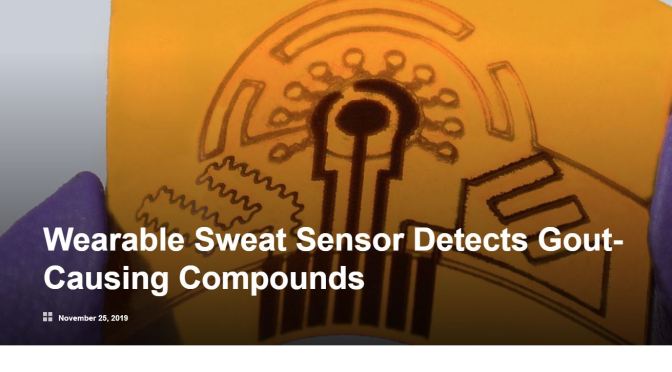
 “Such wearable sweat sensors have the potential to rapidly, continuously, and noninvasively capture changes in health at molecular levels,” Gao says. “They could enable personalized monitoring, early diagnosis, and timely intervention.”
The development of such sensors would allow doctors to continuously monitor the condition of patients with illnesses like cardiovascular disease, diabetes, or kidney disease, all of which result in abnormal levels of nutrients or metabolites in the bloodstream. Patients would benefit from having their physician better informed of their condition, while also avoiding invasive and painful encounters with hypodermic needles.
 Gao’s work is focused on developing devices based on microfluidics, a name for technologies that manipulate tiny amounts of liquids, usually through channels less than a quarter of a millimeter in width. Microfluidics are ideal for an application of this sort because they minimize the influence of sweat evaporation and skin contamination on the sensing accuracy. As freshly supplied sweat flows through the microchannels, the device can make more accurate measurements of sweat and can capture temporal changes in concentrations.
To read more: https://www.caltech.edu/about/news/wearable-sweat-sensor-detects-gout-causing-compounds





 “This proof of concept study demonstrates a new paradigm that measurement of blood proteins can accurately deliver health information that spans across numerous medical specialties and that should be actionable for patients and their healthcare providers,” said Peter Ganz, MD, co-leader of this study and the Maurice Eliaser distinguished professor of medicine at UCSF and director of the Center of Excellence in Vascular Research at Zuckerberg San Francisco General Hospital and Trauma Center.

 Boomers Daily