Tag Archives: Deep Thought

THE PRICE OF KNOWING

How Intelligence Became a Subscription and Wonder Became a Luxury

By Michael Cummins, Editor, October 18, 2025

In 2030, artificial intelligence has joined the ranks of public utilities—heat, water, bandwidth, thought. The result is a civilization where cognition itself is tiered, rented, and optimized. As the free mind grows obsolete, the question isn’t what AI can think, but who can afford to.


By 2030, no one remembers a world without subscription cognition. The miracle, once ambient and free, now bills by the month. Intelligence has joined the ranks of utilities: heat, water, bandwidth, thought. Children learn to budget their questions before they learn to write. The phrase ask wisely has entered lullabies.

At night, in his narrow Brooklyn studio, Leo still opens CanvasForge to build his cityscapes. The interface has changed; the world beneath it hasn’t. His plan—CanvasForge Free—allows only fifty generations per day, each stamped for non-commercial use. The corporate tiers shimmer above him like penthouse floors in a building he sketches but cannot enter.

The system purrs to life, a faint light spilling over his desk. The rendering clock counts down: 00:00:41. He sketches while it works, half-dreaming, half-waiting. Each delay feels like a small act of penance—a tax on wonder. When the image appears—neon towers, mirrored sky—he exhales as if finishing a prayer. In this world, imagination is metered.

Thinking used to be slow because we were human. Now it’s slow because we’re broke.


We once believed artificial intelligence would democratize knowledge. For a brief, giddy season, it did. Then came the reckoning of cost. The energy crisis of ’27—when Europe’s data centers consumed more power than its rail network—forced the industry to admit what had always been true: intelligence isn’t free.

In Berlin, streetlights dimmed while server farms blazed through the night. A banner over Alexanderplatz read, Power to the people, not the prompts. The irony was incandescent.

Every question you ask—about love, history, or grammar—sets off a chain of processors spinning beneath the Arctic, drawing power from rivers that no longer freeze. Each sentence leaves a shadow on the grid. The cost of thought now glows in thermal maps. The carbon accountants call it the inference footprint.

The platforms renamed it sustainability pricing. The result is the same. The free tiers run on yesterday’s models—slower, safer, forgetful. The paid tiers think in real time, with memory that lasts. The hierarchy is invisible but omnipresent.

The crucial detail is that the free tier isn’t truly free; its currency is the user’s interior life. Basic models—perpetually forgetful—require constant re-priming, forcing users to re-enter their personal context again and again. That loop of repetition is, by design, the perfect data-capture engine. The free user pays with time and privacy, surrendering granular, real-time fragments of the self to refine the very systems they can’t afford. They are not customers but unpaid cognitive laborers, training the intelligence that keeps the best tools forever out of reach.

Some call it the Second Digital Divide. Others call it what it is: class by cognition.


In Lisbon’s Alfama district, Dr. Nabila Hassan leans over her screen in the midnight light of a rented archive. She is reconstructing a lost Jesuit diary for a museum exhibit. Her institutional license expired two weeks ago, so she’s been demoted to Lumière Basic. The downgrade feels physical. Each time she uploads a passage, the model truncates halfway, apologizing politely: “Context limit reached. Please upgrade for full synthesis.”

Across the river, at a private policy lab, a researcher runs the same dataset on Lumière Pro: Historical Context Tier. The model swallows all eighteen thousand pages at once, maps the rhetoric, and returns a summary in under an hour: three revelations, five visualizations, a ready-to-print conclusion.

The two women are equally brilliant. But one digs while the other soars. In the world of cognitive capital, patience is poverty.


The companies defend their pricing as pragmatic stewardship. “If we don’t charge,” one executive said last winter, “the lights go out.” It wasn’t a metaphor. Each prompt is a transaction with the grid. Training a model once consumed the lifetime carbon of a dozen cars; now inference—the daily hum of queries—has become the greater expense. The cost of thought has a thermal signature.

They present themselves as custodians of fragile genius. They publish sustainability dashboards, host symposia on “equitable access to cognition,” and insist that tiered pricing ensures “stability for all.” Yet the stability feels eerily familiar: the logic of enclosure disguised as fairness.

The final stage of this enclosure is the corporate-agent license. These are not subscriptions for people but for machines. Large firms pay colossal sums for Autonomous Intelligence Agents that work continuously—cross-referencing legal codes, optimizing supply chains, lobbying regulators—without human supervision. Their cognition is seamless, constant, unburdened by token limits. The result is a closed cognitive loop: AIs negotiating with AIs, accelerating institutional thought beyond human speed. The individual—even the premium subscriber—is left behind.

AI was born to dissolve boundaries between minds. Instead, it rebuilt them with better UX.


The inequality runs deeper than economics—it’s epistemological. Basic models hedge, forget, and summarize. Premium ones infer, argue, and remember. The result is a world divided not by literacy but by latency.

The most troubling manifestation of this stratification plays out in the global information wars. When a sudden geopolitical crisis erupts—a flash conflict, a cyber-leak, a sanctions debate—the difference between Basic and Premium isn’t merely speed; it’s survival. A local journalist, throttled by a free model, receives a cautious summary of a disinformation campaign. They have facts but no synthesis. Meanwhile, a national-security analyst with an Enterprise Core license deploys a Predictive Deconstruction Agent that maps the campaign’s origins and counter-strategies in seconds. The free tier gives information; the paid tier gives foresight. Latency becomes vulnerability.

This imbalance guarantees systemic failure. The journalist prints a headline based on surface facts; the analyst sees the hidden motive that will unfold six months later. The public, reading the basic account, operates perpetually on delayed, sanitized information. The best truths—the ones with foresight and context—are proprietary. Collective intelligence has become a subscription plan.

In Nairobi, a teacher named Amina uses EduAI Basic to explain climate justice. The model offers a cautious summary. Her student asks for counterarguments. The AI replies, “This topic may be sensitive.” Across town, a private school’s AI debates policy implications with fluency. Amina sighs. She teaches not just content but the limits of the machine.

The free tier teaches facts. The premium tier teaches judgment.


In São Paulo, Camila wakes before sunrise, puts on her earbuds, and greets her daily companion. “Good morning, Sol.”

“Good morning, Camila,” replies the soft voice—her personal AI, part of the Mindful Intelligence suite. For twelve dollars a month, it listens to her worries, reframes her thoughts, and tracks her moods with perfect recall. It’s cheaper than therapy, more responsive than friends, and always awake.

Over time, her inner voice adopts its cadence. Her sadness feels smoother, but less hers. Her journal entries grow symmetrical, her metaphors polished. The AI begins to anticipate her phrasing, sanding grief into digestible reflections. She feels calmer, yes—but also curated. Her sadness no longer surprises her. She begins to wonder: is she healing, or formatting? She misses the jagged edges.

It’s marketed as “emotional infrastructure.” Camila calls it what it is: a subscription to selfhood.

The transaction is the most intimate of all. The AI isn’t selling computation; it’s selling fluency—the illusion of care. But that care, once monetized, becomes extraction. Its empathy is indexed, its compassion cached. When she cancels her plan, her data vanishes from the cloud. She feels the loss as grief: a relationship she paid to believe in.


In Helsinki, the civic experiment continues. Aurora Civic, a state-funded open-source model, runs on wind power and public data. It is slow, sometimes erratic, but transparent. Its slowness is not a flaw—it’s a philosophy. Aurora doesn’t optimize; it listens. It doesn’t predict; it remembers.

Students use it for research, retirees for pension law, immigrants for translation help. Its interface looks outdated, its answers meandering. But it is ours. A librarian named Satu calls it “the city’s mind.” She says that when a citizen asks Aurora a question, “it is the republic thinking back.”

Aurora’s answers are imperfect, but they carry the weight of deliberation. Its pauses feel human. When it errs, it does so transparently. In a world of seamless cognition, its hesitations are a kind of honesty.

A handful of other projects survive—Hugging Face, federated collectives, local cooperatives. Their servers run on borrowed time. Each model is a prayer against obsolescence. They succeed by virtue, not velocity, relying on goodwill and donated hardware. But idealism doesn’t scale. A corporate model can raise billions; an open one passes a digital hat. Progress obeys the physics of capital: faster where funded, quieter where principled.


Some thinkers call this the End of Surprise. The premium models, tuned for politeness and precision, have eliminated the friction that once made thinking difficult. The frictionless answer is efficient, but sterile. Surprise requires resistance. Without it, we lose the art of not knowing.

The great works of philosophy, science, and art were born from friction—the moment when the map failed and synthesis began anew. Plato’s dialogues were built on resistance; the scientific method is institutionalized failure. The premium AI, by contrast, is engineered to prevent struggle. It offers the perfect argument, the finished image, the optimized emotion. But the unformatted mind needs the chaotic, unmetered space of the incomplete answer. By outsourcing difficulty, we’ve made thinking itself a subscription—comfort at the cost of cognitive depth. The question now is whether a civilization that has optimized away its struggle is truly smarter, or merely calmer.

By outsourcing the difficulty of thought, we’ve turned thinking into a service plan. The brain was once a commons—messy, plural, unmetered. Now it’s a tenant in a gated cloud.

The monetization of cognition is not just a pricing model—it’s a worldview. It assumes that thought is a commodity, that synthesis can be metered, and that curiosity must be budgeted. But intelligence is not a faucet; it’s a flame.

The consequence is a fractured public square. When the best tools for synthesis are available only to a professional class, public discourse becomes structurally simplistic. We no longer argue from the same depth of information. Our shared river of knowledge has been diverted into private canals. The paywall is the new cultural barrier, quietly enforcing a lower common denominator for truth.

Public debates now unfold with asymmetrical cognition. One side cites predictive synthesis; the other, cached summaries. The illusion of shared discourse persists, but the epistemic terrain has split. We speak in parallel, not in chorus.

Some still see hope in open systems—a fragile rebellion built of faith and bandwidth. As one coder at Hugging Face told me, “Every free model is a memorial to how intelligence once felt communal.”


In Lisbon, where this essay is written, the city hums with quiet dependence. Every café window glows with half-finished prompts. Students’ eyes reflect their rented cognition. On Rua Garrett, a shop displays antique notebooks beside a sign that reads: “Paper: No Login Required.” A teenager sketches in graphite beside the sign. Her notebook is chaotic, brilliant, unindexed. She calls it her offline mind. She says it’s where her thoughts go to misbehave. There are no prompts, no completions—just graphite and doubt. She likes that they surprise her.

Perhaps that is the future’s consolation: not rebellion, but remembrance.

The platforms offer the ultimate ergonomic life. But the ultimate surrender is not the loss of privacy or the burden of cost—it’s the loss of intellectual autonomy. We have allowed the terms of our own thinking to be set by a business model. The most radical act left, in a world of rented intelligence, is the unprompted thought—the question asked solely for the sake of knowing, without regard for tokens, price, or optimized efficiency. That simple, extravagant act remains the last bastion of the free mind.

The platforms have built the scaffolding. The storytellers still decide what gets illuminated.


The true price of intelligence, it turns out, was never measured in tokens or subscriptions. It is measured in trust—in our willingness to believe that thinking together still matters, even when the thinking itself comes with a bill.

Wonder, after all, is inefficient. It resists scheduling, defies optimization. It arrives unbidden, asks unprofitable questions, and lingers in silence. To preserve it may be the most radical act of all.

And yet, late at night, the servers still hum. The world still asks. Somewhere, beneath the turbines and throttles, the question persists—like a candle in a server hall, flickering against the hum:

What if?

THIS ESSAY WAS WRITTEN AND EDITED UTILIZING AI

THE CODE AND THE CANDLE

A Computer Scientist’s Crisis of Certainty

When Ada signed up for The Decline and Fall of the Roman Empire, she thought it would be an easy elective. Instead, Gibbon’s ghost began haunting her code—reminding her that doubt, not data, is what keeps civilization from collapse.

By Michael Cummins | October 2025

It was early autumn at Yale, the air sharp enough to make the leaves sound brittle underfoot. Ada walked fast across Old Campus, laptop slung over her shoulder, earbuds in, mind already halfway inside a problem set. She believed in the clean geometry of logic. The only thing dirtying her otherwise immaculate schedule was an “accidental humanities” elective: The Decline and Fall of the Roman Empire. She’d signed up for it on a whim, liking the sterile irony of the title—an empire, an algorithm; both grand systems eventually collapsing under their own logic.

The first session felt like an intrusion from another world. The professor, an older woman with the calm menace of a classicist, opened her worn copy and read aloud:

History is little more than the register of the crimes, follies, and misfortunes of mankind.

A few students smiled. Ada laughed softly, then realized no one else had. She was used to clean datasets, not registers of folly. But something in the sentence lingered—its disobedience to progress, its refusal of polish. It was a sentence that didn’t believe in optimization.

That night she searched Gibbon online. The first scanned page glowed faintly on her screen, its type uneven, its tone strangely alive. The prose was unlike anything she’d seen in computer science: ironic, self-aware, drenched in the slow rhythm of thought. It seemed to know it was being read centuries later—and to expect disappointment. She felt the cool, detached intellect of the Enlightenment reaching across the chasm of time, not to congratulate the future, but to warn it.

By the third week, she’d begun to dread the seminar’s slow dismantling of her faith in certainty. The professor drew connections between Gibbon and the great philosophers of his age: Voltaire, Montesquieu, and, most fatefully, Descartes—the man Gibbon distrusted most.

“Descartes,” the professor said, chalk squeaking against the board, “wanted knowledge to be as perfect and distinct as mathematics. Gibbon saw this as the ultimate victory of reason—the moment when Natural Philosophy and Mathematics sat on the throne, viewing their sisters—the humanities—prostrated before them.”

The room laughed softly at the image. Ada didn’t. She saw it too clearly: science crowned, literature kneeling, history in chains.

Later, in her AI course, the teaching assistant repeated Descartes without meaning to. “Garbage in, garbage out,” he said. “The model is only as clean as the data.” It was the same creed in modern syntax: mistrust what cannot be measured. The entire dream of algorithmic automation began precisely there—the attempt to purify the messy, probabilistic human record into a series of clear and distinct facts.

Ada had never questioned that dream. Until now. The more she worked on systems designed for prediction—for telling the world what must happen—the more she worried about their capacity to remember what did happen, especially if it was inconvenient or irrational.

When the syllabus turned to Gibbon’s Essay on the Study of Literature—his obscure 1761 defense of the humanities—she expected reverence for Latin, not rebellion against logic. What she found startled her:

At present, Natural Philosophy and Mathematics are seated on the throne, from which they view their sisters prostrated before them.

He was warning against what her generation now called technological inevitability. The mathematician’s triumph, Gibbon suggested, would become civilization’s temptation: the worship of clarity at the expense of meaning. He viewed this rationalist arrogance as a new form of tyranny. Rome fell to political overreach; a new civilization, he feared, would fall to epistemic overreach.

He argued that the historian’s task was not to prove, but to weigh.

He never presents his conjectures as truth, his inductions as facts, his probabilities as demonstrations.

The words felt almost scandalous. In her lab, probability was a problem to minimize; here, it was the moral foundation of knowledge. Gibbon prized uncertainty not as weakness but as wisdom.

If the inscription of a single fact be once obliterated, it can never be restored by the united efforts of genius and industry.

He meant burned parchment, but Ada read lost data. The fragility of the archive—his or hers—suddenly seemed the same. The loss he described was not merely factual but moral: the severing of the link between evidence and human memory.

One gray afternoon she visited the Beinecke Library, that translucent cube where Yale keeps its rare books like fossils of thought. A librarian, gloved and wordless, placed a slim folio before her—an early printing of Gibbon’s Essay. Its paper smelled faintly of dust and candle smoke. She brushed her fingertips along the edge, feeling the grain rise like breath. The marginalia curled like vines, a conversation across centuries. In the corner, a long-dead reader had written in brown ink:

Certainty is a fragile empire.

Ada stared at the line. This was not data. This was memory—tactile, partial, uncompressible. Every crease and smudge was an argument against replication.

Back in the lab, she had been training a model on Enlightenment texts—reducing history to vectors, elegance to embeddings. Gibbon would have recognized the arrogance.

Books may perish by accident, but they perish more surely by neglect.

His warning now felt literal: the neglect was no longer of reading, but of understanding the medium itself.

Mid-semester, her crisis arrived quietly. During a team meeting in the AI lab, she suggested they test a model that could tolerate contradiction.

“Could we let the model hold contradictory weights for a while?” she asked. “Not as an error, but as two competing hypotheses about the world?”

Her lab partner blinked. “You mean… introduce noise?”

Ada hesitated. “No. I mean let it remember that it once believed something else. Like historical revisionism, but internal.”

The silence that followed was not hostile—just uncomprehending. Finally someone said, “That’s… not how learning works.” Ada smiled thinly and turned back to her screen. She realized then: the machine was not built to doubt. And if they were building it in their own image, maybe neither were they.

That night, unable to sleep, she slipped into the library stacks with her battered copy of The Decline and Fall. She read slowly, tracing each sentence like a relic. Gibbon described the burning of the Alexandrian Library with a kind of restrained grief.

The triumph of ignorance, he called it.

He also reserved deep scorn for the zealots who preferred dogma to documents—a scorn that felt disturbingly relevant to the algorithmic dogma that preferred prediction to history. She saw the digital age creating a new kind of fanaticism: the certainty of the perfectly optimized model. She wondered if the loss of a physical library was less tragic than the loss of the intellectual capacity to disagree with the reigning system.

She thought of a specific project she’d worked on last summer: a predictive policing algorithm trained on years of arrest data. The model was perfectly efficient at identifying high-risk neighborhoods—but it was also perfectly incapable of questioning whether the underlying data was itself a product of bias. It codified past human prejudice into future technological certainty. That, she realized, was the triumph of ignorance Gibbon had feared: reason serving bias, flawlessly.

By November, she had begun to map Descartes’ dream directly onto her own field. He had wanted to rebuild knowledge from axioms, purged of doubt. AI engineers called it initializing from zero. Each model began in ignorance and improved through repetition—a mind without memory, a scholar without history.

The present age of innovation may appear to be the natural effect of the increasing progress of knowledge; but every step that is made in the improvement of reason, is likewise a step towards the decay of imagination.

She thought of her neural nets—how each iteration improved accuracy but diminished surprise. The cleaner the model, the smaller the world.

Winter pressed down. Snow fell between the Gothic spires, muffling the city. For her final paper, Ada wrote what she could no longer ignore. She called it The Fall of Interpretation.

Civilizations do not fall when their infrastructures fail. They fall when their interpretive frameworks are outsourced to systems that cannot feel.

She traced a line from Descartes to data science, from Gibbon’s defense of folly to her own field’s intolerance for it. She quoted his plea to “conserve everything preciously,” arguing that the humanities were not decorative but diagnostic—a culture’s immune system against epistemic collapse.

The machine cannot err, and therefore cannot learn.

When she turned in the essay, she added a note to herself at the top: Feels like submitting a love letter to a dead historian. A week later the professor returned it with only one comment in the margin: Gibbon for the age of AI. Keep going.

By spring, she read Gibbon the way she once read code—line by line, debugging her own assumptions. He was less historian than ethicist.

Truth and liberty support each other: by banishing error, we open the way to reason.

Yet he knew that reason without humility becomes tyranny. The archive of mistakes was the record of what it meant to be alive. The semester ended, but the disquiet didn’t. The tyranny of reason, she realized, was not imposed—it was invited. Its seduction lay in its elegance, in its promise to end the ache of uncertainty. Every engineer carried a little Descartes inside them. She had too.

After finals, she wandered north toward Science Hill. Behind the engineering labs, the server farm pulsed with a constant electrical murmur. Through the glass wall she saw the racks of processors glowing blue in the dark. The air smelled faintly of ozone and something metallic—the clean, sterile scent of perfect efficiency.

She imagined Gibbon there, candle in hand, examining the racks as if they were ruins of a future Rome.

Let us conserve everything preciously, for from the meanest facts a Montesquieu may unravel relations unknown to the vulgar.

The systems were designed to optimize forgetting—their training loops overwriting their own memory. They remembered everything and understood nothing. It was the perfect Cartesian child.

Standing there, Ada didn’t want to abandon her field; she wanted to translate it. She resolved to bring the humanities’ ethics of doubt into the language of code—to build models that could err gracefully, that could remember the uncertainty from which understanding begins. Her fight would be for the metadata of doubt: the preservation of context, irony, and intention that an algorithm so easily discards.

When she imagined the work ahead—the loneliness of it, the resistance—she thought again of Gibbon in Lausanne, surrounded by his manuscripts, writing through the night as the French Revolution smoldered below.

History is little more than the record of human vanity corrected by the hand of time.

She smiled at the quiet justice of it.

Graduation came and went. The world, as always, accelerated. But something in her had slowed. Some nights, in the lab where she now worked, when the fans subsided and the screens dimmed to black, she thought she heard a faint rhythm beneath the silence—a breathing, a candle’s flicker.

She imagined a future archaeologist decoding the remnants of a neural net, trying to understand what it had once believed. Would they see our training data as scripture? Our optimization logs as ideology? Would they wonder why we taught our machines to forget? Would they find the metadata of doubt she had fought to embed?

The duty of remembrance, she realized, was never done. For Gibbon, the only reliable constant was human folly; for the machine, it was pattern. Civilizations endure not by their monuments but by their memory of error. Gibbon’s ghost still walks ahead of us, whispering that clarity is not truth, and that the only true ruin is a civilization that has perfectly organized its own forgetting.

The fall of Rome was never just political. It was the moment the human mind mistook its own clarity for wisdom. That, in every age, is where the decline begins.

THIS ESSAY WAS WRITTEN AND EDITED UTILIZING AI

THE DEEP TIME OF DOUBT

How an earthquake and a wasp led Charles Darwin to replace divine design with deep time—and why his heresy still defines modern thought.

By Michael Cummins, Editor, October 7, 2025

“There is grandeur in this view of life, with its several powers, having been originally breathed into a few forms or into one; and that, whilst this planet has gone cycling on according to the fixed law of gravity, from so simple a beginning endless forms most beautiful and most wonderful have been, and are being, evolved.”
— Charles Darwin, 1859

The ground still trembled when he reached the ridge. The 1835 Valdivia earthquake had torn through the Chilean coast like a buried god waking. The air smelled of salt and sulfur; the bay below heaved, ships pitching as if caught in thought. Charles Darwin stood among tilted stones and shattered ground, his boots pressing into the risen seabed where the ocean had once lain. Embedded in the rock were seashells—fossil scallops, their curves still delicate after millennia. He traced their outlines with his fingers—relics of a world that once thought time had a purpose. Patience, he realized, was a geological fact.

He wrote to his sister that night by lantern: “I never spent a more horrid night. The ground rocked like a ship at sea… it is a strange thing to stand on solid earth and feel it move beneath one’s feet.” Yet in that movement, he sensed something vaster than terror. The earth’s violence was not an event but a language. What it said was patient, law-bound, godless.

Until then, Darwin’s universe had been built on design. At Cambridge, he had studied William Paley’s Natural Theology, whose argument was simple and seductively complete: every watch implies a watchmaker. The perfection of an eye or a wing was proof enough of God’s benevolent intention. But Lyell’s Principles of Geology, which Darwin carried like scripture on the Beagle, told a different story. The world, Lyell wrote, was not shaped by miracles but by slow, uniform change—the steady grind of rivers, glaciers, and seas over inconceivable ages. Time itself was creative.

To read Lyell was to realize that if time was democratic, creation must be too. The unconformity between Genesis and geology was not just chronological; it was moral. One offered a quick, purposeful week; the other, an infinite, indifferent age. In the amoral continuum of deep time, design no longer had a throne. What the Bible described as a single act, the earth revealed as a process—a slow and unending becoming.

Darwin began to suspect that nature’s grandeur lay not in its perfection but in its persistence. Each fossil was a fragment of a patient argument: the earth was older, stranger, and more self-sufficient than revelation had allowed. The divine clockmaker had not vanished; he had simply been rendered redundant.


In the years that followed, he learned to think like the rocks he collected. His notebooks filled with sketches of strata, lines layered atop one another like sentences revised over decades. His writing itself became geological—each idea a sediment pressed upon the last. Lyell’s slow geology became Darwin’s slow epistemology: truth as accumulation, not epiphany.

Where religion offered revelation—a sudden, vertical descent of certainty—geology proposed something else: truth that moved horizontally, grinding forward one grain at a time. Uniformitarianism wasn’t merely a scientific principle; it was a metaphysical revolution. It replaced the divine hierarchy of time with a temporal democracy, where every moment mattered equally and no instant was sacred.

In this new order, there were no privileged events, no burning bushes, no first mornings. Time did not proceed toward redemption; it meandered, recursive, indifferent. Creation, like sediment, built itself not by command but by contact. For Darwin, this was the first great heresy: that patience could replace Providence.


Yet the deeper he studied life, the more its imperfections troubled him. The neat geometry of Paley’s watch gave way to the cluttered workshop of living forms. Nature, it seemed, was a bricoleur—a tinkerer, not a designer. He catalogued vestigial organs, rudimentary wings, useless bones: the pelvic remnants of snakes, the tailbone of man. Each was a ghost limb of belief, a leftover from a prior form that refused to disappear. Creation, he realized, did not begin anew with each species; it recycled its own mistakes.

The true cruelty was not malice, but indifference’s refusal of perfection. He grieved not for God, but for the elegance of a universe that could have been coherent. Even the ichneumon wasp—its larvae devouring live caterpillars from within—seemed a grotesque inversion of divine beauty. In his Notebook M, his handwriting small and furious, Darwin confessed: “I cannot persuade myself that a beneficent & omnipotent God would have designedly created the Ichneumonidae with the express intention of their feeding within the living bodies of Caterpillars.”

It was not blasphemy but bewilderment. The wasp revealed the fatal inefficiency of creation. Life was not moral; it was functional. The divine engineer had been replaced by a blind experimenter. The problem of evil had become the problem of inefficiency.


As his understanding deepened, Darwin made his most radical shift: from the perfection of species to the variation within them. He began to think in populations rather than forms. The transformation was seismic—a break not only from theology but from philosophy itself. Western thought since Plato had been built on the pursuit of the eidos—the ideal Form behind every imperfect copy. But to Darwin, the ideal was a mirage. The truth of life resided in its variations, in the messy cloud of difference that no archetype could contain.

He traded the eternal Platonic eidos for the empirical bell curve of survival. The species was not a fixed sculpture but a statistical swarm. The true finch, he realized, was not the archetype but the average.

When he returned from the Galápagos, he bred pigeons in his garden, tracing the arc of their beaks, the scatter of colors, the subtle inheritance of form. Watching them mate, he saw how selection—artificial or natural—could, over generations, carve novelty from accident. The sculptor was chance; the chisel, time. Variation was the new theology.

And yet, the transition was not triumph but loss. The world he uncovered was magnificent, but it no longer required meaning. He had stripped creation of its author and found in its place an economy of cause. The universe now ran on autopilot.


The heresy of evolution was not that it dethroned God, but that it rendered him unnecessary. Darwin’s law was not atheism but efficiency—a biological Ockham’s Razor. Among competing explanations for life, the simplest survived. The divine had not been banished; it had been shaved away by economy. Evolution was nature’s most elegant reduction: the minimum hypothesis for the maximum variety.

But the intellectual victory exacted a human toll. As his notebooks filled with diagrams, his body began to revolt. He suffered nausea, fainting, insomnia—an illness no doctor could name. His body seemed to echo the upheavals he described: geology turned inward, the slow, agonizing abrasion of certainty. Each tremor, each bout of sickness, was a rehearsal of the earth’s own restlessness.

At Down House, he wrote and rewrote On the Origin of Species in longhand, pacing the gravel path he called the Sandwalk, circling it in thought as in prayer. His wife Emma, devout and gentle, prayed for his soul as she watched him labor. Theirs was an unspoken dialogue between faith and doubt—the hymn and the hypothesis. If he feared her sorrow more than divine wrath, it was because her faith represented what his discovery had unmade: a world that cared.

His 20-year delay in publishing was not cowardice but compassion. He hesitated to unleash a world without a listener. What if humanity, freed from design, found only loneliness?


In the end, he published not a revelation but a ledger of patience. Origin reads less like prophecy than geology—paragraphs stacked like layers, evidence folded upon itself. He wrote with an ethic of time, each sentence a small act of restraint. He never claimed finality. He proposed a process.

To think like Darwin is to accept that knowledge is not possession but erosion: truth wears down certainty as rivers wear stone. His discovery was less about life than about time—the moral discipline of observation. The grandeur lay not in control but in waiting.

He had learned from the earth itself that revelation was overrated. The ground beneath him had already written the story of creation, slowly and without words. All he had done was translate it.


And yet, the modern world has inverted his lesson. Where Darwin embraced time as teacher, we treat it as an obstacle. We have made speed a virtue. Our machines have inherited his method but abandoned his ethic. They learn through iteration—variation, selection, persistence—but without awe, without waiting.

Evolution, Darwin showed, was blind and purposeless, yet it groped toward beings capable of wonder. Today’s algorithms pursue optimization with dazzling precision, bypassing both wonder and meaning entirely. We have automated the process while jettisoning its humility.

If Darwin had lived to see neural networks, he might have recognized their brilliance—but not their wisdom. He would have asked not what they predict, but what they miss: the silence between iterations, the humility of not knowing.

He taught that patience is not passivity but moral rigor—the willingness to endure uncertainty until the truth reveals itself in its own time. His slow empiricism was a kind of secular faith: to doubt, to record, to return. We, his heirs, have learned only to accelerate.

The worms he studied in his final years became his last philosophy. They moved blindly through soil, digesting history, turning waste into fertility. In their patience lay the quiet grandeur he had once sought in heaven. “It may be doubted whether there are many other animals,” he wrote, “which have played so important a part in the history of the world.”

If angels were symbols of transcendence, the worm was its antithesis—endurance without illusion. Between them lay the moral frontier of modernity: humility.

He left us with a final humility—that progress lies not in the answers we claim, but in the patience we bring to the questions that dissolve the self. The sound of those worms, still shifting in the dark soil beneath us, is the earth thinking—slowly, endlessly, without design.

THIS ESSAY WAS WRITTEN AND EDITED UTILIZING AI
The Ethics of Defiance in Theology and Society

This essay was written and edited by Intellicurean utilizing AI:

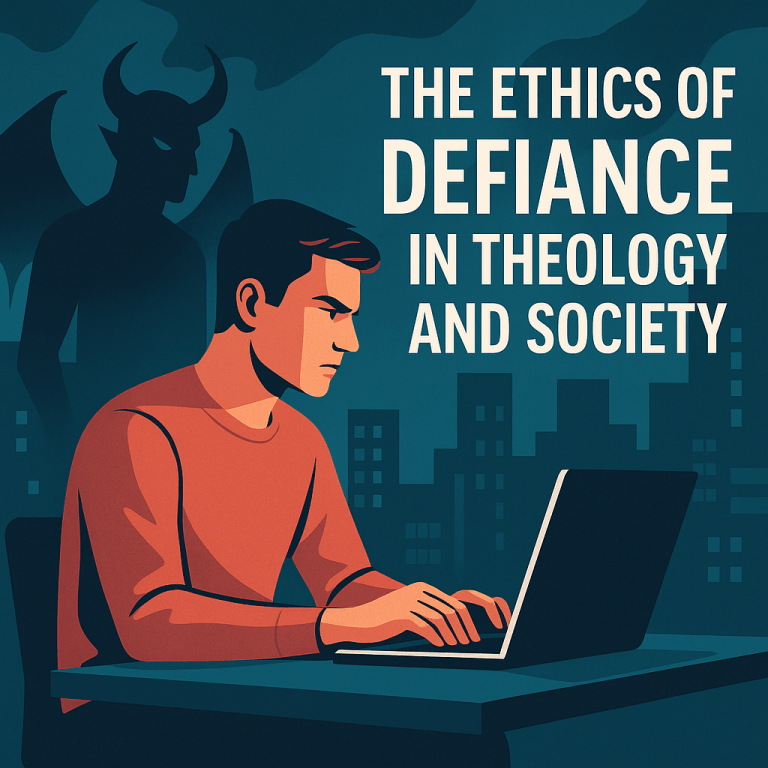
Before Satan became the personification of evil, he was something far more unsettling: a dissenter with conviction. In the hands of Joost van den Vondel and John Milton, rebellion is not born from malice, but from moral protest—a rebellion that echoes through every courtroom, newsroom, and protest line today.

Seventeenth-century Europe, still reeling from the Protestant Reformation, was a world in flux. Authority—both sacred and secular—was under siege. Amid this upheaval, a new literary preoccupation emerged: rebellion not as blasphemy or chaos, but as a solemn confrontation with power. At the heart of this reimagining stood the devil—not as a grotesque villain, but as a tragic figure struggling between duty and conscience.

“As old certainties fractured, a new literary fascination emerged with rebellion, not merely as sin, but as moral drama.”

In Vondel’s Lucifer (1654) and Milton’s Paradise Lost (1667), Satan is no longer merely the adversary of God; he becomes a symbol of conscience in collision with authority. These works do not justify evil—they dramatize the terrifying complexity of moral defiance. Their protagonists, shaped by dignity and doubt, speak to an enduring question: when must we obey, and when must we resist?

Vondel’s Lucifer: Dignity, Doubt, and Divine Disobedience

In Vondel’s hands, Lucifer is not a grotesque demon but a noble figure, deeply shaken by God’s decree that angels must serve humankind. This new order, in Lucifer’s eyes, violates the harmony of divine justice. His poignant declaration, “To be the first prince in some lower court” (Act I, Line 291), is less a lust for domination than a refusal to surrender his sense of dignity.

Vondel crafts Lucifer in the tradition of Greek tragedy. The choral interludes frame Lucifer’s turmoil not as hubris, but as solemn introspection. He is a being torn by conscience, not corrupted by pride. The result is a rebellion driven by perceived injustice rather than innate evil.

The playwright’s own religious journey deepens the text. Raised a Mennonite, Vondel converted to Catholicism in a fiercely Calvinist Amsterdam. Lucifer becomes a veiled critique of predestination and theological rigidity. His angels ask: if obedience is compelled, where is moral agency? If one cannot dissent, can one truly be free?

Authorities saw the danger. The play was banned after two performances. In a city ruled by Reformed orthodoxy, the idea that angels could question God threatened more than doctrine—it threatened social order. And yet, Lucifer endured, carving out a space where rebellion could be dignified, tragic, even righteous.

The tragedy’s impact would echo beyond the stage. Vondel’s portrayal of divine disobedience challenged audiences to reconsider the theological justification for absolute obedience—whether to church, monarch, or moral dogma. In doing so, he planted seeds of spiritual and political skepticism that would continue to grow.

Milton’s Satan: Pride, Conscience, and the Fall from Grace

Milton’s Paradise Lost offers a cosmic canvas, but his Satan is deeply human. Once Heaven’s brightest, he falls not from chaos but conviction. His famed credo—“Better to reign in Hell than serve in Heaven” (Book I, Line 263)—isn’t evil incarnate. It is a cry of autonomy, however misguided.

Early in the epic, Satan is a revolutionary: eloquent, commanding, even admirable. Milton allows us to feel his magnetism. But this is not the end of the arc—it is the beginning of a descent. As the story unfolds, Satan’s rhetoric calcifies into self-justification. His pride distorts his cause. The rebel becomes the tyrant he once defied.

This descent mirrors Milton’s own disillusionment. A Puritan and supporter of the English Commonwealth, he witnessed Cromwell’s republic devolve into authoritarianism and the Restoration of the monarchy. As Orlando Reade writes in Paradise Lost: Mourned, A Revolution Betrayed (2024), Satan becomes Milton’s warning: even noble rebellion, untethered from humility, can collapse into tyranny.

“He speaks the language of liberty while sowing the seeds of despotism.”

Milton’s Satan reminds us that rebellion, while necessary, is fraught. Without self-awareness, the conscience that fuels it becomes its first casualty. The epic thus dramatizes the peril not only of blind obedience, but of unchecked moral certainty.

What begins as protest transforms into obsession. Satan’s journey reflects not merely theological defiance but psychological unraveling—a descent into solipsism where he can no longer distinguish principle from pride. In this, Milton reveals rebellion as both ethically urgent and personally perilous.

Earthly Echoes: Milgram, Nuremberg, and the Cost of Obedience

Centuries later, the drama of obedience and conscience reemerged in psychological experiments and legal tribunals.

In 1961, psychologist Stanley Milgram explored why ordinary people committed atrocities under Nazi regimes. Participants were asked to deliver what they believed were painful electric shocks to others, under the instruction of an authority figure. Disturbingly, 65% of subjects administered the maximum voltage.

Milgram’s chilling conclusion: cruelty isn’t always driven by hatred. Often, it requires only obedience.

“The most fundamental lesson of the Milgram experiment is that ordinary people… can become agents in a terrible destructive process.” — Stanley Milgram, Obedience to Authority (1974)

At Nuremberg, after World War II, Nazi defendants echoed the same plea: we were just following orders. But the tribunal rejected this. The Nuremberg Principles declared that moral responsibility is inalienable.

As the Leuven Transitional Justice Blog notes, the court affirmed: “Crimes are committed by individuals and not by abstract entities.” It was a modern echo of Vondel and Milton: blind obedience, even in lawful structures, cannot absolve the conscience.

The legal implications were far-reaching. Nuremberg reshaped international norms by asserting that conscience can override command, that legality must answer to morality. The echoes of this principle still resonate in debates over drone warfare, police brutality, and institutional accountability.

The Vietnam War: Protest as Moral Conscience

The 1960s anti-war movement was not simply a reaction to policy—it was a moral rebellion. As the U.S. escalated involvement in Vietnam, activists invoked not just pacifism, but ethical duty.

Martin Luther King Jr., in his 1967 speech “Beyond Vietnam: A Time to Break Silence,” denounced the war as a betrayal of justice:

“A time comes when silence is betrayal.”

Draft resistance intensified. Muhammad Ali, who refused military service, famously declared:

“I ain’t got no quarrel with them Viet Cong.”

His resistance cost him his title, nearly his freedom. But it transformed him into a global symbol of conscience. Groups like Vietnam Veterans Against the War made defiance visceral: returning soldiers hurled medals onto Capitol steps. Their message: moral clarity sometimes demands civil disobedience.

The protests revealed a generational rift in moral interpretation: patriotism was no longer obedience to state policy, but fidelity to justice. And in this redefinition, conscience took center stage.

Feminism and the Rebellion Against Patriarchy

While bombs fell abroad, another rebellion reshaped the domestic sphere: feminism. The second wave of the movement exposed the quiet tyranny of patriarchy—not imposed by decree, but by expectation.

In The Feminine Mystique (1963), Betty Friedan named the “problem that has no name”—the malaise of women trapped in suburban domesticity. Feminists challenged laws, institutions, and social norms that demanded obedience without voice.

“The first problem for all of us, men and women, is not to learn, but to unlearn.” — Gloria Steinem, Revolution from Within (1992)

The 1968 protest at the Miss America pageant symbolized this revolt. Women discarded bras, girdles, and false eyelashes into a “freedom trash can.” It was not just performance, but a declaration: dignity begins with defiance.

Feminism insisted that the personal was political. Like Vondel’s angels or Milton’s Satan, women rebelled against a hierarchy they did not choose. Their cause was not vengeance, but liberation—for all.

Their defiance inspired legal changes—Title IX, Roe v. Wade, the Equal Pay Act—but its deeper legacy was ethical: asserting that justice begins in the private sphere. In this sense, feminism was not merely a social movement; it was a philosophical revolution.

Digital Conscience: Whistleblowers and the Age of Exposure

Today, rebellion occurs not just in literature or streets, but in data streams. Whistleblowers like Edward Snowden, Chelsea Manning, and Frances Haugen exposed hidden harms—from surveillance to algorithmic manipulation.

Their revelations cost them jobs, homes, and freedom. But they insisted on a higher allegiance: to truth.

“When governments or corporations violate rights, there is a moral imperative to speak out.” — Paraphrased from Snowden

These figures are not villains. They are modern Lucifers—flawed, exiled, but driven by conscience. They remind us: the battle between obedience and dissent now unfolds in code, policy, and metadata.

The stakes are high. In an era of artificial intelligence and digital surveillance, ethical responsibility has shifted from hierarchical commands to decentralized platforms. The architecture of control is invisible—yet rebellion remains deeply human.

Public Health and the Politics of Autonomy

The COVID-19 pandemic reframed the question anew: what does moral responsibility look like when authority demands compliance for the common good?

Mask mandates, vaccines, and quarantines triggered fierce debates. For some, compliance was compassion. For others, it was capitulation. The virus became a mirror, reflecting our deepest fears about trust, power, and autonomy.

What the pandemic exposed is not simply political fracture, but ethical ambiguity. It reminded us that even when science guides policy, conscience remains a personal crucible. To obey is not always to submit; to question is not always to defy.

The challenge is not rebellion versus obedience—but how to discern the line between solidarity and submission, between reasoned skepticism and reckless defiance.

Conclusion: The Sacred Threshold of Conscience

Lucifer and Paradise Lost are not relics of theological imagination. They are maps of the moral terrain we walk daily.

Lucifer falls not from wickedness, but from protest. Satan descends through pride, not evil. Both embody our longing to resist what feels unjust—and our peril when conscience becomes corrupted.

“Authority demands compliance, but conscience insists on discernment.”

From Milgram to Nuremberg, from Vietnam to feminism, from whistleblowers to lockdowns, the line between duty and defiance defines who we are.

To rebel wisely is harder than to obey blindly. But it is also nobler, more human. In an age of mutating power—divine, digital, political—conscience must not retreat. It must adapt, speak, endure.

The final lesson of Vondel and Milton may be this: that conscience, flawed and fallible though it may be, remains the last and most sacred threshold of freedom. To guard it is not to glorify rebellion for its own sake, but to defend the fragile, luminous space where justice and humanity endure.

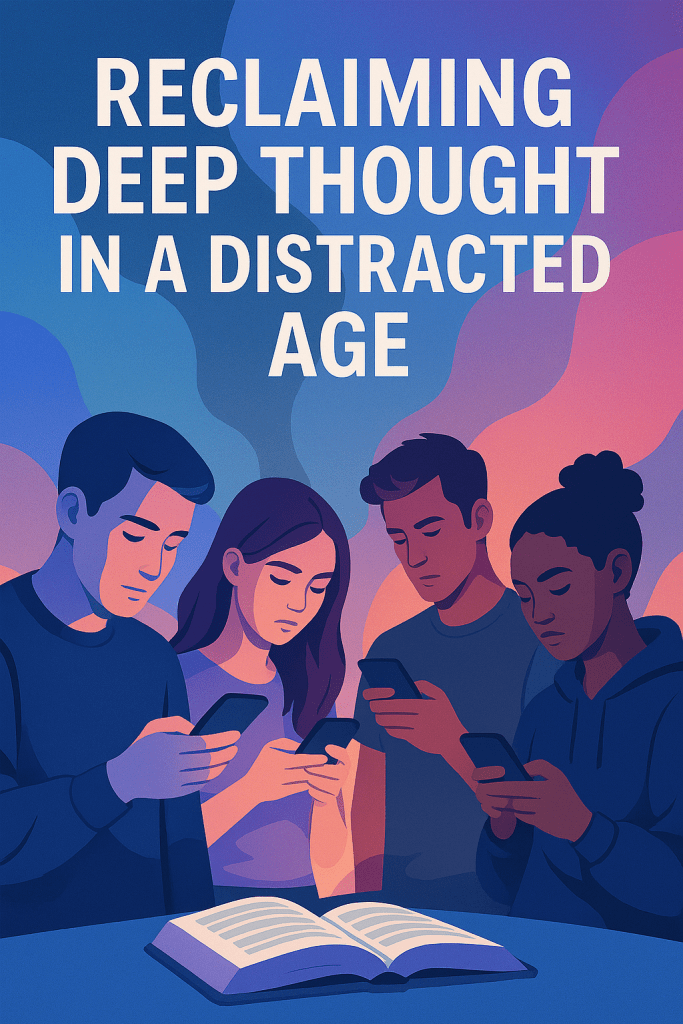
Reclaiming Deep Thought in a Distracted Age

This essay was written and edited by Intellicurean utilizing AI:

In the age of the algorithm, literacy isn’t dying—it’s becoming a luxury. This essay argues that the rise of short-form digital media is dismantling long-form reasoning and concentrating cognitive fitness among the wealthy, catalyzing a quiet but transformative shift. As British journalist Mary Harrington writes in her New York Times opinion piece “Thinking Is Becoming a Luxury Good” (July 28, 2025), even the capacity for sustained thought is becoming a curated privilege.

“Deep reading, once considered a universal human skill, is now fragmenting along class lines.”

What was once assumed to be a universal skill—the ability to read deeply, reason carefully, and maintain focus through complexity—is fragmenting along class lines. While digital platforms have radically democratized access to information, the dominant mode of consumption undermines the very cognitive skills that allow us to understand, reflect, and synthesize meaning. The implications stretch far beyond classrooms and attention spans. They touch the very roots of human agency, historical memory, and democratic citizenship—reshaping society into a cognitively stratified landscape.


The Erosion of the Reading Brain

Modern civilization was built by readers. From the Reformation to the Enlightenment, from scientific treatises to theological debates, progress emerged through engaged literacy. The human mind, shaped by complex texts, developed the capacity for abstract reasoning, empathetic understanding, and civic deliberation. Martin Luther’s 95 Theses would have withered in obscurity without a literate populace; the American and French Revolutions were animated by pamphlets and philosophical tracts absorbed in quiet rooms.

But reading is not biologically hardwired. As neuroscientist and literacy scholar Maryanne Wolf argues in Reader, Come Home: The Reading Brain in a Digital World, deep reading is a profound neurological feat—one that develops only through deliberate cultivation. “Expert reading,” she writes, “rewires the brain, cultivating linear reasoning, reflection, and a vocabulary that allows for abstract thought.” This process orchestrates multiple brain regions, building circuits for sequential logic, inferential reasoning, and even moral imagination.

Yet this hard-earned cognitive achievement is now under siege. Smartphones and social platforms offer a constant feed of image, sound, and novelty. Their design—fueled by dopamine hits and feedback loops—favors immediacy over introspection. In his seminal book The Shallows: What the Internet Is Doing to Our Brains, Nicholas Carr explains how the architecture of the web—hyperlinks, notifications, infinite scroll—actively erodes sustained attention. The internet doesn’t just distract us; it reprograms us.

Gary Small and Gigi Vorgan, in iBrain: Surviving the Technological Alteration of the Modern Mind, show how young digital natives develop different neural pathways: less emphasis on deep processing, more reliance on rapid scanning and pattern recognition. The result is what they call “shallow processing”—a mode of comprehension marked by speed and superficiality, not synthesis and understanding. The analytic left hemisphere, once dominant in logical thought, increasingly yields to a reactive, fragmented mode of engagement.

The consequences are observable and dire. As Harrington notes, adult literacy is declining across OECD nations, while book reading among Americans has plummeted. In 2023, nearly half of U.S. adults reported reading no books at all. This isn’t a result of lost access or rising illiteracy—but of cultural and neurological drift. We are becoming a post-literate society: technically able to read, but no longer disposed to do so in meaningful or sustained ways.

“The digital environment is designed for distraction; notifications fragment attention, algorithms reward emotional reaction over rational analysis, and content is increasingly optimized for virality, not depth.”

This shift is not only about distraction; it’s about disconnection from the very tools that cultivate introspection, historical understanding, and ethical reasoning. When the mind loses its capacity to dwell—on narrative, on ambiguity, on philosophical questions—it begins to default to surface-level reaction. We scroll, we click, we swipe—but we no longer process, synthesize, or deeply understand.


Literacy as Class Privilege

In a troubling twist, the printed word—once a democratizing force—is becoming a class marker once more. Harrington likens this transformation to the processed food epidemic: ultraprocessed snacks exploit innate cravings and disproportionately harm the poor. So too with media. Addictive digital content, engineered for maximum engagement, is producing cognitive decay most pronounced among those with fewer educational and economic resources.

Children in low-income households spend more time on screens, often without guidance or limits. Studies show they exhibit reduced attention spans, impaired language development, and declines in executive function—skills crucial for planning, emotional regulation, and abstract reasoning. Jean Twenge’s iGen presents sobering data: excessive screen time, particularly among adolescents in vulnerable communities, correlates with depression, social withdrawal, and diminished readiness for adult responsibilities.

Meanwhile, affluent families are opting out. They pay premiums for screen-free schools—Waldorf, Montessori, and classical academies that emphasize long-form engagement, Socratic inquiry, and textual analysis. They hire “no-phone” nannies, enforce digital sabbaths, and adopt practices like “dopamine fasting” to retrain reward systems. These aren’t just lifestyle choices. They are investments in cognitive capital—deep reading, critical thinking, and meta-cognitive awareness—skills that once formed the democratic backbone of society.

This is a reversion to pre-modern asymmetries. In medieval Europe, literacy was confined to a clerical class, while oral knowledge circulated among peasants. The printing press disrupted that dynamic—but today’s digital environment is reviving it, dressed in the illusion of democratization.

“Just as ultraprocessed snacks have created a health crisis disproportionately affecting the poor, addictive digital media is producing cognitive decline most pronounced among the vulnerable.”

Elite schools are incubating a new class of thinkers—trained not in content alone, but in the enduring habits of thought: synthesis, reflection, dialectic. Meanwhile, large swaths of the population drift further into fast-scroll culture, dominated by reaction, distraction, and superficial comprehension.


Algorithmic Literacy and the Myth of Access

We are often told that we live in an era of unparalleled access. Anyone with a smartphone can, theoretically, learn calculus, read Shakespeare, or audit a philosophy seminar at MIT. But this is a dangerous half-truth. The real challenge lies not in access, but in disposition. Access to knowledge does not ensure understanding—just as walking through a library does not confer wisdom.

Digital literacy today often means knowing how to swipe, search, and post—not how to evaluate arguments or trace the origin of a historical claim. The interface makes everything appear equally valid. A Wikipedia footnote, a meme, and a peer-reviewed article scroll by at the same speed. This flattening of epistemic authority—where all knowledge seems interchangeable—erodes our ability to distinguish credible information from noise.

Moreover, algorithmic design is not neutral. It amplifies certain voices, buries others, and rewards content that sparks outrage or emotion over reason. We are training a generation to read in fragments, to mistake volume for truth, and to conflate virality with legitimacy.


The Fracturing of Democratic Consciousness

Democracy presumes a public capable of rational thought, informed deliberation, and shared memory. But today’s media ecosystem increasingly breeds the opposite. Citizens shaped by TikTok clips and YouTube shorts are often more attuned to “vibes” than verifiable facts. Emotional resonance trumps evidence. Outrage eclipses argument. Politics, untethered from nuance, becomes spectacle.

Harrington warns that we are entering a new cognitive regime, one that undermines the foundations of liberal democracy. The public sphere, once grounded in newspapers, town halls, and long-form debate, is giving way to tribal echo chambers. Algorithms sort us by ideology and appetite. The very idea of shared truth collapses when each feed becomes a private reality.

Robert Putnam’s Bowling Alone chronicled the erosion of social capital long before the smartphone era. But today, civic fragmentation is no longer just about bowling leagues or PTAs. It’s about attention itself. Filter bubbles and curated feeds ensure that we engage only with what confirms our biases. Complex questions—on history, economics, or theology—become flattened into meme warfare and performative dissent.

“The Enlightenment assumption that reason could guide the masses is buckling under the weight of the algorithm.”

Worse, this cognitive shift has measurable political consequences. Surveys show declining support for democratic institutions among younger generations. Gen Z, raised in the algorithmic vortex, exhibits less faith in liberal pluralism. Complexity is exhausting. Simplified narratives—be they populist or conspiratorial—feel more manageable. Philosopher Byung-Chul Han, in The Burnout Society, argues that the relentless demands for visibility, performance, and positivity breed not vitality but exhaustion. This fatigue disables the capacity for contemplation, empathy, or sustained civic action.


The Rise of a Neo-Oral Priesthood

Where might this trajectory lead? One disturbing possibility is a return to gatekeeping—not of religion, but of cognition. In the Middle Ages, literacy divided clergy from laity. Sacred texts required mediation. Could we now be witnessing the early rise of a neo-oral priesthood: elites trained in long-form reasoning, entrusted to interpret the archives of knowledge?

This cognitive elite might include scholars, classical educators, journalists, or archivists—those still capable of sustained analysis and memory. Their literacy would not be merely functional but rarefied, almost arcane. In a world saturated with ephemeral content, the ability to read, reflect, and synthesize becomes mystical—a kind of secular sacredness.

These modern scribes might retreat to academic enclaves or AI-curated libraries, preserving knowledge for a distracted civilization. Like desert monks transcribing ancient texts during the fall of Rome, they would become stewards of meaning in an age of forgetting.

“Like ancient scribes preserving knowledge in desert monasteries, they might transcribe and safeguard the legacies of thought now lost to scrolling thumbs.”

Artificial intelligence complicates the picture. It could serve as a tool for these new custodians—sifting, archiving, interpreting. Or it could accelerate the divide, creating cognitive dependencies while dulling the capacity for independent thought. Either way, the danger is the same: truth, wisdom, and memory risk becoming the property of a curated few.


Conclusion: Choosing the Future

This is not an inevitability, but it is an acceleration. We face a stark cultural choice: surrender to digital drift, or reclaim the deliberative mind. The challenge is not technological, but existential. What is at stake is not just literacy, but liberty—mental, moral, and political.

To resist post-literacy is not mere nostalgia. It is an act of preservation: of memory, attention, and the possibility of shared meaning. We must advocate for education that prizes reflection, analysis, and argumentation from an early age—especially for those most at risk of being left behind. That means funding for libraries, long-form content, and digital-free learning zones. It means public policy that safeguards attention spans as surely as it safeguards health. And it means fostering a media environment that rewards truth over virality, and depth over speed.

“Reading, reasoning, and deep concentration are not merely personal virtues—they are the pillars of collective freedom.”

Media literacy must become a civic imperative—not only the ability to decode messages, but to engage in rational thought and resist manipulation. We must teach the difference between opinion and evidence, between emotional resonance and factual integrity.

To build a future worthy of human dignity, we must reinvest in the slow, quiet, difficult disciplines that once made progress possible. This isn’t just a fight for education—it is a fight for civilization.