Tag Archives: Concrete Architecture

Concrete Design: Dilkera House, Brisbane, Australia

The Local Project – (April 4, 2023) – Fulfilling the client’s desire to build their concrete dream house, Shaun Lockyer Architects considers the tactile and environmental benefits of building with concrete. Located in an inner-city suburb of Brisbane,

Video timeline: 00:00 – Introduction to the Concrete Dream House 00:32 – The Home and The Area 01:05 – Views from the Home 01:31 – A Modernist Theme on Approach 02:02 – A Walkthrough of the Home 02:22 – A Canvas for Life and Personality 02:40 – Less is More 02:59 – The Materials 03:41 – Controlling and Curating the Light 04:29 – Engaging with the Landscape 05:16 – Client and Architect Relationships

Dilkera embodies responsive design in how it reacts to both its climate as well as its location. Dilkera’s striking concrete façade and distinctive form are largely informed by the subtropical climate. The residence is a direct expression of how a home’s design can manage a rapidly changing mix of rain, heat and humidity – typical conditions of Brisbane and south-east Queensland where the home resides.

So that the inhabitants are not constantly moving between the inside and the outside to avoid the weather, there are deep thresholds, lovely wide eaves and protected edges so there’s a constant sense of being able to live throughout the entire concrete dream house, despite the season. Shaun Lockyer Architects also explores what elements make up a concrete dream house. The home offers vestiges to surrounding scenery, including views of bushland on the eastern side, an expansive river looking across to New Farm Park and The Powerhouse on the western side, and views of the city to the southwest.

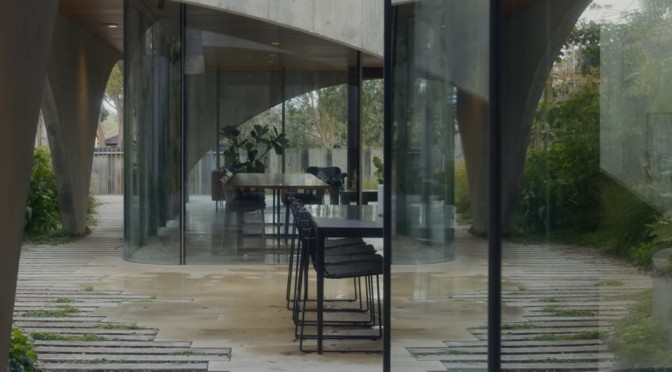
Through a bold approach to materiality, Shaun Lockyer Architects designs a robust yet welcoming home. The structure’s materiality is kept minimal and, while concrete dominates, it is complemented by a beautiful stone that forms the base of the house along with black and blond timbers throughout. Concrete floor finishes from the inside to outside are consistent, creating a seamlessness between indoor and outdoor spaces as the concrete transitions to oak cabinetry and extends through to the furniture.

An incremental revealing of what lies beyond this concrete dream house expresses a deliberate modernist theme. As soon as one enters the home there is an opening of space, with a double-height room that becomes the centre of gravity in both the form and architecture of the house. Walking around the home, views through to the landscape and garden reveal themselves, which nurtures a connection to the outside and a sense of the residence’s transparency.

Dilkera expresses the tangible reality of what was once a mere vision of a concrete dream house. To achieve this, Shaun Lockyer Architects prioritised the relationship with the client and in turn created a home that is distinctly different, resulting in a deliberate attempt for the home to engage with the landscape rather than be a dialogue about the building in itself.
Melbourne Architecture: Tour of Hawthorn House

The Local Project (December 16, 2022) – Inside one of Melbourne’s most modern architectural homes, the house tour of Hawthorn House showcases Edition Office’s timeless design. Working with Flux Construction, Edition Office plays with light and shadow to reveal the form and characteristics of the home.

Video timeline: 00:00 – Introduction to the Most Brilliant Architectural Home 00:26 – Playing with Light and Shadow 00:44 – Creating a Family Home 01:47 – Filtering Through the Concrete Shroud 02:00 – Views From Each Living Space 02:24 – The Original Brief 02:59 – A Quick but Complex Build 04:14 – Emulating A Sanctuary with Other Worldly Vibes 04:30 – The Skin of the Building 04:46 – A Balancing Act with The Materials 05:05 – Returning to the Project 05:26 – Proud Moments

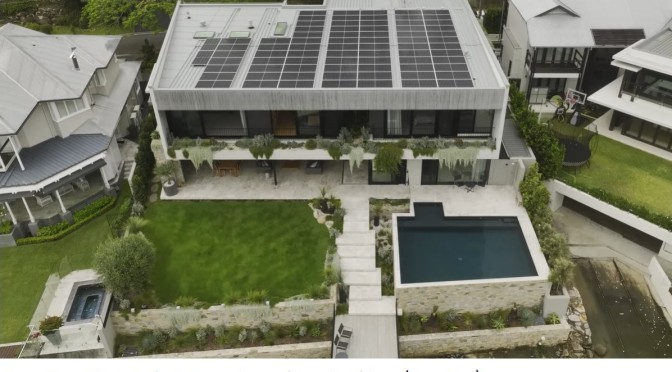
Over an 18-month building process, Flux Construction and Edition Office have created a house unlike other modern architectural homes. First seen from the outside, Hawthorn House appears as a monolithic structure yet, on the inside, the family home becomes a private sanctuary for its owners. Similar to other modern architectural homes, Hawthorn House suffered from lack of privacy in its suburban location.

To respond to this need, Edition Office has pushed the skin of the building out from the glass line, which allows for both privacy and the softening of light. Upstairs has been provided more privacy through light volumes, a structural choice between the buildings form and glass line that open up to the sky. Furthermore, the light volumes also provide advantageous views and the experience of seeing the seasons as they change.

Employing unique interior design choices that allow for ease of living, the architect and interior designer have configured downstairs as one singular platform. Offering different experiences, each living area has a differing focus. From the front pavilion, the homing in on the northern light and established lemon gum tree offers the owners a space to connect with their surrounds. Experienced in the more intimate rear pavilion, an inward focus of the home brings a soft and warming essence to the interior. Celebrating the structural form of modern architectural homes, Edition Office and Flux Construction operated with a concise approach when completing the house.

Through the connection of materials, the home is a celebration of concrete, timber and glass, which is observed immediately from the exterior shell. Equally as important as the home, the evolving landscape offers a place of cognitive restoration. With a mixed use of exotic species and natives, the green life helps to provide a comforting space that will continue to grow in place. Over the modern architectural home’s form, Edition Office has provided its clients with complete privacy through a humble material palette and lush landscaping.

Tours: Cliffhanger House In Toowoomba, Australia

Evoking grandiosity through carefully considered sharp points and rounded edges, the concrete super house by Joe Adsett Architects offers unrivalled views of Toowoomba’s sweeping landscape. Creating a piece of architecture that was befitting of the location and striking natural landscape,

Video timeline: 00:00 – A Welcome to Cliffhanger House 00:36 – The Location of the Super House 00:46 – Building On The Edge of A Landslide Zone 01:36 – Arriving At The Site 02:00 – The Vitrocsa Glazing Suite 02:40 – A Seamless Flow From Kitchen to Outdoors 03:00 – An Extension of The Main Living Area 03:14 – The Material Palette 03:52 – Emulating The Architecture Through Furniture 04:17 – Designing Weather Flexible Houses 04:41 – The Challenging Aspect of The Cantilever

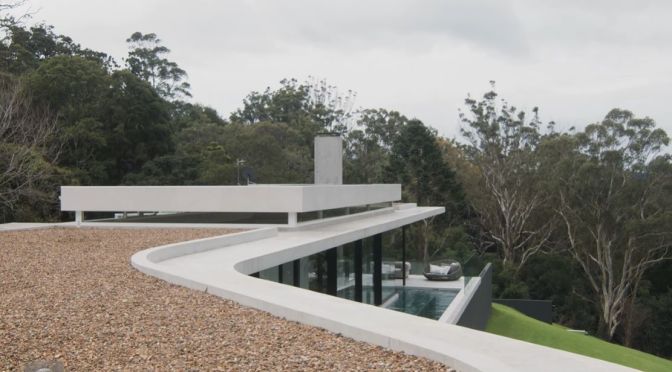
Vitrocsa collaborated with Joe Adsett Architects to produce the concrete super house that fully embraced its location. Balancing at the very top of the site, the concrete super house offers views from East of Brisbane toward Picnic Point and Table Top Mountain. Whilst the home’s location is situated over a ridge, Joe Adsett Architects endeavoured to create more space by cantilevering away from the slope.

By projecting part of the concrete super house out from the built space, the ability to create a more functional living space with privacy from surrounding neighbours arose. Arriving at the concrete super house, the gaze is immediately ensnared by the curving concrete wall that cantilevers away from the base of the home. With the garage underneath the house offering one way of entrance, it is the curved pathway leading to the deliberately oversized glass pivot door that is the striking entrance of the home.

Working with Vitrocsa to create the glazing for the home, the frame of the windows was done with a slender aluminium product comprised of reinforced stainless steel. Made in Australia and designed to Swiss specifications, the framing offers unbroken views of the surrounding landscape whilst also bringing a seamless indoor-outdoor flow into the home. With restrained materials used across the exterior architecture, the interior design choices also reflect the primary theme of the concrete super house.

Softened with veneered timber products and large porcelain tiles, curves and sharp points are repeated through the joinery elements. Furthermore, the furnishings also introduce soft textures and colours that bring a humanising element to the concrete super house.

Modern Architecture: 10 Apartment Home ‘Fenwick’, Kew, Melbourne, Australia

Uniting the gestures of interior design, architecture and landscape, Fenwick embodies a coherent vision of modern apartment homes. Developed by ANGLE in collaboration with Edition Office and Flack Studio, the building uses an evolving connection to context to answer an open design brief.

00:00 – Introduction to the Modern Apartment Homes 00:42 – The Client Brief 01:29 – Finding Inspiration for the Apartment’s Design 02:18 – The Kitchen Island Bench 02:35 – Durable Material Selection 03:10 – Hero Spaces 03:30 – Landscape Architecture 04:42 – Connection to Country

Situated on the banks of Yarra River in the Melbourne suburb of Kew, Fenwick straddles environments of dense forest and heritage buildings. As a unique by-product of its location – wherein nothing can be built in front of the home – the ten modern apartment homes have access to immersive, panoramic views that capture both the wilderness and city.

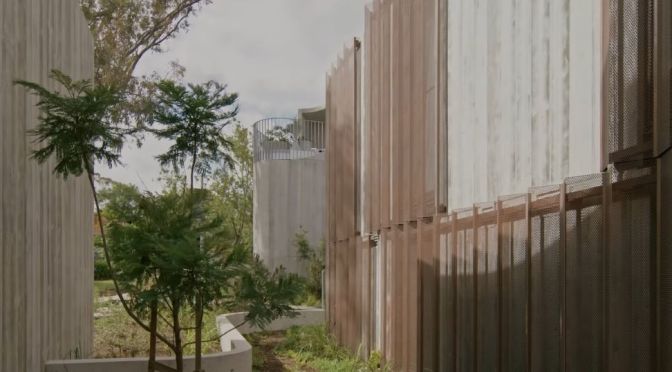
The exterior of Fenwick purposefully interacts with the natural surrounds. Conceived as a broken mass, the modern apartment homes are divided amongst three distinct pavilions that allow for view corridors between parts, extending across the gardens to the landscaped scenes beyond. Presenting Fenwick as an extension of the environment, Eckersley Garden Architecture designs a landscape reminiscent of the neighbouring greenery.

Lying beyond the modern apartment homes are layers of native shrubs, grasses and lower ground covers that change in accordance with the seasons, continuing to establish the development over time. With an interior design that draws the eye towards the outdoors, Fenwick thoroughly embraces its Kew context. By pursuing a connection to nature through interior design, architecture and landscaping, ANGLE ensures that the modern apartment homes effectively echo the language of the surrounds.

Concrete Architecture: The Sandcastle In Point Chevalier, New Zealand

As an architectural house, The Sandcastle by Ponting Fitzgerald Architects champions the creative and structural benefits of concrete. Inspired by a sandcastle and built by Bannan Construction, the sculptural building is firmly established within its coastal context.

00:00 – An Introduction to the Architectural House 00:53 – Creating a Sandcastle 01:19 – Entering the House 02:06 – Building for the Coastal Climate 02:32 – A Unique Use of Concrete 03:37 – Materiality 04:07 – Lighting in the House 04:25 – Unique Qualities of the House 05:00 – What the Builder is Most Proud Of

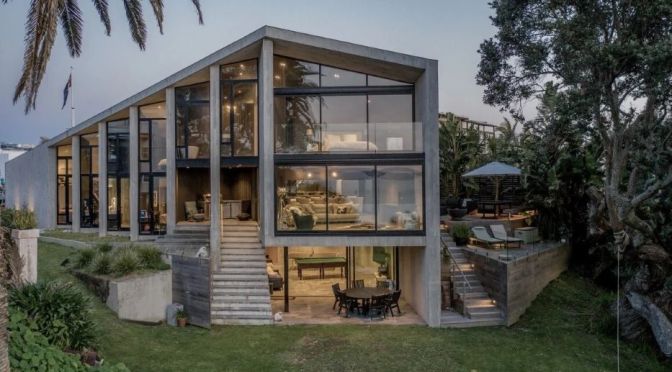
Built within the inner harbour zone of Point Chevalier, The Sandcastle is situated directly above the shore. Sitting on a bluff of land that resembles a sand dune in constitution, the three-storey concrete home is conceived as an architectural house that naturally extends from the surrounding landscape. A house tour of The Sandcastle evidences its status as an architectural house, with the form of the building representing a playful yet sophisticated interpretation of a sandcastle. Concrete plays an important role in realising the shape of the home, offering endless formal possibilities in its pre-set, liquid state. Ponting Fitzgerald Architects crafts a dynamic materiality that withstands the erosive coastal climate. Although the concrete exterior interacts with the salt, wind and water of the environment – gracefully expressing the passage of time through a weather-beaten appearance – The Sandcastle maintains its structural integrity, establishing itself as an architectural house embedded in the landscape. With the help of Bannan Construction, Ponting Fitzgerald Architects creates an architectural house that is both rugged in nature and refined in form and concept. The Sandcastle stands as an enduring aspect of the coast; a solid piece of architecture, made in recognition of place.