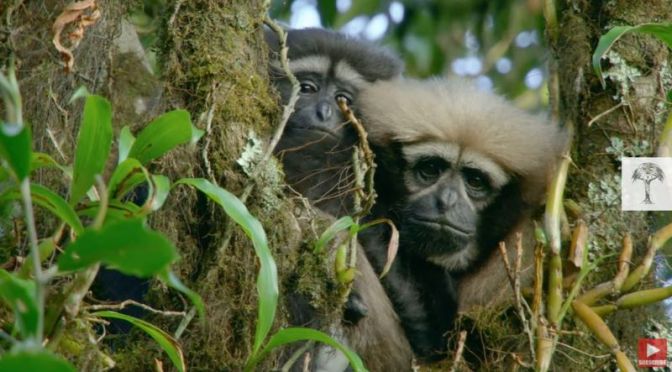
Deep in a cloud forest far, far away are the planet’s last remaining Skywalker gibbons. These small members of the apes family were only identified in 2017 (by, you guessed it, a Star Wars fan), but already they’re endangered.
Now, researchers in south-west China have developed an ingenious technique for getting gibbons from different territories to meet and form a partnership – these Skywalkers mate for life. Join us to see how technology can be used as a Force for good to help protect this vanishing species.
Scientists announced the discovery of a new species of primate, the skywalker hoolock gibbon (Hoolock tianxing), in the American Journal of Primatology on Tuesday. The scientists named it skywalker because the Chinese characters for its scientific name translate to “heaven’s movement”—but also because they’re fans of Star Wars, according to the BBC.
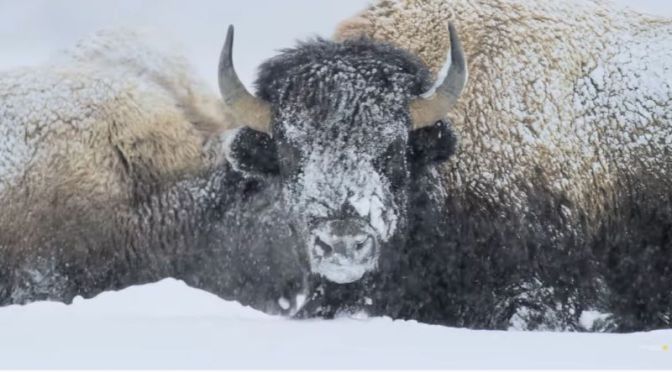
With a dense coat, a powerful mass of muscle and a large head ideally suited for clearing away snow and locating buried grass, bison are built for frigid conditions in Yellowstone. If it wasn’t for a hidden herd in the deepest reaches of this National Park, bison would have been wiped out in the late 1800s. Today, thousands of them thrive.
Billions of birds migrate annually across the Western Hemisphere… but if we don’t know where they go when they leave their breeding grounds, how can we protect them? By extracting DNA from individual feathers (and borrowing cutting-edge technology from the Human Genome Project) scientists can map bird migration with greater precision than ever before. The result is the Bird Genoscape Project, and it’s revolutionizing bird conservation by connecting migratory birds – and the people who care about them – across the Americas. This work was funded by the National Geographic Society. Learn more at http://www.natgeo.org.
These gorgeous videos will transport you to National Parks like Yosemite and Yellowstone, all from the comfort of your own home.
Video timeline: 0:00 – Intro to 12 Stunning National Parks 0:26 – The Grand Canyon: How It Was Formed 2:38 – Yellowstone: Human-Bear Interaction Spirals 3:40 – Glacier National Park: Awe-inspiring Peaks 6:49 – Yellowstone: The Grand Prismatic Spring 9:24 – Yellowstone: The War Against Poachers 11:58 – Yellowstone: A Coyote Preys on Swans 14:42 – Yosemite: A 1970s Riot 16:19 – Yellowstone: Strenuous Grizzly Courtship 18:33 – Yellowstone: The View from Above 19:54 – Jasper National Park: A Controlled Inferno 21:45 – Yellowstone: The World’s Most Famous Geyser 24:38 – Yellowstone: A Sneaky Bobcat Hunts
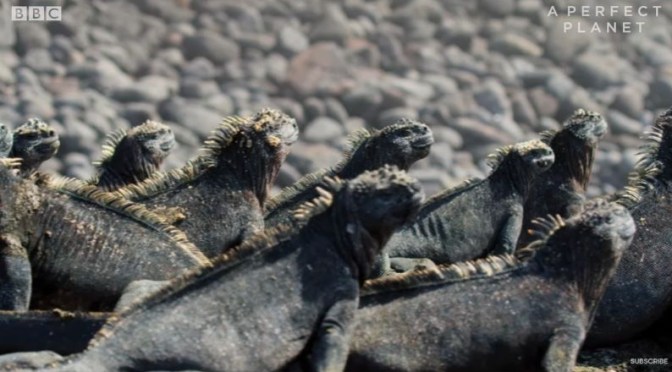
This sea-diving lizard only has 30 minutes to search for food before his muscles seize up.
The marine iguana, also known as the sea iguana, saltwater iguana, or Galápagos marine iguana, is a species of iguana found only on the Galápagos Islands. Unique among modern lizards, it is a marine reptile that has the ability to forage in the sea for algae, which makes up almost all of its diet.
The Galápagos Islands is a volcanic archipelago in the Pacific Ocean. It’s considered one of the world’s foremost destinations for wildlife-viewing. A province of Ecuador, it lies about 1,000km off its coast. Its isolated terrain shelters a diversity of plant and animal species, many found nowhere else. Charles Darwin visited in 1835, and his observation of Galápagos’ species later inspired his theory of evolution.
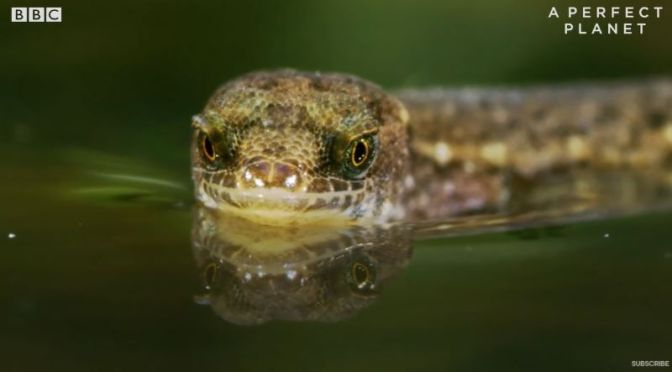
This little pygmy gecko has an amazing superpower, that helps it survive in the wet season.
The Amazon pigmy gecko is a species of lizard in the Sphaerodactylidae family found in northern South America in Colombia, Venezuela, the Guianas, Brazil, Ecuador, and northern Peru.
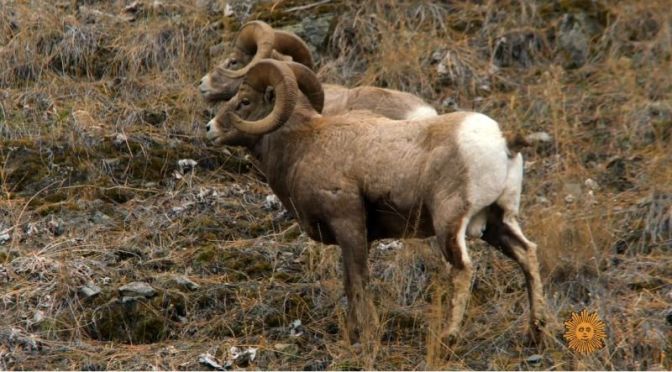
“Sunday Morning” takes us to Big Sky Country, in Western Montana’s Sapphire Mountains. Videographer: Brad Markel.
The Sapphire Mountains are a range of mountains located in southwestern Montana in the northwestern United States. From a point near the Clark Fork River and the city of Missoula, they run in a southerly direction for a distance of approximately 60 miles (100 km), making up much of the border between Ravalli County (to the west) and Granite County. To the west is the Bitterroot Valley, and to the east is Rock Creek. The southern end of the range meets the larger Anaconda Range at West Pintler Peak.
Reptiles are a class of vertebrates made up mostly of snakes, turtles, lizards, and crocodilians. These animals are most easily recognized by their dry, scaly skin. Almost all reptiles are cold-blooded, and most lay eggs—though some, like the boa constrictor, give birth to live young. Instead of possessing gills like fish or amphibians, reptiles have lungs for breathing.
News, Views and Reviews For The Intellectually Curious





 Boomers Daily