Charles Piller, an investigative journalist for Science, talks with host Sarah Crespi about a risky trial of vitamin D in asthmatic children that has caused a lot of concern among ethicists.
They also discuss how the vitamin D trial connects with a possibly dangerous push to compare new treatments with placebos instead of standard-of-care treatments in clinical trials.
Next, Birhanu Eshete, professor of computer and information science at the University of Michigan, Dearborn, talks with producer Joel Goldberg about the risks of exposing machine learning algorithms online—risks such as the reverse engineering of training data to access proprietary information or even patient data.
The promise of therapeutics made in plants, a novel method for characterizing the masses of supermassive black holes, and a tusk records the history of a mammoth’s life.
Researchers uncover how grid cells fire in a 3D space to help bats navigate, and a fabric that switches between being stiff and flexible.
In this episode:
00:47 Mapping a bat’s navigation neurons in 3D
Grid cells are neurons that regularly fire as an animal moves through space, creating a pattern of activity that aids navigation. But much of our understanding of how grid cells work has involved rats moving in a 2D plane. To figure out how the system works in a 3D space, researchers have mapped the brain activity of bats flying freely around a room.
09:59 A flexible fabric that transforms from soft to rigid (and back again)
Researchers have created a ‘tunable’ fabric, inspired by medieval chainmail, that when compressed changes from flexible to rigid. The stiffened structure can hold 30 times its own weight, and the team behind it suggest this material could be used to build temporary shelters or have medical applications.
This week the UN’s Intergovernmental Panel on Climate Change released its long awaited report detailing compiling the latest climate science data. Nature’s Jeff Tollefson joins us to discuss the report and the warnings it contains for our warming world.
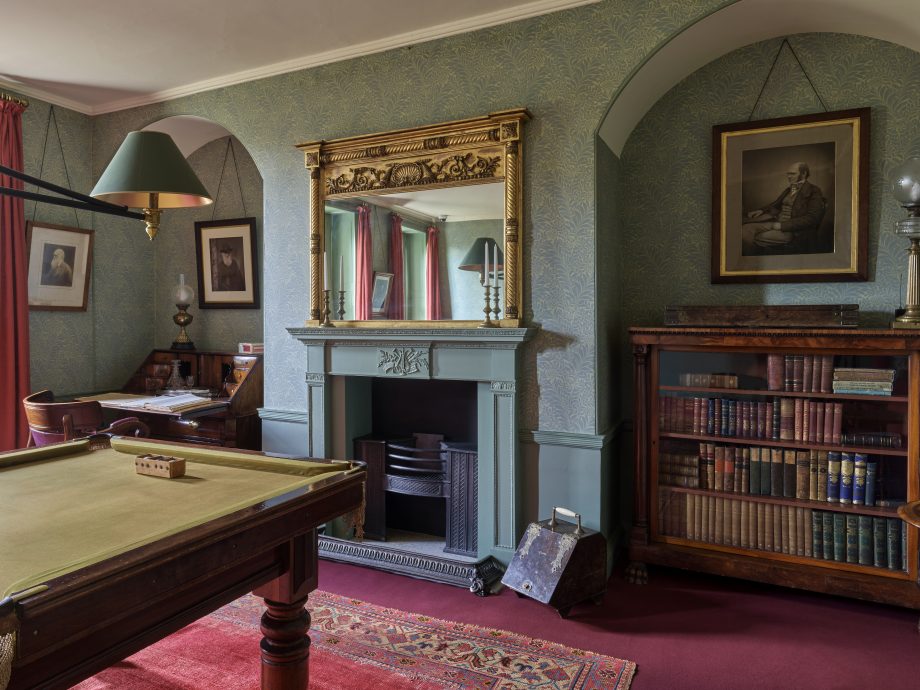
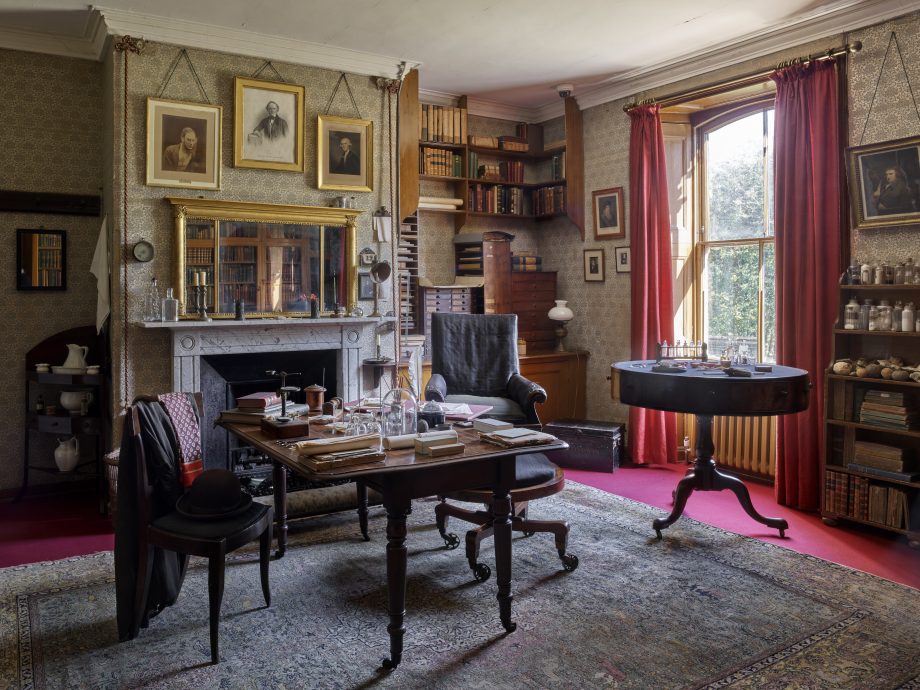
Down House (confusingly, next to Downe village) was Darwin’s family home for nearly 40 years. In its rooms, gardens and grounds, he researched and refined the ideas for which he became famous.
In origin, Down House was a plain Georgian property, a brick box with a main front five window bays wide built in about 1730. It was internally reconfigured and extended with a kitchen block by a wealthy businessman and landowner, George Butler, after he purchased the house in 1778.
At the same time, the main entrance was moved from the front to the side of the building. The house was then leased and sold again before coming into the possession of the Revd J. Drummond, vicar of Downe, in 1837. He employed the London-based architect Edward Cresy to make various improvements and also to render the house in conformity with the taste of the moment.
It was this house, with its 18 acres of land, that the Darwins occupied on September 24, 1842. Charles quickly settled into his new home, establishing a regular routine that distinguished his domestic arrangements. ‘My life goes on as clockwork,’ he wrote in 1843, ‘I am fixed in the place where I shall end it.’
International News Editor Martin Enserink talks with host Sarah Crespi about a moratorium on prion research after the fatal brain disease infected two lab workers in France, killing one.
Next, Abhay Goyal, a postdoctoral fellow at Georgetown University, talks with intern Claire Hogan about his Science Advances paper on figuring out how to reduce the massive carbon footprint of cement by looking at its molecular structure.
Finally, in a sponsored segment from the Science/AAAS Custom Publishing Office, Sean Sanders interviews Ansuman Satpathy, assistant professor in the department of pathology at Stanford University School of Medicine and 2018 winner of the Michelson Prize for Human Immunology and Vaccine Research, about the importance of supporting early-career research and diversity in science, technology, engineering, and math. This segment is sponsored by Michelson Philanthropies.
Discoveries of mass graves of Indigenous children in Canada have prompted new scrutiny of the residential school system – including the role physicians played in unethical experiments, says paediatrician Samir Shaheen-Hussain
Killing fossil fuels to halt global warming is the greatest challenge we face. We now have a masterplan of what we must do when – and there’s no time to delay
People think using more energy is a bad thing, says International Energy Agency chief Fatih Birol – but as long as we can make it cleanly, it needn’t be
Killing fossil fuels to halt global warming is the greatest challenge we face. We now have a masterplan of what we must do when – and there’s no time to delay
Satellite imaging has shown population increases are 10x higher in flood prone areas than previously thought, and a new way to introduce fairness into a democratic process.
In this episode:
00:47 Calculating how many people are at risk of floods.
Researchers have used satellite imagery to estimate the number of people living in flood-prone regions. They suggest that the percentage of people exposed to floods has increased 10 times more than previously thought, and with climate change that number is only set to climb.
Citizens’ assemblies are small groups of people invited to come together to help inform and affect policy decisions. But deciding who is in these groups is a mathematical challenge — the process needs to be random, but still reflect social demographics. This week, researchers describe a new algorithm that could offer a solution.
We discuss some highlights from the Nature Briefing. This time, how ships could spread a deadly coral disease, and research shows that female scientists are less likely to be cited in elite medical journals.


















 Boomers Daily