Brilliant Classics (June 1, 2023): A release of new classical music variating from the greatest composers of all time to the lesser known but still excellent composers.
The French Clarinet: 19th- & 20th- Century Music for Clarinet & Piano
Warner Classics (May 5, 2023) – Delirium Musicum and the ensemble’s artistic director Etienne Gara play a fiery movement from Max Richter’s thrilling reinterpretation of Vivaldi’s The Four Seasons.
“In a world where climate change is at the heart of our attention, these eight delightfully unhinged seasons are scattered across a wildly singular time. They cast an artistic blur on our perception of what has always seemed taken for granted, unshakeable: the seasons with their established climates, our perception of time and space, Vivaldi’s Four Seasons…”
To compose this piece in 1899, Maurice Ravel was inspired by the Princess of Polignac. The title refers to Ravel’s idea of describing “a pavana that a little princess may have danced in the old times at the Spanish court”. But It is also said that Ravel chose the title because he was fascinated by the sound of its pronunciation.
The piece is original for piano but the composer made an orchestral version too. We present our own transcription for guitar quartet, performed at the “Salone dell’Arengo” (Novara), a magical hall dating back to the 12th century. We hope you like It.
Deutsche Grammophon – DG (April 28, 2023) – A journey in three chapters to discover Chopin’s life through the sound of the cello.
CELLO Camille Thomas
PIANO Julien Brocal
The Chopin’s sonata for cello and piano was dedicated to his friend Auguste-Joseph Franchomme. Franchomme transcribed the Chopin’s piano pieces for cello after knowing Chopin found no objection to this.
The most ambitious project of the Franco-Belgian cellist Camille Thomas. Camille Thomas plays on the Franchomme’s mythical cello – the Stradivarius Feuermann.
Mulan: Sérgio Assad (dedicated to the Duo Chinoiserie)
La catedral: Agustín Barrios Mangoré
A Moonlit Night on the Spring River: Chinese classical work (arr. Jing Xia)
Danza ritual del fuego: Manuel de Falla (arr. Duo Chinoiserie)
“Duo Chinoiserie has found a unique voice, a new way of expressing music. Never before had I heard such a moving and impressive combination. They keep audiences in awe of their mastery and profound musicality. Their attractive phrasing of melodies is paired with an impressive level of technical difficulty. Their work demonstrates an instinctive understanding of the emotive and transformative power of a piece. They play with a strong finesse that produces a new, different sound to the conventional classical pieces.”
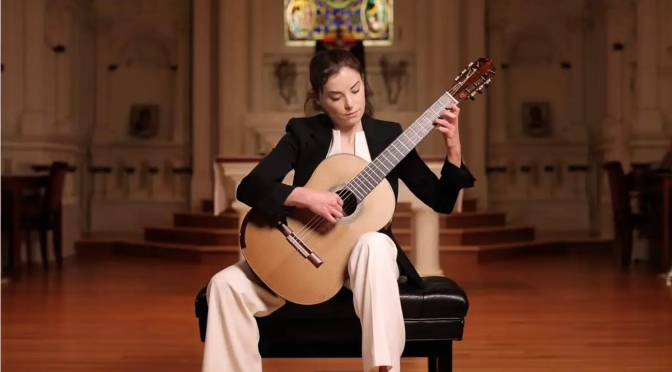
Omni Foundation (March 26, 2023) – The Omni Foundation presents Croatian guitar virtuoso Zoran Dukić. This performance was filmed in front of a live audience at St. Mark’s Lutheran Church in San Francisco on January 28, 2023.
PROGRAM:
Siciliana, BWV 1001 by Johann Sebastian Bach (1685 – 1750)
Invierno Porteño by Astor Piazzolla (1933-1990)
Andante, BWV 1003 by Johann Sebastian Bach (1685 – 1750)
Adios Nonino by Astor Piazzolla (1933-1990)
Largo, BWV 1005 by ohann Sebastian Bach (1685 – 1750)
La Muerte del Angel by Astor Piazzolla (1933-1990)
Sarabanda, BWV 1004 by Johann Sebastian Bach (1685 – 1750)
Omni Foundation (March 26, 2023) – The Omni Foundation presents 4 rising young stars of the guitar in concert for its 2nd edition to the Young Virtuosos Live from St. Mark’s series.
EGOT winner Rita Moreno, who was an original cast member of the 1961 film, joins Spielberg’s film as a consultant and opens up about years of battling colorism in Hollywood.
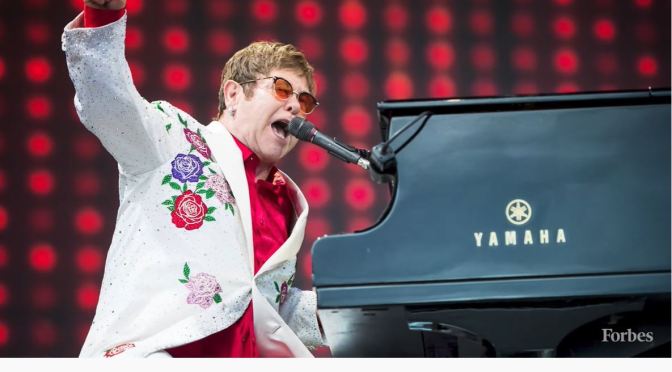
In this episode of Building Fortunes, we look how Elton John became one of the best-selling artists of all time. In 2020, Elton John’s yearly earnings amounted to $81 million. His Farewell Yellow Brick Road Tour grossed $212 million in 2019, the second-highest tally in the business. With the pandemic postponing his North American tour dates in April, the Rocket Man will have to wait to complete his 300-show, five-continent tour. In April, the Rocket Man’s Elton John AIDS Foundation announced a $1 million emergency fund to help those with HIV maintain their care amid Covid-19.
Music Ensemble: Il Giardino Armonico, Milano, Italy Dancer & Choreography: Margarita Ermachenko
Antonio Vivaldi
Antonio Vivaldi (1678–1741) grew up in Venice, Italy where his father, a professional violinist, taught him to play the violin and introduced him to some of the finest musicians and composers in the city. At the age of 15, he also began studying to become a priest. Because of his red hair, he was known as il Prete Rosso (“the Red Priest”). Vivaldi had to leave the clergy due to health issues, and he accepted several short-term musical positions funded by patrons in Mantua and Rome. It was in Mantua that he wrote his four-part masterpiece, The Four Seasons. He was also known for his operas, including Argippo and Bajazet. Vivaldi’s work, including nearly 500 concertos, influenced many later composers, including Bach.
The collection of Twelve Trio Sonatas Op. 1 was published by the Venetian house of Giuseppe Sala in 1705. Similarly to the other published collections by Vivaldi, it became known throughout Europe and reprinted four more times within the composer’s lifetime. It was dedicated to Count Annibale Gambara.
At the turn of the 17th and 18th centuries, the trio sonata was one of the most popular genres of instrumental music in Italy. The composers modelled their work on four sonata collections by Arcangelo Corelli. Mastery in the genre was generally seen as a test of composing talent, allowing a display of the ability to simultaneously shape the melody and the counterpoint.
Vivaldi, similarly to Albinoni and Caldara, made his debut with a collection of twelve trio sonatas. They were written for two violins and a cello (more precisely a violone) or a harpsichord. The earliest preserved Vivaldi pieces, they are characteristic in their individual and fully-formed style.
News, Views and Reviews For The Intellectually Curious










 Boomers Daily