
From Harvard School of Public Health website:
 What does it mean for someone to flourish? Flourishing is more than just being happy—although that’s a part of it. But the idea of flourishing expands beyond happiness to look at a person’s overall well-being, taking into account things like life satisfaction or someone’s sense of purpose. That’s why studying flourishing is an interdisciplinary science drawing on public health, philosophy, psychology, and more.
In this week’s episode we’re talking to two researchers from Human Flourishing Program at Harvard University who are tackling big questions about flourishing: What does it mean for people to flourish? How do we measure it? And are there things that make people more or less likely to flourish?
Our guests are Tyler VanderWeele, director of the Human Flourishing Program and John L. Loeb and Frances Lehman Loeb Professor of Epidemiology in the Departments of Epidemiology and Biostatistics at the Harvard Chan School, and Matthew Wilson, associate director of the Human Flourishing Program and a research associate at Harvard’s Institute for Quantitative Social Science.
Website: https://www.hsph.harvard.edu/news/multimedia-article/harvard-chan-this-week-in-health-archive/

 Orthopedic surgeon Dr. Daniel Thuillier looks at the options to treat severe ankle pain from nonsteroidal anti-inflammatory drugs to surgery including ankle replacement and ankle fusion.
 Rieder likens his experiences trying to get off prescription pain meds to a game of hot potato. “The patient is the potato,” he says. “Everybody had a reason to send me to somebody else.”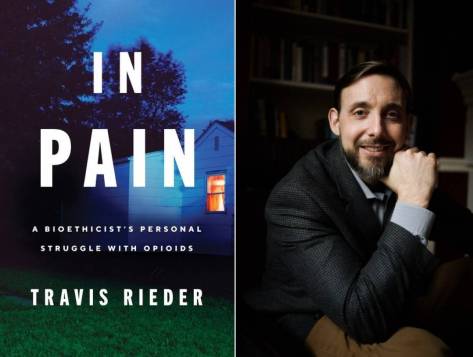
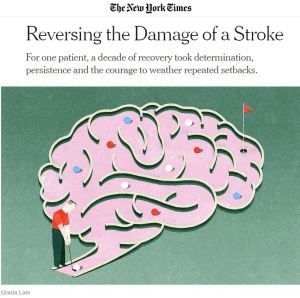 The learning curve was steep: “I couldn’t read; I couldn’t write. I could see the hospital signs, the elevator signs, the therapists’ cards, but I couldn’t understand them,” he wrote. The aphasia — the inability to understand or express speech — “had beaten and battered” his pride.
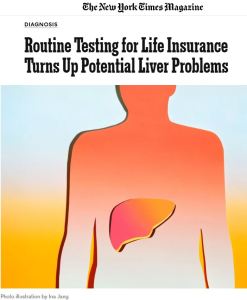 “The doctor asked whether he was sure that he had not taken anything else when he was sick? No acetaminophen? No herbs or supplements? The man was certain. Moreover, his labs were abnormal even before he took the antibiotics. The doctor hypothesized that the man’s liver had been a little inflamed from some minor injury — maybe a virus or other exposure — and the antibiotic, which is cleared through the liver, somehow added insult to injury.”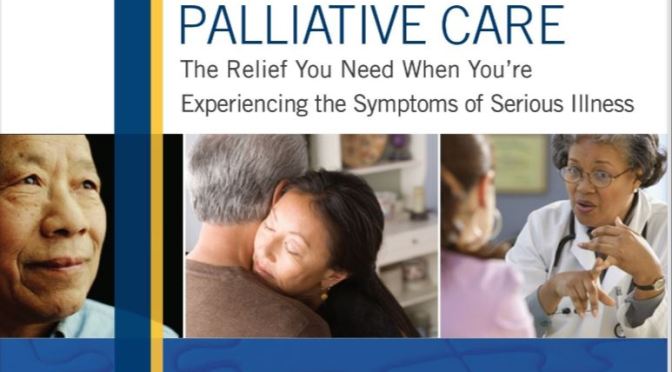
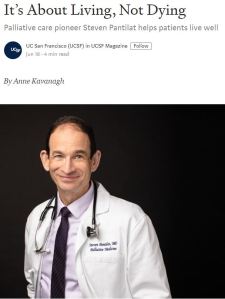 “Doctors and patients are increasingly recognizing the benefits of palliative care. People want care that helps them live as well as possible for as long as possible. Once people learn what palliative care is, they want it. So we’re training experts to meet this growing demand. We have one of the largest fellowship programs in the state, and we also train nursing students, medical students, and residents. We want all clinicians to know the basics of palliative care: how to manage pain, shortness of breath, and nausea and how to talk to patients about the things that matter most to them.”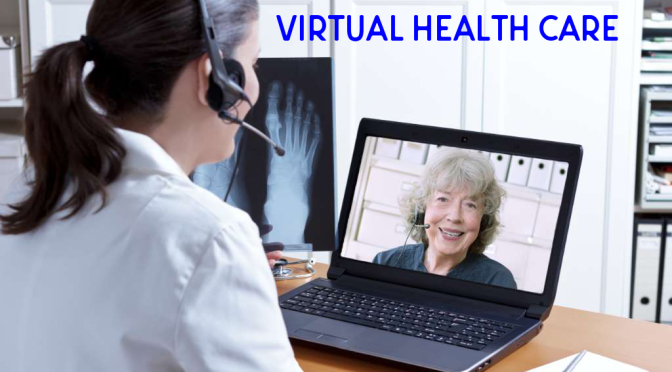
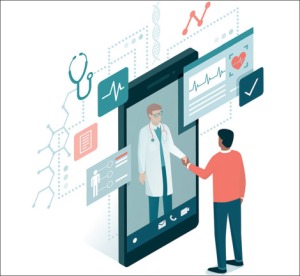 From time immemorial, an invariable feature of doctor–patient interaction has been that it takes place in person. But the status quo is changing. A large portion of patient care might eventually be delivered via telemedicine by virtualists, physicians who treat patients they may never meet.
 “Will price transparency lower health care costs? Economic theory and hospital opposition suggest it would, but the answer is not as straightforward as you might expect and could differ from market to market. Health care is a
  Boomers Daily