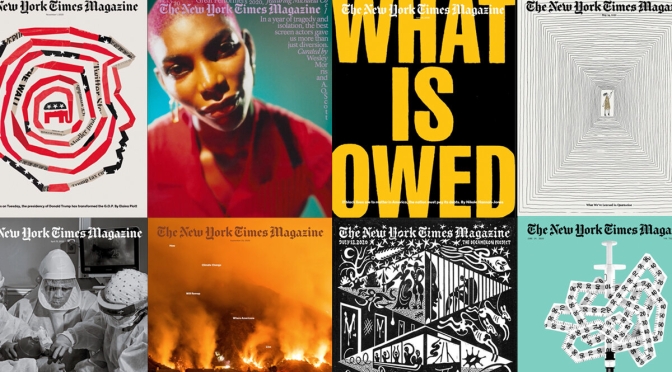
THE NEW YORK TIMES MAGAZINE:The 11.9.25 Issue features Parul Sehgal on Guillermo del Toro’s adaptation of ‘Frankenstein’; Emily Baumgaertner Nunn on the trafficked girls of Los Angeles; Jesse Barron on the suicide of a teen who fell in love with an A.I. chatbot; J Wortham on the art exhibition using decommissioned Confederate monuments; and more.
The industry keeps echoing ideas from bleak satires and cyberpunk stories as if they were exciting possibilities, not grim warnings.By Casey Michael HenryCreditPhoto illustration by Michael Houtz
His opponents tried to smear him for his youth, inexperience, and leftist politics. But New Yorkers didn’t want a hardened political insider to be mayor—they wanted Zohran Mamdani.
Dick Cheney’s Brand of Conservatism
For years before taking office, the former Vice-President appeared less dogmatic than he was.
The Dishy Operatics of Lily Allen’s Breakup Album
On “West End Girl,” all the gritty bits are there: messages with a husband’s mistress, the discovery of a cache of sex toys.
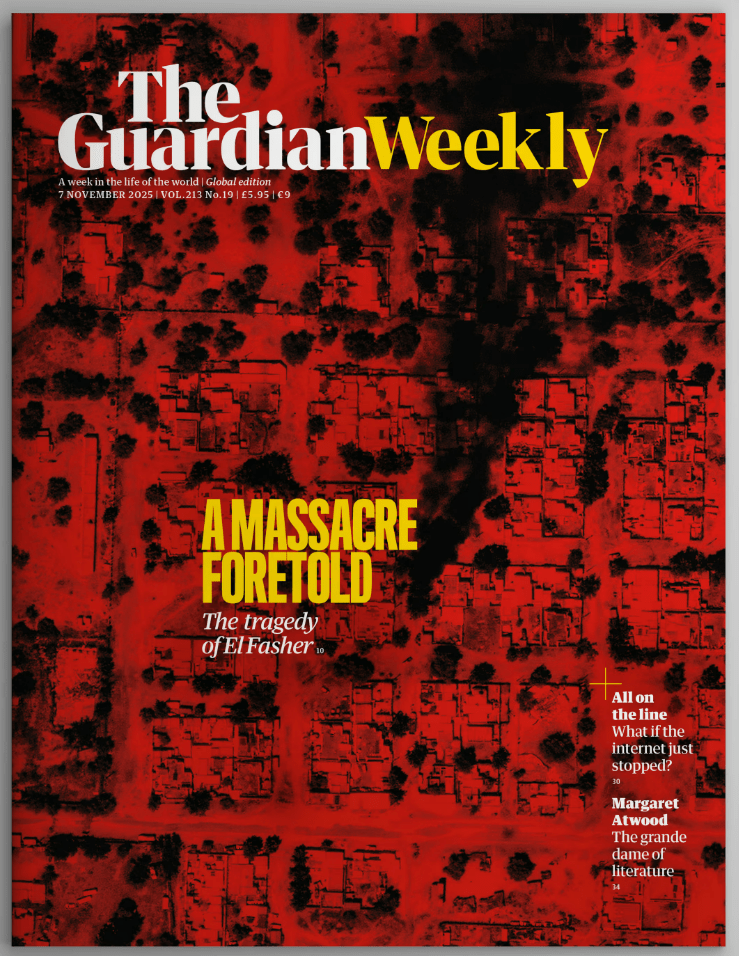
For some time now, El Fasher in Sudan has been a city beyond the reach of journalists. But the haunting satellite image on our cover this week, of smoke billowing from fires near El Fasher’s airport, told its own story as starkly as anything that could be reported from the ground.
Other satellite images showed clusters of burned-out vehicles, and what appeared to be pools of blood beside piles of bodies on the ground. A massacre was under way that could be seen from space.
The last major city in Darfur to fall to the Rapid Support Forces (RSF) was already the scene of catastrophic levels of human suffering, but has “descended into an even darker hell”, senior UN officials warned last week. This key moment in the two-and-a-half-year-long civil war has unfolded in plain sight with minimal intervention from the international community, unless you count the United Arab Emirates, which has been arming the RSF paramilitaries.
Spotlight | The Andrew formerly known as a prince Stupidity and self-entitlement sank King Charles III’s disgraced younger brother – and the royal reckoning may not be over yet, writes Stephen Bates
Technology | What if the internet just … stopped working? Could everything suddenly go offline and if so, how? Aisha Down goes inside the fragile system holding the modern world together
Interview | Margaret Atwood puts the world to rights At 85, she’s a literary seer and saint – and queen of the Canadian resistance. So what does the writer make of our dystopian society? Lisa Allardice finds out
Opinion | World leaders: Cop30 could be your great legacy With the US backing away from the climate crisis, now is the moment when other nations must step up, says former British prime minister Gordon Brown
Culture | Back to black with Lynne Ramsay The Scottish film director burst on to the scene with Ratcatcher and terrified audiences with We Need to Talk About Kevin. Her latest film stars Hollywood darling Jennifer Lawrence, but it doesn’t flinch from the dark side of family life, finds Amy Raphael
ChatGPT does not have an inner life. Yet it seems to know what it’s talking about. By James Somers
Voting Rights and Immigration Under Attack
The President’s goals were clear on the first day of his term, when he issued an executive order overruling the Fourteenth Amendment’s birthright-citizenship clause. By Jelani Cobb
Mobsters We Have Seen on High
The jewel heist at the Louvre reminded Brooklynites of the time, in 1952, when two bejewelled crowns were swiped from a beloved local church—the one with a Mob boss on the ceiling. By Susan Mulcahy
THE NEW YORK TIMES MAGAZINE:The 11.2.25 Issue features Susan Dominus on women taking testosterone; Dan Brooks on the comedian Stavros Halkias; Joshua Leifer on Haredi conscription in Israel; and more.
A mother in Florida filed a lawsuit against an A.I. start-up, alleging its product led to her son’s death. The company’s defense raises a thorny legal question. By Jesse Barron
Sulawesi, Indonesia, blurs the boundaries between myth and ecology. What might it reveal about our past – or destiny? Photographs and Text by Balarama Heller
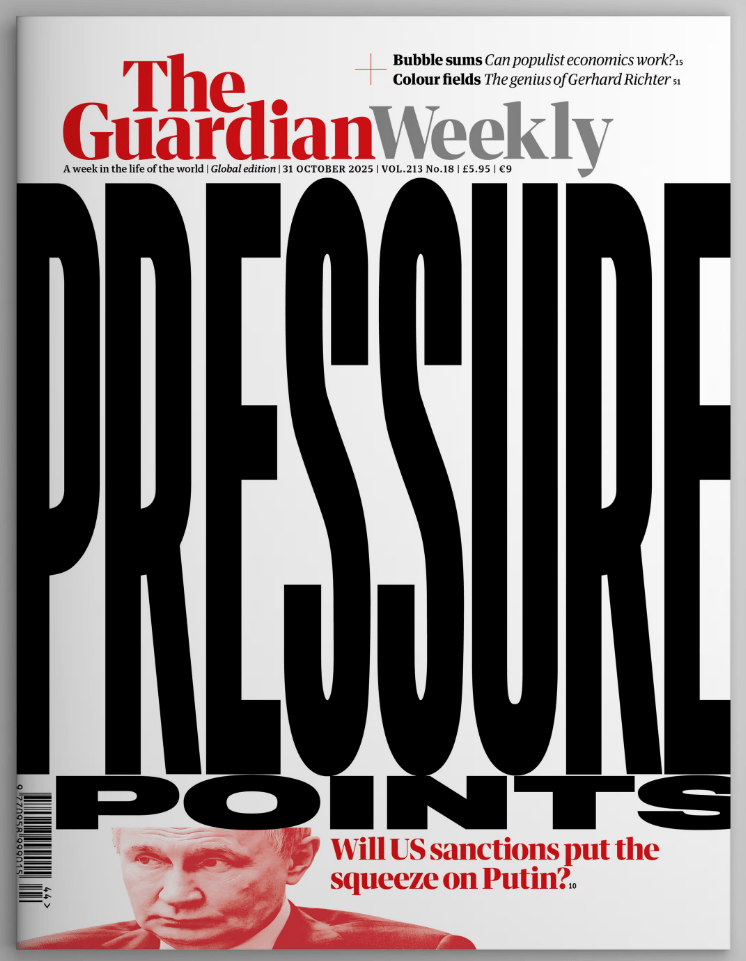
Donald Trump’s sudden decision last week to sanction Russian oil producers suggested the US president has finally lost patience with Vladimir Putin after a series of fruitless talks over ending the war in Ukraine.
Could it break the deadlock? Oil sanctions have the potential to genuinely damage Moscow’s finances, as the Russian president himself admitted last week. It remains to be seen, though, whether economic pressure alone can bend Putin’s arm over a conflict he views as defining to his legacy.
In this week’s big story, Guardian Russia affairs reporter Pjotr Sauer asks whether sanctions could succeed where diplomacy has failed, while Christopher S Chivvis of the Carnegie Endowment for International Peace argues that a negotiated settlement remains the likeliest way to bring nearly four years of fighting to a halt.
In the frontline Ukrainian city of Kupiansk, senior reporter Peter Beaumont finds little hope of a quick resolution, with much of the population having left and the remaining soldiers stuck in a war they believe is “going nowhere for either side”.
Five essential reads in this week’s edition
Spotlight | The populist leaders’ economic playbook From Milei to Meloni,are the economics of populism always doomed to failure? This long read from economics editor Heather Stewart tries to bridge the gaps between populist aspiration and fiscal reality
Environment | The deadly migration routes of elephants Human-wildlife conflict has overtaken poaching as a cause of fatalities among elephants – and is deadly for people too. Now some villages are finding new ways to live alongside the mammals, reports Patrick Greenfield
Interview | Is Jimmy Wales the good guy of the internet? The Wikipedia founder stands out from his contemporaries for being driven by more than money. But can the people’s encyclopedia withstand attacks from AI and Elon Musk? ByDavid Shariatmadari
Opinion | Without genuine truth and justice, the war in Gaza cannot end A fragile ceasefire is in place, but what’s needed is an international tribunal for resolution and reparation.That’s the only route to lasting peace, argues Simon Tisdall
Culture | The electrifying genius of Gerhard Richter He has painted everything from a candle to 9/11, walked his naked wife through photographic mist, and turned Titian into a sacred jumble. A new Paris show reveals the German artist in all his contradictory brilliance, says Adrian Searle
The act of destruction is precisely the point: a kind of performance piece meant to display Trump’s arbitrary power over the Presidency, including its physical seat. By Adam Gopnik
Trump and the Presidency That Wouldn’t Shut Up
His posts and rants are omnipresent, ugly, and unhinged. Don’t look to history to make it make sense. By Jill Lepore
Inside the Data Centers That Train A.I. and Drain the Electrical Grid
A data center, which can use as much electricity as Philadelphia, is the new American factory, creating the future and propping up the economy. How long can this last? By Stephen Witt
Madagascar rarely makes front page news but the toppling of its president by protesters led by Gen Z Madagascar is part of a phenomenon that stretches from Nepal to Indonesia and the Philippines to Morocco. Leaderless groups, formed online, have learned from one another as they take to the streets to vent their frustration against what they see as corrupt older elites and a lack of economic opportunity for their generation.
Our southern Africa correspondent, Rachel Savage, explains how a tumultuous month unfolded on the Indian Ocean island and explores the deep-seated discontent that led to the military siding with student demonstrators to force President Andry Rajoelina out of power.
Five essential reads in this week’s edition
Spotlight | A far-right fight club on their hands Ben Makuch reports on security service monitoring of ‘active clubs’ as they move across borders to spread extremism, mixing the behaviour of football hooligans with the ideology of the Third Reich
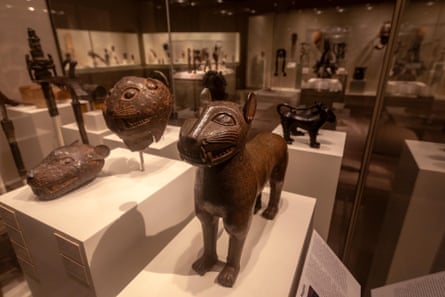
Benin bronzes at the Metropolitan Museum of Art in New York. Photograph: Art2010/Alamy
Spotlight | Nothing to see here? Due to open within weeks,Nigeria’s Museum of West African art is intended to showcase the Benin bronzes and other masterpieces stolen by 19th-century colonisers. But the project has been beset by political rows that mean, as Philip Oltermannand Eromo Egbejule report, visitors will see more replicas than original pieces
Science | Waiting for graphene to explode Two decades after the material was first produced and then much hyped, graphene has dropped from business and general discussion. Julia Kollewe reports on the successes and setbacks of taking it from lab to mainstream use
Opinion | An A-level in English won’t make integration work A government demand that immigrants get a qualification that most British citizens don’t have if they want to earn the right to stay is the latest absurd way to focus on ‘outsiders’ rather than address domestic problems, argues Nesrine Malik
Culture | The hardest part David Harewood reflects on returning to play Othello after almost 20 years and with fellow Black actors looks at how attitudes to Shakespeare’s most difficult tragedy have changed
What else we’ve been reading
The year’s Stirling prize has gone to a social housing complex for older people in south-east London. Catherine Slessor writes with great enthusiasm about how the award-winning architects Witherford Watson Mann have completely reimagined accommodation for later life. Out with disorientating corridors, in with bright, informal, nature filled spaces, described by the Stirling judges as “a provision of pure delight”. Emily El Nusairi, deputy production editor
Kathryn Lewek as the Queen Of The Night in The Magic Flute at the Royal Opera House. Photograph: Tristram Kenton/The Guardian
I saw The Magic Flute in Paris last year, and it was fascinating to see how different opera houses interpret the staging. This review of a London production made me reflect on the way different directors handle staging and sound to bring the story to life. It reminded me of listening to the Queen of the Night’s aria when I was growing up and the experience of seeing opera live. Hyunmu Lee, CRM executive








 Boomers Daily