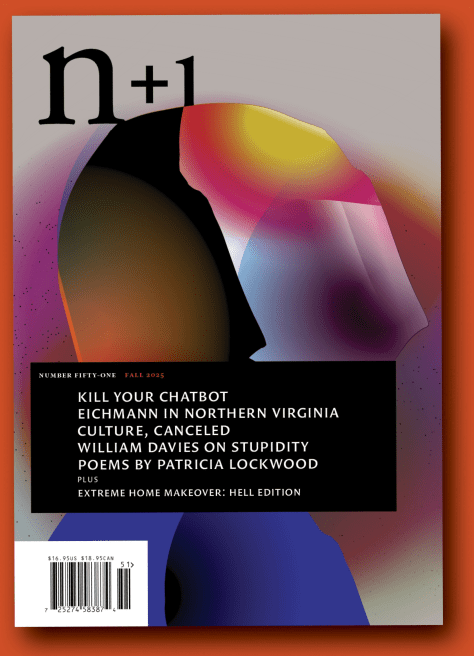
The AI upheaval is unique in its ability to metabolize any number of dread-inducing transformations. The university is becoming more corporate, more politically oppressive, and all but hostile to the humanities? Yes — and every student gets their own personal chatbot. The second coming of the Trump Administration has exposed the civic sclerosis of the US body politic? Time to turn the Social Security Administration over to Grok. Climate apocalypse now feels less like a distant terror than a fact of life? In five years, more than a fifth of global energy demand will come from data centers alone.
Naturally there were lots of law enforcement types hanging around the convention — men with military fades, moisture-wicking shirts, and tattoos of the Bible and the Constitution and eagles and flags distended across their arms. But there were also a handful of women ICE applicants and a lot of men of color. The deportation officer applicant pool was, I felt, shockingly diverse — one might say it looked like America. The whole place looked and felt like America.
The challenge posed by this political crisis is how to take the stupidity seriously without reducing it to a wholly mental or psychiatric, let alone genetic, phenomenon. Stupidity can be understood as a problem of social systems rather than individuals, as André Spicer and Mats Alvesson explore in their book The Stupidity Paradox. Stupidity, they write, can become “functional,” a feature of how organizations operate on a daily basis, obstructing ideas and intelligence despite the palpable negative consequences. Yet it’s hard to identify anything functional about Trumpian stupidity, which is less a form of organizational inertia or disarray than a slash-and-burn assault on the very things — universities, public health, market data — that help make the world intelligible.
Xi Jinping had been waiting for the right moment to serve notice of China’s growing might and influence to the rest of the world, and the 80th anniversary of the end of the second world war provided the Mao-suited Chinese leader with the perfect opportunity.
Last week’s bombastic (or should that be bomb-tastic?) military parade in Beijing – in the presence of Vladimir Putin, Kim Jong-un and a host of other global strongmen – was intended as a show of force and stability to contrast sharply with the chaotic unpredictability of Donald Trump’s America. And, as the leaders of the world’s most notorious pariah states bear-hugged and strolled around Tiananmen Square like the cast of Reservoir Dogs, the optics did not disappoint.
But behind the scenes, how robust actually is the so-called “axis of upheaval”? As our big story this week explores, the illiberal alliance is riven by internal fractures and mistrust between China, Russia and North Korea that date back many years and cannot be discarded as quickly as Xi, or anyone else, might like.
Spotlight | France’s latest political crisis The fall this week of prime minister François Bayrou exposed a political malaise that is likely to sour French politics well beyond the 2027 presidential election, reports Paris correspondent Angelique Chrisafis
Interview | Leonard Barden, chairman of the chess board From honing his game in air raid shelters during the second world war to beating grand masters, our record-breaking chess columnist has lived an extraordinary life. Now aged 96, he chats to our chief sports reporter Sean Ingle
Feature | Syria’s cycle of sectarian violence Over a few brutal days in March, as sectarian violence and revenge killings tore through parts of the country, two friends from different communities tried to find a way to survive. By Ghaith Abdul-Ahad
Opinion | Angela Rayner’s exit is a bombshell for Keir Starmer The UK deputy prime minister’s fall will exacerbate all the doubts about the PM himself and his ability to keep Labour in power, writes Jonathan Freedland
Culture | Spinal Tap turn it up to 11, one last time More than 40 years since the film This Is Spinal Tap was mistaken for a comedy, its hard-rocking subjects are back for a legally obligated final gig. Our writer Michael Hann smells the glove





 Boomers Daily