
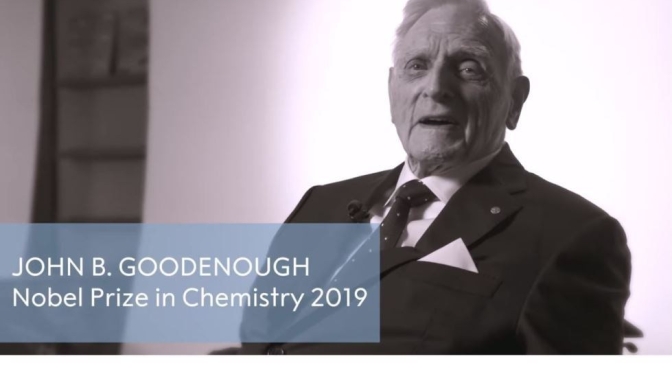
Interview with the 2019 Nobel Laureate in Chemistry John B. Goodenough, 6 December 2019
0:07 – What advice would you give to a younger version of yourself? 0:32 – How do you recognise a good teacher? 0:58 – Do you see yourself as a mentor now? 1:33 – What qualities do you think you need to be a successful scientist? 3:04 – How do you cope with failure? 3:16 – How has your dyslexia shaped you? 3:44 – How important has nature been for you? 4:40 – Has music played an important role in your life? 5:06 – How did your interest in poetry start? 6:14 – How did you meet your wife? 7:06 – What life advice can you share? 8:30 – How do you remember so much of your life? 8:47 – How does it feel to be back in Stockholm after 80 years? 9:21 – How has living through World War II influenced you? 10:03 – What is your relationship with your lab colleagues? 11:18 – What are the characteristics of a very good team? 11:55 – What is your relationship with Akira Yoshino? 12:28 – How has the scientific landscape has changed over the years? 13:42 – What environment encourage creative thinking? 14:48 – What research are you working on now? 15:39 – What are your thoughts on sustainability? 16:37 – What future do you see for sustainable batteries?
John Bannister Goodenough born July 25, 1922) is an American materials scientist, a solid-state physicist, and a Nobel laureate in chemistry. He is a professor of mechanical engineering and materials science at the University of Texas at Austin. He is widely credited with the identification and development of the lithium-ion battery, for developing the Goodenough–Kanamori rules in determining the sign of the magnetic superexchange in materials, and for seminal developments in computer random access memory.
 Boomers Daily