
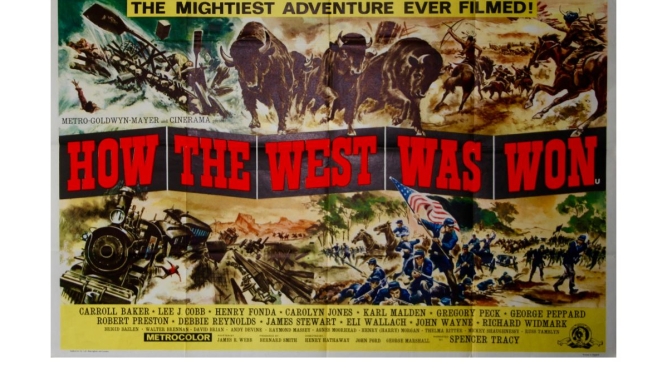
How the West Was Won is a 1962 American epic Western adventure film directed by Henry Hathaway (who directs three out of the five chapters involving the same family), John Ford, and George Marshall, produced by Bernard Smith, written by James R. Webb, and narrated by Spencer Tracy. Originally filmed in true three-lens Cinerama with the according three-panel panorama projected onto an enormous curved screen, the film stars an ensemble cast consisting of (in alphabetical order) Carroll Baker, Lee J. Cobb, Henry Fonda, Carolyn Jones, Karl Malden, Gregory Peck, George Peppard, Robert Preston, Debbie Reynolds, James Stewart, Eli Wallach, John Wayne, and Richard Widmark. The supporting cast features Brigid Bazlen, Walter Brennan, David Brian, Ken Curtis, Andy Devine, Jack Lambert, Raymond Massey as Abraham Lincoln, Agnes Moorehead, Harry Morgan as Ulysses S. Grant, Thelma Ritter, Mickey Shaughnessy, Harry Dean Stanton, Russ Tamblyn and Lee Van Cleef.
How the West Was Won is widely considered one of Hollywood‘s greatest epics.[1] The film received widespread critical acclaim and was a box office success, grossing $50 million on a budget of $15 million.[2] At the 36th Academy Awards, it earned eight nominations, including Best Picture, and won three, for Best Story and Screenplay Written Directly for the Screen, Best Sound, and Best Film Editing. In 1997, it was selected for preservation in the National Film Registry by the Library of Congress as being “culturally, historically, or aesthetically significant”.
 Boomers Daily