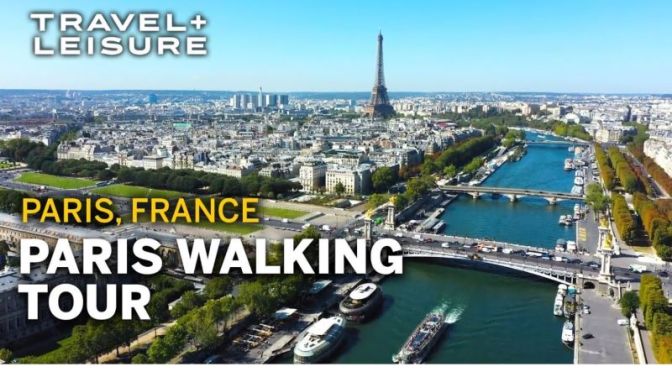
Paris, France’s capital, is a major European city and a global center for art, fashion, gastronomy and culture. Its 19th-century cityscape is crisscrossed by wide boulevards and the River Seine. Beyond such landmarks as the Eiffel Tower and the 12th-century, Gothic Notre-Dame cathedral, the city is known for its cafe culture and designer boutiques along the Rue du Faubourg Saint-Honoré.
Video timeline: 00:00 Introduction 00:35 Shakespeare and Company Bookstore 01:25 Wallace fountains 02:14 Oldest bridge in the City 03:15 Pont des Arts 04:00 Notre Dame 05:27 Louvre Museum 06:08 Eiffel Tower 06:53 Montmartre 07:40 Wall of Love
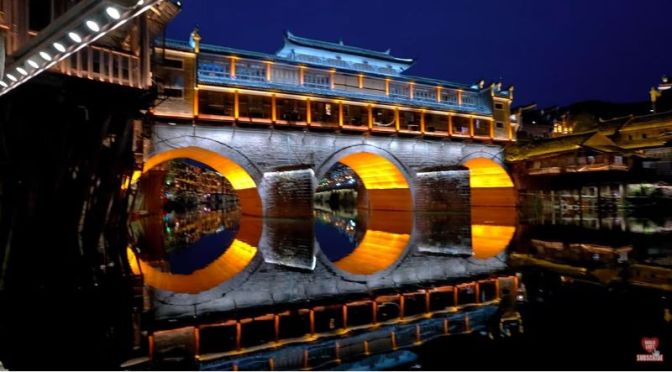
Fenghuang Ancient City, also know as Phoenix Ancient Town, is located in Xiangxi Tujia and Miao Autonomous Prefecture, in southwest of Hunan Province. It is one of the smaller counties in Hunan, but now it is known as the most beautiful ancient town for its long history and well-preserved appearances. The name of Phoenix (Phoenix in Chinese Pinyin is Fenghuang) town mainly derived from the Phoenix Mountain which is in a phoenix shape.
The Tiber Island is the only island in the part of the Tiber which runs through Rome. Tiber Island is located in the southern bend of the Tiber. The island is boat-shaped, approximately 270 metres long and 67 metres wide, and has been connected with bridges to both sides of the river since antiquity.
Video timeline: 0:00 – [Brief Intro] 1:40 – [Tiber Island walk begins] 1:50 – [Fabricius Bridge – Oldest bridge in Rome of 62 a.C.] 4:00 – [Via di Ponte Quattro Capi] 4:28 – [S.Bartolomeo all’Isola Square] 5:16 – [View of Cestio Bridge] 5:46 – [St.John Hospital on the right] 8:00 – [Walking around the island] 15:41 – [The roman marble shape of the Boat that famously was used to bring Asclepius’ statue to the island – it’s still visible the symbol of the snake around the ship mast] 17:37 – [Southern bank of the island]
Lalitpur Metropolitan City, historically Patan, is the third largest city of Nepal after Kathmandu and Pokhara, and it is located in the south-central part of Kathmandu Valley, a new metropolitan city of Nepal. Lalitpur is also known as Manigal.
The river Seine flows right through the heart of Paris bordering 10 of the 20 arrondisements. It was no accident that the city evolved around this gigantic avenue for commerce and transportation, or that the early Parisi tribes on the river’s island were attacked and overthrown by the Romans. This early coup took place on what was later to become some very prime real estate. At that time the river was called by it’s Latin name: Sequana. The river is still the chief commercial waterway and half of the water used in Paris still comes form the Seine. Don’t think about that when you look at the sick green water flowing under the bridge, or when your waiter brings you a glass of tap water.
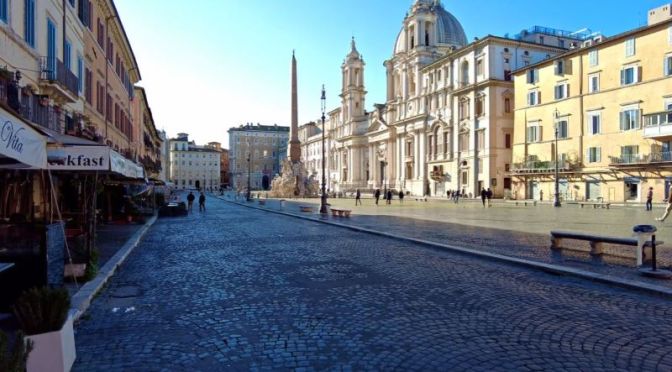
A walking in a Sunday morning in 𝗥𝗼𝗺𝗲 , Italy, in and around 𝗣𝗶𝗮𝘇𝘇𝗮 𝗡𝗮𝘃𝗼𝗻𝗮. Very quiet weekend day, good weather in this day of winter.
Piazza Navona is a public open space in Rome, Italy. It is built on the site of the Stadium of Domitian, built in the 1st century AD, and follows the form of the open space of the stadium. The ancient Romans went there to watch the agones, and hence it was known as “Circus Agonalis”.
Video timeline: 0:00 – [Brief Intro] 2:05 – [Piazza Navona] 4:36 – [Sant’Agnese in Agone Church *tour inside* – (info on subtitles)] 6:50 – [Piazza Navona] 8:00 – [*Fontain of Moro* – 1654 – (info on subtitles)] 9:32 – [Via della Cuccagna] 10:20 – [Piazza dei Massimi] 11:40 – [Piazza S.Andrea della Valle] 12:36 – [Corso VIttorio Emanuele II] 14:00 – [Piazza di S.Pantaleo] 14:30 – [Via della Cuccagna] 15:30 – [Via di Pasquino] 16:25 – [Via di S.Maria dell’Anima] 19:20 – [Vicolo della Pace] 22:43 – [Piazza del Fico] 23:10 – [Vicolo del Fico] 24:13 – [Via di Monte Giordano] 26:10 – [Via del Corallo] 27:31 – [Via del Governo Vecchio] 29:18 – [Via di Parione] 31:33 – [Via del Teatro Pace] 32:55 – [Vicolo dei Granari] 34:00 – [Via di S.Maria dell’Anima] 35:00 – [Piazza di Pasquino] 36:00 – [Via del Governo Vecchio] 37:30 – [Vicolo Savelli] 38:48 – [Corso Vittorio Emanuele II] 40:10 – [Via dei Leutari] 41:45 – [The *Talking Statue* of Pasquino – (info on subtitles) – it reads **This city, now old, by everyone is cheated, everyone says “great beauty”, but noone caresses you, it’s because they forgot, that in the past you founded them, My Rome, let them see, if you get enraged what can happen!*] 43:00 – [Piazza Navona]
Castello covers a large vibrant area, with one section bordering St. Mark’s Square and dotted with luxury hotels. Farther from St. Mark’s, the neighborhood gets more laid-back, with casual bars where locals stop in for a glass of wine. Shops and eateries catering to all budgets line buzzing Via Garibaldi. In alternating years, the Giardini della Biennale park hosts the Biennale exhibition of contemporary art.
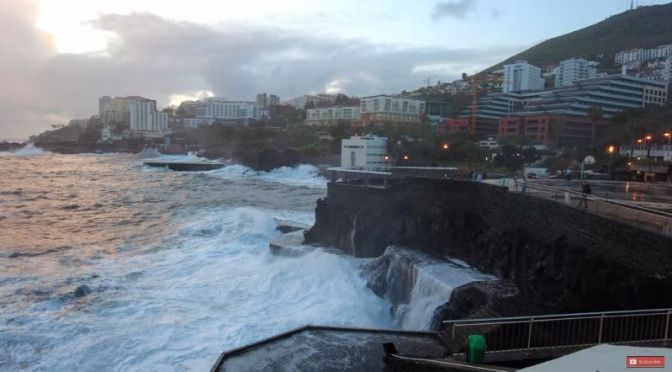
The Lido Promenade is a seafront walkway that provides a pedestrian link between the Lido area and Formosa Beach. The entire path affords far-reaching views over the Atlantic.
Funchal is the capital city of Portugal’s Madeira archipelago. It’s backed by hills, and known for its harbor, gardens and Madeira wine cellars. The centuries-old Funchal Cathedral, which mixes Gothic and Romanesque styles, is notable for its carved wooden ceiling. Fronting the harbor is the São Tiago Fortress, built in the 1600s. It now houses the Contemporary Art Museum, with a large collection of Portuguese works.
Haarlem is a city outside of Amsterdam in the northwest Netherlands. Once a major North Sea trading port surrounded by a defensive wall, it retains its medieval character of cobblestone streets and gabled houses. It’s the center of a major flower-bulb-growing district, and famous for its outlying tulip fields, art museums and hofjes (almshouses built around leafy courtyards).
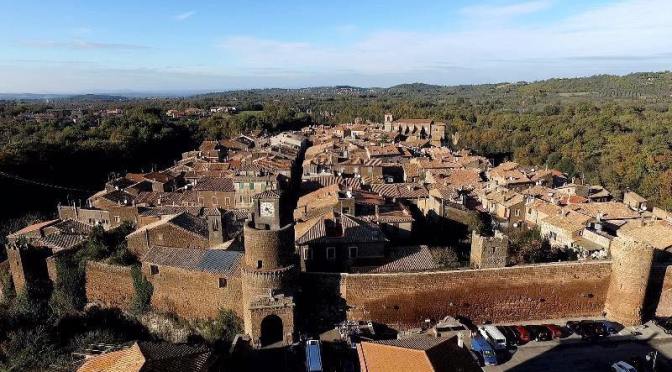
Barbarano Romano is a comune in the Province of Viterbo in the Italian region Latium, located about 50 kilometres northwest of Rome and about 20 kilometres south of Viterbo. Barbarano Romano borders the following municipalities: Blera, Capranica, Vejano, Vetralla, Villa San Giovanni in Tuscia.
Video timeline: 0:00 – [Brief Intro] 2:05 – [Tour begins] 2:28 – [*Roman Gate*] 7:50 – [*Church of St.Angel*] 12:44 – [Via Roma] 13:54 – [Largo di Porta Canale] 17:30 – [*Municipal Palace*] 18:28 – [*Church of St.Maria Assunta*] 26:00 – [Panormaa on the countryside] 26:30 – [Back into the town] 30:42 – [*Church of the Cross*] 33:00 – [Back into the town] 39:54 – [Via Garibaldi] 42:23 – [*City Walls*]
The town consists of a first nucleus probably dating back to the 10th century, to which are added various buildings, from the 13th to the 17th century. It constitutes an example of a medieval village, with a main central road flanked by two secondary parallels, stretched on the wedge between two gorges and closed by walls with quadrilateral open-gorge towers dating back to 14th century, further lined by a wall towards the end of the 15th century with the addition of circular towers. The volcanic hill on which the town stands was probably the seat of a village from the Ancient Bronze Age in prehistoric times, as attested by the numerous artefacts identified at the foot of the acrocoro. However, news of a permanent settlement only dates back to the Middle Ages. Almost at the end of the main street, Via Vittorio Emanuele, until 1930 stood a pentagonal tower that was left over from a Longobard fortress, known as Desiderio – the last Lombard King who around 771 fortified Viterbo and the nearby villages to counter the Franks of Charlemagne. An original marble plaque from 1280 – located at the entrance to the main church of S. Maria Assunta – indicates that it was built in 1280, during the vacant seat of the papacy following the death of Pope Nicholas III Orsini. Barbarano was therefore part of the Longobard Roman Duchy which, following the donation of Liutprando in 728, had then become a possession of the Church in the eighth century. Feud of the Anguillara family in the 14th century, then it passed to the Orsini and finally to the Borgias in the 15th century.
News, Views and Reviews For The Intellectually Curious




 Boomers Daily