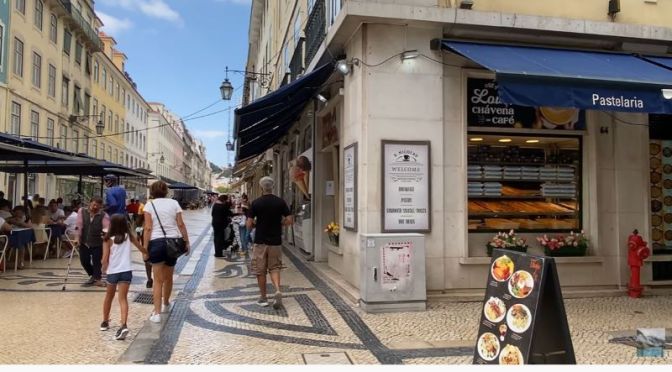
Filmed on August 12th, 2020. A walk in Lisbon, Portugal.
Lisbon is Portugal’s hilly, coastal capital city. From imposing São Jorge Castle, the view encompasses the old city’s pastel-colored buildings, Tagus Estuary and Ponte 25 de Abril suspension bridge. Nearby, the National Azulejo Museum displays 5 centuries of decorative ceramic tiles. Just outside Lisbon is a string of Atlantic beaches, from Cascais to Estoril.
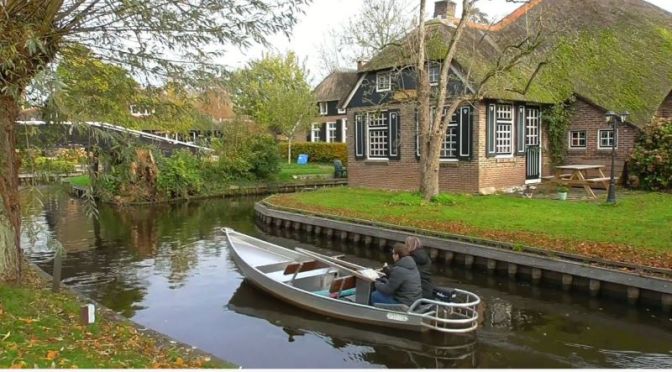
A couple of years ago I have uploaded a video about summer in Giethoorn, which got many views. Now we have visited the village in autumn. This time there were not many visitors (also due to corona), even though I hope you will enjoy the video. The video is with original sound and music by Gheorghe Iovu.
Giethoorn is a mostly car-free village in the northeastern Dutch province of Overijssel. It’s known for its boat-filled waterways, footpaths, bicycle trails and centuries-old thatched-roof houses. It borders a section of the Weerribben-Wieden National Park, a marshy area once popular for peat and reed harvesting. Next to the park, Museum Giethoorn ‘t Olde Maat Uus is a farm museum illustrating the region’s history.
We recorded this 4k ultra hd video during our trip to Strasbourg, France on August 2020.
Strasbourg is the capital and largest city of the Grand Est region of France and is the official seat of the European Parliament. Located at the border with Germany in the historic region of Alsace, it is the capital of the Bas-Rhin department. Our guided walking tour is about 4.35 miles (7 km) long, starts at Petite France, ends at Orangerie Park and covers most attractions and historic sites of Strasbourg.
Video Timeline Links: 00:00 – Strasbourg, France Walking Tour Intro 02:05 – Petite France 12:03 – Saint-Thomas Church 20:50 – Gutenberg Square 25:18 – Kammerzell House 25:39 – Notre-Dame Cathedral 33:25 – Prints and Drawings Museum 35:05 – Museum of Fine Arts 42:25 – Raven Bridge and Square 53:00 – St William’s Church 1:02:34 – Tomi Ungerer Museum 1:06:19 – Republic Garden Square 1:07:27 – Palace of the Rhine 1:16:04 – Saint Paul Church 1:19:39 – Kennedy Bridge 1:26:33 – Council of Europe 1:29:21 – Orangerie Park
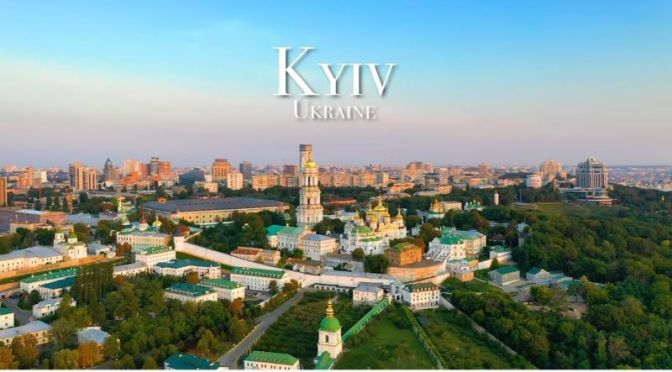
Europe’s capital cities remain unmatched to the rest of the world. From Malta’s medieval city of Valletta, to jaw dropping architecture of Kyiv, Europe’s capitals have so much to offer. I wanted to highlight some of Europe’s underrated capitals and hope it inspires you to visit them one day.
VILLA VEDRAMAR is located at the south west coast, one of the most protected nature reserves of Ibiza where the magical rock Es Vedrá rises out of the sea like a majestic sculpture. Cala Carbó beach offers two restaurants with great fish specialities. It’s one of the most relaxing beaches of Ibiza, with comfortable sun loungers and palm leaf parasols. On entering Cala Carbó, you will find our HARISSA office, a supermarket and our tapas bar LA SARDINA LOCA for food and drinks.
Ibiza is one of the Balearic islands, an archipelago of Spain in the Mediterranean Sea. It’s well known for the lively nightlife in Ibiza Town and Sant Antoni, where major European nightclubs have summer outposts. It’s also home to quiet villages, yoga retreats and beaches, from Platja d’en Bossa, lined with hotels, bars and shops, to quieter sandy coves backed by pine-clad hills found all around the coast.
Saint-Germain-des-Prés is one of the four administrative quarters of the 6th arrondissement of Paris, France, located around the church of the former Abbey of Saint-Germain-des-Prés.
Rothenburg ob der Tauber is a German town in northern Bavaria known for its medieval architecture. Half-timbered houses line the cobblestone lanes of its old town. The town walls include many preserved gate houses and towers, plus a covered walkway on top. St. Jakob’s Church houses an intricate, late Gothic altarpiece by woodcarver Tilman Riemenschneider. The medieval Town Hall has a tower with panoramic views.
An imperial castle dating back to 1142 represents the beginning of the town. Elevated to a Free Imperial City in 1274, Rothenburg became one of the most important city states of the Middle Ages. In 1631, during the Thirty Years War, Rothenburg was taken by imperial troops. Ex-Mayor Nusch saved the town by drinking nearly 13 cups of wine in a single gulp, the so-called “Master draught”. Losing its importance in the following centuries, Rothenburg’s medieval center remained untouched. In the Romantic era, the town was discovered by painters and poets and became a symbol of the Middle Ages in Germany. An informative walking tour along the city walls (and to a large extent on the former battlements) is offered by the Rothenburger Turmweg. Information panels and a brochure provide an overview of the town’s 42 towers. The year-round ‘Christmas-Village’ store in Rothenburg is a Christmas Winter Wonderland with more than 30,000 traditional German Christmas decorations and on the 2nd floor of the Käthe Wohlfahrt Christmas Village store in Rothenburg is a very unique German Christmas museum. Nowadays Rothenburg, situated in Western Franconia, is one of the most visited towns in Europe. Its richness of old medieval buildings and museums – such as the famous Criminal Museum and the Imperial City Museum – explains Rothenburg´s reputation as one of the most attractive destinations in Germany. Highlights of next year’s calendar of events are the Historical Festival Play “The Master draught” over Whitsun weekend, the “Imperial City Festival” in September and the world-famous Christmas Market “Rothenburger Reiterlesmarkt“ in December.
Madrid – Madrid is by far the largest city in Spain with a population of over 3.3 million. While the size of the place might seem intimidating to some, there is a vast amount to see in this fine European capital. Getting around is also fairly straightforward thanks to the city having a superb metro system. Whether you’re looking for an unforgettable party holiday or a cultural visit to some of Spain’s best known landmarks, Madrid has everything to offer. Among the many sites to see in Madrid is the enormous central square (Plaza Mayor), the stunning Royal Palace, the Puerta de Alcala and the Plaza de Cibeles.
Barcelona – Barcelona is Spain’s second-largest city with a population of about two million. It is the capital of the region of Catalonia and you’ll hear the Catalan language being spoken here considerably more often than you’ll hear Spanish. The city offers plenty of sightseeing opportunities and a legendary nightlife scene. Barcelona was first established as a Roman town about 2,000 years ago. Sightseeing in Barcelona largely revolves around the Old Town, known locally as “Cuitat Vella.” The area is also home to the Barri Gotic, the city’s Gothic Quarter. One of Spain’s most famous landmarks, La Sagrada Familia is also located in Barcelona. One of the most stunning structures in the world, the church has been under construction since 1882 and is only now nearing completion.
Cadiz – For lovers of history, Cadiz certainly won’t disappoint. Founded by the Phoenicians as early as 1104BC, it is the oldest continuously inhabited city in the Iberian Peninsula. The city is located in the very south of Spain. It has a population of only 130,000 making it an easy place to explore on foot. Cadiz boasts a vast number of historical landmarks including the central Plaza de Mina, the Plaza de San Antonio, Cadiz Cathedral, the Roman theatre, the City Walls and the Fortress of Candelaria. Cadiz is also home to some of Spain’s best beaches, especially the Playa de la Caleta. Another popular beach is the Playa de la Victoria, a three kilometer stretch of sand near the city.
Bremen is a city in northwest Germany located at the Weser River. The city is known for Hanseatic buildings around the Market Square. In Germany Bremen is also famous by the fairy tale “Bremer Stadtmusikanten” (Town Musicians of Bremen).
News, Views and Reviews For The Intellectually Curious






 Boomers Daily