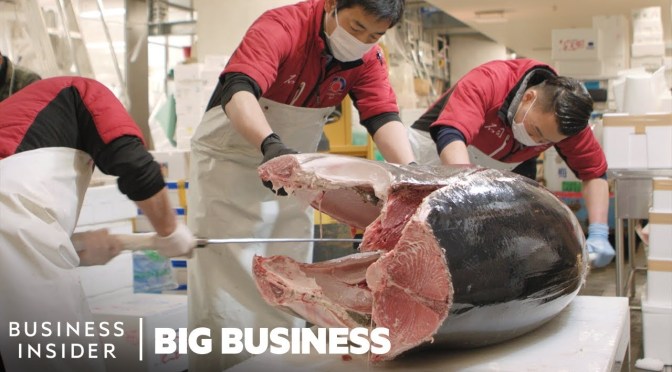
How a 600-pound tunafish sells for $3 million
Toyosu Market in Tokyo is home to the world-famous tuna bidding wars each morning. But overfishing is starting to take its toll on marine life.

How a 600-pound tunafish sells for $3 million
Toyosu Market in Tokyo is home to the world-famous tuna bidding wars each morning. But overfishing is starting to take its toll on marine life.
Tyler Brûlé and the weekend’s biggest news stories dissected with panellists Christoph Lenz and Urs Bühler, plus check-ins with our correspondents and friends in Tokyo, Helsinki and London.
Emma Nelson covers the weekend’s biggest and most interesting news stories with Rob Cox, Simon Brooke, Christof Münger and Christoph Amend from ‘Zeit Magazin’. Plus: Olympic updates from Monocle’s Tokyo bureau chief, Fiona Wilson.
Tokyo is a city of neighborhoods and Paul Tierney from Walk Japan is here to take you to some of the must-see landmarks like famous temples, shrines, restaurants, and small local areas that allow you to get the sights, sounds, and flavors of Tokyo.
Video timeline: 00:00 Introduction 00:26 Nihonbashi 01:26 Kanda Shrine 02:22 Akihabara 03:27 Sentō (Public Bathhouse) 04:08 Yanaka Ginza 04:56 Sensō-ji 07:07 Ameyoko 08:10 Niku no Oyama
Postponed by a year. Plagued by existential rumors. The Tokyo Olympics have had a rocky road, thus far. But what’s it like for the athletes? This film looks at how Olympic hopefuls experience Olympic-sized uncertainties, under the already strained circumstances of a global pandemic.
Despite the rampant Coronavirus pandemic, the mythos of the Olympic Games is alive and well. The world’s top athletes dream of participating, though only a fraction of them will make it that far. This film accompanies four athletes over the course of a year, as they try to reach the Olympic Games in Tokyo. For fencer Alexandra Ndolo, high jumper Marie-Laurence Jungfleisch, javelin thrower Thomas Röhler and taekwondo master Madeline Folgmann, the time leading up to the Summer Games constitutes the greatest sporting challenge of their lives.
The postponement of the Games throws a wrench in their intensive training plans. It also forces them to confront some uncomfortable questions. What if all of this intensive preparation goes to waste? Are they working towards a moment in their lives that may never come? These four competitive athletes experience a year full of disruption, hardships, health risks, small successes, and big disappointments.
For one athlete, the pandemic even becomes a stroke of luck – but can she take advantage of it? The challenges that these elite athletes face striving for their dream of competing in the Olympic Games are unique. It is a time that will leave its mark on these athletes, as they embark on a journey with an uncertain outcome.
Tyler Brûlé dissects the weekend’s biggest and most interesting news stories with panellists Chandra Kurt and Florian Egli, and our friends and contributors in the UK, Japan and Germany.
Five stories to know for July 8: Florida collapse, Haiti, Trump sues Facebook and Twitter, Rudy Giuliani, Olympics
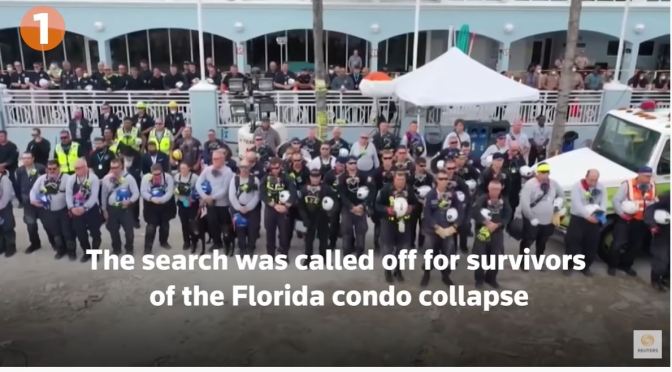
1. South Florida officials called off the search for survivors of a June condominium tower collapse, saying there was no longer any hope of pulling someone alive from the ruins of the flattened building.
2. Haiti’s security forces were locked in a fierce gun battle with assailants who assassinated President Jovenel Moise at his home overnight.
3. Donald Trump filed lawsuits against Twitter, Facebook, and Google, as well as their chief executives, alleging they unlawfully silence conservative viewpoints.
4. A U.S. appeals court suspended Rudy Giuliani, a former attorney for Trump, from practicing law in Washington, D.C.
5. Japan declared a coronavirus state of emergency for Tokyo that will run through its hosting of the Olympic Games to curb a new wave of infections.
The Olympics are less than three weeks away and over this past weekend we saw three big headlines, all having to do with restrictions that have primarily affected women of color and intersex people.
And it’s left many fans wondering who these Olympic rules are actually serving.
Guests: Axios’ Ina Fried, Margaret Talev and Harvard University constitutional law professor Noah Feldman.
Emma Nelson covers the weekend’s biggest talking points with panelists Simon Brooke, Terry Stiastny and Benno Zogg. Plus, we check in with Monocle’s editorial director Tyler Brûlé and our Tokyo bureau chief, Fiona Wilson.
In 2018, the Rio games were estimated to have a total cost of $20 billion, far beyond the Rio organizing committee’s initial estimate of $2.8 billion. The city of Rio shelled out $8.2 billion on legacy builds, or builds intended to live well beyond the Olympic’s three-week life-cycle. Cities incurring overrun costs when hosting the Olympics is not just unique to just Rio; according to the Council on Foreign Relations, since 1960, every Olympics saw high overrun costs. As overrun costs become a growing concern, several cities withdrew their 2022 winter Olympic bids in 2014, citing the potential costs. The International Olympic Committee (IOC) enacted the Olympic Agenda 2020 in 2014; the agenda provided new regulations specifically to mitigate cost concerns. However, the IOC was faced with another challenge: hosting the Tokyo Olympics amid the Covid-19 pandemic.







 Boomers Daily