


Tag Archives: Science Magazine
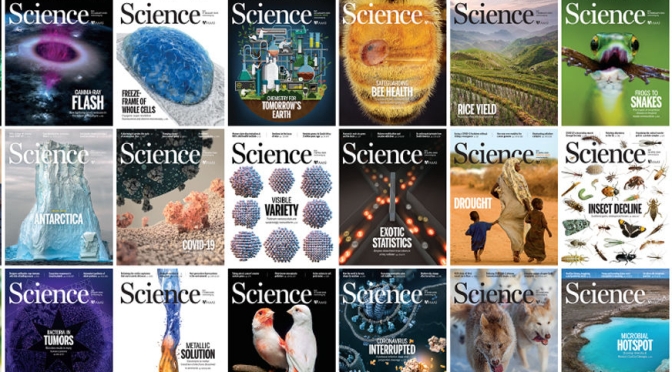
Front Covers: Science Magazine – October 8
Cover Previews: Nature Magazine – October 7, 2021
Science: Whole-Genome Screening For Newborns, Active Learning For STEM
Today, most newborns get some biochemical screens of their blood, but whole-genome sequencing is a much more comprehensive look at an infant—maybe too comprehensive?
Staff Writer Jocelyn Kaiser joins host Sarah Crespi to discuss the ethical ins and outs of whole-genome screening for newborns, and the kinds of infrastructure needed to use these screens more widely. Sarah also talks with three contributors to a series of vignettes on the importance of active learning for students in science, technology, engineering, and math. Yuko Munakata, professor in the department of psychology and Center for Mind and Brain at the University of California, Davis, talks about how the amount of unstructured time and active learning contributes to developing executive function—the way our brains keep us on task. Nesra Yannier, special faculty at Carnegie Mellon University and inventor of NoRILLA, discusses an artificial intelligence–driven learning platform that helps children explore and learn about the real world. Finally, Louis Deslauriers, senior preceptor in the department of physics and director of science teaching and learning at Harvard University, laments lectures: why we like them so much, why we think we learn more from lectures than inquiry-based learning, and why we’re wrong.
Front Covers: Science Magazine – September 24
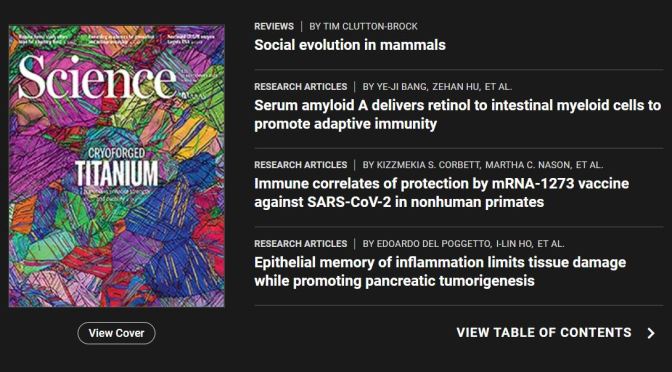
Front Covers: Science Magazine – September 17

Science: Potty-Trained Cows, Massive Sardines Run Off South Africa
Online News Editor David Grimm joins host Sarah Crespi to talk about the health and environmental benefits of potty training cows.
Next, Peter Teske, a professor in the department of zoology at the University of Johannesburg, joins us to talk about his Science Advances paper on origins of the sardine run—a massive annual fish migration off the coast of South Africa.
Science: NASA’s First Moon Mission In 50 Years, Robots That Look, Act Like People
Staff Writer Paul Voosen talks with host Sarah Crespi about plans for NASA’s first visit to the Moon in 50 years—and the quick succession of missions that will likely follow.
Next, Eileen Roesler, an engineering psychologist at the Technical University of Berlin, discusses the benefits of making robots that look and act like people—it’s not always as helpful as you would think.
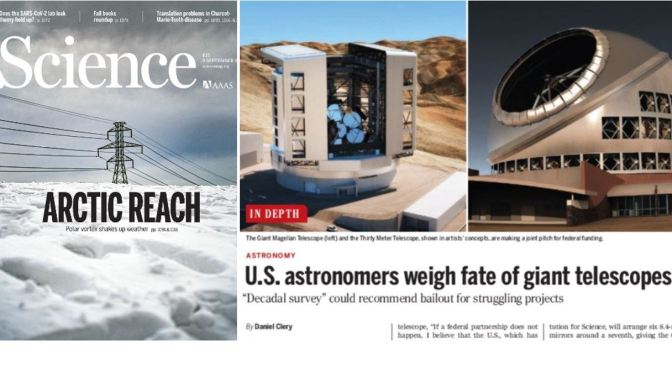
Front Covers: Science Magazine – September 3
Science: Endometriosis Insights, Deep Learning That Predicts RNA Folding
News Intern Rachel Fritts talks with host Sarah Crespi about a new way to think about endometriosis—a painful condition found in one in 10 women in which tissue that normally lines the uterus grows on the outside of the uterus and can bind to other organs.
Next, Raphael Townshend, founder and CEO of Atomic AI, talks about predicting RNA folding using deep learning—a machine learning approach that relies on very few examples and limited data.
Finally, in this month’s edition of our limited series on race and science, guest host and journalist Angela Saini is joined by author Lundy Braun, professor of pathology and laboratory medicine and Africana studies at Brown University, to discuss her book: Breathing Race into the Machine: The Surprising Career of the Spirometer from Plantation to Genetics.
 Boomers Daily