
Tag Archives: Roman Amphitheater

Travel Tour: Pula, On The Istrian Peninsula, Croatia

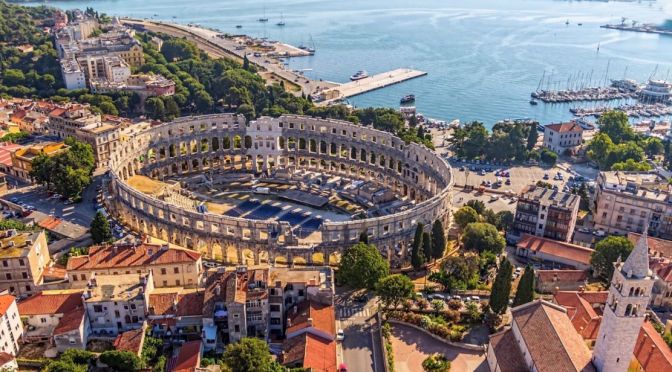
Massimo Nalli (Uploaded April 18, 2023) – Pula is situated at the southern tip of the Istrian peninsula in Croatia. The city is best known for its many surviving ancient Roman buildings, the most famous of which is its 1st-century amphitheatre, which is among the six largest surviving Roman arenas in the world, and locally known as the Arena.

Video timeline:00:00 – VIEW OF THE PULA FROM ABOVE – 00:13 – TWIN GATE AND CITYT WALLS – 00:55 – TRIUMPHAL ARC OF THE SERGI – 02:04 – FORUM SQUARE – 04:07 – TEMPLE OF AUGUSTUS – 05:03 – ST.FRANCIS CHURCH – 06:55 – CATHEDRAL – 09:55 – ADMIRALTY BUILDING – 11:31 – CASTLE – 13:37 – CHURCH OF ST.MARY FORMOSA – 14:46 – AMPHITHEATER

During the World War II Italian fascist administration, there were attempts to dismantle the arena and move it to mainland Italy, which were quickly abandoned due to the costs involved. Two other notable and well-preserved ancient Roman structures are the 1st-century AD triumphal arch, the Arch of the Sergii and the co-eval Temple of Augustus, built in the 1st century AD built on the forum during the reign of the Roman emperor Augustus.

The Twin Gates (Porta Gemina) is one of the few remaining gates after the city walls were pulled down at the beginning of the 19th century. It dates from the mid-2nd century, replacing an earlier gate. It consists of two arches, columns, a plain architrave, and a decorated frieze. Close by are a few remains of the old city wall.
Walking Tours: Side In Southern Turkey (4K)

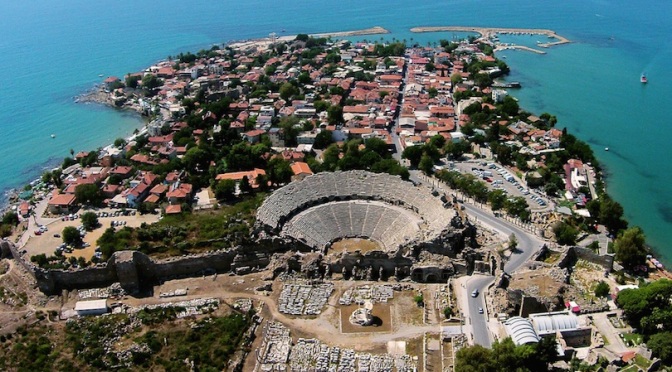
Side is a resort town on Turkey’s southern Mediterranean coast. An ancient port city, it’s known for long beaches and Greco-Roman ruins. In the center are the remains of the 2nd-century Antique Theater, which seated up to 15,000. The white marble columns of the Hellenistic Temple of Athena stand near the harbor. Other sites are sprinkled throughout, with finds housed at the Side Museum, a restored Roman bath complex. 

Views: The Great Roman Games Of Nimes, France

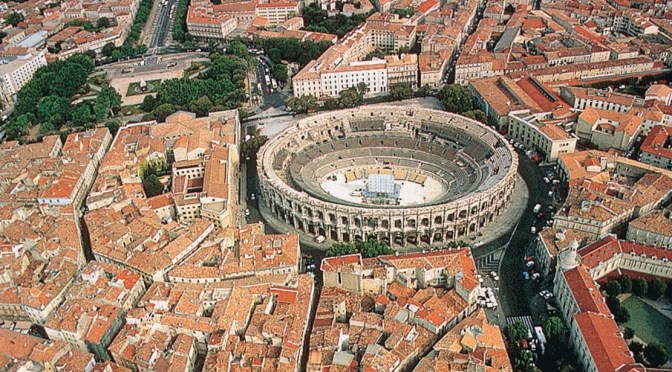
In the southern French city of #Nîmes, the passion for #AncientRome is more alive than ever. For the past decade, the city has been holding the Great Roman Games show every spring. Legionaries, centurions and gladiators invade the city and bring its incredible Roman monuments back to life: in particular the arena, where the Great Games are organised. Thousands of people, young and old alike, turn out to be transported back to the Rome of #JuliusCaesar.

Nîmes, a city in the Occitanie region of southern France, was an important outpost of the Roman Empire. It’s known for well-preserved Roman monuments such as the Arena of Nîmes, a double-tiered circa-70 A.D. amphitheater still in use for concerts and bullfights. Both the Pont du Gard tri-level aqueduct and the Maison Carrée white limestone Roman temple are around 2,000 years old.

Archaeological Views: Bosra In Southern Syria

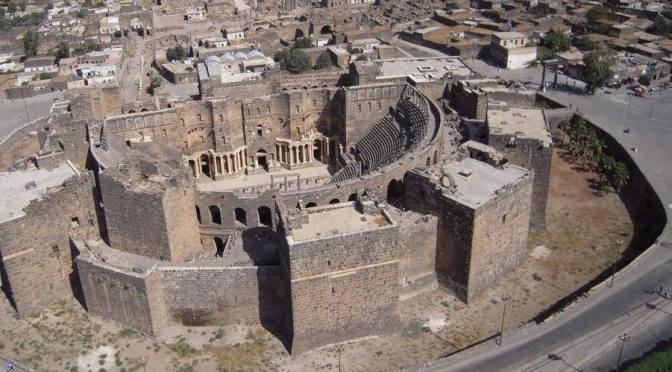
Bosra is a major archaeological site in Syria, with ruins from Roman, Byzantine, and Muslim times. The most impressive of all is the magnificent perfectly preserved Roman amphitheater, built in the second century. Bosra, also spelled Bostra, Busrana, Bozrah, Bozra and officially called Busra al-Sham, is a town in southern Syria.