The scholar of Palestinian history talks about what has and has not surprised him about the world‘s response to Israel‘s assault on Gaza.
Under the Spanish Volcano
A recent exhibition at the Prado showcased artists engaging with the ferment and conflict of turn-of-the-century Spain.
‘The Look of Shame’
The French director Catherine Breillat has spent her career insisting on women’s agency and reclaiming taboo desires—sometimes with troubling implications.
In late Renaissance Florence one in five women lived behind institutional walls whose rule was sensory mortification. Historians are struggling to recover their inexpressible secrets.
“A Veil of Silence: Women and Sound in Renaissance Italy” by Julia Rombough
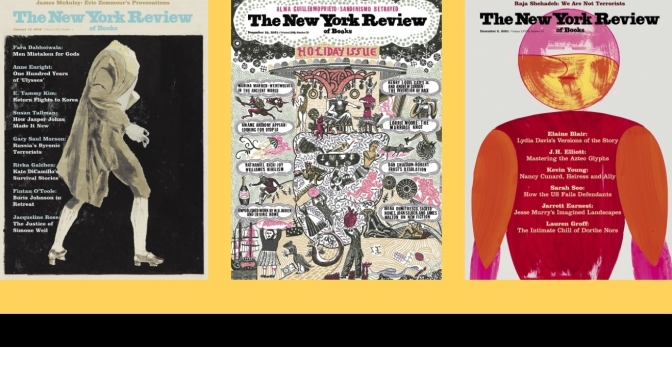
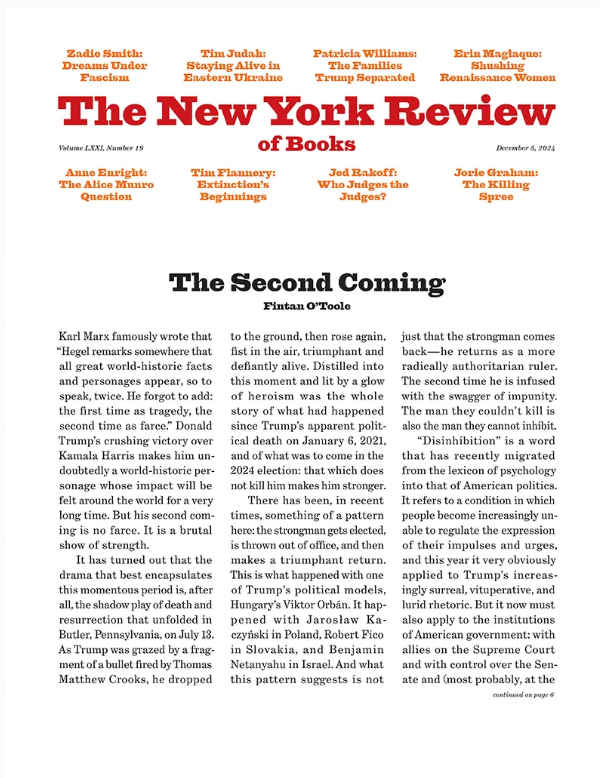
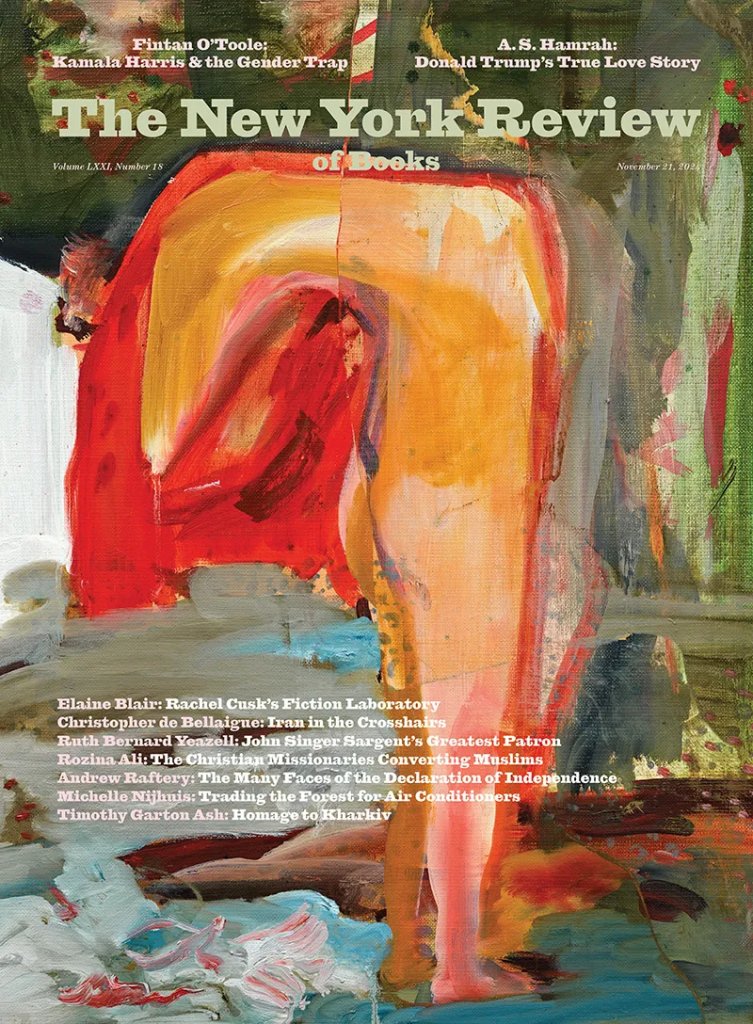
The New York Review of Books (October 31, 2024)– The latest issue featuresCoco Fusco on yearning to breathe free, Elaine Blair on Rachel Cusk, Fintan O’Toole on Trump’s predations, Ruth Bernard Yeazell on John Singer Sargent, Michelle Nijhuis on the disasters wrought by remaking nature for human ends, Clair Wills on Janet Frame, Andrew Raftery on the Declaration of Independence, Rozina Ali on evangelical missionaries in Afghanistan and Iraq, A.S. Hamrah on the Trump biopic, Tim Parks on Nathaniel Hawthorne, poems by John Kinsella and Emily Berry, and much more.
The Islamic Republic’s sordid proxy war with the West may now be leaving it open to an all-out attack as Israel attempts to eliminate its enemies throughout the region.
At the heart of Daniel Defoe’s fictional world is a feeling for change, of the mutability and shiftiness of modern life and the people who thrive in it.
The Oxford Handbook of Daniel Defoe edited by Nicholas Seager and J.A. Downie
Some botanists maintain that peas are capable of associative learning, others that tropical vines have a sort of vision. If plants possess sentience, what is the morally appropriate response?
The Light Eaters: How the Unseen World of Plant Intelligence Offers a New Understanding of Life on Earth by Zoë Schlanger
The Nation of Plants by Stefano Mancuso, translated from the Italian by Gregory Conti
Planta Sapiens: The New Science of Plant Intelligence by Paco Calvo with Natalie Lawrence
A collection of excerpts from women’s diaries written over the past four centuries offers a vast range of human experience and a subtle counterhistory.
Secret Voices: A Year of Women’s Diaries edited by Sarah Gristwood
The painter Paula Modersohn-Becker’s ascension to greater visibility raises questions about how we assess artistic talent, how reputations are made, and how we reevaluate once-neglected artists, particularly women.
Paula Modersohn-Becker: Ich bin Ich/I Am Me an exhibition at the Neue Galerie, New York City, June 6–September 9, 2024, and the Art Institute of Chicago, October 12, 2024–January 12, 2025
During the last half-century, artists, curators, and scholars have been increasingly preoccupied with the idea of spectacle and with how to embrace, critique, or co-opt the power of work that envelops and overwhelms the viewer.
Jenny Holzer: Light Line – An exhibition at the Solomon R. Guggenheim Museum, New York City, May 17–September 29, 2024
Tricks of the Light: Essays on Art and Spectacle by Jonathan Crary
The Avant-Gardists: Artists in Revolt in the Russian Empire and the Soviet Union, 1917–1935 by Sjeng Scheijen
Reading the Constitution: Why I Chose Pragmatism, Not Textualism by Stephen Breyer
In his new book, Reading the Constitution, Stephen Breyer criticizes recent Supreme Court decisions on issues such as abortion and gun rights as the product of rigid and imperfect reasoning rather than of ideology, and he argues for a more pragmatic jurisprudence.
In James, Percival Everett’s smart, funny, brutal retelling of The Adventures of Huckleberry Finn, Everett takes readers deeper into the capricious yet certain violence of American slavery, giving the characters a life that seems to lift off the page.
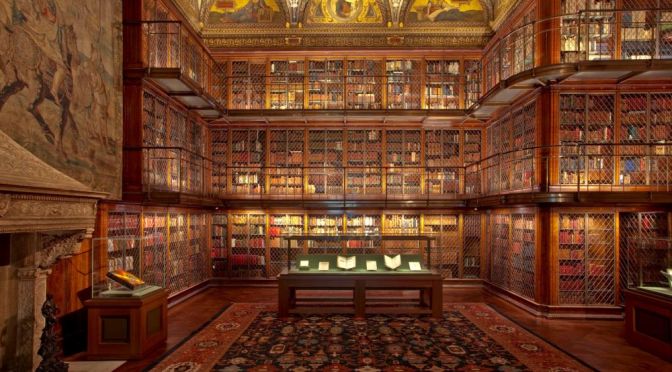
Building on the Morgan’s tradition of presenting to the American public distinguished works from outstanding institutions abroad, Van Eyck to Mondrian: 300 Years of Collecting in Dresden focuses on the exceptional drawing collection of the Kupferstich-Kabinett, Dresden.
Established by Augustus II the Strong, Elector of Saxony, in 1720, the museum is one of the oldest and finest depositories of works on paper in the world. The exhibition celebrates pivotal moments and key traditions in the history of European draftsmanship. Most remarkably, it will feature Jan van Eyck’s Portrait of an Elderly Man (ca. 1435–40)—an exceptionally rare drawing by the great Netherlandish Renaissance painter, which has never before traveled to the United States.
The Kupferstich-Kabinett’s strength in Northern Renaissance and Baroque drawings will be further showcased through works by Lucas Cranach the Elder, Hans Holbein the Younger, Rembrandt, and Rubens, while the museum’s rich holdings of Southern European works will be represented by Correggio, Bronzino, Sofonisba Anguissola, and others.
Among works produced in the nineteenth and twentieth centuries, highlights include studies by Caspar David Friedrich, Goya, Käthe Kollwitz, Gustav Klimt, Otto Dix, and Piet Mondrian.
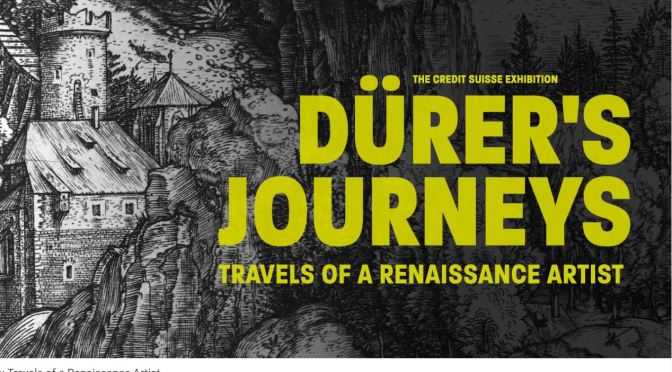
Albrecht Dürer’s drawings, paintings and prints make up some of the most iconic images in the history of art and have influenced generations of artists. Through paintings, drawings, prints, and letters, our exhibition ‘Dürer’s Journeys: Travels of a Renaissance Artist’ brings to life this art history megastar and the people and places he visited. ‘The Credit Suisse Exhibition: Dürer’s Journeys: Travels of a Renaissance Artist’ Until 27 February 2022
News, Views and Reviews For The Intellectually Curious




 Boomers Daily