Tag Archives: religion

THE GUARDIAN WEEKLY – DECEMBER 12, 2025 PREVIEW

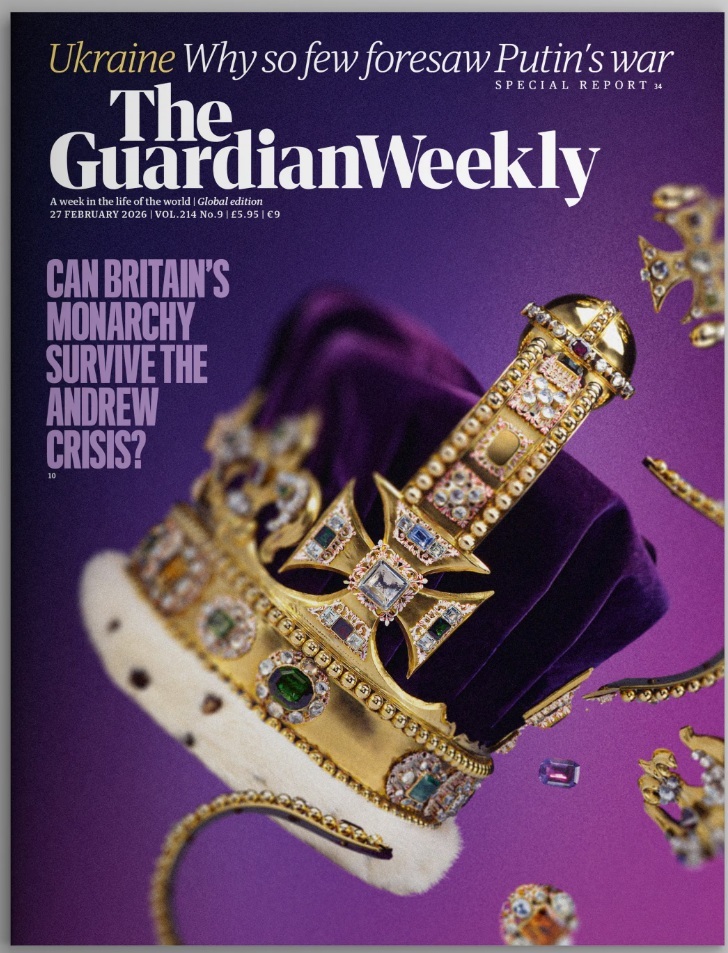
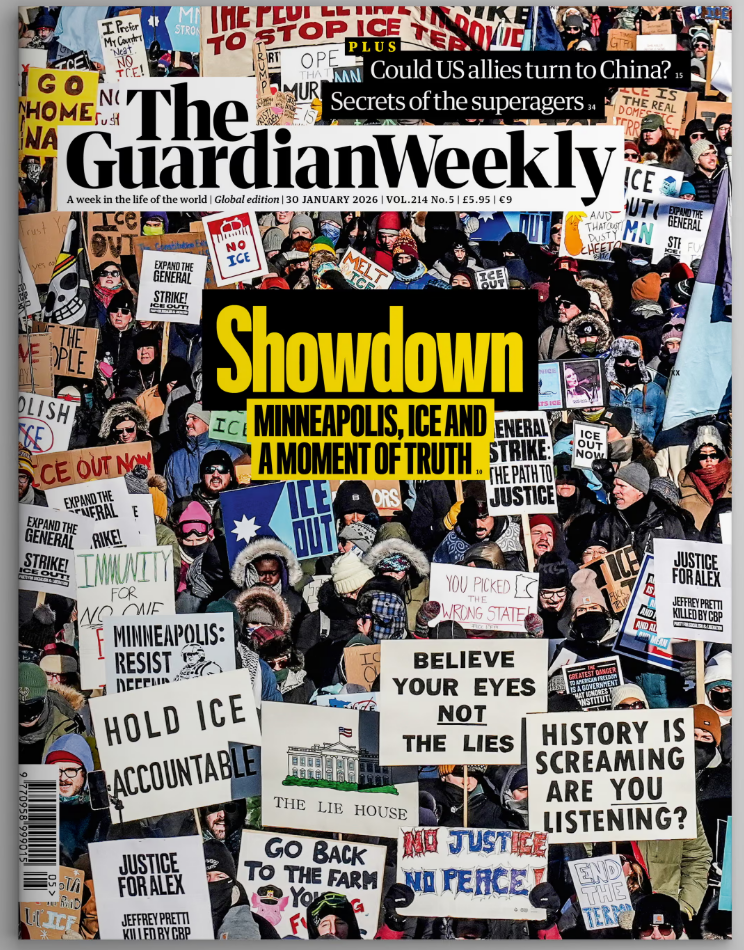
THE GUARDIAN WEEKLY: The latest issue features ‘Blocked!’ – Why Australia banned kids from social media (and what they think of it)

Millions of teenagers in Australia woke up on Wednesday to find themselves locked out of social media accounts after the government introduced a ban for under-16s – the first of its kind – on the platforms.

Far from being a kneejerk response to a moral panic, it’s a move backed up by detailed investigation into the effects of unfettered online access on children – and one that several other countries are poised to follow. Australian eSafety research found seven in 10 children aged 10 to 15 had encountered content associated with harm online. Three-quarters of those had most recently encountered that – including misogyny, violence, disordered eating and suicide – on a social media platform.

“We are seeking to create some friction [in the] system to protect children where previously there has been close to none … We are treating big tech like the extractive industry it has become,” Australia’s eSafety commissioner, Julie Inman Grant, told an audience earlier this year.

Spotlight | Syria, one year after Assad
While country’s return to global stage has filled many Syrians with pride, domestically old grievances threaten efforts to rebuild the state. William Christou reports from Damascus

Feature | The inside story of the race to create the ultimate AI
In Silicon Valley, rival companies are spending trillions of dollars to reach a goal that could change humanity – or potentially destroy it. Robert Booth reports

Feature | On the trail of London’s snail farming don
Terry Ball – renowned shoe salesman, friend to former mafiosi – has vowed to spend his remaining years finding ways to cheat authorities he feels have cheated him. His greatest ruse? A tax-dodging snail empire. Jim Waterson caught up with him

Opinion | What words are left to describe Trump’s global rampage?
Deadly US boat strikes in the Caribbean are the latest example of a president corrupting both the law and morality, argues Jonathan Freedland

Culture | The best books of 2025
From fiction to food, people to poetry, science to sport: Guardian critics round up the year’s essential reads

THE GUARDIAN WEEKLY – DECEMBER 5, 2025 PREVIEW

THE GUARDIAN WEEKLY: The latest issue features ‘After The Inferno’ – Anger and questions in the wake of the Hong Kong fires…

Watching with horror from London last week as flames ripped through seven adjacent apartment blocks in Hong Kong, it was impossible not to think back to the Grenfell Tower fire of 2017, which exposed major systemic failures around UK social housing and eventually led to law changes around safety and accountability for high-rise buildings.

The comparisons with Hong Kong were not just visually obvious but also because the semi-autonomous city’s worst fire in decades appears to have followed months of complaints from residents about shoddy materials used in building works.

Hong Kong is of course a very different place to London, with politicians facing less public accountability in a political climate that makes it much harder for citizens to express dissent. But, as anger rises, hard questions are nevertheless being asked of authorities amid accusations of negligence and corruption.

Five essential reads in this week’s edition

The big story | Can Europe unite to tame Russia – without the US?
Washington’s Putin-appeasing plan for peace in Ukraine has failed, but many heard the death knell sound for European reliance on US protection, writes Patrick Wintour

Spotlight | If Rachel Reeves goes, will Keir Starmer fall with her?
British prime ministers rarely sack their chancellors – and when they do it almost inevitably leads to their own downfall. After last week’s budget, Starmer knows the same is true of him and Reeves, says Jessica Elgot

Feature | The dangerous rise of extremist Buddhism
Buddhism is still largely viewed as a peaceful philosophy – but across much of south-east Asia, the religion has been weaponised to serve nationalist goals. Sonia Faleiro investigates

Opinion | From the West Bank to Syria and Lebanon, Israel’s onslaught continues
Broken ceasefires, bombing, ground incursions and mounting deaths: Israeli imperialism is now expanding across the region, says Nesrine Malik

Culture | Ethan Hawke and Richard Linklater: two men on the moon
As their 11th movie together, Blue Moon, is released, the actor and director tell Xan Brooks about musicals, the legacy of Philip Seymour Hoffman and what being bald and short does to your flirting skills

THE GUARDIAN WEEKLY – NOVEMBER 28, 2025 PREVIEW

THE GUARDIAN WEEKLY: The latest issue features ‘A Fighting Chance’ – Can COP conferences deliver on climate justice?

Bitter rows, implacably opposed delegations, threatened walkouts and then, hours after the planned deadline with fear of failure stalking the delegates, a statement towards which recalcitrant countries have been nudged into agreeing is produced. Cop30, which concluded last Saturday in Belém, Brazil, was little different from its recent predecessors, despite the growing urgency of needing to find a solution to our ever hotter planet. For this week’s big story, environment editor Fiona Harvey details how weak consensus was forged between states on the frontline of climate change and the petrostates that sought a rollback from the need to “transition away from fossil” fuels agreed two years ago in Dubai.

Five essential reads in this week’s edition

Spotlight | Is Ukraine edging closer to a peace deal?
A whirl of international diplomacy was sparked by a US-Russian authored ‘peace plan’ to end the Ukraine war. Luke Harding and Pjotr Sauer cast a critical eye over the prospects for an agreement.

Spotlight | Trump, Saudi Arabia and shifting Middle Eastern sands
Pageantry and trillion-dollar promises reveal how Washington’s regional loyalties may be tilting away from Israel and towards the Gulf, writes Julian Borger

Feature | Is Alex Karp the world’s scariest CEO?
His company, Palantir, is potentially creating the ultimate state surveillance tool. Now, Alex Karp’s biographer reveals what makes him tick. By Steve Rose

Opinion | An improbable new adversary for Trump – the Catholic church
Inequality, immigration and civil rights are the battlegrounds on which the church – and some other Christian denominations – are fighting the Trump administration, writes Simon Tisdall

Culture | Edmund de Waal’s loose ends
The celebrated ceramicist explains to Charlotte Higgins why he turned his decades-long f ixation with Axel Salto – the maker of unsettling stoneware full of tentacle sproutings and knotty growths – into a new show

THE GUARDIAN WEEKLY – NOVEMBER 21, 2025 PREVIEW

THE GUARDIAN WEEKLY: The latest issue features ‘Epstein’ – The scandal that won’t go away.

The release last week of a tranche of Jeffrey Epstein’s private emails raised more questions about Donald Trump’s links to the disgraced financier.

The US president had spent much of this year trying to bat away questions about Epstein while rejecting pressure to release the bulk of the files. But in an abrupt reversal on Sunday – widely seen as an admission that he cannot control his Maga base on the issue – Trump urged House Republicans to back the release of the files after all.

That was duly passed this week and if the Senate also votes the same way, the justice department will be compelled to release all unclassified materials on Epstein, who died in jail in 2019 while awaiting trial on sex-trafficking charges.

So we may soon find out what Trump has tried for so long to keep buried. As David Smith writes for our big story, last week’s email release pointed less to a grand conspiracy and more to an elite world in which wealthy, powerful and privileged individuals operate above the law.

One thing’s for sure: despite Trump’s wishes, the Epstein scandal isn’t going away just yet.

Spotlight | Can methane cuts avert climate disaster?
With temperatures breaching limits set out in the Paris Agreement, designed to mitigate climate change, experts say tackling the powerful gas could buy crucial time as the clean-energy shift stalls. Fiona Harvey reports

Spotlight | The US military’s plans for a divided Gaza
A ‘green zone’ will be secured by international and Israeli troops, while almost all Palestinians have been displaced to a ‘red zone’ where no reconstruction is planned, reports Emma Graham-Harrison

Feature | What chance did one boy have to survive on Britain’s streets?
When documentary film-maker Pamela Gordon first met Craig in Nottingham, he was 13 and homeless. She still thought his life might turn around, but she was tragically wrong

Opinion | Labour’s asylum plans are cruel, overspun and unachievable
There is mounting disquiet among Labour MPs, while the vulnerable refugees at the heart of this story are living with a renewed sense of panic, writes Diane Taylor

Culture | Stranger Things reaches its upside down finale
After a decade, the Netflix hit is bowing out. Ahead of its last episodes, the show’s creators and cast talk to Rebecca Nicholson about big 80s hair, recruiting a Terminator killer – and the birds Kate Bush sent them

THE GUARDIAN WEEKLY – NOVEMBER 14, 2025 PREVIEW

THE GUARDIAN WEEKLY: The latest issue features ‘A New Hope’ – How Zohran Mamdani broke the mould of US politics’

The dust may have settled on Zohran Mamdani’s astounding, against-the-odds victory in the New York mayoral election. But a week on, the scale of his achievement looks no less impressive.

As Ed Pilkington outlines in this week’s big story, Mamdani swept away his establishment-backed heavyweight opponent Andrew Cuomo by mobilising an army of grassroots volunteers and donors, while also connecting deeply with the voters whose support he most needed on the issues that mattered most to them, namely affordability and economic justice.

It’s a ground-up approach to doing things that US Democrats – who also won governorships in Virginia and New Jersey on an encouraging night – can learn from as they reflect on a torrid year since Donald Trump swept to power.

Spotlight | The green monster of Cop30
Amid bombast, strife and competing interests, is the annual climate summit, which opened in Brazil this week, still the forum we need to save the planet? Fiona Harvey reports from the Amazonian city of Bélem

Spotlight | The extraordinary fall of the BBC’s top bosses
A whirlwind that began with a report criticising the editing of a speech by Donald Trump is part of a wider political story, some say. Media editor Michael Savage charts the tale

Feature | Why not everyone is sad to see the end of USAID
When Donald Trump set about dismantling USAID, many around the world were shocked. But on the ground in Sierra Leone, the latest betrayal was not unexpected. Mara Kardas-Nelson finds out why

Opinion | A president groped? Sadly it isn’t a shock
After Claudia Sheinbaum was assaulted last week, her opponents claimed she staged it. From their own experiences, the women Mona Eltahawy met know she didn’t have to

Culture | Rosalía, the Catalan queen of pop
With a towering new album about female saints in 13 languages, she’s pop’s boldest star – and one of its most controversial. She tells Laura Snapes why we need forgiveness instead of cancel culture

THE GUARDIAN WEEKLY – NOVEMBER 7, 2025 PREVIEW

THE GUARDIAN WEEKLY: The latest issue features ‘A Massacre Foretold’ – The Tragedy of El Fasher’

For some time now, El Fasher in Sudan has been a city beyond the reach of journalists. But the haunting satellite image on our cover this week, of smoke billowing from fires near El Fasher’s airport, told its own story as starkly as anything that could be reported from the ground.

Other satellite images showed clusters of burned-out vehicles, and what appeared to be pools of blood beside piles of bodies on the ground. A massacre was under way that could be seen from space.

The last major city in Darfur to fall to the Rapid Support Forces (RSF) was already the scene of catastrophic levels of human suffering, but has “descended into an even darker hell”, senior UN officials warned last week. This key moment in the two-and-a-half-year-long civil war has unfolded in plain sight with minimal intervention from the international community, unless you count the United Arab Emirates, which has been arming the RSF paramilitaries.

Spotlight | The Andrew formerly known as a prince
Stupidity and self-entitlement sank King Charles III’s disgraced younger brother – and the royal reckoning may not be over yet, writes Stephen Bates

Technology | What if the internet just … stopped working?
Could everything suddenly go offline and if so, how? Aisha Down goes inside the fragile system holding the modern world together

Interview | Margaret Atwood puts the world to rights
At 85, she’s a literary seer and saint – and queen of the Canadian resistance. So what does the writer make of our dystopian society? Lisa Allardice finds out

Opinion | World leaders: Cop30 could be your great legacy
With the US backing away from the climate crisis, now is the moment when other nations must step up, says former British prime minister Gordon Brown

Culture | Back to black with Lynne Ramsay
The Scottish film director burst on to the scene with Ratcatcher and terrified audiences with We Need to Talk About Kevin. Her latest film stars Hollywood darling Jennifer Lawrence, but it doesn’t flinch from the dark side of family life, finds Amy Raphael

THE GUARDIAN WEEKLY – OCTOBER 31, 2025 PREVIEW

THE GUARDIAN WEEKLY: The latest issue features ‘Pressure Points’ – Will US sanctions put the squeeze on Putin?

Donald Trump’s sudden decision last week to sanction Russian oil producers suggested the US president has finally lost patience with Vladimir Putin after a series of fruitless talks over ending the war in Ukraine.

Could it break the deadlock? Oil sanctions have the potential to genuinely damage Moscow’s finances, as the Russian president himself admitted last week. It remains to be seen, though, whether economic pressure alone can bend Putin’s arm over a conflict he views as defining to his legacy.

In this week’s big story, Guardian Russia affairs reporter Pjotr Sauer asks whether sanctions could succeed where diplomacy has failed, while Christopher S Chivvis of the Carnegie Endowment for International Peace argues that a negotiated settlement remains the likeliest way to bring nearly four years of fighting to a halt.

In the frontline Ukrainian city of Kupiansk, senior reporter Peter Beaumont finds little hope of a quick resolution, with much of the population having left and the remaining soldiers stuck in a war they believe is “going nowhere for either side”.

Five essential reads in this week’s edition

Spotlight | The populist leaders’ economic playbook
From Milei to Meloni, are the economics of populism always doomed to failure? This long read from economics editor Heather Stewart tries to bridge the gaps between populist aspiration and fiscal reality

Environment | The deadly migration routes of elephants
Human-wildlife conflict has overtaken poaching as a cause of fatalities among elephants – and is deadly for people too. Now some villages are finding new ways to live alongside the mammals, reports Patrick Greenfield

Interview | Is Jimmy Wales the good guy of the internet?
The Wikipedia founder stands out from his contemporaries for being driven by more than money. But can the people’s encyclopedia withstand attacks from AI and Elon Musk? By David Shariatmadari

Opinion | Without genuine truth and justice, the war in Gaza cannot end
A fragile ceasefire is in place, but what’s needed is an international tribunal for resolution and reparation. That’s the only route to lasting peace, argues Simon Tisdall

Culture | The electrifying genius of Gerhard Richter
He has painted everything from a candle to 9/11, walked his naked wife through photographic mist, and turned Titian into a sacred jumble. A new Paris show reveals the German artist in all his contradictory brilliance, says Adrian Searle

THE GUARDIAN WEEKLY – OCTOBER 24, 2025 PREVIEW

THE GUARDIAN WEEKLY: The latest issue features ‘Youth Quake’ – How Gen Z protesters toppled Madagascar’s leader.

Madagascar rarely makes front page news but the toppling of its president by protesters led by Gen Z Madagascar is part of a phenomenon that stretches from Nepal to Indonesia and the Philippines to Morocco. Leaderless groups, formed online, have learned from one another as they take to the streets to vent their frustration against what they see as corrupt older elites and a lack of economic opportunity for their generation.

Our southern Africa correspondent, Rachel Savage, explains how a tumultuous month unfolded on the Indian Ocean island and explores the deep-seated discontent that led to the military siding with student demonstrators to force President Andry Rajoelina out of power.

Five essential reads in this week’s edition

Spotlight | A far-right fight club on their hands
Ben Makuch reports on security service monitoring of ‘active clubs’ as they move across borders to spread extremism, mixing the behaviour of football hooligans with the ideology of the Third Reich

Benin bronzes at the Metropolitan Museum of Art in New York.
Benin bronzes at the Metropolitan Museum of Art in New York. Photograph: Art2010/Alamy

Spotlight | Nothing to see here?
Due to open within weeks, Nigeria’s Museum of West African art is intended to showcase the Benin bronzes and other masterpieces stolen by 19th-century colonisers. But the project has been beset by political rows that mean, as Philip Oltermann and Eromo Egbejule report, visitors will see more replicas than original pieces

Science | Waiting for graphene to explode
Two decades after the material was first produced and then much hyped, graphene has dropped from business and general discussion. Julia Kollewe reports on the successes and setbacks of taking it from lab to mainstream use

Opinion | An A-level in English won’t make integration work
A government demand that immigrants get a qualification that most British citizens don’t have if they want to earn the right to stay is the latest absurd way to focus on ‘outsiders’ rather than address domestic problems, argues Nesrine Malik

Culture | The hardest part
David Harewood reflects on returning to play Othello after almost 20 years and with fellow Black actors looks at how attitudes to Shakespeare’s most difficult tragedy have changed


What else we’ve been reading

The year’s Stirling prize has gone to a social housing complex for older people in south-east London. Catherine Slessor writes with great enthusiasm about how the award-winning architects Witherford Watson Mann have completely reimagined accommodation for later life. Out with disorientating corridors, in with bright, informal, nature filled spaces, described by the Stirling judges as “a provision of pure delight”. Emily El Nusairi, deputy production editor

Kathryn Lewek as the Queen Of The Night in The Magic Flute at the Royal Opera House.
Kathryn Lewek as the Queen Of The Night in The Magic Flute at the Royal Opera House. Photograph: Tristram Kenton/The Guardian

I saw The Magic Flute in Paris last year, and it was fascinating to see how different opera houses interpret the staging. This review of a London production made me reflect on the way different directors handle staging and sound to bring the story to life. It reminded me of listening to the Queen of the Night’s aria when I was growing up and the experience of seeing opera live. Hyunmu Lee, CRM executive

ZENDEGI-E NORMAL

After the theocracy’s fall, the search for a normal life becomes Iran’s quietest revolution.

By Michael Cummins, Editor | October 16, 2025

This speculative essay, based on Karim Sadjadpour’s Foreign Affairs essay “The Autumn of the Ayatollahs,”  transforms geopolitical forecast into human story. In the imagined autumn of the theocracy, when the last sermons fade into static, the search for zendegi normal—a normal life—becomes Iran’s most radical act.

“They said the revolution would bring light. I learned to live in the dark.”

The city now keeps time by outages. Twelve days of war, then the silence that follows artillery—a silence so dense it hums. Through that hum the old voice returns, drifting across Tehran’s cracked frequencies, a papery baritone shaped by oxygen tanks and memory. Victory, he rasps. Someone in the alley laughs—quietly, the way people laugh at superstition.

On a balcony, a scarf lifts and settles on a rusted railing. Its owner, Farah, twenty-three, hides her phone under a clay pot to muffle the state’s listening apps. Across the street, a mural once blazed Death to America. Now the paint flakes into harmless confetti. Beneath it, someone has stenciled two smaller words: zendegi normal.

She whispers them aloud, tasting the risk. Life, ordinary and dangerous, returning in fragments.

Her father, gone for a decade to Evin Prison, was a radio engineer. He used to say truth lived in the static between signals. Farah believed him. Now she edits protest footage in the dark—faces half-lit by streetlamps, each one a seed of defiance. “The regime is weakening day by day,” the exiled activist on BBC Persian had said. Farah memorized the phrase the way others memorize prayers.

Her mother, Pari, hears the whispering and sighs. “Hope is contraband,” she says, stirring lentils by candlelight. “They seize it at checkpoints.”

Pari had survived every iteration of promise. “They say ‘Death to America,’” she liked to remind her students in 1983, “but never ‘Long Live Iran.’” The slogans were always about enemies, never about home. She still irons her scarf when the power flickers back, as if straight lines could summon stability. When darkness returns, she tells stories the censors forgot to erase: a poet who hid verses in recipes, a philosopher who said tyranny and piety wear the same cloak.

Now, when Farah speaks of change—“The Ayatollah is dying; everything will shift”—Pari only smiles, thinly. “Everything changes,” she says, “so that everything can remain the same.”


Farah’s generation remembers only the waiting. They are fluent in VPNs, sarcasm, and workaround hope. Every blackout feels like rehearsal for something larger.

Across town, in a military café that smells of burnt sugar and strategy, General Nouri stirs his fourth espresso and writes three words on a napkin: The debt is settled. Dust lies thick on the portraits of the Supreme Leader. Nouri, once a devout Revolutionary Guard, has outlived his faith and most of his rivals.

He decides that tanks run on diesel, not divinity. “Revelation,” he mutters, “is bad logistics.” His aides propose slogans—National Dignity, Renewal, Stability—but he wants something purer: control without conviction. “For a nation that sees plots everywhere,” he tells them, “the only trust is force.”

When he finally appears on television, the uniform is gone, replaced by a tailored gray suit. He speaks not of God but of bread, fuel, electricity. The applause sounds cautious, like people applauding themselves for surviving long enough to listen.

Nouri does not wait for the clerics to sanction him; he simply bypasses them. His first decree dissolves the Assembly of Experts, calling the aging jurists “ineffective ballast.” It is theater—a slap at the theocracy’s façade. The next decree, an anticorruption campaign, is really a seizure of rival IRGC cartels’ assets, centralizing wealth under his inner circle. This is the new cynicism: a strongman substituting grievance-driven nationalism for revolutionary dogma. He creates the National Oversight Bureau—a polite successor to the intelligence services—charged not with uncovering American plots but with logging every official’s loyalty. The old Pahlavi pathology returns: the ruler who trusts no one, not even his own shadow. A new app appears on every phone—ostensibly for energy alerts—recording users’ locations and contacts. Order, he demonstrates, is simply organized suspicion.


Meanwhile Reza, the technocrat, learns that pragmatism can be treason. He studied in Paris and returned to design an energy grid that never materialized. Now the ministries call him useful and hand him the Normalization Plan.

“Stabilize the economy,” his superior says, “but make it look indigenous.” Reza smiles the way one smiles when irony is all that remains. At night he writes memos about tariffs but sketches a different dream in the margins: a library without checkpoints, a square with shade trees, a place where arguments happen in daylight.

At home the refrigerator groans like an old argument. His daughter asks if the new leader will let them watch Turkish dramas again. “Maybe,” he says. “If the Internet behaves.”

But the Normalization Plan is fiction. He is trying to build a modern economy in a swamp of sanctioned entities. When he opens ports to international shipping, the IRGC blocks them—its generals treat the docks as personal treasuries. They prefer smuggling profits to taxable trade. Reza’s spreadsheets show that lifting sanctions would inject billions into the formal economy; Nouri’s internal reports show that the generals would lose millions in black-market rents. Iran, he realizes, is not China; it is a rentier state addicted to scarcity. Every reformist since 1979 has been suffocated by those who prosper from isolation. His new energy-grid design—efficient, global—stalls when a single colonel controlling illicit oil exports refuses to sign the permit. Pragmatism, in this system, is a liability.


When the generator fails, darkness cuts mid-sentence. The air tastes metallic. “They promised to protect us,” Pari says, fumbling for candles. “Now we protect ourselves from their promises.”

“Fattahi says we can rebuild,” Farah answers. “A secular Iran, a democratic one.”
“Child, they buried those words with your father.”
“Then I’ll dig them out.”

Pari softens. “You think rebellion is new. I once wrote freedom on a classroom chalkboard. They called it graffiti.”

Farah notices, for the first time, the quiet defiance stitched into daily life. Pari still irons her scarf, a habit of survival, but Farah ties hers loosely, a small deliberate chaos. At the bakery, she sees other acts of color—an emerald coat, a pop song leaking from a car, a man selling forbidden books in daylight. A decade ago, girls lined up in schoolyards for hijab inspections; now a cluster of teenagers stands laughing, hair visible, shoulders touching in shared, unspoken defiance. The contradiction the feminist lawyer once described—“the situation of women shows all the contradictions of the revolution”—is playing out in the streets, private shame becoming public confidence.

Outside, the muezzin’s call overlaps with a chant that could be mourning or celebration. In Tehran, it is often both.


Power, Nouri decides, requires choreography. He replaces Friday prayers with “National Addresses.” The first begins with a confession: Faith divided us. Order will unite us. For a month, it works. Trucks deliver bread under camera lights; gratitude becomes policy. But soon the whispering returns: the old Ayatollah lives in hiding, dictating verses. Nouri knows the rumor is false—he planted it himself. Suspicion, he believes, is the purest form of control. Yet even he feels its poison. Each morning he finds the same note in the intelligence reports: The debt is settled. Is it loyalty—or indictment?


Spring creeps back through cracks in concrete. Vines climb the radio towers. In a basement, Farah’s father’s transmitter still hums, knobs smoothed by fear. “Tonight,” she whispers into the mic, “we speak of normal life.”

She reads messages from listeners: a woman in Mashhad thanking the blackout for showing her the stars; a taxi driver in Shiraz who has stopped chanting anything at all; a child asking if tomorrow the water will run. As the signal fades, Farah repeats the question like a prayer. Somewhere, a neighbor mistakes her voice for revelation and kneels toward the sound. The scarf on her balcony stirs in the dark.


The old voice never returns. Rumor fills the vacuum. Pari hangs laundry on the balcony; the scarf flutters beside her, now simply weather. Below, children chalk zendegi normal across the pavement and draw birds around the words—wings in white dust. A soldier passes, glances, and does nothing. She remembers writing freedom on that school chalkboard, the silence that followed, the summons to the principal’s office. Now no one erases the word. She turns up the radio just enough to catch Farah’s voice, low and steady: “Tonight, we speak of normal life.” In the distance, generators pulse like mechanical hearts.


Nouri, now called Marshal, prefers silence to titles. He spends mornings signing exemptions, evenings counting enemies. Each new name feels like ballast. He visits the shrine city he once scorned, hoping faith might offer cover. “You have replaced revelation with maintenance,” a cleric tells him.
“Yes,” Nouri replies, “and the lights stay on.”

That night the grid collapses across five provinces. From his balcony he watches darkness reclaim the skyline. Then, through the static, a woman’s voice—the same one—rises from a pirated frequency, speaking softly of ordinary life. He sets down his glass, almost reaches for the dial, then stops. The scarf lifts somewhere he cannot see.


Weeks later, Reza finds a memory stick in his mail slot—no note, only the symbol of a scarf folded into a bird. Inside: the civic network he once designed, perfected by unseen hands. In its code comments one line repeats—The debt is settled. He knows activation could mean death. He does it anyway.

Within hours, phones across Iran connect to a network that belongs to no one. People share recipes, poetry, bread prices—nothing overtly political, only life reasserting itself. Reza watches the loading bar crawl forward, each pixel a quiet defiance. He thinks of his grandfather, who told him every wire carries a prayer. In the next room, his daughter sleeps, her tablet tucked beneath her pillow. The servers hum. He imagines the sound traveling outward—through routers, walls, cities—until it reaches someone who had stopped believing in connection. For the first time in years, the signal clears.


Farah leans toward the microphone. “Tonight,” she says, “we speak of water, bread, and breath.” Messages flood in: a baker in Yazd who plays her signal during morning prep; a soldier’s mother who whispers her words to her son before he leaves for duty; a cleric’s niece who says the broadcast reminds her of lullabies. Farah closes her eyes. The scarf rises once more. She signs off with the whisper that has become ritual: Every revolution ends in a whisper—the sound of someone turning off the radio. Then she waits, not for applause, but for the hum.


By late October, Tehran smells of dust and pomegranates. Street vendors return, cautious but smiling. The murals are being repainted—not erased but joined—Death to America fading beside smaller, humbler words: Work. Light. Air. No one claims victory; they have learned better. The revolution, it turns out, did not collapse—it exhaled. The Ayatollah became rumor, the general a footnote, and the word that endured was the simplest one: zendegi. Life. Fragile, ordinary, persistent—like a radio signal crossing mountains.

The scarf lifts once more. The signal clears. And somewhere, faint but unmistakable, the hum returns.

“From every ruin, a song will rise.” — Forugh Farrokhzad

THIS ESSAY WAS WRITTEN AND EDITED UTILIZING AI

RELIGION, REIMAGINED

In the third-floor study of his home, in wartime Hartford, Wallace Stevens drafted his modernist poem and philosophical meditation  “Notes Toward A Supreme Fiction“, as a secular creed— abstract, changing, and meant to give pleasure—to stand where a worn-out faith once stood.

Beginephebe, by perceiving the idea
Of this invention, this invented world,
The inconceivable idea of the sun.

By Michael Cummins, Editor, September 6, 2025

He never learned to drive. For decades, Wallace Stevens walked the two miles from his home on Westerly Terrace to the Hartford Accident and Indemnity Company on Asylum Avenue. The walk itself became a kind of poem: a solitary procession through the stoic, brick-lined streets of a New England city, the rhythm of meter embedding itself in the movement of his body. The crunch of gravel underfoot, the feel of cold air on his face—these were the metronome that set the cadence for his thoughts. He would arrive at the office with lines already formed, phrases taking shape in the quiet hum of his stride.

But what kind of poetry emerges from a man who spends his days pricing catastrophe? During office hours, Stevens turned to policies and claims, reducing calamity to columns of numbers. He knew the language of indemnity, the actuarial calm that measured and priced chaos. Yet outside, the world was burning in ways no policy could contain. The radio spoke of Warsaw reduced to rubble, of Coventry turned to ash. What was a deductible against Dresden? What was a premium against Auschwitz? The ledger comforted, but it lied.

And when the day ended, where did he go to reconcile the irreconcilable? At night, Stevens climbed the narrow staircase to the top floor of his house, entering a space that felt half withdrawn from Hartford itself, as though it belonged more to sky than to street. Down below, trolley bells rang, dogs barked, radios crackled with war bulletins. Up here, only the radiator ticked. The air smelled of paper, tobacco, and ink. On his desk lay a folder carried home that afternoon: typed pages, the ribbon-black letters crisp and uniform. His secretary had produced them that morning, slotting them into a manila folder marked Notes. They sat now in the lamplight, more mysterious than any insurance claim, more charged than any policy.

What could a poem do in 1942? Certainly not repair the world. Yet Stevens felt imagination had to answer catastrophe with something larger than despair. Eliot had turned to Anglican certainty in Four Quartets, weaving fragments into a tapestry of faith. Admirable, yes. But Stevens could not follow him. He could not put belief in a myth while knowing it to be a myth. What remained? Only candor. Only imagination itself.

He opened the folder. The Preface came first, a modest eight lines. He whispered them into the quiet, testing their balance. They were not a commandment but a confession. The “you” of those lines was no person but the project itself: the supreme fiction, imagination’s own power to refresh. “And for what, except for you, do I feel love?” The words startled him even now, black against white, plain as a typed invoice yet trembling with a kind of vulnerable devotion. They challenged every idol: money, power, even the “extremest book of the wisest man,” perhaps Plato, perhaps the Bible, dryly possessed and hidden away in the self. No, he thought, a truly lived truth could not be static. It was a “living changingness,” an “uncertain light” that could nonetheless offer “vivid transparence,” a kind of peace. Here, typed cleanly in a bureaucratic font, was his prayer for a godless age.

But how does one begin such a prayer? He turned the page and entered the first law. Begin, ephebe, by perceiving the idea. The command still startled him. The ephebe: always a novice, always beginning again. Yes, to begin meant stripping away what was inherited—cathedrals thick with guilt, Phoebus in his chariot, Protestant hymns murmured in childhood pews. They no longer held. The old scaffolds collapsed into dust. The voice told him: see the sun again with ignorant eyes. Not Phoebus, not god, not myth—only the sun, bare and difficult.

And what happens when even the sun loses its name? The section closed with the line that haunted him: Phoebus is dead, ephebe. But Phoebus was / A name for something that never could be named. He felt the candor of it. Nietzsche’s cry without Nietzsche’s frenzy. Not a madman in a square, but a quiet verdict written at a desk. The god dead, but the sun still burning. What died was not the light, but the comfort of a name.

Could metaphor survive the death of myth? Another page: It is the celestial ennui of apartments… The phrase made him smile. Ennui of apartments, the weariness of modern rooms, pressing us back toward origins. Yet the origins themselves could be poisonous. So poisonous are the ravishments of truth, so fatal to / The truth itself, the first idea becomes / The hermit in a poet’s metaphors. Truth seduced, then withdrew. Desire was never sated; it renewed itself endlessly, only to vanish again. Schopenhauer lurked here, his vision of the world gnawed by will. Yet where Schopenhauer had seen only despair, Stevens found material for candor. Truth had to retreat into metaphor, glimpsed and lost. Desire itself was not shame but rhythm, the cycle by which imagination endured.

And if truth could be rhythm, could nonsense be revelation? He read the third section slowly: The poem refreshes life so that we share, / For a moment, the first idea… There it was—the poem’s task. Not to console, not to preach, but to refresh. To make perception vivid again. Even nonsense could do it. At night an Arabian in my room, with his damned hoobla-hoobla-hoobla-how… He laughed aloud in the quiet. Nonsense syllables as a kind of truer candor, doves chanting, seas howling hoo. Life’s nonsense pierced us with strange relation. What if absurdity was not opposed to truth but its heartbeat? What if laughter was the sharpest candor of all?

But what if even our myths were secondhand? The fourth section sobered him: The first idea was not our own. Yes. Adam in Eden, Eve with her mirror of air—they had not created anything. They had only encountered what was already there. There was a muddy centre before we breathed. There was a myth before the myth began. He stared at those lines. How blunt they looked, typed like any memorandum, yet carrying the weight of cosmology. Existence preceded language. Clouds had been clouds long before anyone called them gods. We were mimics, not originators, adding our metaphors onto a world that was always other. The clouds were pedagogues, teachers by their very indifference. The air was not a mirror but a board on which we scribbled meanings. How hard it was to admit: the first idea was not ours, never ours.

And if we are not originators, what kind of hero can we be? He turned to the fifth section: The lion roars at the enraging desert… Heroic animals filled the page. Lion, elephant, bear—creatures asserting themselves against emptiness. But then came the turn, the line that caught him like a mirror: But you, ephebe, look from your attic window… Yes, the attic window was his own. Not desert roars but a man clutching his pillow, writhing with dumb violence, cowed by rooftops. The modern hero was not lion or elephant but the solitary human in his narrow room. Yet perhaps this was truer heroism: to lash lions, to teach bears, to turn raw force into candor. Heroism now belonged to ordinaries, to those who endured the attic’s silence.

And what does the eye see when it learns to unsee? He lingered over the sixth section: Not to be realized because not to be seen… The weather itself became abstraction. Franz Hals brushed in clouds, winds moving in strokes. It must be visible or invisible, / Invisible or visible or both: / A seeing and unseeing in the eye. He felt the paradox, the resonance of Zen: to see was also to unsee, to let go in order to glimpse. Truth flashed, vanished, reappeared. Forsythia yellow, northern blue—beauty glimmered, then was gone. Yes, he thought, Okakura Kakuzō was right: truth glimpsed was truer than truth claimed.

But could architecture hold what abstraction revealed? Truth happened not in argument but in rhythm, in breath, in the gait of a body moving. Perhaps there are moments of awakening… Yes, truth came not as achievement but as gift. A balance stumbled into, two people falling into love, a cock announcing absurd perfection. Philosophy as choreography. Doctrine as breath. The eighth section brought architecture: Can we compose a castle-fortress-home, / Even with the help of Viollet-le-Duc…? He thought of Gothic cathedrals restored to an imagined perfection, never as they had been, always as they might have been. That was his work too—not theology restored, but poetic structure remade. The first idea is an imagined thing. Even MacCullough, reading by the sea, might at last hear the waves say what language had always stammered. Logos was only language. And yet language could awaken, could suddenly ease into saying what it had labored to speak.

But what if language, once awakened, began to preach? In the ninth section he heard a warning: The romantic intoning, the declaimed clairvoyance… Apotheosis was a danger. Romantic grandeur could seduce but not sustain. He is and may be but oh! he is, he is… He smiled at the heat in that line even as he resisted its drift toward sanctity. The figure must remain human, a foundling of the infected past, bright and ordinary, precious for the touch that wakes him and the hum of thoughts evaded in the mind. Better to keep him close to candor than to crown him with vision. Give him no names. Dismiss him from your images. Let him be felt in the heart, not embalmed in the eye.

And what, at last, could stand in place of the gods? The tenth section steadied him: The major abstraction is the idea of man / and major man is its exponent. Not a divine figure, not a hero in bronze, but the ordinary walker at the edge of town, trousers sagging, coat worn thin. He could almost see him in Hartford’s dim streets. Cloudless the morning. It is he. The man / In that old coat, those sagging pantaloons… It was of him, he read again, “to make, to confect / The final elegance, not to console / Nor sanctify, but plainly to propound.” No incense, no altar—only candor. The poem would not save; it would say. And in saying plainly, it would give back a kind of dignity to the commonal, to the difficult visage of the everyday.

The attic grew darker. The lamp made a circle of light over the typed sheets. The radiator hissed steadily. From this high room, Stevens whispered the creed that would govern the work to come: It must be abstract. It must change. It must give pleasure. Three laws, enough for a new religion. Not revelation but ethic. Not theology but candor.

He stacked the pages neatly, slid them back into their folder. Tomorrow his secretary would type more, never guessing she was transcribing scripture for an age without gods. The notebook felt less like a book than a reliquary—a vessel for the sacred ordinary. He had reviewed the first law, It Must Be Abstract. Tomorrow—or another night—he would face the second: It Must Change. The world would move; the poem must move with it.

He closed the folder. The command still echoed, inexhaustible: Begin, ephebe, by perceiving the idea. And so he would. Again.

THIS ESSAY WAS WRITTEN AND EDITED UTILIZING AI